What Is an Impression on Twitter? a 2026 Creator's Guide
Author:

An impression on Twitter, now X, is the total number of times a post appears on a screen, and it's a non-unique count, so the same person can create multiple impressions by seeing the same post more than once. That's why a tweet can show a big impression number in analytics even when the creator isn't sure how many actual people saw it.
That confusion shows up every day. A creator opens X Analytics, sees impressions climbing, and wonders whether the number means real momentum or just repeat exposure to the same followers. The answer sits in how X counts visibility. Impressions measure delivery, not attention. They tell a creator that X placed the post in front of screens, which makes them one of the most useful starting metrics for understanding growth, engagement potential, and even monetization.
Table of Contents
The Core Question What Is an X Impression
A creator checks analytics after posting a strong opinion, a product update, or a thread. The tweet has far more impressions than likes. That usually triggers the question: what is an impression on Twitter, really?
An X impression is the number of times a post is served to a user's device and rendered on screen inside the platform. That includes moments when someone pauses to read it and moments when someone scrolls right past it. TweetBinder puts it plainly in its explanation of Twitter impressions: the same user seeing the same tweet three times creates three separate impressions.
A simple way to think about it
A storefront analogy helps. If a shop sits on a busy street, every passerby who walks by the window adds to foot traffic. Some stop. Some walk on. Some come back later and pass the window again.
Impressions work the same way. They count appearances, not guaranteed attention.
Practical rule: An impression means “this post got shown.” It doesn't mean “this person read it,” “liked it,” or “remembered it.”
What counts and what doesn't
An impression can come from a few common places inside X:
Home timeline views: The post appears in someone's feed.
Search exposure: A user sees the post in search results.
Profile visits: Someone opens the account profile and sees the post there.
Repeated exposure: The same user sees the same post more than once.
Some views don't count the same way. The core definition is about content shown natively inside X. That's one reason the metric feels larger than engagement but still narrower than “everyone who may have come across a screenshot somewhere else.”
For creators who want a broader social-media framing, this guide to what social media impressions mean is useful because it shows how the same idea carries across platforms.
Why beginners misread the number
The biggest mistake is assuming impressions equal audience size. They don't. They measure how many times X delivered the post to screens. That distinction matters because a creator can improve impressions by earning more placement in feeds, replies, search, and profile visits, even before turning that visibility into clicks or followers.
Impressions vs Reach vs Engagement A Clear Breakdown
These three metrics get mixed together constantly. A creator sees high impressions and assumes the post reached a large new audience. Another sees lots of likes and assumes impressions must also be strong. Neither assumption is reliable without context.
The cleanest way to separate them is this: impressions count displays, reach counts unique people, and engagement counts actions.
Impressions vs. Reach vs. Engagement at a Glance
Metric | What It Measures | Example |
|---|---|---|
Impressions | Total times the post was shown on screen | One person sees a tweet three times, that creates three impressions |
Reach | Unique people who saw the post | That same one person still counts as reach of one |
Engagement | Interactions with the post | Likes, replies, reposts, clicks, and similar actions |
Where most creators get confused
The trap is non-unique counting. Social Status notes in its discussion of Twitter metrics that impressions can be inflated by repeat views from the same person, and it states that 60% of impressions in viral posts often come from repeat views by the same engaged users rather than new followers.
That means a post can look huge on the surface while still circulating mostly inside a relatively tight audience pocket.
High impressions don't automatically mean broad distribution. Sometimes they mean one interested group kept seeing the same post.
A practical example
Take a creator who posts a sharp one-liner about startup pricing. A few followers like it quickly. X keeps testing it in timelines. Some of those same followers see it again through replies, repost chains, or profile visits.
The result can look like this in plain language:
Impressions rise because the tweet keeps getting displayed.
Reach may stay modest if the same people are driving a lot of those views.
Engagement may be strong or weak depending on whether people act on it.
That's why impressions are the top-of-funnel metric, not the whole story.
Why this distinction improves strategy
A creator who confuses impressions with reach may think audience growth is stronger than it is. A creator who ignores impressions may miss the signal that X is testing content aggressively, even before engagement fully lands.
For anyone who also works across platforms, AdStellar AI's Instagram insights guide is a useful companion because it helps translate how visibility metrics differ from interaction metrics in another major feed-based network.
The simple benchmark mindset
A healthy reading habit looks like this:
Check impressions first: Did X distribute the post?
Check engagement next: Did the content give people a reason to respond?
Estimate reach carefully: Was visibility broad, or repetitive?
This is how creators stop treating impressions like vanity and start treating them like signal.
Why Impressions Matter for Your Growth and Income
For creators who want to build a serious presence on X, impressions aren't cosmetic. They sit at the top of everything else. No impressions means no chance for replies, profile visits, follows, newsletter clicks, lead flow, or deal flow.
That's why this metric matters even when a post doesn't “blow up.” A creator is watching whether X is willing to put content in front of screens at all. If the answer is yes, there's something to work with.

Impressions are the top of the funnel
A good post moves through a simple chain:
Visibility first: X shows the post to users.
Interaction second: Some of those users click, like, reply, or repost.
Conversion third: A smaller group visits the profile, follows, subscribes, or reaches out.
That's why low impressions create a ceiling on everything below them. Even strong writing can't convert people who never saw the post.
Impressions also affect monetization
This metric becomes even more concrete when money enters the picture. According to the eligibility threshold referenced in this post about X's monetization requirement, a creator needs 15 million impressions within the last 90 days to qualify for X's Ad Revenue Sharing program in the example discussed by Cinema With AB on X.
That threshold changes the conversation. Impressions stop being a dashboard number and become a business KPI.
A creator chasing monetization can't treat impressions as optional. They're part of the entry requirement.
What this means for working creators
A coach, founder, consultant, or indie hacker doesn't need to obsess over every daily fluctuation. But a serious creator does need to treat impressions like distribution inventory. Every post either expands that inventory or leaves it flat.
That changes how content gets judged. Instead of asking only “Did people like this?” the better question is “Did X keep serving this?”
Growth and income are connected
A creator who wants a broader view of revenue streams can pair platform analytics with a guide on making money as a creator. The takeaway is simple. Audience visibility supports nearly every monetization path, whether income comes directly from X or from products, services, sponsorships, or consulting.
Impressions don't guarantee income. But they create the conditions that make income possible.
7 Proven Strategies to Increase Your X Impressions
Impressions grow when X keeps finding reasons to show a post to more screens. That usually comes down to timing, format, relevance, and distribution habits. The tactics below are practical because they target those levers directly.
A creator who wants a broader software stack can also compare X growth tools for increasing impressions, especially when consistency and workflow matter as much as content quality.
1. Post when the audience is actually active
Timing changes whether a post gets early traction. If a creator posts when followers and adjacent audiences are online, the tweet has a better shot at early views, replies, and reposts.
The practical move is to review top-performing posts and look for patterns. Morning may work for one niche. Late evening may work better for another. The right posting window is usually account-specific.
2. Write stronger opening lines
A weak first line kills distribution fast. The post may still get shown, but users scroll past without giving X any reason to keep testing it.
Strong hooks usually do one of three things:
Create curiosity: They open a gap the reader wants to close.
Make a clear promise: They tell the reader what value is coming.
Take a sharp position: They trigger agreement, disagreement, or discussion.
3. Use replies as a distribution channel
Many creators focus only on original tweets. That leaves a huge impression source untouched. Smart replies under relevant posts can expose an account to new audiences who already care about the topic.
This works best when the reply adds substance. Short flattery gets ignored. A crisp insight, counterpoint, example, or framework earns profile visits.
A reply can outperform an original post when it sits under the right conversation and adds real value.
4. Use visuals when the idea benefits from them
Text-only posts can work well, especially for sharp opinions. But some ideas spread better with screenshots, simple graphics, charts, or short clips because visuals slow the scroll and create context fast.
A founder sharing product lessons might attach a screenshot. A marketer breaking down a campaign idea might use a clean visual. The point isn't decoration. The point is clarity.
A useful walkthrough sits below for creators who want another take on content mechanics:
5. Turn dense ideas into threads
Threads can hold attention longer when the topic needs steps, examples, or a sequence. A good thread gives X more reasons to keep the content circulating because readers spend more time with it and often interact across multiple tweets in the chain.
A practical thread structure looks like this:
Start with a clear promise
Break the idea into short, skimmable points
End with a useful conclusion or invitation to respond
6. Stay close to active conversations
Posts tied to topics people are already discussing tend to earn visibility faster than disconnected thoughts dropped into a quiet feed. That doesn't mean chasing every trend. It means finding live conversations inside the creator's niche and contributing while attention is already there.
This is especially effective for builders, operators, and consultants whose audiences cluster around recurring themes.
7. Publish consistently enough to generate signals
A creator doesn't need to post nonstop. But random bursts make it harder to learn what works. Consistency creates comparable data. It also gives X repeated chances to understand the account's topics, audience, and performance patterns.
That's where many creators finally see impressions stabilize. Not because one post changed everything, but because repetition made the winners easier to spot.
How to Read Your Impressions in X Analytics
A creator can't improve impressions by glancing at one big number and moving on. The useful part starts when that number gets tied to individual posts, patterns, and engagement rate.
Sprout Social explains in its overview of Twitter impressions that impressions are the denominator for engagement rate, calculated by dividing total engagements by total impressions. It also notes that this impression data is available only to the account owner inside X Analytics.
Where to find the metric
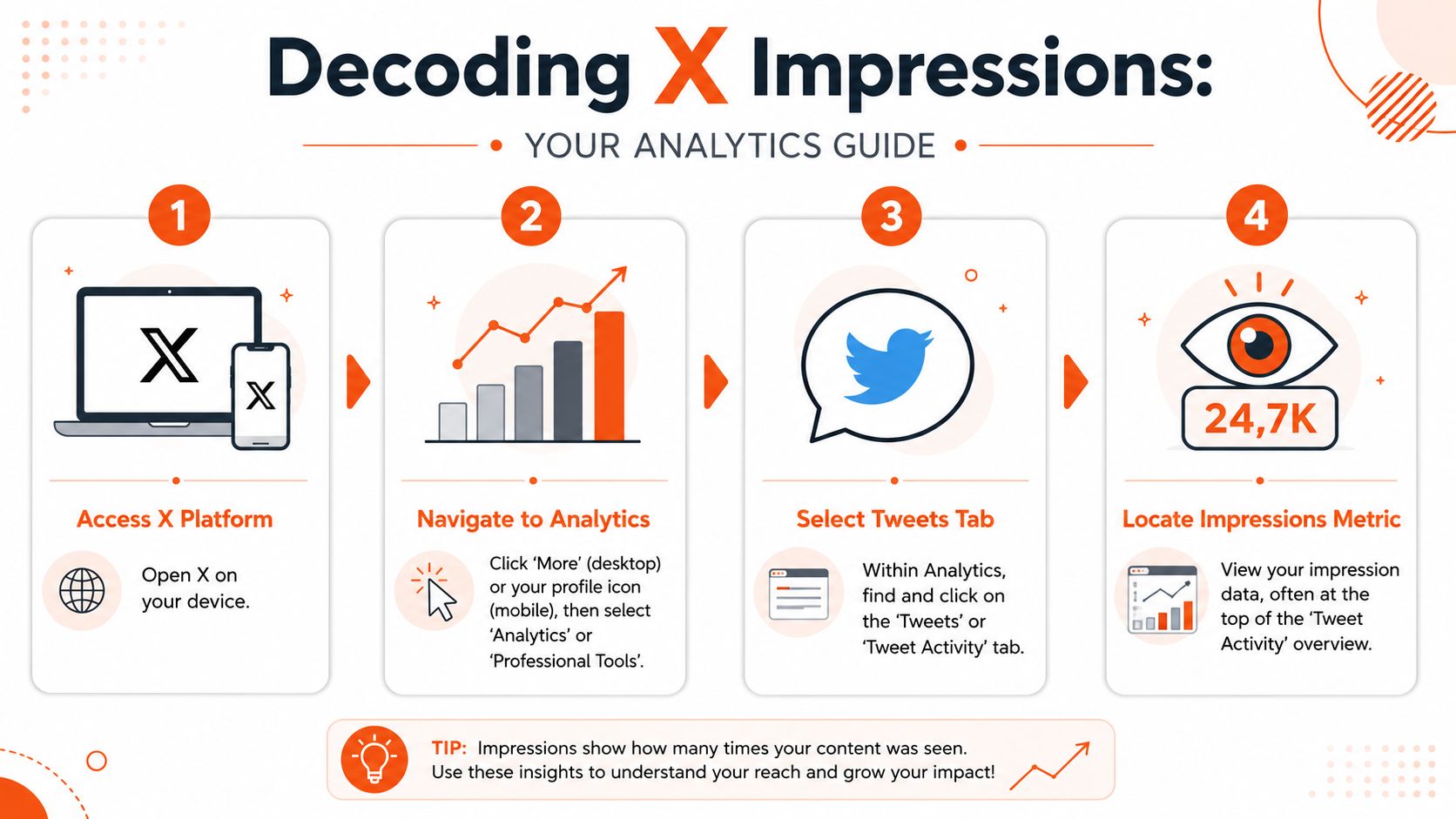
The fastest path is usually:
Open X on desktop or mobile
Go to Analytics or Professional Tools
Open the Tweets or Tweet Activity view
Check impression data at the post level
Creators who want a broader measurement stack can also review Twitter analytics tools to compare native reporting with third-party workflows.
What to look for inside the dashboard
The smart move isn't to stare at the total. It's to inspect posts that overperformed and underperformed.
A creator should ask:
Which topics earned the most impressions
Which formats got seen but didn't convert into engagement
Whether certain hooks consistently win early distribution
Whether images, threads, or short takes show a pattern
That reading habit turns analytics into editorial direction.
Use engagement rate with context
If engagement rate is calculated as engagements divided by impressions, then impressions matter twice. They show distribution, and they shape how engagement gets interpreted.
A post with solid impressions and weak engagement often has a packaging problem. The topic got distribution, but the post didn't create enough response. A post with modest impressions and strong engagement may need better timing, stronger hooks, or another format to expand delivery.
Reading tip: Don't ask only “How many impressions did this get?” Ask “What did this post do with the impressions it earned?”
That's the question that helps creators move from reporting to iteration.
Turning Impressions into Followers and Opportunities
Impressions matter because they create chances. But chances only turn into followers, clients, partnerships, or revenue when the content behind those impressions gives people a reason to care.
The strongest creators treat the process like a loop. A post earns impressions. Analytics reveal why it traveled. The next post keeps what worked and cuts what didn't. Over time, visibility becomes easier to repeat.
The conversion mindset
A creator can improve the odds of turning impressions into outcomes by focusing on a few habits:
Make the profile worth visiting: A clear bio and focused positioning help casual viewers decide to follow.
Publish recognizable themes: Repetition around a niche builds trust faster than random topic-hopping.
Open posts with stronger hooks: A sharper first line increases the odds that visibility turns into attention.
For creators who want to improve that first line specifically, this guide on writing better hooks is a useful next step.
Consistency does most of the heavy lifting. Not because every post wins, but because regular publishing creates enough surface area for impressions to compound into reputation. That's how a feed becomes more than content. It becomes proof of expertise.
Creators who want a system for planning posts, improving hooks, finding strong conversations to join, and staying consistent can explore SupaBird. It's built for people who want a more organized path to growing followers and impressions on X without running their workflow manually every day.

The Reply Guy Strategy: A Growth Guide for X

Why New X Accounts Get Less Reach

ClimbX Review (2026): Features, Pricing, Pros and Cons

How Developer Startups Build a Brand on X Before Launch

30-Day Starting Plan for New X (Twitter) Accounts

How Often Should You Tweet for Maximum Growth?

What Should Your First 10 Tweets Be About?

How to Run X for Ten Clients: The Agency Workflow

How to write a bio that gets people to follow you
