Most X posts don't fail because the author lacks expertise. They fail because the post gives people nothing easy, timely, or worthwhile to respond to. A large 2014 study of more than 4 million tweets found that 36% received at least one retweet, 43% received at least one favorite, and only 0.7% received a reply (historical Twitter engagement analysis). The lesson still matters: likes and reposts can happen passively, but replies require a reason to participate.
To increase Twitter engagement consistently, treat X as a system rather than a slot machine. Create a clear hook, publish when your audience is available, invite discussion, enter relevant conversations, respond actively, and review which interactions show real interest. This guide gives creators, founders, and marketers 10 practical tactics for building that loop.
For example, a weak post might say, “Most SaaS teams need better onboarding.” A stronger version asks, “Which onboarding step would you remove if your team had to ship the next version this week?” Add a simple three-step framework or visual, then reply to early answers with specific follow-up questions. The post now has a sharper hook, a useful asset, and a deliberate path toward conversation. Teams researching audiences and competitors can also use a social media scraper benchmark to inform their content comparisons without treating raw collection as a substitute for judgment.
Table of Contents
4. Leverage Trending Topics and Hashtags With Original Takes
9. Respond to Every Comment and Reply in Your First 24 Hours
1. Reply to High-Signal Conversations Within the First Hour
A useful reply is more than an opinion attached to someone else's post. It's a compact demonstration of expertise placed where the right audience is already paying attention. Focus on posts from relevant accounts that are beginning to attract discussion, then aim to contribute while the conversation still has room for new voices.
The first hour gives you a practical operating window, not a guaranteed ranking advantage. A SaaS founder might see a respected no-code creator publish a post about tool selection, then respond with one overlooked implementation risk and a short example from customer work. A marketing manager could join an industry news thread before the replies become repetitive, adding context that helps readers interpret the announcement.
Use SupaBird Engage to find and reply to the right posts on X faster, then apply a simple filter before responding:
Relevance: Does the conversation attract the people you want to reach?
Specificity: Can you add an example, distinction, or useful counterpoint?
Timing: Is the post still gathering fresh attention?
Voice: Does the reply sound like you, rather than a recycled template?
Practical rule: Speed earns a place in the conversation. Specificity earns a reason to remember you.
Prepare a few response structures in advance, such as “One overlooked issue is…,” “This works when…, but breaks when…,” or “A practical way to test this is….” Templates reduce hesitation, but never publish a generic compliment. Track which topics repeatedly attract your niche, then build a small daily monitoring habit around those themes.
2. Create Thread Replies That Add Distinct Value
A thread reply works when every post expands the original conversation instead of merely making your response longer. Use it when the topic deserves explanation, especially when a single sentence would force you to leave out the context that makes your point credible.
Suppose an AI consultant sees a post asking whether better prompts solve poor workflow design. A strong reply thread could distinguish prompt quality from process quality, show a before-and-after workflow, explain where human review belongs, and finish with a question about the reader's experience. Each post should have one job. The first post earns attention, the middle posts deliver the framework, and the final post keeps the discussion open.
A thread should feel connected to the original post. Mention the point you're extending, disagree respectfully when needed, and make the relationship clear to readers who discover your response later. A practical structure looks like this:
Opening hook: State the surprising distinction or useful promise.
Context: Explain why the original question matters.
Framework: Break the answer into a few memorable steps.
Example: Show how a founder, creator, or marketer would apply it.
Conversation prompt: Ask what readers would add, remove, or test.
Use SupaBird's Twitter thread template when you need a starting structure, then rewrite it around your actual experience. One visual, framework, or verified data point can make the thread easier to scan, but don't add decoration without meaning. The trade-off is clear: threads demand more preparation, yet they can communicate authority more effectively than a compressed reply.
3. Engage Consistently With a Tight Circle of Peer Creators
You don't need a large networking operation to build stronger engagement. A small group of peers whose work you respect can create a healthier publishing environment, provided the interaction is based on useful participation rather than automatic praise.
Choose creators, founders, or consultants who serve related audiences without producing identical content. Read their posts closely. Reply when you have a real contribution, quote a useful idea with added context, and celebrate launches or insights when you'd be happy to support them without expecting an immediate return.
The best peer circle has variety. A product founder might connect with a developer educator, a growth consultant, and a customer research specialist. Their audiences overlap enough to create relevance, but their perspectives remain distinct. That makes recommendations and quote posts feel natural rather than coordinated.
Keep the relationship credible
Avoid turning peer engagement into a visible exchange of empty reactions. If five accounts reply to each other with the same praise on every post, readers can sense the pattern and the engagement becomes less valuable. Rotate your attention, respond to ideas that matter, and let disagreement remain possible.
A sustainable routine might include:
A focused reading block: Review a short list of peer accounts before publishing.
Useful responses: Add an example, question, or counterargument instead of applause.
Public support: Share genuine wins and explain why the work matters.
Scheduled consistency: Use SupaBird's social media content strategy resources to organize recurring engagement without making it mechanical.
The payoff is relational as much as algorithmic. Peers learn your point of view, recognize your name, and become more likely to join conversations where your expertise is relevant. That's stronger than chasing temporary visibility through a manufactured engagement pod.
4. Leverage Trending Topics and Hashtags With Original Takes
A trend gives you attention, not authority. If your response repeats the same surface-level opinion as everyone else, it becomes indistinguishable from the surrounding noise. Use trends as a prompt for a sharper interpretation, a practical warning, or a framework your audience can apply.
A startup founder responding to a product announcement could explain what the change means for small teams, not merely repeat the announcement. A marketing manager discussing AI and content could separate production speed from editorial quality, then show how a team should evaluate both. The original angle matters more than attaching a popular label to a familiar thought.
Check three conditions before joining a trend:
Audience fit: Your target readers should care about the topic for a reason connected to your expertise.
Useful tension: Identify a trade-off, assumption, or consequence that other posts overlook.
Evidence: Use your own observations, clearly sourced information, or a framework that helps readers assess the issue.
SupaBird's guide to finding trending topics can support discovery, while your editorial judgment decides whether a trend deserves a post. Don't force every trend into your content calendar. A late, irrelevant response can weaken trust more than it increases reach.
Hashtags can help categorize a relevant post, but they won't rescue a weak idea. Lead with a clear sentence, explain why the topic matters, and make the reader's next action obvious. If the trend moves too quickly for research, publish a careful question or a useful decision framework instead of pretending certainty.
5. Ask Specific, High-Value Questions That Invite Replies
A reply-worthy question gives people a clear decision, problem, or experience to address. “What do you think about marketing?” leaves the reader to define the subject. A focused prompt reduces that effort and creates room for different answers.
Use a question that reflects a real decision. A SaaS founder could ask, “Which feature would you remove if you had to make the product easier to adopt this month?” A coach might ask, “What skill did you learn online that changed how you sell your work?” Both prompts invite memory and judgment instead of a one-word reaction.
Your own position gives the conversation a starting point. If you ask about pricing, onboarding, hiring, or content distribution, state what you currently believe and explain the constraint behind it. Readers can then agree, challenge the assumption, or add an example.
A useful prompt usually contains one strong angle:
A forced trade-off: Ask readers to choose between speed and control, simplicity and flexibility, or reach and relevance.
A concrete scenario: Set limits involving time, budget, staff, or product maturity.
A respectful challenge: Identify common advice and explain the situation where it may fail.
A follow-up path: Tell readers how you will use the most useful responses.
Use replies as research
Read early responses for the language your audience uses naturally. If several people describe the same obstacle in different terms, preserve those distinctions. They can sharpen a product page, shape a later post, or support a follow-up thread that credits contributors.
SupaBird's X-GPT can help refine a draft question, but keep the wording specific enough to retain a point of view. After publishing, respond with genuine follow-ups rather than collecting comments passively. Ask for an example, clarify an assumption, or explain where an answer changes your view.
The question starts the exchange. Your replies determine whether it becomes a useful conversation and a repeatable source of audience insight.
6. Post Consistently at Optimal Times for Your Audience
Timing gives a clear testable variable, not a substitute for a strong post. Use a practical starting window, then adjust it with evidence from your own audience and publishing results.
One 2026 timing study recommends Tuesday through Thursday from 9 to 11 AM in the audience's local timezone. An analysis of more than 8.7 million tweets identified Tuesday at 9 AM as its strongest single time (weekday morning posting research). Use that window as a test point rather than a permanent rule. Developers, B2B buyers, and global creators may check X at very different times.
Test timing as part of your content system
Choose several weekday windows that match your audience's locations and working habits. Publish comparable topics or formats in each window, keeping the hook reasonably consistent. Compare total interactions with the speed of meaningful replies, profile visits, and conversations that continue beyond the original post.
A distributed audience may require separate schedules for Berlin, New York, London, and Mumbai. Do not force every reader into one local morning. SupaBird's calendar can organize those variations and keep publishing consistent when manual posting is impractical.
Use this workflow:
Identify audience locations through account data and customer knowledge.
Select initial windows based on weekday mornings and working patterns.
Publish comparable formats so content quality does not obscure the timing result.
Review interaction quality after each test period.
Adjust gradually when audience behavior or your publishing mix changes.
Keep a record of the format, topic, time, timezone, and response quality. A creator might find that educational threads perform during work hours, while a founder's personal observations attract replies later in the day. A marketer with an international audience may gain more from several smaller windows than one broad schedule.
Consistency helps readers recognize when to expect your posts and gives you enough repeated observations to separate a useful timing pattern from a lucky result. Revisit the schedule when your audience, offer, or content mix changes.
7. Quote Tweet and Add Meaningful Commentary
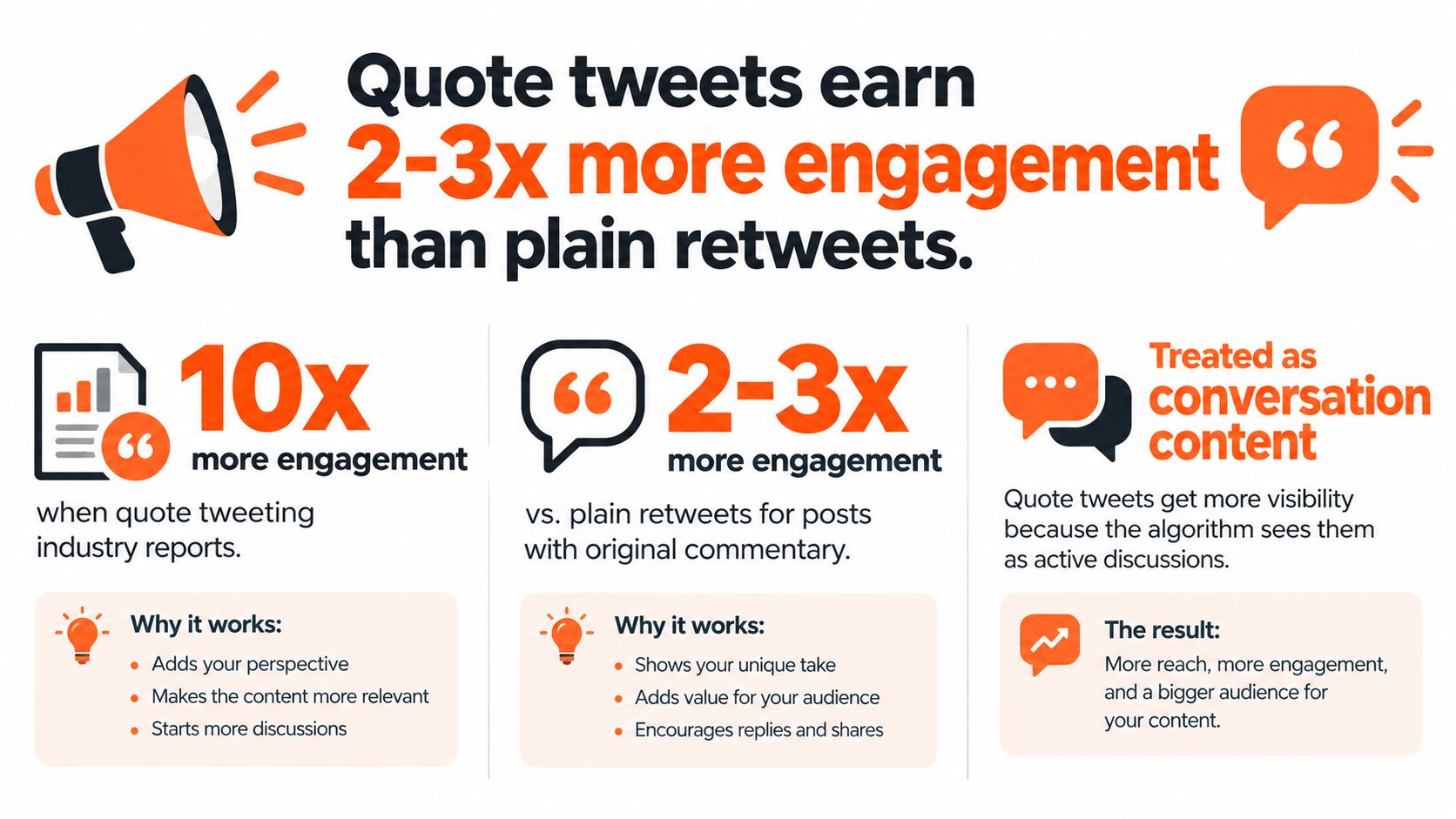
A plain repost distributes someone else's idea. A quote tweet lets you show how you interpret it, where it applies, and where its limits appear. That makes it useful for positioning, provided your commentary earns attention on its own.
Start with one clear contribution. You might explain the operational consequence of a product announcement, connect a founder's lesson to customer research, or respectfully challenge an industry claim with a different assumption. Three focused sentences often work better than a paragraph that tries to cover every angle.
For example, a consultant could quote a report about content production and write: “The important distinction isn't volume. It's whether the team has a review system that protects accuracy. Faster drafting without stronger review merely moves the bottleneck downstream.” That commentary gives readers a reason to discuss the point, even if they haven't read the original post.
Use SupaBird Engage to surface posts worth responding to, then ask:
What does the original author leave unexplained?
Can I add context without stealing the conversation?
Will my audience learn something from my interpretation?
Can I tag the author naturally and invite their view?
Don't quote posts only because they're popular. Relevance matters more than borrowed visibility. If your quote tweet attracts replies, continue the discussion beneath it. The strongest curation turns another person's idea into a useful exchange, not a vehicle for empty agreement.
8. Share Data, Stats, and Visual Insights Regularly
Evidence earns attention when it helps readers make a decision. A screenshot of a dashboard, a simple chart, or a clean comparison can give your audience something concrete to inspect and share. The visual should clarify one point, not force readers to decode a crowded graphic.
Use data from your own analytics, a transparent survey, or a source you can link directly. Separate what the data shows from what you think it means. If you're sharing a content analysis, explain the sample and limits instead of presenting a narrow observation as a universal rule.
A founder might publish a visual showing where trial users stop during onboarding, then add the operational implication: “The drop happens before setup, so adding more advanced features won't solve the first problem.” A marketer could compare hooks by topic and explain which wording attracted qualified replies, not merely which post received the most likes.
Create a repeatable visual workflow:
Choose one claim: Decide what the reader should remember.
Simplify the design: Use readable type, clear labels, and mobile-friendly spacing.
Add interpretation: Explain why the insight matters to the audience.
Invite examination: Ask readers whether their experience matches the pattern.
Repurpose carefully: Reframe the same underlying evidence rather than reposting the identical graphic.
You can also turn a visual explanation into a short video for a different consumption style. The transformation should preserve the core insight, not add motion for its own sake.
A useful visual gives readers a reason to pause, understand, and respond. That's more valuable than decorative media attached to an otherwise incomplete thought.
9. Respond to Every Comment and Reply in Your First 24 Hours
Your post needs active follow-up after publication. Early replies show whether the hook attracted the right audience, while your responses can turn isolated reactions into a useful conversation.
Acknowledge relevant comments while the discussion is active. Keep the response specific, then ask one question that makes the next contribution easier. If a founder describes a problem, ask which constraint caused it. If a marketer disagrees, clarify the assumption behind the alternative view. If someone shares a strong example, explain how it extends the original point. Sustained replies support brand growth through comments when you follow up with questions that invite substance.
Published analyses of X's recommendation scoring associate deeper interactions with more weight than a simple like. One overview reports bookmarks at about 10 times, replies at about 13.5 times, reposts at about 20 times, and author-replied conversations at about 75 times a like (X recommendation scoring overview). A separate analysis places an author response to a reply at roughly 150 times the value of a like (analysis of the X ranking model). Treat these figures as workflow context, not a reason to manufacture exchanges.
Create check-in points during the first day. Save patterns for recurring questions, but adapt each response to the person and topic. If replies exceed your capacity, prioritize early contributors, customers, prospects, and comments that introduce evidence or a useful disagreement. A creator can then record repeated questions for future posts, while a marketer can use strong objections to refine the next hook. Consistent, thoughtful participation beats rushed volume.
10. Build a Signature Content Format or Framework
A recognizable format helps people understand why a post deserves attention. Keep the container familiar, then vary the topic, evidence, and conclusion so the substance stays fresh.
A founder could publish “The Product Friction Report” each week, identifying one point where software teams lose users and proposing a test. A coach might create “Three Decisions From a Founder Story,” turning one public example into practical lessons. A marketer could use “Contrarian Distribution Notes” to challenge growth advice and explain when it fails.
Review your strongest recent posts. Mark recurring structures, such as a direct claim followed by a framework, a short story ending with a question, or a before-and-after breakdown. Give the format a name only when that name helps readers recognize and anticipate it.
Test the format without becoming repetitive
Run the format across several topics. Keep its core sequence stable while changing the audience, examples, evidence, and conclusion. Repeating identical vocabulary and pacing makes the series feel automated. Recognition should make a post easier to enter, not make its outcome obvious.
Use this publishing sequence as a starting point:
Signature opening: Use a consistent phrase or recognizable framing.
Specific problem: Name the situation your audience faces.
Useful breakdown: Provide steps, distinctions, or a framework.
Applied example: Show how a creator, founder, or marketer could use it.
Invitation: Request an experience, objection, or alternative.
Review replies after each post. If readers respond to the example but ignore the question, revise the invitation. If they quote the opening, retain that framing and improve the breakdown. This turns engagement into a feedback loop for stronger formats.
Use SupaBird's AI listicle generator resource for structural ideas, then rewrite the output in your own voice and test it against real audience questions. A signature format should speed up ideation and rewriting while still earning replies through relevance and substance.
Top 10 Twitter Engagement Tactics Comparison
Strategy | Implementation difficulty | Resource requirements | Expected outcomes | Ideal use cases | Key advantages |
|---|---|---|---|---|---|
Reply to High-Signal Conversations Within the First Hour | Medium | Continuous monitoring or automation; 15–30 min/day | Higher visibility and faster likes/retweets; increased credibility | Responding to niche posts gaining traction | Leverages freshness; lower reply competition; builds reciprocal relationships |
Create Thread Replies That Add Distinct Value | Medium–High | 20–40 min per thread; drafting/refinement tools | Establishes authority, more profile clicks, shares and longer thread visibility | Demonstrating expertise on complex or viral topics | Depth and shareability; increased dwell time and quotability |
Engage Consistently With a Tight Circle of Peer Creators | Low–Medium | 15–20 min/day; coordination with 5–15 peers | Predictable engagement and compounded follower growth | Cooperative growth with similar-sized creators | Reciprocal amplification; authentic relationships; reliable engagement |
Leverage Trending Topics and Hashtags With Original Takes | Medium | Trend monitoring; 10–20 min per response | Fast initial engagement and expanded reach via trend momentum | Timely commentary and thought leadership on trending topics | Combines reach + relevance; stands out with unique angle |
Ask Specific, High-Value Questions That Invite Replies | Low | 10–15 min/post; follow-up time to sustain thread | 2–3× higher reply rates; richer audience insights | Audience research and community-building posts | Drives substantive replies; generates content ideas and engagement |
Post Consistently at Optimal Times for Your Audience | Low | 5–10 min initial analysis; scheduling tools for automation | 30–50% higher initial engagement; predictable audience habit | Regular content cadence across time zones | Data-driven timing; consistency compounds reach |
Quote Tweet and Add Meaningful Commentary | Low–Medium | 5–10 min per quote tweet; curation tools | Higher engagement than plain retweets; expanded visibility | Amplifying reports or adding context to others' posts | Positions you as curator; sparks conversation and cross-audience reach |
Share Data, Stats, and Visual Insights Regularly | Medium | 20–30 min per post; data sources and design tools | 40–60% higher engagement; more shareable and memorable posts | Original research, benchmarks, and explainers | Data-driven credibility; high shareability and retention |
Respond to Every Comment and Reply in Your First 24 Hours | Medium | 30–60 min during first 24 hours; active monitoring | Prolonged algorithmic circulation; stronger community loyalty | Launches and high-engagement posts | Keeps threads alive; increases likelihood of repeat engagement |
Build a Signature Content Format or Framework | Medium–High | Ongoing effort; templates; ~20–30 posts to establish | Recognizable brand, faster content production, consistent engagement | Brand differentiation and repeatable value delivery | Reduces creation friction; builds audience anticipation and equity |
Turn These Tactics Into a Weekly Engagement Workflow
Ten tactics become manageable when they operate as one loop. Begin with Ideas Lab to identify a strong audience problem, a distinctive angle, or a variation of your signature format. Draft the hook and supporting framework, then use X-GPT to tighten the opening, remove vague language, and make the question easier to answer. Keep your own judgment in charge. A polished hook that makes a weak promise will create the wrong kind of attention.
Use the calendar to schedule core posts around your tested audience windows, especially weekday mornings as an initial benchmark. Leave space around publishing time for conversation discovery. Engage should help you find high-signal posts from relevant accounts, but the final reply should reflect your knowledge rather than a generic reaction. After publishing, reserve time to answer comments, extend useful exchanges, and identify replies that deserve a follow-up post.
Measure engagement quality, not only visible totals. A standard rate commonly uses (Likes + Replies + Retweets + Bookmarks) ÷ Impressions × 100, with impressions as the denominator (X engagement rate calculation). That distinction matters because a post can collect many interactions while still showing a modest rate if its impressions are very large. Review which posts attract informed replies, profile visits, qualified conversations, and repeat participation.
Test one variable at a time. Change the hook while keeping the format stable, or change the posting window while keeping the topic comparable. If you change the hook, media, timing, and reply method together, you won't know what caused the result. Keep a simple weekly record of the post premise, format, publishing window, interaction quality, and follow-up actions.
A seven-day starter sequence can look like this:
Day one: Use Ideas Lab to create three angles around one audience problem.
Day two: Draft a signature-format post and refine its hook with X-GPT.
Day three: Publish during a tested window and monitor Engage for relevant conversations.
Day four: Quote a useful industry post with your own interpretation.
Day five: Publish a specific question and respond to the early answers.
Day six: Turn the strongest reply or observation into a visual framework.
Day seven: Review meaningful interactions, then choose one variable to test next week.
SupaBird can centralize ideation, conversation discovery, rewriting, scheduling, and coaching at supabird.io. The platform's X Coach can also add daily feedback and human mentoring when you need help understanding why a post worked or failed, then turning that lesson into a practical edit.
SupaBird brings Ideas Lab, Engage, X-GPT, scheduling, and X Coach into one workflow for creators, founders, and marketers building engagement on X. Use it to develop stronger hooks, find relevant conversations, refine replies, and maintain a consistent publishing rhythm. Visit SupaBird to start turning your engagement process into a repeatable system.

ClimbX Review (2026): Features, Pricing, Pros and Cons

How Developer Startups Build a Brand on X Before Launch

30-Day Starting Plan for New X (Twitter) Accounts

How Often Should You Tweet for Maximum Growth?

What Should Your First 10 Tweets Be About?

How to Run X for Ten Clients: The Agency Workflow

How to write a bio that gets people to follow you

Digital Product Launch Strategy

Best Twitter Growth Service for Creators in 2026