Most software gets built quietly and launched loudly. A team spends months heads-down, then tries to compress all their distribution into a single Product Hunt post or a launch tweet. For developer-focused startups, that sequence has quietly reversed. The building happens in public, in short posts on X, months before there is anything to launch.
This piece looks at why X in particular has become the default channel for that shift, what developer audiences actually respond to there, and what a realistic posting pattern looks like for a startup with no existing following. It also covers the tooling question, since documenting a build well is its own kind of work that benefits from the right systems around it.
Why X Became the Default Channel for Developer-Founder Audiences
Developer attention is unusually concentrated on X compared to other social platforms. Technical founders, open source maintainers, early-stage investors, and the developers who make up most early SaaS signups are already active there, and they already follow the kind of build-in-public content that startups are trying to create. That overlap matters more than raw reach. A founder does not need a large audience on X, they need the right few thousand people paying attention.
The platform remains where technical buyers, founders, and early investors converse daily, and posting there costs nothing to reach a highly relevant audience. That combination, a concentrated technical audience plus zero distribution cost, is why X has stayed the default even as other platforms have fragmented developer attention elsewhere.
The format also fits how developers evaluate tools. A screenshot of a bug fixed at 2am, a one-line explanation of a tricky architectural decision, or a short thread on why a feature got cut, all read as evidence rather than marketing. The platform's culture rewards authenticity and specificity, and followers build a genuine relationship with a founder over months of honest updates. That relationship is what converts, not the follower count itself.
What “Building in Public” Actually Means for a Developer Startup
Building in public is often reduced to “share your revenue numbers,” but for developer startups it is broader than that. It means sharing the journey of creating a product openly and in real time, instead of working in stealth mode and launching a polished product with no track record. For a technical audience, the most credible version of that journey includes decisions and constraints, not just outcomes.
A useful way to think about what to post is in layers, moving from the surface down to what actually earns trust:
Outcome posts. Milestone updates: signups, revenue, a feature shipped. These are the easiest to write and the ones every founder defaults to, but on their own they read as a highlight reel and tend to plateau in engagement.
Process posts. What a specific technical decision looked like, why an approach got picked over an alternative, what a debugging session actually involved. These are more work to write well, but they are what a developer audience actually recognizes as work.
Failure posts. A launch that flopped, a feature nobody used, a pivot and the reasoning behind it. A post about a feature that flopped or a strategic mistake will outperform a milestone announcement by a wide margin in most cases, because everyone fails and very few founders talk about it honestly.
The mix matters more than any single post. A feed that is mostly product updates reads like a company newsletter rather than a personal brand, and it stays small. Startups that get traction usually keep outcome posts as the minority and process or failure posts as the majority.
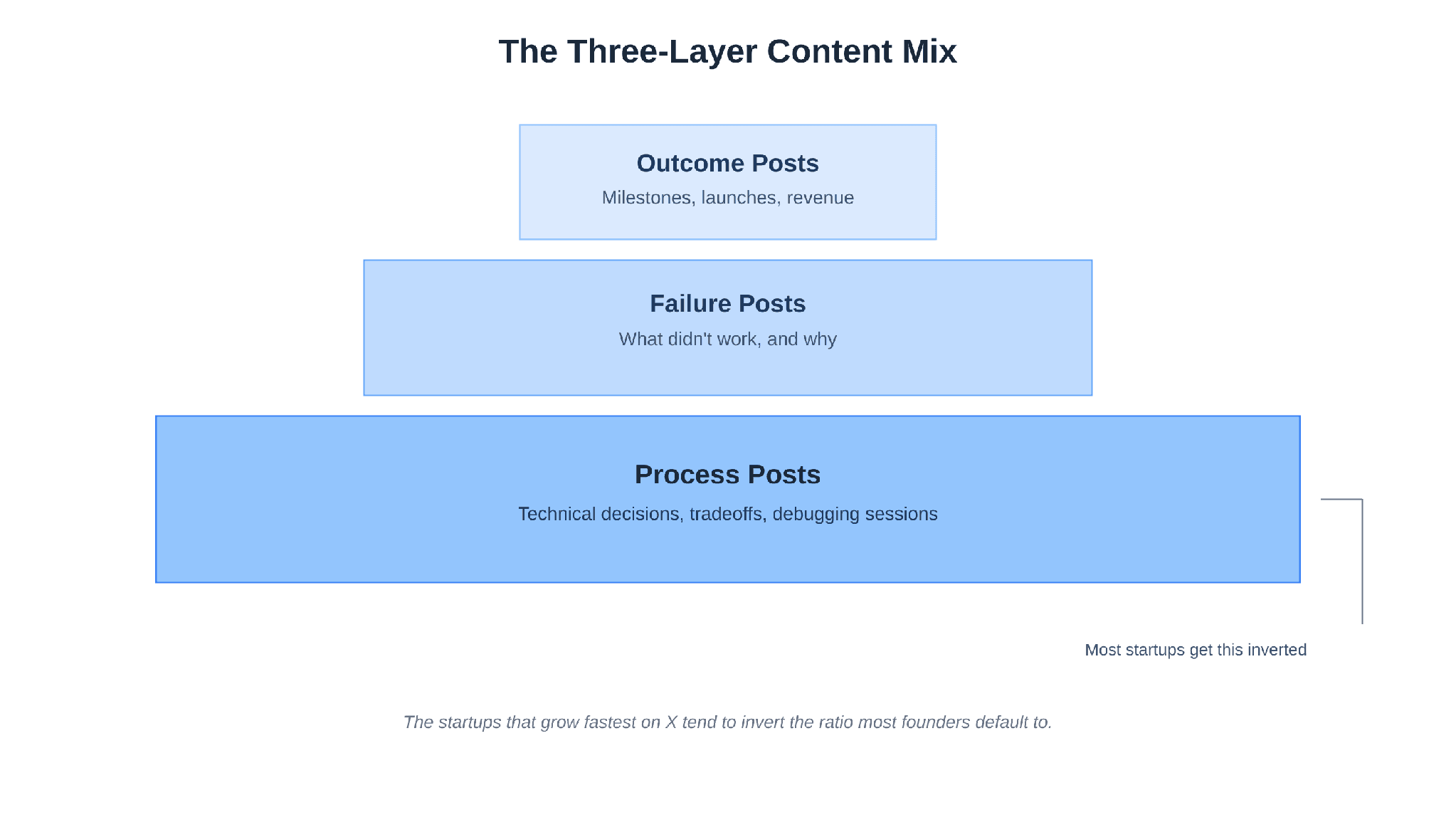
The startups that grow fastest on X tend to invert the ratio most founders default to.
What a Realistic Posting Timeline Looks Like Before Launch
One reason developer startups underinvest in X is that early growth looks discouraging. The first stretch has almost no visible payoff, and it is easy to conclude the channel is not working when it is actually just early. The first month or two typically brings a small following with low engagement, since the founder is still establishing their voice and posting consistency, and this is the hardest phase because it can feel like posting into a void.
Growth is not linear from there. By months three and four, an account posting consistently starts getting recognized by the platform as an active source, and posts begin reaching people who are not yet followers, with engagement picking up noticeably. By months five through eight, growth accelerates further, and inbound direct messages, collaboration requests, and thousands of impressions per post become routine.
The practical implication is straightforward: a startup that wants an engaged audience by launch day needs to start posting three to four months before launch, not the week before. Waiting until the product is ready means arriving at launch with the same zero-audience problem building in public was meant to solve.
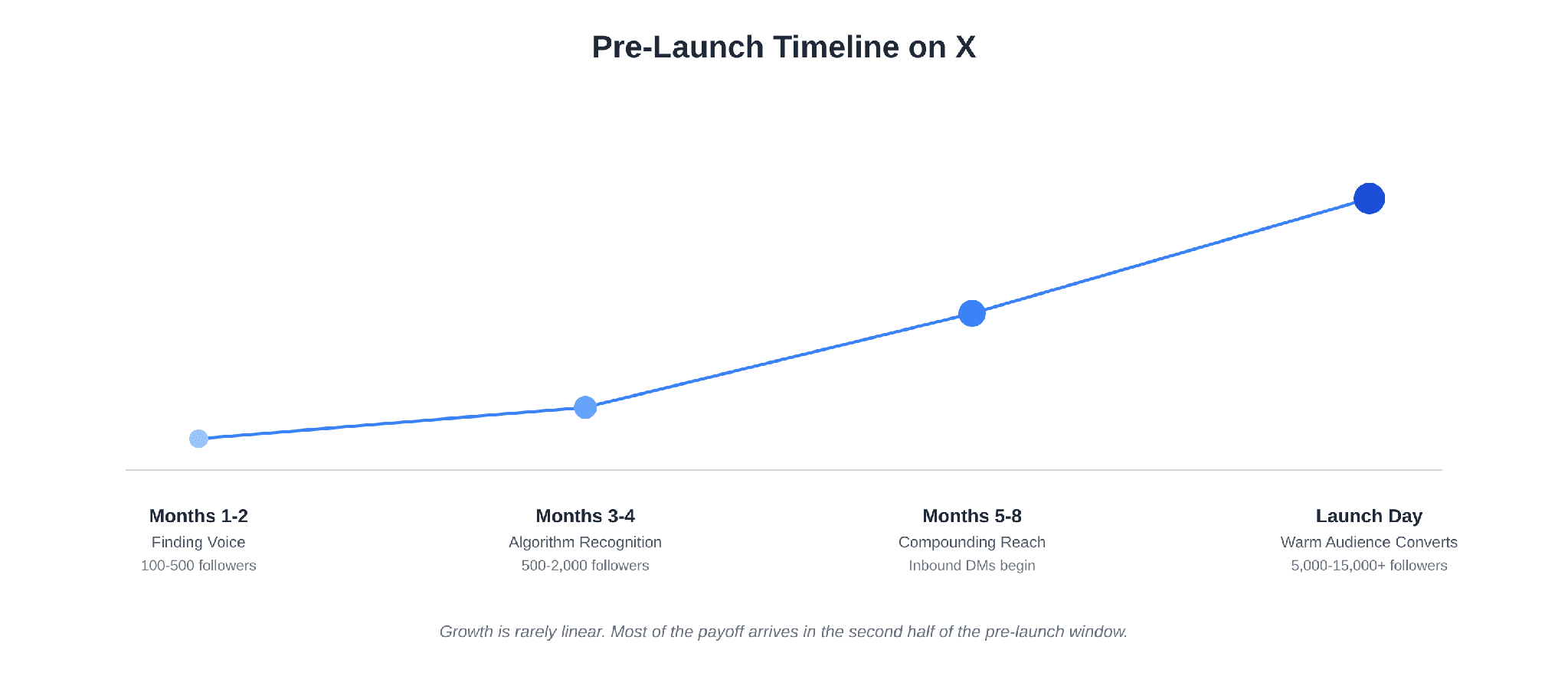
Audience growth on X is rarely linear, and most of the payoff arrives in the second half of the pre-launch window.
How Pre-Launch X Activity Actually Converts to Product Traction
The value of an audience built before launch is not the audience itself, it is what that audience does on launch day and afterward. A person who has watched a build unfold for three months arrives at the landing page with context a cold visitor does not have, which changes both the conversion rate and what kind of user shows up.
Waitlist and pre-launch conversion data reflects this gap between channels. Twitter and X build-in-public content typically converts visitors to waitlist signups at a 5 to 15 percent rate for devtools, AI, and indie SaaS products, a notably higher range than most cold-traffic channels produce, because the traffic arriving from a founder's own posts is already warm.
That warmth also shows up in the type of engagement a launch gets. Founders who have documented a build for months tend to see comments and shares from people who reference specific earlier posts, not generic congratulations. Those replies are frequently the source of the first cohort of users who give real product feedback rather than just trying a demo and leaving.
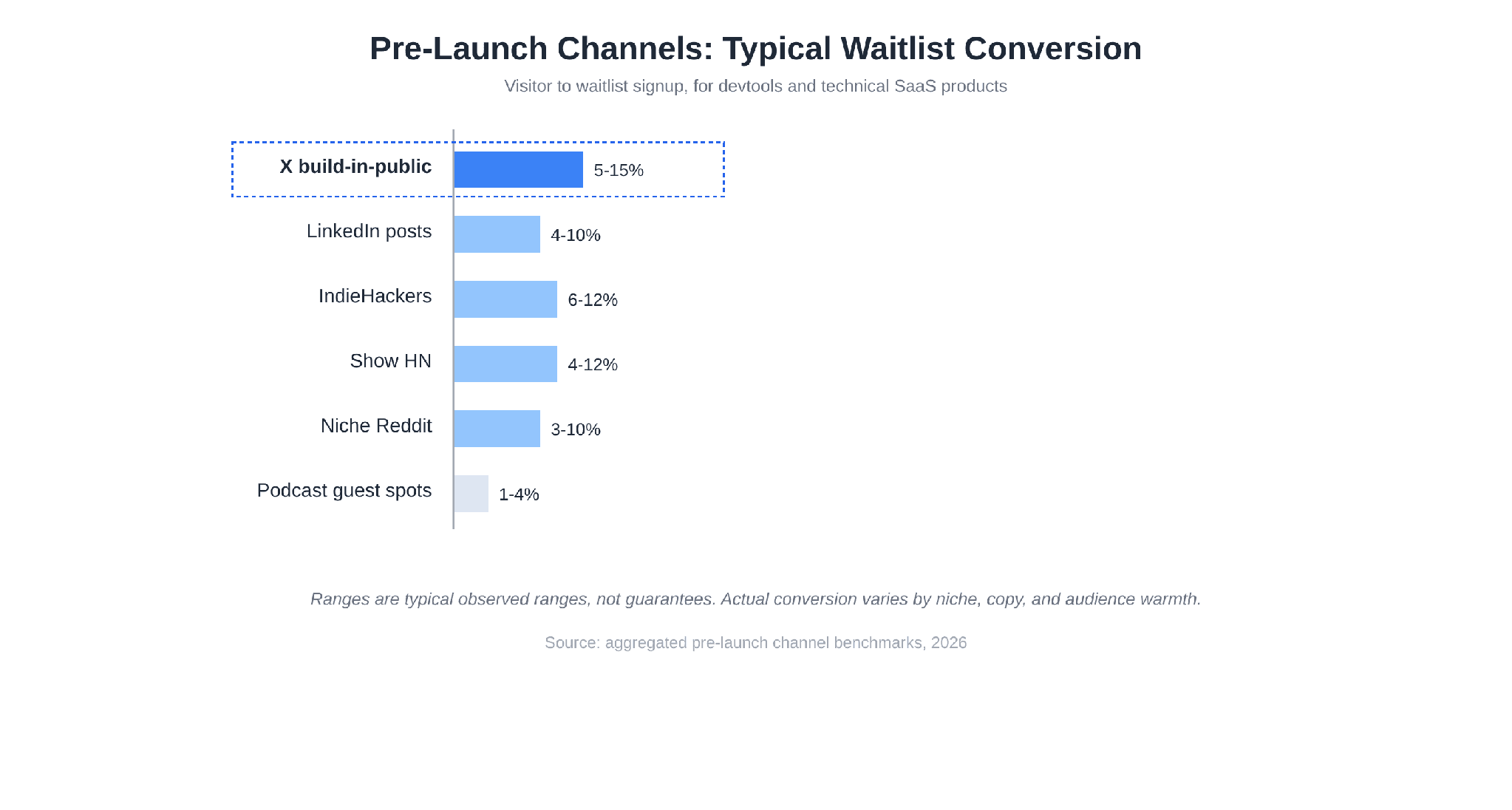
X build-in-public typically converts warmer than most other pre-launch channels for technical products.
Where Developer Startups Get This Wrong
A few patterns show up repeatedly in build-in-public feeds that never gain traction, and they are worth naming directly since they are easy to fall into without noticing.
Posting only wins. Polished content that only shares wins functions as marketing with a different label, and readers stop trusting a feed that never shows a loss. The credibility of a milestone post depends partly on the failure posts sitting next to it.
Inconsistency. A burst of posts followed by weeks of silence resets whatever algorithmic recognition and audience habit had started to build. A steady habit of a few posts a week compounds far more than one high-performing post followed by a gap.
Company account instead of founder account. Early-stage developer audiences respond to a person, not a logo. A brand-new company account with no history reads as marketing by default, while a founder's personal account carries the specificity and stakes that make build-in-public content credible in the first place.
No clear path from post to product. A founder's bio link and pinned post function as the primary conversion path from casual reader to warm lead, and an account without a clear, current link to the product or waitlist leaves that traffic with nowhere to go.
Documenting the Build Without Losing the Time to Do It
The honest obstacle for most technical founders is not knowing what to post, it is finding a repeatable way to turn the day's actual work into something postable without it eating an hour they don't have. The founders who sustain this for months tend to build a lightweight habit around it: a running note of decisions and small wins kept alongside the actual work, turned into two or three posts a week rather than reconstructed from memory on a Friday.
That documentation habit is close to the same discipline that goes into good technical writing more broadly, since both are about capturing a decision and its reasoning while the context is still fresh rather than after it has faded. Startups that already work with a technical content marketing agency for their blog or docs often extend the same rhythm to X, since the raw material, a shipped feature, a fixed bug, a customer conversation, is usually the same input either way.
Conclusion: The Audience Is the Actual Launch Asset
A developer startup's real launch asset is rarely the product page or the Product Hunt post, it is the group of people who already understand what the product does and why it exists before either of those goes live. X remains the channel where that group is built cheapest and fastest for a technical audience, provided the posting is consistent, specific, and honest about what did not work along the way. Startups that treat the months before launch as quiet preparation time are giving up the exact window where that audience gets built.
If turning ongoing technical work into consistent, credible content sounds like more than a founder can sustain solo, it is the same skill set behind developer-focused product documentation services.
FAQs
How many followers does a developer startup actually need before launch?
There is no reliable follower threshold. A few hundred genuinely engaged followers who understand the product's context convert better than tens of thousands of passive ones. What matters more than count is whether the audience has actually followed the build closely enough to act on launch day.
Should the founder post from a personal account or the company account?
A personal account, especially in the early months. Developer audiences respond to a specific person taking specific risks, and a company account has no individual stakes to make the content credible until it already has an established audience of its own.
How often should a pre-launch startup post on X?
A few times a week, consistently, beats posting daily for two weeks and then going quiet. Consistency is what builds the algorithmic recognition and audience habit that compound over months.
Does this approach work for B2B developer tools, or only consumer products?
It works well for B2B and developer-facing products specifically, since the buyer and the audience on X substantially overlap. Enterprise-only products aimed at non-technical buyers tend to see less overlap and may need to split effort with LinkedIn.
What is the biggest mistake developer startups make with build-in-public content?
Only sharing wins. A feed of exclusively positive updates reads as curated marketing rather than an honest account of the build, and it is usually the failure and process posts, not the milestone posts, that earn the most trust.

How Developer Startups Build a Brand on X Before Launch

30-Day Starting Plan for New X (Twitter) Accounts

How Often Should You Tweet for Maximum Growth?

What Should Your First 10 Tweets Be About?

How to Run X for Ten Clients: The Agency Workflow

How to write a bio that gets people to follow you

Digital Product Launch Strategy

Best Twitter Growth Service for Creators in 2026
From X to Every Platform: Repurpose Without Flopping
