How to Find Trending Topics That Actually Move the Needle
Author:

The most popular advice about trending topics is wrong: a trending hashtag isn't automatically an opportunity. It's often a crowded room you've entered late, carrying an opinion nobody asked for.
The skill in learning how to find trending topics isn't discovering what's moving. X Explore, Reddit, Google Trends, and news feeds can surface candidates quickly. The edge comes from deciding whether a topic has enough momentum, relevance, and replay value to deserve your audience's attention.
A one-day spike can produce impressions that vanish before the day ends. A validated trend can give you a timely opening for an evergreen idea, a useful reply, or a repeatable content series. The difference is a disciplined filter between discovery and publication.
Table of Contents
Why Most Trending Topic Lists Are a Trap
A trending list records attention, not fit. Creators see a hashtag climbing, publish a rushed take, then mistake the first burst of impressions for evidence that the idea worked. In practice, that post often rents attention from a news cycle and gives little reason for followers to return.
Platform-native trend systems track emerging discussion and unusual activity, not only the biggest established topics. Research on trending topics separates sudden increases in discussion from absolute popularity. That distinction matters when you choose what to publish. A huge topic may already be saturated, while a smaller conversation accelerates quickly. The history of trending topics on X and Twitter explains why novelty and velocity matter more than a global popularity list.
The spike trap
Across creator workflows, a common pattern is easy to observe: widely shared lists repeat headlines already circulating across major feeds. By the time a creator reacts, larger accounts have framed the story, specialists have supplied context, and casual participants are repeating the obvious angle.
The result is predictable:
Weak relevance: Your audience cannot see why the topic belongs on your account.
Shallow engagement: The post attracts drive-by impressions instead of thoughtful replies.
Short shelf life: Interest collapses once the event leaves the immediate news cycle.
Practical rule: Ask whether a topic's acceleration creates a useful opening for your audience, not simply whether it appears on a trending list.
Posting on every unrelated viral thread also trains your workflow around reaction instead of expertise. If your posts jump from a celebrity story to a software launch to a political argument, followers have no clear reason to return. Your account becomes a commentary surface rather than a trusted point of view.
The validation gap separates discovery from durable growth. Discovery supplies raw candidates. Validation checks whether the conversation is expanding across multiple days, whether your audience cares, and whether you can add a perspective that survives the original event. That filter is how you separate a one-day spike from momentum that can compound into followers, rather than impressions that disappear.
Google Trends helps with that check because its dataset reaches back to 2004, giving analysts a historical baseline for recurring spikes, seasonality, and emerging topics. Google launched Trends in the summer of 2006 and later described it as a way to understand changes in search interest over time through aggregated data. Google's account of Google Trends makes the useful distinction clear: a trend reflects a departure from normal interest, not merely whatever is popular at the moment.
The Discovery Stack Every X Creator Should Run Weekly
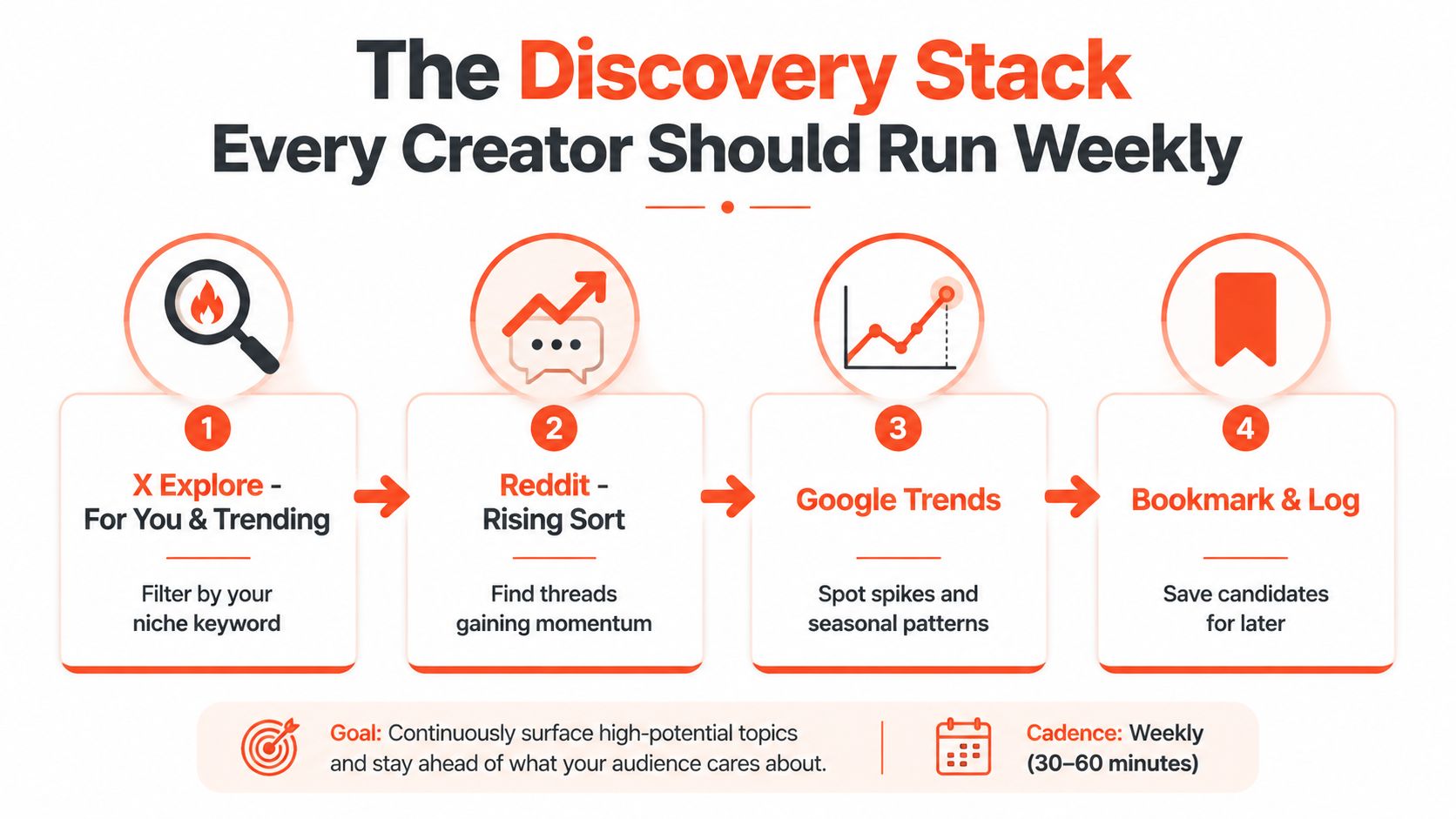
Run discovery as a stack, not a random tour of social platforms. Each source answers a different question. X shows visible conversation, Reddit exposes community-level momentum, Google Trends adds search context, and industry feeds surface slower-moving stories.
Start with X Explore. Open For You and Trending, then filter the scan through one niche keyword, such as “pricing,” “developer tools,” or “creator economy.” Read recent posts, not only headlines. Save topics that offer several distinct angles. One viral post is a lead, not a content plan.
Check Reddit's Rising sort across carefully chosen subreddits. Look for detailed comments, repeated questions, and language your audience might use. A single thread cannot prove demand. It can reveal a question worth testing across other sources.
Add search and industry context
Open Google Trends after the social scan. Compare candidate terms in Explore, then review regional popularity, related topics, and related queries. Put competing topics beside one another instead of judging each chart alone. The goal is to identify multi-day momentum, not reward the loudest one-day spike.
Use a news aggregator next. Hacker News suits developer and startup topics, while Google News RSS can be filtered by industry terms. Review recent material during the same research block. Flag stories that appear across publications or connect to a recurring business problem.
Your stack should create candidates, not finished posts. Record each one in a single swipe file with its topic, source, original post or article, audience connection, and first possible angle. A strong input library also supports broader finding content ideas, beyond whatever is trending today.
Reserve enough capacity for validation, drafting, and replies instead of filling the calendar with reactions. SupaBird's scheduling slots guide can help organize that capacity. If public X conversations need structured research, learn how to scrape tweets with Python responsibly and within applicable platform rules.
Validating Spikes vs Sustained Momentum With Google Trends
Google Trends is a validation tool, not an idea generator. Before drafting, test every candidate for momentum, audience relevance, and enough depth to support more than one reaction.
Start with Top and Rising views. Top terms show established interest in the selected context. Rising terms show acceleration, but acceleration alone can reflect a news event, product launch, or controversy. Use the Trending page for discovery, then open a comparison view to examine candidates against one another over time.
Read the curve, then interrogate it
Pull a 90-day chart for serious candidates. A flat line followed by a sharp peak usually signals a short-lived trigger. A steadier upward slope indicates that interest is building across several days. Treat the first pattern as a possible timely reaction and the second as a stronger candidate for content that can keep attracting followers after the initial burst.
Related queries reveal whether the topic has depth. A rising main term with few adjacent searches may be a headline artifact. A growing cluster of related questions creates room for explainers, comparisons, workflows, and replies. That distinction separates raw impressions from repeatable audience demand.
Check the regional filter as well. A topic can trend globally while missing the markets where your followers live. Compare interest in the regions you serve before committing editorial time.
A rising line is a signal. A cluster of related questions is an opportunity.
Reject a topic if its Rising curve peaked before you found it, unless you have a clear post-event analysis. Reject it when you cannot add a niche-specific interpretation. Search momentum confirms attention, not your account's right to join the conversation.
Use Twitter analytics tools to compare the candidate with your past posts. Look for topics that produce meaningful replies, profile visits, or follows, rather than judging success by impressions alone. Then apply the viral retention playbook to evaluate whether the idea can hold attention after the trigger fades.
The winning topic is rarely the loudest spike. Choose the candidate with sustained interest, related questions, regional relevance, and a clear reason your audience should hear your take.
Turning a Spike Into a Post That Replays
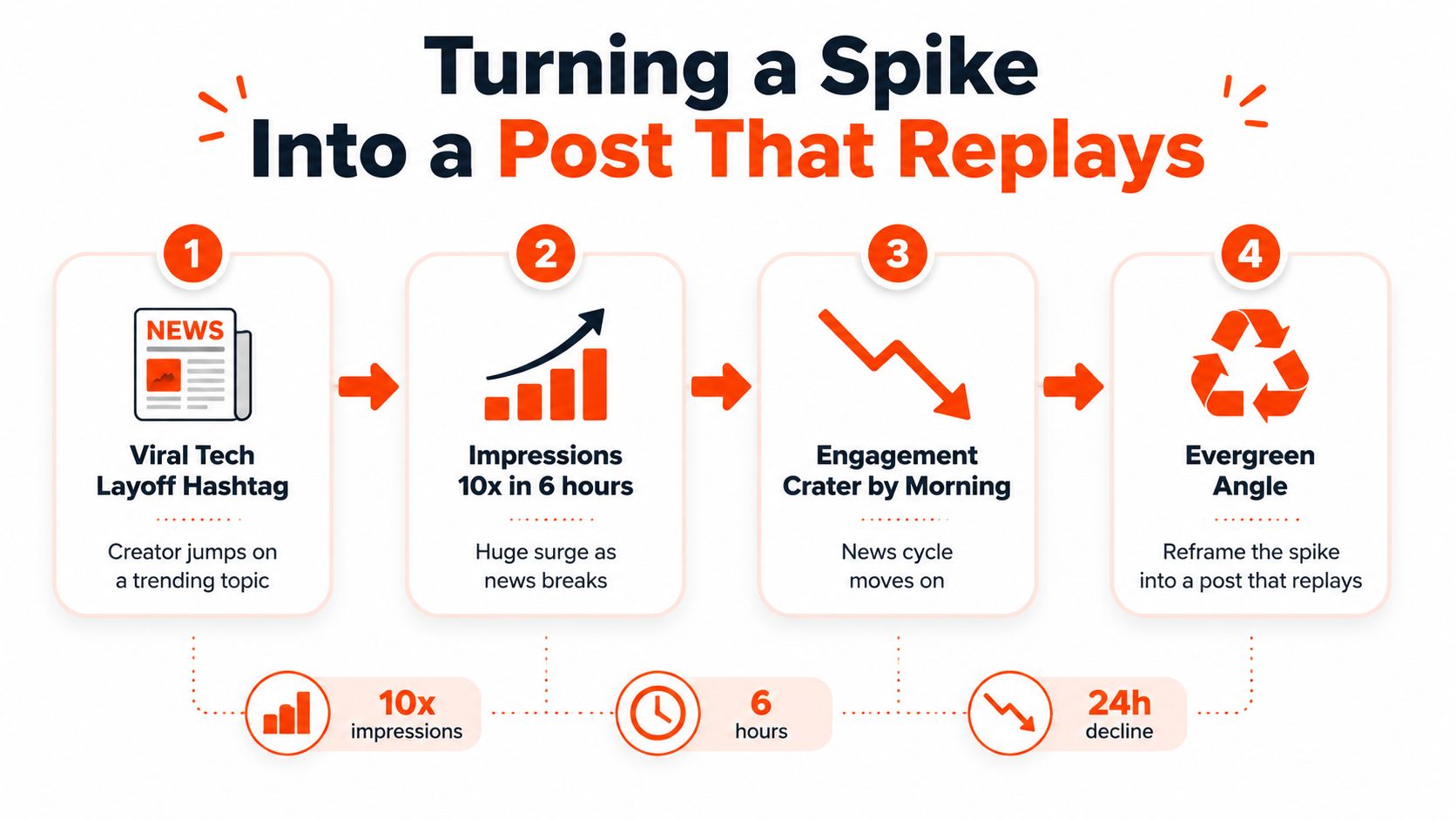
A viral tech layoff hashtag can produce a fast burst of impressions, then disappear by morning. If the post depends entirely on the breaking event, replies slow with the news cycle and the idea has no reason to circulate again.
That is the spike trap. Use the event as an entry point, then build the post around a durable idea that earns attention after the trigger fades.
Build the durable idea first
For the layoff example, the durable idea could be a checklist for judging company resilience, a breakdown of warning signs in hiring plans, or a contrarian explanation of why headcount cuts can expose planning problems instead of solving them.
Attach the trend to the opening:
Lead with the current event. Make the post timely enough to earn the first read.
Move into a reusable framework. Give readers a method they can apply to another company or situation.
Add a specific example. Show how the framework changes the interpretation.
Close with a saveable prompt. Invite readers to bookmark the checklist or share it with a team.
The opening earns attention. The framework earns rereads. A numbered list, named model, or concise checklist gives the post a useful life beyond the original news cycle.
Sustained attention requires a clear promise after the trend. Apply the viral retention playbook to tighten the hook, sequence the explanation, and give readers a reason to continue. That is the difference between borrowing reach and building an asset.
Extend the same asset into a thread, reply series, or short video through a deliberate content repurposing strategy. Each format should preserve the durable idea while adapting the delivery to the audience's reading context.
Watch the visual walkthrough here for another way to frame the transition from immediate news to evergreen content:
Filtering Trends Through Your Niche and Audience
Relevance beats reach when you're building an account people remember. Before writing a single word, run every candidate through four questions:
Existing conversation: Does this topic appear in discussions your audience already has?
Distinct perspective: Can someone in your niche explain it better or differently?
Follower value: Would the ideal follower save, reply, or follow after reading?
Audience expectation: Would your audience notice if you ignored the topic?
A celebrity breakup fails this filter for a SaaS founder. A pricing-page redesign trend passes because it connects directly to conversion, positioning, and product decisions. The trend itself isn't valuable. Your interpretation determines whether it belongs in the feed.
Translate the headline into your domain
Use a translation table so you don't rebuild your thinking from scratch each time.
Trend Category | SaaS Founder Hook | Coach Hook | Indie Hacker Hook |
|---|---|---|---|
Viral AI tool | “The workflow integration most SaaS teams will miss” | “How coaches can use the tool without losing their voice” | “The smallest useful product you could build around this tool” |
Breaking political moment | “What the reaction reveals about customer sentiment” | “A lesson in handling disagreement with clients” | “A distribution lesson from a rapidly changing conversation” |
Sports upset | “What the team's strategy teaches about product focus” | “How preparation changes performance under pressure” | “The operating decision that helped an underdog compete” |
Product launch | “What the positioning says about the category” | “How to explain a new tool to a skeptical audience” | “The narrow problem a solo builder could solve next” |
The table works because it replaces the headline subject with a problem your audience recognizes. A viral AI tool becomes a workflow question. A sports upset becomes an operating lesson. A political moment becomes a discussion about sentiment, risk, or communication.
Don't force a connection. If your angle needs a long explanation before the reader understands why it matters, discard the trend. Your audience should recognize the bridge quickly, even when the original topic came from outside your industry.
The best candidate is the one your followers would pay to see analyzed, not the one with the largest general audience.
Scheduling Trend-Driven Posts Without Burning Out
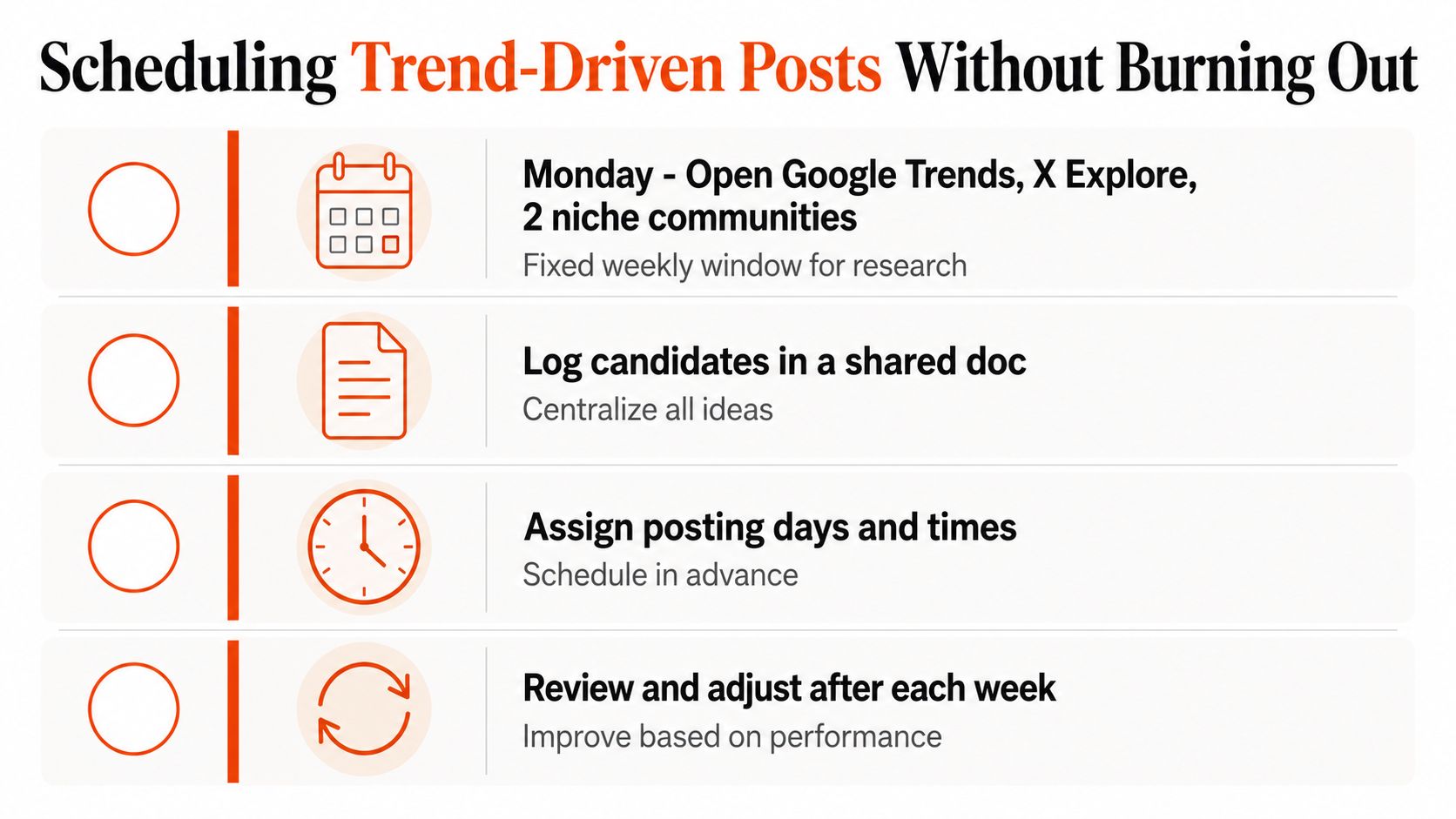
Reactive posting drains time because research, drafting, and publishing collide. Separate the work. Use a fixed research block to review Google Trends, X Explore, and two niche communities, then record candidates in one document with columns for momentum, niche fit, and replay potential. Validation belongs before scheduling. A one-day spike can earn impressions while a topic with multi-day momentum gives you several useful entry points and a better chance to gain followers.
Assign validated winners to the publishing calendar for Tuesday through Thursday. Keep Friday open for new conversations and late-breaking signals. Reserve capacity for response without making the whole week reactive.
Use a queue-first system
Prepare reusable hooks and frameworks before a trend appears. Once a candidate passes validation, update the opening with the timely reference while preserving the core structure. The post should read like a prepared idea with a current doorway, not an emergency essay.
RSS feeds can send industry stories into a trend inbox, and Zapier bridges can route selected items toward a scheduler. Automation should collect and route signals. You still decide whether the topic fits your audience, positioning, and standards.
Keep trend content a minority of your output. A practical ceiling is 30 percent of weekly posts, based on the operating approach here rather than a sourced platform statistic. Use the remaining posts for original frameworks, lessons, product thinking, and audience-specific opinions. Those ideas continue building recognition after the news cycle ends.
A scheduling calendar should absorb velocity while preserving judgment. Use SupaBird's scheduling slots guide to structure open publishing slots, while keeping the final niche-fit decision with a human. Tools can handle collection and publishing. You decide which validated trend deserves your name.
Your Weekly 90 Minute Trend Hunting Routine
Put trend hunting on the same day and time every week. A repeatable block prevents you from opening X whenever you feel stuck, which is how research consumes the calendar.
Use one document for raw signals, validation notes, angles, and scheduling decisions. Then divide the session into four distinct passes.
The first pass finds candidates
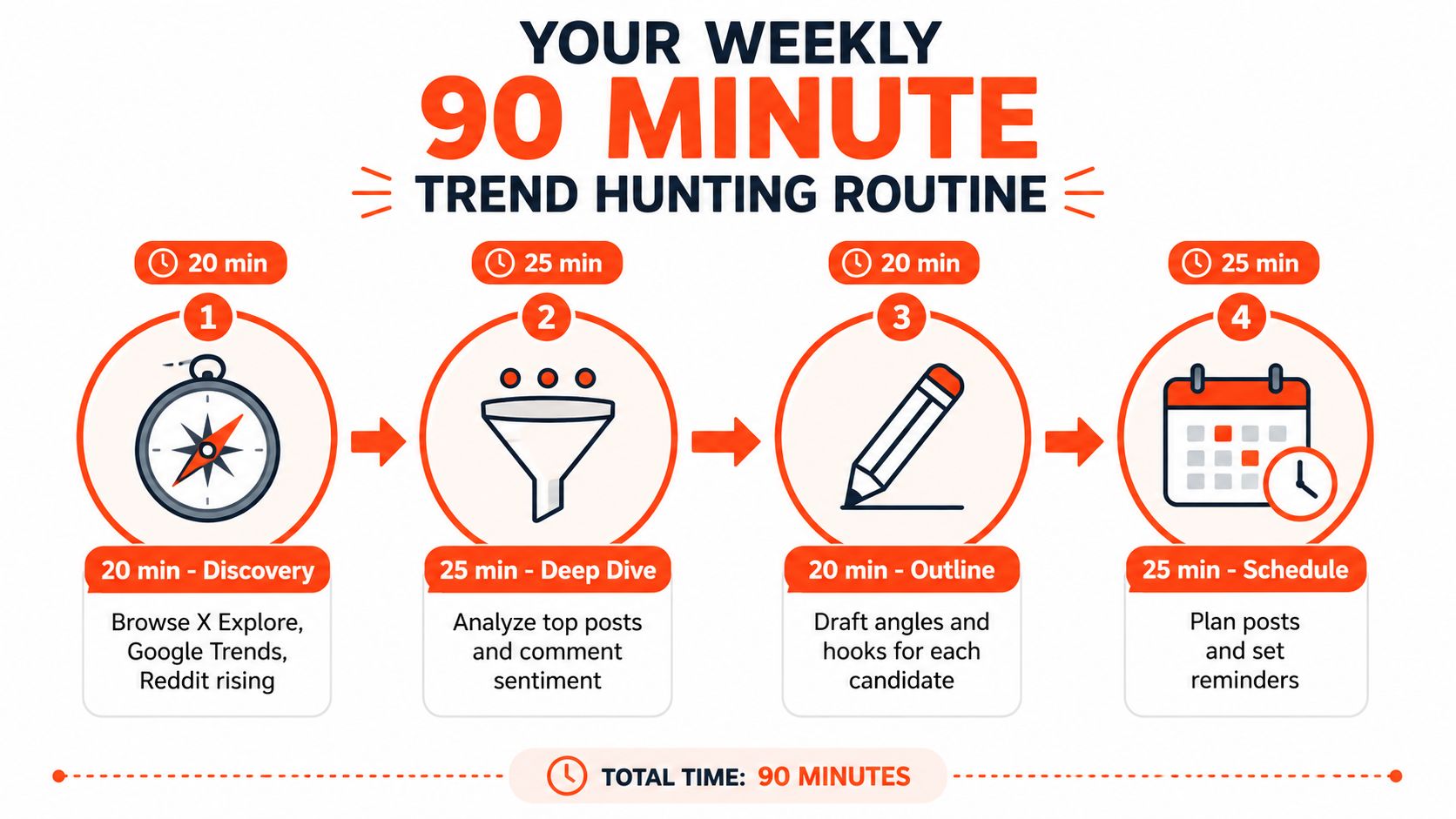
Spend 20 minutes browsing X Explore, Google Trends, Reddit Rising, and two niche newsletters. Save the source, topic, and one sentence explaining why it might matter. Don't draft yet. Your only job is to collect signals that deserve inspection.
Use the next 15 minutes for spike validation. Check Rising against Top, inspect the 24-hour and 7-day curves, review related queries, and scan competitor post counts. A crowded conversation with no distinct angle is usually a poor use of your attention.
The second half turns evidence into content
Spend 25 minutes translating the survivors into three to five possible hooks. Tie each angle to your positioning, then choose the one that gives readers a reusable framework rather than a passing reaction.
Use the final 30 minutes for batched scheduling. Assign each draft to an open slot, add a reply or follow-up where useful, and leave room for an important breaking conversation.
Add a Friday review. Score which posts earned meaningful follows and replies, not just impressions, then record what made the strongest candidates different. The purpose is to improve your judgment each week.
Skipping validation is the move that turns trend hunting into wasted effort. You're not trying to win every news cycle. You're building a repeatable system that finds acceleration, filters for audience fit, creates replayable posts, and teaches you which conversations compound.
SupaBird helps X creators turn scattered trend signals into organized ideas, relevant engagement opportunities, and scheduled posts, with tools for post discovery, idea generation, rewriting, and calendar planning. Visit SupaBird to build a trend workflow that protects your niche while helping you publish timely content consistently.

The Reply Guy Strategy: A Growth Guide for X

Why New X Accounts Get Less Reach

ClimbX Review (2026): Features, Pricing, Pros and Cons

How Developer Startups Build a Brand on X Before Launch

30-Day Starting Plan for New X (Twitter) Accounts

How Often Should You Tweet for Maximum Growth?

What Should Your First 10 Tweets Be About?

How to Run X for Ten Clients: The Agency Workflow

How to write a bio that gets people to follow you
