Most advice on content growth is backwards. It tells creators to publish more, chase more topics, and keep the calendar full at all costs. For X creators, that usually leads to rushed posts, inconsistent quality, and a backlog of strong ideas that never get reused.
A better content repurposing strategy starts with a harsher truth. The next month of strong posts often already exists inside old threads, newsletters, videos, blog posts, customer emails, and reply chains. The problem usually isn't idea scarcity. It's extraction.
That shift matters because repurposing is no longer a fringe tactic. A 2026 industry survey found that 94% of marketers repurpose content across different channels according to this summary of the Referral Rock survey. For creators building on X, that should reframe the job. The goal isn't to sound endlessly new. The goal is to make strong ideas travel further, in more native formats, without lowering the bar.
Creators who want a broader foundation for this thinking can review these content strategies for creators, especially if the difference between reposting, crossposting, and actual repurposing still feels blurry. For day-to-day execution, a useful shortcut is studying proven content collections to spot repeatable post structures worth adapting.
Table of Contents
Why Your Best New Content Already Exists
The strongest X accounts don't treat every day like a blank page. They treat past work like inventory.
A creator might spend hours shaping a sharp podcast segment, a useful client lesson, or a thoughtful blog post, then squeeze one post out of it and move on. That's wasteful. If the original idea had enough depth to deserve publication once, it usually has enough depth to support multiple angles, hooks, and formats on X.
Stop feeding the blank-page habit
The blank-page habit feels productive because it looks creative. In practice, it often produces weaker output than disciplined reuse. Fresh ideas haven't earned trust yet. Older ideas that already triggered replies, shares, bookmarks, or meaningful comments have done that work.
Practical rule: If an idea already proved it can hold attention in one format, it deserves a second life in a format built for speed and conversation.
For a solopreneur, this changes the weekly workload. Instead of inventing seven unrelated posts, one strong source asset can produce a thread, two single-post takes, a contrarian question, a quote card concept, and a reply-bank prompt.
That is how consistency gets easier without turning the feed repetitive.
X rewards reframing, not duplication
X is not a storage locker for blog snippets. It is a fast, reactive feed where posts compete for attention in seconds. A content repurposing strategy for X works when it treats the platform as a place to reframe ideas, not merely transfer them.
Three examples make the point:
A webinar takeaway can become a thread that breaks down one mistake line by line.
A customer question can become a punchy post that invites debate.
A blog section can become a short opinion post that challenges common advice.
The creator isn't publishing less original thinking. The creator is distributing the same thinking more intelligently.
Finding Your Content Goldmine with a Quick Audit
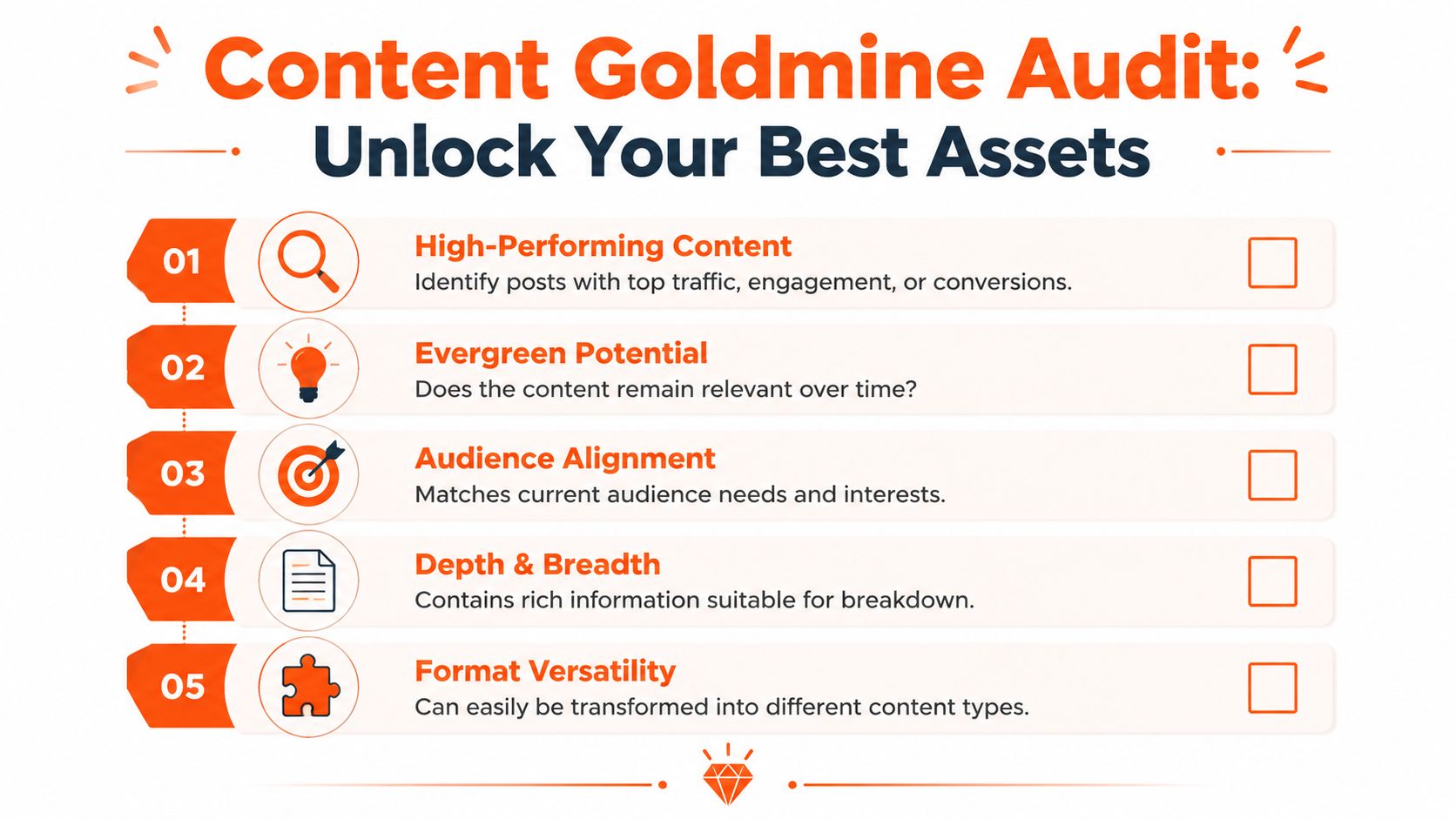
Most creators repurpose the wrong material. They grab whatever is newest, whatever they remember, or whatever feels easiest to recycle. A better content repurposing strategy starts with selection.
Optimizely's guidance is clear on the principle. Repurposing should be selective, with analytics guiding which assets have proven traffic, engagement, and conversion potential, rather than reworking everything indiscriminately in its overview of content repurposing.
Creators who need fresh prompts while auditing can also pull from content idea discovery methods, especially when deciding which old themes still match current audience demand.
Start with proof, not preference
A fast audit works best when it uses a single sheet or Notion page with five columns:
Asset | Original format | Signal of value | Evergreen status | X potential |
|---|---|---|---|---|
Blog post | Article | Strong comments or clicks | High | Thread, hook post, FAQ post |
Video | YouTube | Clear audience retention moments | Medium to high | clip summary, transcript post, contrarian take |
Newsletter | Replies or forwards | High | opinion post, list post, reply bait | |
Old thread | X thread | Bookmarks or strong discussion | High | shorter restatement, quote remix, expanded thread |
The key is to score content by evidence, not attachment. A creator may love a post that took all weekend to write. If nobody cared and the topic has no lasting relevance, it isn't a goldmine. It's an archive entry.
Use this short filter:
Audience response: Did people react, reply, save, or ask follow-up questions?
Shelf life: Is the insight still useful without heavy rewriting?
Current fit: Does the topic still support the creator's offer, niche, or positioning?
Depth: Can the asset produce multiple distinct micro-angles?
Portability: Can the idea survive outside its original format?
What to skip immediately
Repurposing gets easier when weak candidates are eliminated fast.
Don't start with:
Time-sensitive news: Launch announcements, trend reactions, and dated commentary expire fast.
Underperformers with no lesson: If the post failed and there is no reason to believe the core insight was strong, leave it.
Off-brand topics: A tangent from six months ago can confuse current followers.
Thin content: One-line thoughts usually don't contain enough substance to atomize well.
The real leverage comes from saying no early. Repurposing bad inputs only multiplies weak outputs.
A practical audit session can be done in under an hour. Pull the last batch of blogs, videos, newsletters, and X posts. Mark only the assets that are still relevant and clearly rich enough to split into multiple ideas. That shortlist becomes the working library.
The Atomization Method for Endless X Content
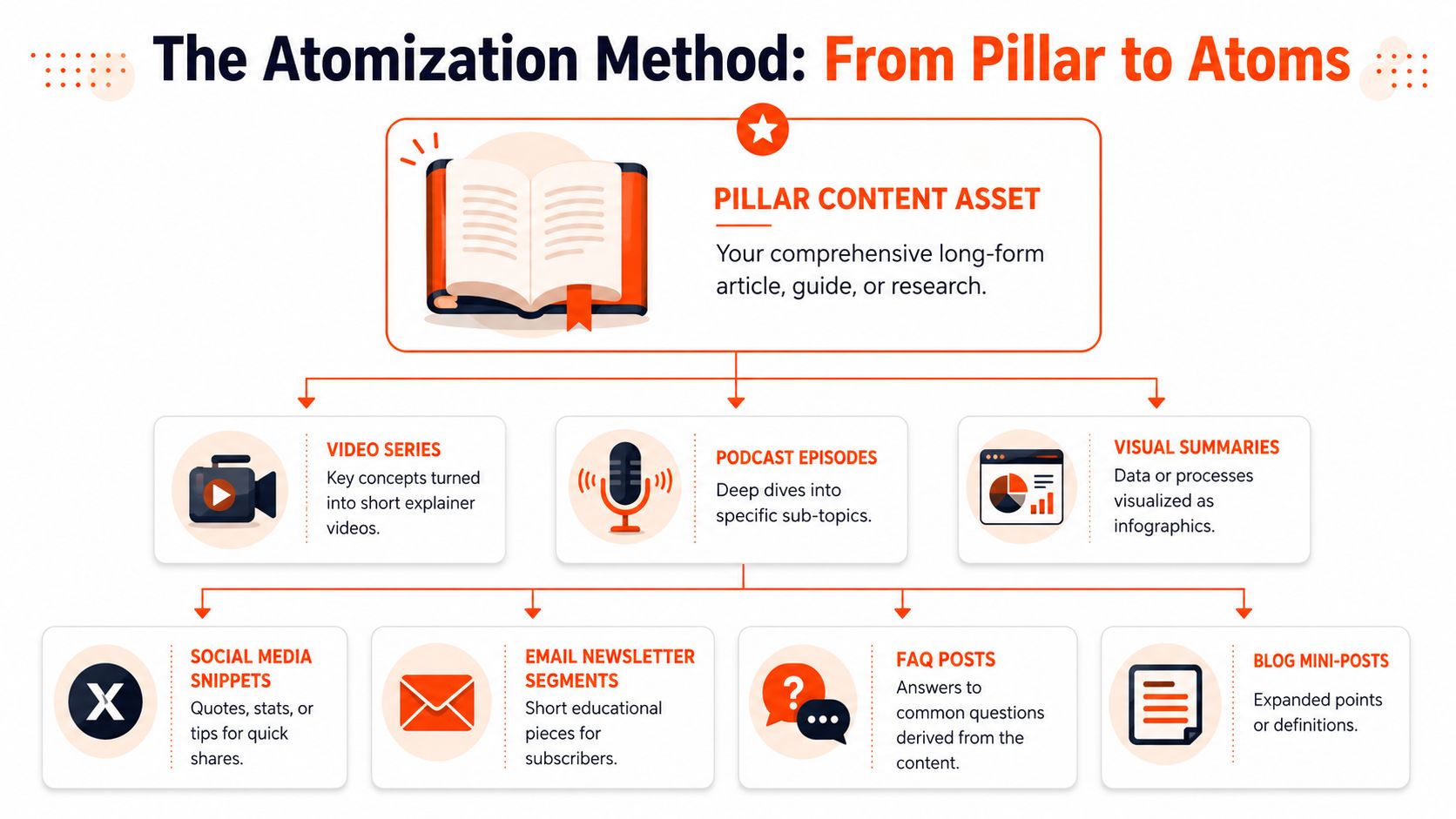
Atomization is where repurposing stops being vague and starts becoming operational. Instead of seeing one article or video as one unit, the creator breaks it into reusable parts.
A published guide recommends extracting at least 10 distinct assets from each flagship post in a repurposing workflow, and explains atomization around reusable content atoms such as stats, quotes, and how-to steps in this one-piece-to-ten-formats guide. That benchmark is useful because it forces a creator to look deeper than the headline.
A visual model helps here:
Creators working from video-heavy material can also study a YouTube transcript to tweet automation workflow for ideas on turning spoken content into multiple X-ready drafts. If the source material is video, tools for turning video into posts can speed up extraction before manual editing.
What an atom actually looks like
Suppose a creator has a long article about personal brand positioning. That article can be split into atoms like these:
A sharp belief: "Clarity beats cleverness on profile pages."
A process step: Define problem, audience, promise, proof.
A mistake: Writing a bio that describes interests instead of outcomes.
A phrase worth quoting: "If people can't repeat what you do, they won't refer you."
A debate prompt: Should creators niche down early or publish broadly first?
Each of those atoms can become a different X post. The belief becomes a one-liner. The process becomes a thread. The mistake becomes a warning post. The quote becomes a graphic concept. The debate prompt becomes a reply magnet.
That is the shift. The source asset is no longer a document. It is a mine.
A second format fits well midway through the workflow because it shows how people can turn extracted ideas into platform-ready drafts:
A simple atom library for solopreneurs
The library doesn't need complex software. A spreadsheet is enough if the fields are useful.
Track these columns:
Source asset
Name the original blog, video, newsletter, or thread.Atom type
Mark it as quote, story, stat, opinion, lesson, objection, or step.X format
Decide whether it fits a single post, thread, poll, image post, or reply prompt.Status
Drafted, scheduled, posted, or needs rewrite.Result notes
Record what happened after posting. Not just likes. Note whether the post attracted replies, profile visits, or the wrong audience.
This system creates repeatability. When creators complain that they run out of ideas, the issue often isn't creative ability. It is poor storage and retrieval.
Remixing Your Content for the X Audience
Repurposing fails most often at the remix stage. The creator finds a good old idea, extracts a usable atom, then posts it in the tone of a blog paragraph. On X, that usually lands flat.
The same idea has to feel native to the platform. That means faster setup, cleaner phrasing, stronger opinion, and a structure built for scrolling behavior.
Creators borrowing lessons from visual-first platforms sometimes find useful contrast in this Tube to Gram strategy, because it shows how the same source material has to change shape when the destination platform changes.
Before and after the remix
A formal source sentence might read like this:
Many founders struggle with personal branding because their message tries to speak to too many audiences at once.
That is fine inside an article. On X, it needs force and specificity. Better remixes look like this:
Founders don't lack content. They lack a message tight enough to repeat.
If a profile tries to speak to everyone, nobody remembers it.
Most personal brands stall for one reason. The audience is too broad to trigger recognition.
Same idea. Different delivery.
A thread needs the same treatment. A blog list such as "three ways to improve positioning" becomes weak if posted as three copied bullets. A stronger X version opens with tension:
Most creators don't need better writing.
They need tighter positioning.Three fixes that make posts easier to understand:
That opening earns the next lines. The original article language rarely does.
What native X writing usually includes
A post adapted well for X usually has some of these traits:
Immediate payoff: The value appears in the first line, not buried later.
Compressed language: Fewer qualifiers, fewer setup words, fewer transitions.
An angle: Agreement is fine, but plain summaries rarely travel.
Reply potential: A question, challenge, or polarizing frame gives people a reason to respond.
Readable shape: Short lines, clean spacing, one point per block.
A copied sentence informs. A remixed post competes.
This is also where many creators overdo automation. AI can produce variants quickly, but X punishes generic wording. The safest workflow is to use tools for raw options, then make human edits around tone, specificity, and edge.
A useful test is simple. Read the draft out loud. If it sounds like an article sentence, it still needs work. If it sounds like something a sharp creator would say in a live conversation, it is closer.
Building Your Repurposing Cadence and Measuring ROI
A content repurposing strategy becomes sustainable when it has a cadence. Without one, creators extract good material, post a few reused ideas, then fall back into random publishing.
One practical benchmark suggests extracting 5 to 7 pieces from each long-form asset and scheduling those derivatives 2 to 4 weeks after original publication to extend the distribution window in this 2025 repurposing guide. That timing matters because immediate reposting often feels repetitive, while delayed reuse makes the idea feel fresh again.
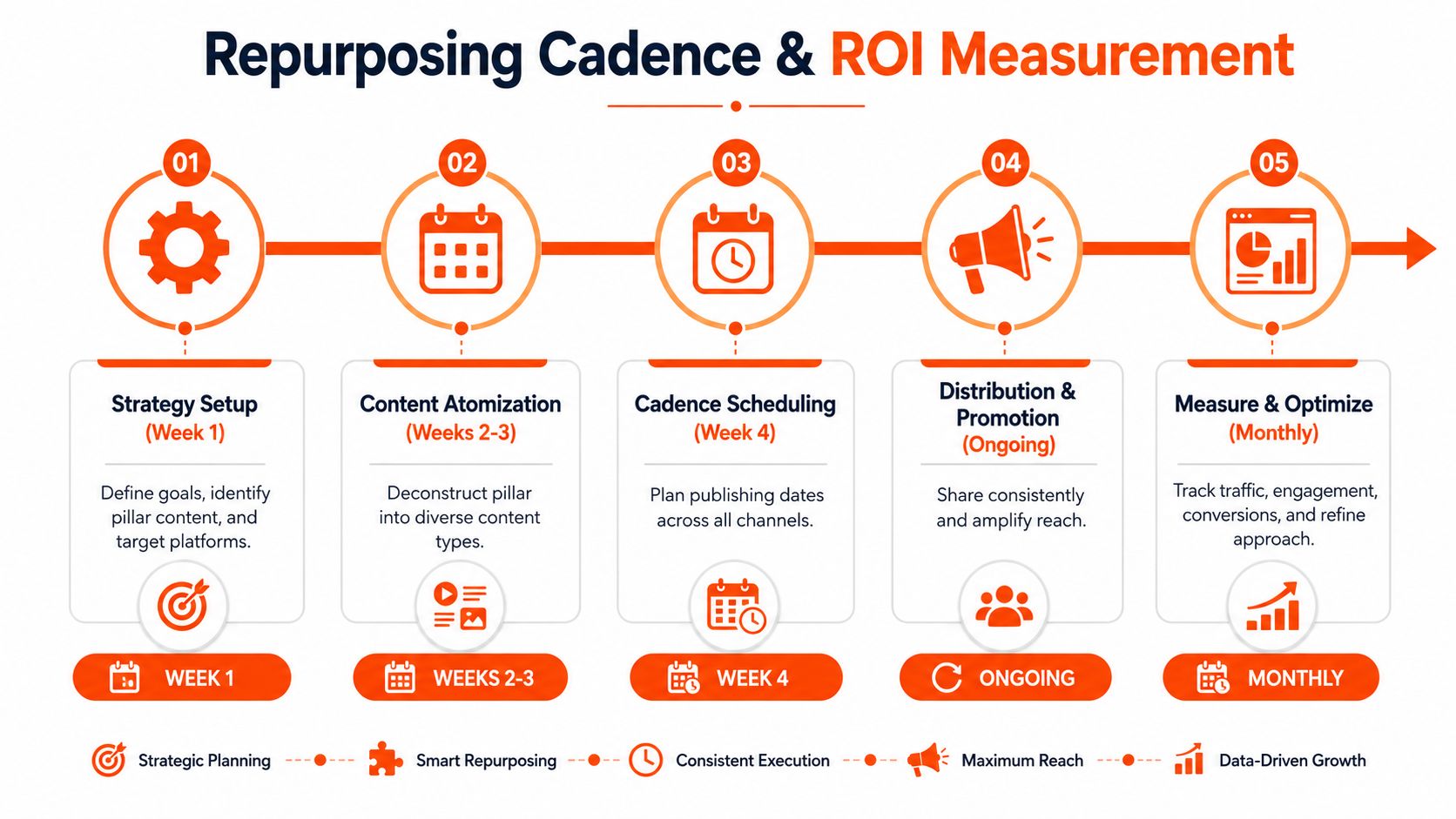
For creators trying to keep this routine manageable, a system for social media marketing automation can reduce scheduling drag and make the cadence easier to maintain.
A workable publishing rhythm
A simple weekly model works better than a complicated monthly spreadsheet no one updates.
Day | Post 1 (Morning) | Post 2 (Afternoon) |
|---|---|---|
Monday | Fresh opinion post | Repurposed insight from old thread |
Tuesday | Reply-driven question | Repurposed lesson from newsletter |
Wednesday | New short thread | Repurposed clip takeaway |
Thursday | Contrarian one-liner | Repurposed framework post |
Friday | Build-in-public update | Repurposed FAQ or objection post |
This kind of cadence keeps the feed mixed. Followers see current thinking and proven ideas side by side. The creator also avoids an easy mistake, which is filling the week with only reused content and making the account feel stale.
A few guardrails help:
Stagger formats: Don't repurpose three threads in a row from the same source.
Rotate source types: Pull from blogs, videos, client calls, newsletters, and old X posts.
Refresh the angle: The reused idea should add a new frame, example, or hook.
What to measure besides likes
Likes are fast feedback. They are not enough to judge whether repurposing is doing useful work.
The more important question is whether repurposed posts create incremental lift or just split attention across repeated versions. Guidance on cross-platform repurposing increasingly stresses that each format should stand on its own and be measured separately by outcome, not treated as duplicate filler. For X creators, that means tracking which repurposed formats earn better conversations, more profile curiosity, and clearer audience signals.
A practical review can include:
Profile visits: Did this recycled idea spark interest in the creator behind it?
Follows after post clusters: Did a run of related repurposed posts improve follower momentum?
Reply quality: Did the post attract peers, prospects, or random engagement bait?
DMs or signups: Did the content move someone closer to a business outcome?
Format performance: Do threads outperform single posts for repurposed educational content, or is the opposite true?
The point isn't perfect attribution. The point is learning which old ideas deserve more surface area and which formats deserve less.
Common Questions About Content Repurposing on X
How often can a creator reuse the same idea
More often than is commonly assumed, but not in the same wrapper.
A strong idea can appear as a one-liner, then a thread, then a customer-story post, then a reply prompt weeks later. Repetition becomes a problem when the wording, structure, and timing barely change. It stays effective when the core lesson is stable but the presentation is fresh.
What tools help manage a repurposing workflow
The essentials are simple. A spreadsheet, Notion, or Airtable can hold the library. Canva can handle quick visuals. Basic transcript tools help with video and podcast sources. Scheduling tools matter once the creator has enough inventory that manual posting starts creating friction.
The best tool stack is the one that gets used every week. Fancy systems don't help if the atom library stays empty.
Where is the line between repurposing and plagiarism
Repurposing means reworking your own original ideas into new formats. Plagiarism means lifting someone else's language, structure, or insights and presenting them as your own.
Curating an external idea is fine when the creator adds commentary, credits the source, and contributes a distinct point of view. Copying a viral thread structure line by line and swapping nouns is not a content repurposing strategy. It's imitation with a short shelf life.
The durable approach is simple. Capture original lessons, store them well, and keep rewriting them for the format where the audience pays attention.
Creators who want a tighter system for turning old ideas into better X posts can try SupaBird. It helps with idea generation, rewriting drafts into stronger X formats, scheduling consistently, and turning source material like videos into post-ready content without rebuilding the workflow from scratch.

How Often Should You Tweet for Maximum Growth?

What Should Your First 10 Tweets Be About?

How to Run X for Ten Clients: The Agency Workflow

How to write a bio that gets people to follow you

Digital Product Launch Strategy

Best Twitter Growth Service for Creators in 2026

From X to Every Platform: Repurpose Without Flopping

How to Get Cited by Grok: Winning X’s AI Search in 2026

5 X (Twitter) Growth Metrics Every Serious Creator Should Track — and How to Get the Data