Social Media Marketing Automation: A Playbook for X
X creators usually hit the same wall at the same point. The posting habit is there, the ideas are half-there, and the audience is starting to notice. Then the daily loop takes over. Draft a post. Rewrite the hook. Check replies. Scan the timeline for people worth engaging. Save a few ideas for later. Miss the best posting window because actual work got in the way.
That's when social media marketing automation starts looking attractive, and that's also when it's often mismanaged.
A weak setup turns an account into a content vending machine. Posts go out on time, but they sound flat. Replies feel canned. Reporting focuses on vanity metrics, while leads, conversions, and qualified conversations stay fuzzy. A smarter setup does the opposite. It removes repetitive work, protects consistency, and gives the creator more room for judgment, better writing, and sharper engagement. Teams that want to automate social media efforts without flattening their voice need that distinction early.
On X, the difference matters more because the platform rewards timing, relevance, and point of view. Scheduling alone doesn't build that. A system does.
Table of Contents
Beyond the Grind Your Introduction to Smart Automation
You post before breakfast, reply between meetings, save promising threads for later, and end the day with twenty open tabs and no clear record of what produced qualified attention. The account looks active. The operating system behind it is scattered.
Smart social media marketing automation fixes that operational mess. It handles repeatable work so creators can spend their time on the parts that still need judgment, taste, and timing.
On X, that usually means setting up three quiet systems in the background. One queues and publishes posts. One surfaces useful signals, such as reply opportunities, mentions, or recurring audience questions. One turns raw activity into reporting you can use. If you want to automate social media efforts, start there instead of trying to automate everything at once.
The line that matters is simple.
Practical rule: Automate the process. Keep the voice human.
That distinction decides whether automation improves output or flattens it. A good system can draft post variations, pull ideas from saved notes, group recurring themes, and schedule content at the right cadence. It should not publish hot takes you have not reviewed, jump into sensitive conversations on autopilot, or turn replies into canned support scripts. Those shortcuts save minutes and cost trust.
I have seen the strongest X workflows use AI as an assistant, not a substitute for a point of view. A founder can use SupaBird to collect ideas from past posts, turn them into first drafts, and queue the ones worth publishing. The final pass still needs a human hand. The phrasing, the claim, the risk level, and the decision to post now or wait are where the true edge comes from.
If your content engine still depends on memory and manual effort, fix the system before you push for more volume. A clear workflow and a real social media content strategy for X growth will do more than another week of posting harder.
Start with Strategy Define Your Automation Goals
Most broken automation systems fail before the first workflow is built. They start with tools instead of targets.
If the objective is newsletter growth, then more impressions alone won't tell much. If the business needs demos, then a thread that gets praise but no qualified clicks is weaker than it looks. Social media marketing automation only earns its place when it connects to outcomes a business values.
Metrics become much more meaningful when they're tied to a reliable acquisition strategy. If paid search is part of your growth plan, working with performance marketing agencies can improve lead quality before those leads enter your automated workflows.
Pick the business outcome first
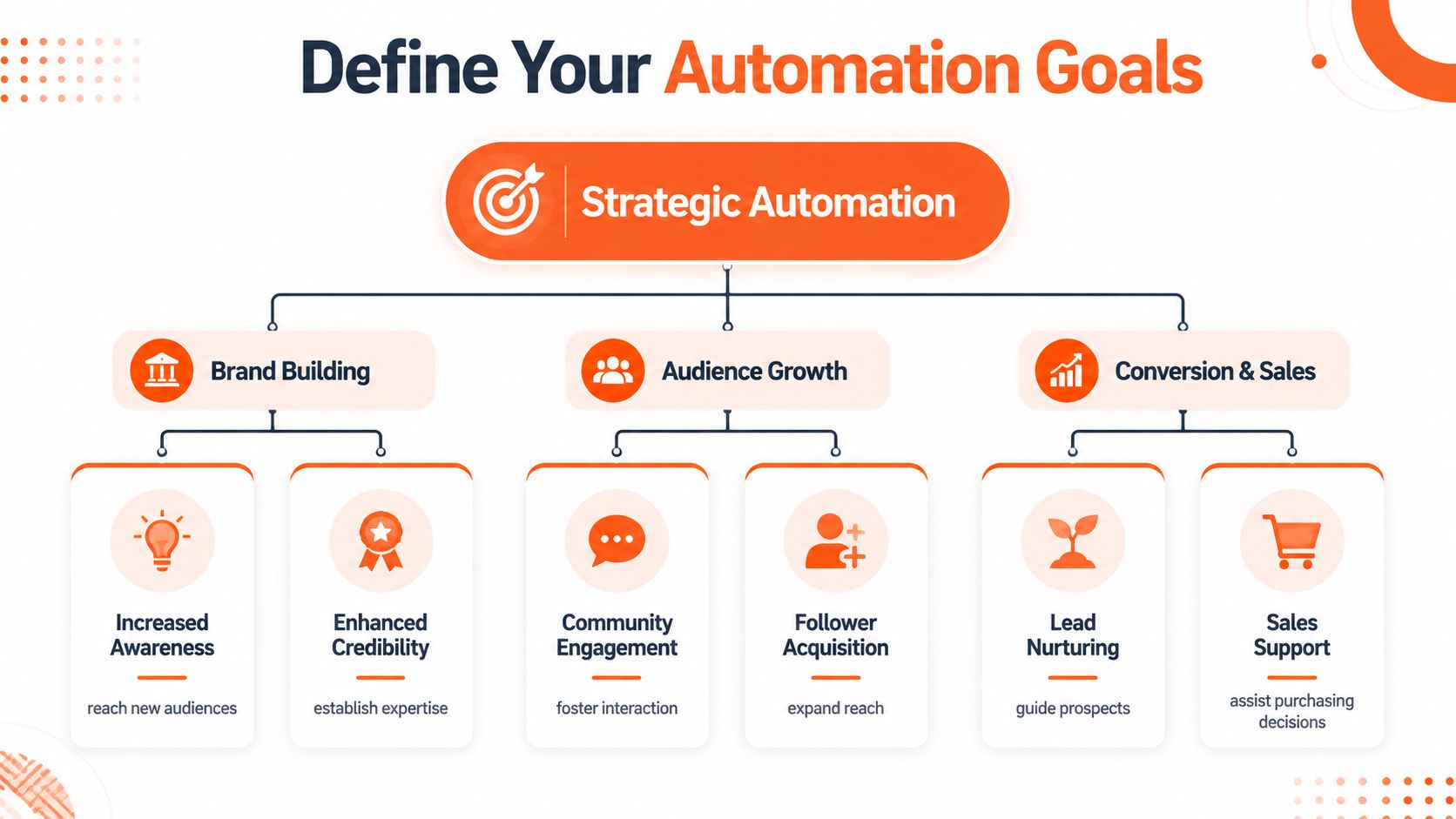
A simple way to set this up is to choose one primary outcome and one supporting outcome.
Primary outcomes usually sit at the business layer. Examples include lead capture, booked calls, product trials, or newsletter subscriptions. Supporting outcomes sit at the platform layer. These include profile visits, link clicks, qualified replies, and post saves. The platform metrics matter, but only if they support the business result.
A practical way to map this:
For founders selling SaaS: Treat trial starts or demo requests as the main KPI. Track which post types drive qualified traffic, not just the most visible threads.
For consultants and coaches: Use inbound inquiries or booked calls as the target. Replies and profile visits are useful only when they turn into serious conversations.
For creators building owned audience: Focus on newsletter signups or community joins. A viral post that attracts the wrong audience often creates extra noise, not useful growth.
This is the point where a real content strategy matters. A strong social media content strategy gives automation guardrails so the system doesn't flood the feed with disconnected content.
The wrong KPI makes a good workflow look bad, and a bad workflow look successful.
Build a measurement chain
Once the business outcome is clear, the measurement has to follow the full path from post to conversion.
The most reliable framework uses event tracking, attribution, and experiment design, as outlined in Storyteq's guide to measuring marketing automation success. That means every scheduled link gets UTM parameters, important actions beyond clicks get tracked as custom events, and those events connect back to conversions. On X, that often means distinguishing between someone who clicked and bounced versus someone who clicked, started a form, or used a product feature.
Three habits make this work:
Attach UTMs to every scheduled link. That keeps post-level traffic visible.
Track downstream events. Video views, form starts, signups, and feature usage say more than likes.
Test formats deliberately. Compare hooks, thread structures, CTAs, and audience segments through cohort and funnel analysis instead of gut feel alone.
The financial case is already strong enough to justify rigor. A Nucleus Research analysis found that marketing automation delivers an average benefit of $5.44 for every $1 spent, with a payback period of under six months, according to the Salesforce-hosted Nucleus summary.
That return doesn't come from posting more. It comes from measuring what creates real business movement, then automating around it.
The Human Filter What to Automate on X and What to Keep Real
The fastest way to ruin an X account is to automate the parts followers expect to feel human.
That usually starts innocently. A creator batches content, adds automated replies, sets generic DM flows, and treats the system like a solved problem. Output increases. Quality drops. The account stays active, but the voice starts sounding interchangeable with everyone else using the same shortcuts.
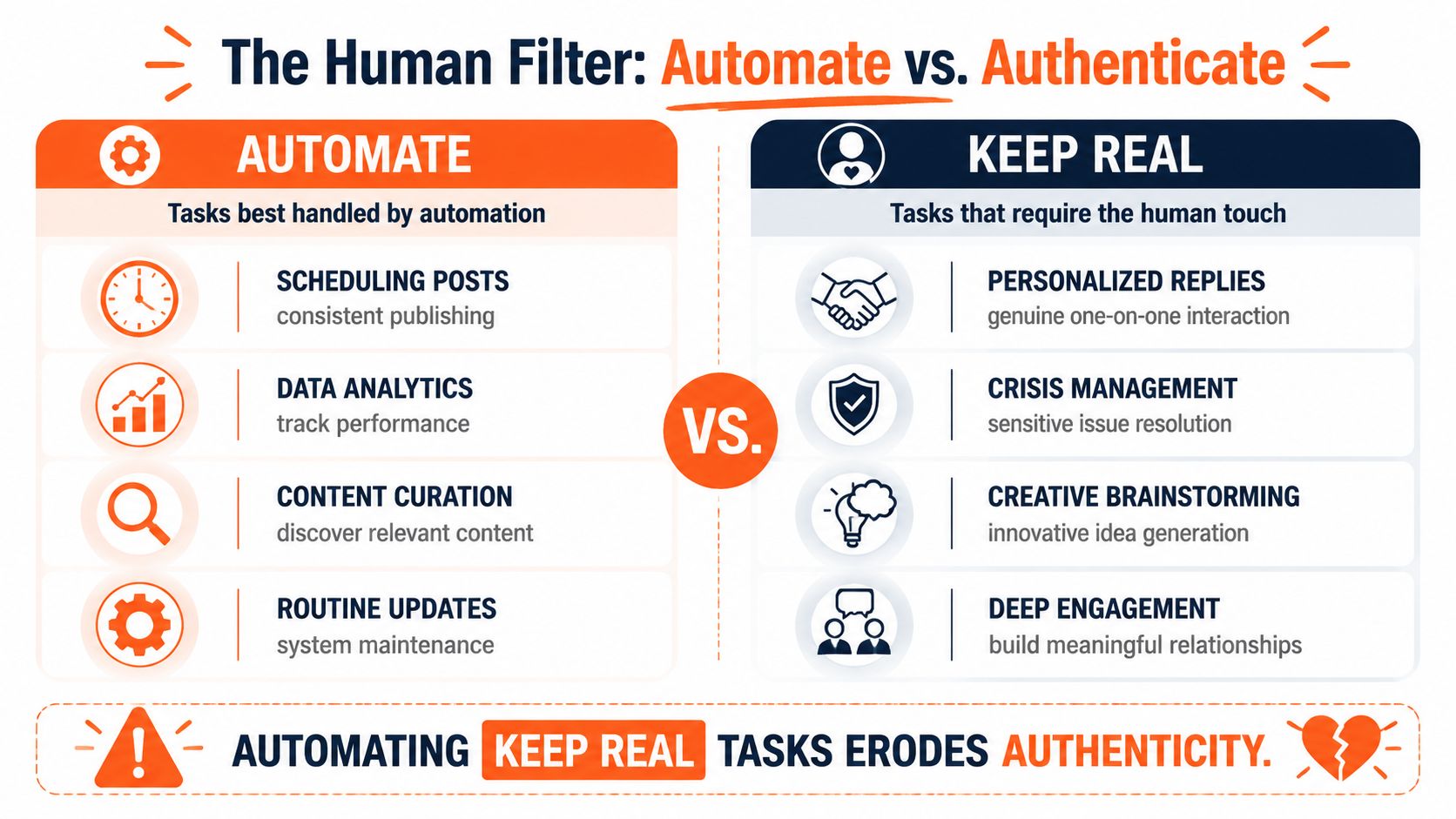
The safer model is narrower. Automate repetitive publishing and analytics. Keep engagement, judgment, and brand voice human-in-the-loop, as recommended in Social Media Examiner's guidance on using AI to automate marketing.
Use the delete delegate or automate lens
A clean X workflow gets simpler when every recurring task passes through one of three decisions.
Decision | What belongs here on X | What usually goes wrong |
|---|---|---|
Delete | Low-value habits like reactive scrolling, unnecessary reposting, or saving weak ideas | Creators mistake activity for progress |
Delegate | Design support, transcript cleanup, spreadsheet reporting, asset prep | The creator keeps tasks that don't require creator judgment |
Automate | Scheduling, recurring content queues, performance summaries, idea capture, content surfacing | Teams automate visible interactions and damage trust |
Many creators get distracted by growth hacks. Something like an auto follow bot on Twitter might look efficient on paper, but it pushes attention toward mechanical activity instead of earned relevance. On X, relevance compounds. Automation should support that, not replace it.
A few tasks are almost always safe to automate:
Publishing logistics: Queue posts, set calendars, and spread content across time slots.
Reporting prep: Pull post performance into recurring summaries so patterns are easy to review.
Content collection: Save strong posts, recurring objections, and audience questions into a usable backlog.
Conversation discovery: Surface accounts, topics, and live posts that are worth engaging manually.
Gumloop's roundup on social media automation notes that 47% of marketers report using automation to make marketing processes more efficient, 93% use it for administrative tasks, and 92% use it for data analysis and reporting in its best social media automation tools overview. That pattern says something useful. Mature teams use automation for workflow efficiency, not for outsourcing taste.
Keep these parts human
Some parts of X performance depend on tone and timing too much to hand off casually.
Keep these manual:
Personal replies to important accounts: A reply to a customer, peer, investor, or respected operator needs context.
DM conversations: High-value conversations need judgment, especially when intent is unclear.
Brand voice decisions: AI can draft in a style. It can't decide what the brand should sound like under pressure.
Nuanced posts on sensitive topics: If the account comments on industry tension, layoffs, pricing, or customer frustration, a human should own every word.
The best automation systems remove friction around the work. They don't automate the relationship itself.
On X, followers don't mind systems. They mind sterility. The line is easy to remember. Automate the invisible mechanics. Keep the visible trust signals real.
Build Your Automated Content Creation Workflow
It's 8:40 a.m. You want to post by 9. Instead, you're staring at a draft doc with six half-formed ideas, no hook, and no confidence that any of them fit today's conversation on X. That's the bottleneck automation should remove.
A useful workflow does not replace judgment. It reduces the number of times you have to start from zero.
The teams that get value from social media marketing automation usually follow the same pattern described earlier in the article. They use automation to make strong posting easier to repeat. The win is not volume by itself. The win is a system that turns rough ideas into publishable posts faster, while keeping the final voice human.
Turn research into a usable backlog
Content gets easier when research stops living in bookmarks, screenshots, and memory.
On X, the best raw material usually comes from four places:
Audience language: Questions in replies, objections, support friction, and recurring confusion
Peer signals: Posts in your niche that earned saves, replies, reposts, or strong quote-post discussion
Internal evidence: Product updates, customer stories, launch results, failed tests, and opinion shifts
Repeatable formats: Hooks, reframes, short lists, mini case studies, strong opening lines, and clear CTAs
I've found that one small change improves throughput fast. Save ideas in parts, not as whole posts. Capture the hook, the argument, the proof, and the CTA separately. That gives you components you can recombine instead of a pile of links you never revisit.
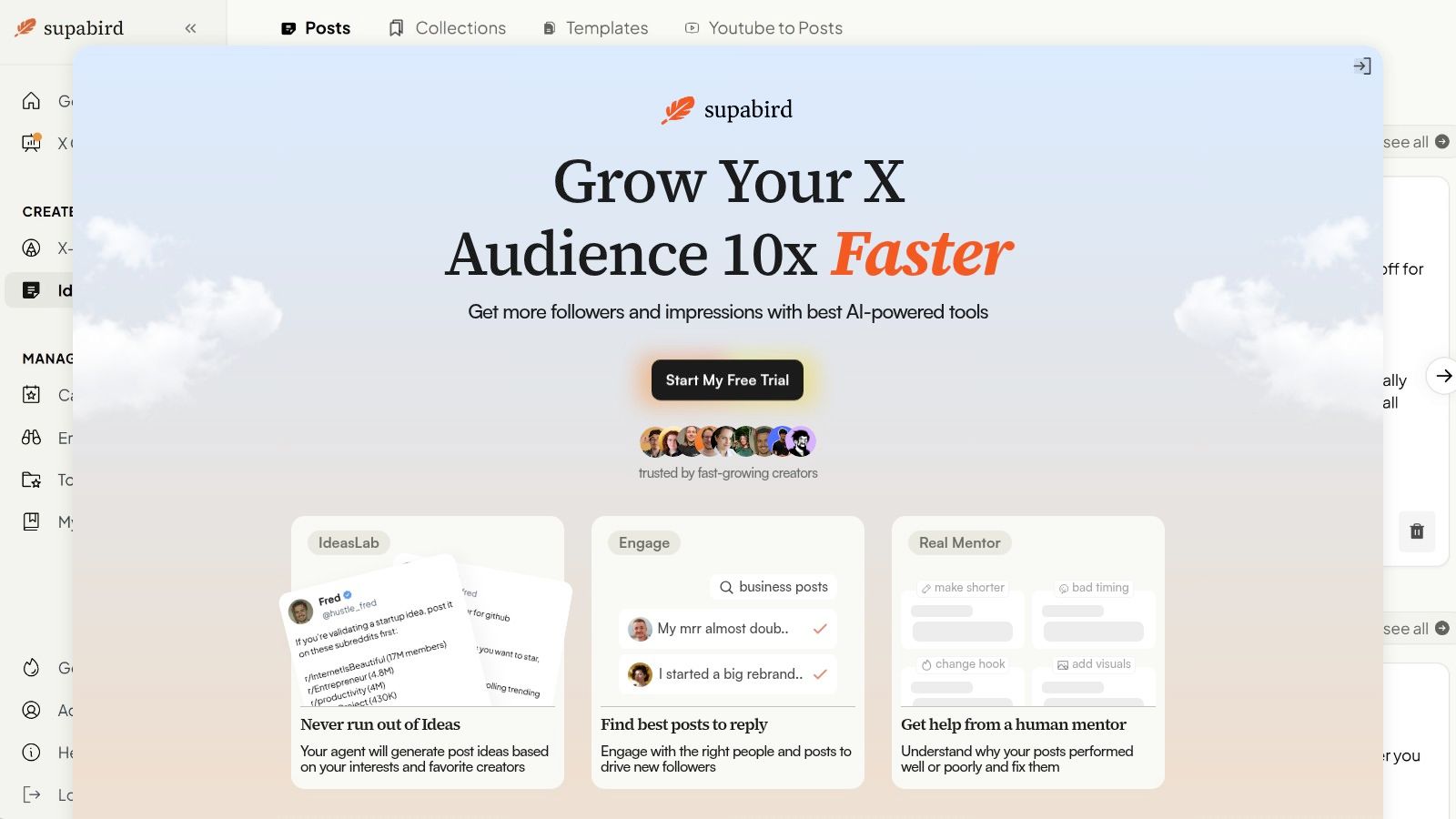
Tools help when they reduce sorting time. SupaBird's Ideas Lab is useful here because it analyzes selected creators and turns those patterns into topic suggestions. That can save hours each week if you use it as a research assistant, not a copying machine.
Draft faster without flattening your voice
The quality of the draft depends on the quality of the input. A lazy prompt gets a lazy post.
“Write a viral tweet about sales” will give you generic output because the instruction has no point of view, no audience, and no constraint. A better workflow starts with a rough observation and adds context: who this is for, what the takeaway is, what format you want, and what action the post should drive. If you want to sharpen that skill, this guide on optimizing social media AI prompts is a useful reference.
The human step matters here. AI can give you speed, options, and structure. It cannot decide which opinion is worth attaching to your name.
A practical prompt might include:
Source idea: “Founders over-explain product features and under-explain outcomes”
Audience: SaaS founders and early-stage marketers
Format: one short post plus a 5-post thread
Tone: direct, specific, slightly contrarian
Goal: drive replies from operators with the same problem
That gives the model enough structure to produce something workable. Then edit hard. Cut filler. Add specificity. Replace generic claims with details from your own experience. If the draft sounds like it could come from any account in the niche, it is still a draft.
A dedicated writing tool can speed up that revision pass. The SupaBird X-GPT workflow for better X posts is a good example because it reshapes rough notes into X-native formats instead of bloated marketing copy.
Before anything gets scheduled, run a simple review:
Does the first line earn attention fast?
Is there one clear takeaway?
Would a follower recognize the voice as yours?
Is the CTA specific enough to deserve a response or click?
A short demo helps make the workflow tangible:
Schedule for consistency, not autopilot
Scheduling helps with output. It does not remove the need for editorial judgment.
Many creators run into trouble. They build a two-week queue, feel productive, and then miss the posts they should have written live. On X, that trade-off matters. A polished scheduled post can underperform if the conversation shifted overnight.
The better setup is a mixed calendar. Use automation for the baseline. Leave space for manual posts that respond to launches, breaking industry news, customer sentiment, or a thread that opened up a fresh angle.
A workable cadence usually includes:
Evergreen posts: durable lessons, frameworks, and opinion pieces
Timely posts: reactions to current events in your market
Conversation posts: prompts designed to surface audience language and objections
Conversion posts: product education, offers, waitlist pushes, or demo CTAs
One quick test catches weak scheduled content. Read the post and ask: could this have been published on almost any day this quarter? If yes, it probably needs more context, sharper proof, or better timing.
The goal is simple. Automate the repetitive parts of content production so you can spend more attention on the parts followers notice: judgment, taste, timing, and voice.
Automate Engagement Discovery and Analytics Safely
A lot of creators say they want to automate engagement. Usually they mean they're tired of digging through X to find the right conversations.
That's a real problem. It just has the wrong solution.
The better move is to automate engagement discovery, not engagement execution. Work Brighter makes that distinction clearly in its human social media automation guidance, arguing that the effective approach is to use automation to find who to engage with, then reply manually to maintain quality and relevance.
Automate finding the conversation
Manual engagement discovery wastes energy because most of the timeline isn't actionable. A creator needs a shorter list of posts where their reply could add value.
That usually means filtering for:
Relevant accounts: Customers, peers, industry operators, journalists, and adjacent creators.
Fresh posts with traction: Enough activity to matter, but not so much that replies disappear instantly.
Topics tied to expertise: Areas where the creator can contribute insight, not just agreement.
Intent signals: Questions, confusion, requests for recommendations, and visible pain points.
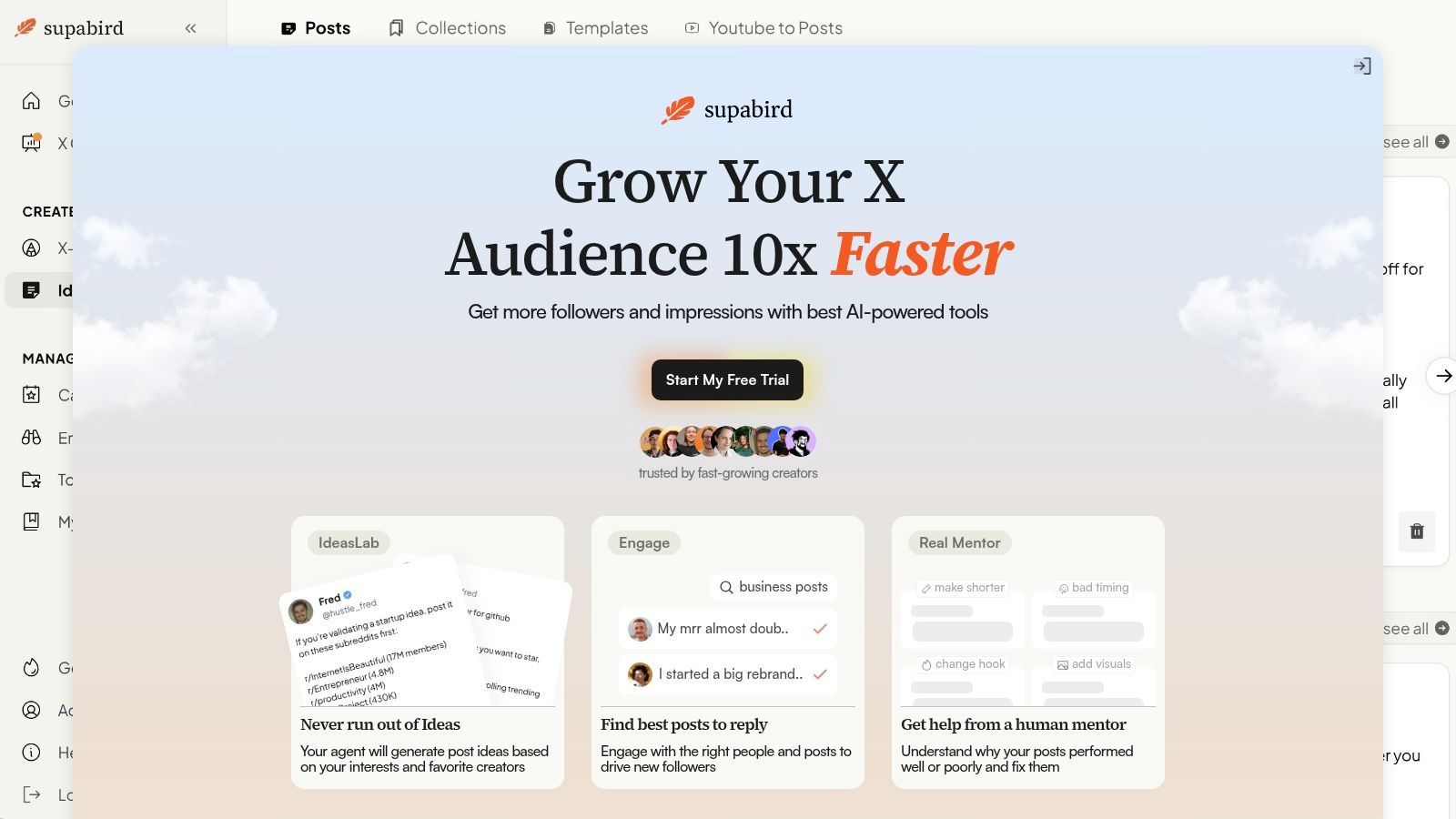
A tool-driven workflow can monitor those signals and surface a shortlist. The reply should still be manual. That's where nuance lives. The creator decides whether to educate, challenge, agree, or stay out of the thread completely.
One example is the SupaBird Engage workflow for finding and replying to the right X posts faster, which focuses on surfacing posts worth responding to rather than automating the response itself.
A simple human-in-the-loop check helps keep quality high:
Before replying | Question to ask |
|---|---|
Relevance | Does this thread match the account's niche and audience? |
Originality | Is the reply adding a perspective, not just repeating the obvious? |
Tone | Would this sound credible if a prospect clicked through the profile right now? |
Automate reporting with clean inputs
Analytics are another place where automation helps, but only when the data is trustworthy.
Automated reports should summarize which hooks, topics, and formats pulled quality traffic or conversions. They should also flag underperforming patterns before those patterns become habit. If reporting inputs are messy, the output becomes persuasive nonsense. UTMs are inconsistent, campaign names drift, and dashboards stop being usable.
That's where process discipline matters. Teams building more reliable measurement pipelines can borrow principles from this guide to robust data governance, especially around naming consistency, event quality, and preventing silent data errors.
Useful automated reporting on X should answer a few plain questions:
Which post angles earned qualified clicks?
Which reply patterns led to profile visits or direct inquiries?
Which content themes attracted the wrong audience?
Which scheduled slots consistently underperform and need revision?
The value of automation here isn't that it creates insight by itself. It organizes the evidence fast enough that the creator can make better calls while the signal is still fresh.
Measure Your Impact and Avoid Common Pitfalls
The final test of social media marketing automation is simple. Does the system produce outcomes that matter, without damaging voice, trust, or judgment?
A clean measurement stack usually works across three layers. First comes the platform layer, where the account tracks reach, engagement, profile visits, and link clicks. Then comes the behavior layer, where the creator looks at qualified traffic, form starts, trial intent, or other meaningful on-site actions. The last layer is the business result, where the account ties content and engagement to conversions, sales conversations, or pipeline movement.
Track the right layer of results
A simple dashboard should separate signal from noise.
Content efficiency: Which formats consistently earn attention worth keeping.
Traffic quality: Which posts attract people who move deeper into the funnel.
Conversion impact: Which topics and CTAs influence business outcomes.
Operational health: Whether the workflow still matches current priorities.
High-performing programs don't treat automation as a one-time setup. The strongest systems preserve consistency without removing human judgment, and they monitor performance continuously instead of running on autopilot, as noted in Gumloop's earlier-cited guidance.
Watch for the failure modes
Most automation problems show up in recognizable patterns.
First, creators start posting on schedule but stop reviewing outcomes. Second, the tone gets flatter because drafts aren't edited hard enough. Third, engagement becomes over-automated and starts sounding transactional. Fourth, reporting celebrates surface metrics while qualified actions stay weak.
A social account can look busy and still be strategically idle.
The fix is usually operational, not philosophical. Review the queue. Check whether the scheduled content still matches what the audience cares about. Audit replies for tone drift. Remove automations that save little time but create visible quality loss. Tighten the connection between posting data and business outcomes.
A strong system should feel lighter to run and sharper in output. If it feels easier but sounds worse, the wrong things got automated.
SupaBird fits this category as an AI-powered X workflow tool for idea generation, drafting, engagement discovery, and scheduling. For creators and teams that want a focused system for X instead of a generic cross-platform scheduler, it's worth reviewing how the platform handles research, writing support, and conversation discovery in one place at SupaBird.

Digital Product Launch Strategy

Best Twitter Growth Service for Creators in 2026
From X to Every Platform: Repurpose Without Flopping

How to Get Cited by Grok: Winning X’s AI Search in 2026

5 X (Twitter) Growth Metrics Every Serious Creator Should Track — and How to Get the Data
Best Twitter (X) Scheduling Tools in 2026

Best X (Twitter) Growth Tools in 2026

Twitter Growth Hacking Tips 2026
How to Get More Followers on X (Twitter) in 2026
