Twitter Copywriting Playbook: Hooks, Threads, and Viral
Author:

“Write shorter” is the most repeated advice in Twitter copywriting, and it's also the advice most likely to produce forgettable posts. Brevity matters, but the right length depends on the job your post must do. A one-line opinion can earn reach, while a structured explanation may create profile visits, replies, DMs, clicks, or sales.
X has also moved far beyond its original compression constraint. Tweets launched in 2006 with a 140-character limit, partly because the service needed to leave room for usernames in SMS-style delivery. Jack Dorsey's first tweet, “just setting up my twttr,” used only 24 characters. The platform expanded to 280 characters in November 2017, then introduced paid-user limits of 4,000, 10,000, and 25,000 characters in 2023, while free accounts stayed at 280 characters. Those changes created more room for context, but they didn't remove the need for sharp thinking. Twitter's character-limit history shows why modern Twitter copywriting now spans compressed hooks, substantial single posts, and long-form structures.
This playbook treats every post as a small funnel asset. You'll learn how to choose hooks, formats, CTAs, editing rules, timing tests, and weekly workflows based on the outcome you want, not on a universal word-count superstition.
Table of Contents
Why Most Twitter Copywriting Advice Fails in 2026
“Just write shorter” sounds practical because short posts are easy to consume. The problem is that shortness is a format decision, not a strategy. A reach post needs immediate tension. A reply post needs a question people can answer. A DM post needs a clear exchange. A sales post needs enough context to make the offer believable.
The platform's economics make this distinction more important. Recent 2026 reporting places average brand engagement on X/Twitter at 0.035% per post, an extremely low absolute baseline that makes every word earn its place. The same reporting estimates roughly 104–108 million users in the United States, 69–71 million in Japan, and 24–25 million in India, while Nigeria leads monthly X usage as a share of internet users at 80.7%, followed by Saudi Arabia at 66.7%, Kenya at 60.0%, and Turkey at 58.7%. These markets and usage patterns create a crowded, uneven environment where generic copy disappears quickly. The 2026 X/Twitter statistics report provides the broader context.

Replace word-count rules with an objective
Start every draft by completing this sentence:
“This post exists to make the reader…”
Choose one outcome:
Notice me, for reach.
Answer me, for replies.
Message me, for DMs.
Visit something, for clicks.
Buy or book, for sales.
Then choose the structure that naturally creates that behavior. A provocative one-liner can invite reposts, but it usually won't explain a complex product. A detailed tutorial can generate trust, but it may be too slow for a cold audience.
The useful Twitter copywriting system is therefore objective, format, hook, body, CTA, measurement. The rest of this guide turns that sequence into practical decisions and templates.
Hook Formulas That Stop the Scroll
A hook earns the next second. It doesn't need to sound theatrical, but it must make the reader understand why the post deserves attention. Strong hooks usually combine a clear benefit, a relevant problem, a concrete detail, or a tension the body will resolve.
Use these seven patterns as a rotation system rather than forcing every idea into the same “controversial opinion” mold. For additional hook structures, this guide to writing hooks is a useful reference.
Seven patterns worth rotating
Contrarian take, best for reach and reposts.
Weak: “Consistency is important on X.”
Strong: “Posting every day won't fix unclear positioning. It'll just spread the confusion.”Curiosity gap, best for threads and educational posts.
Weak: “Here are some lessons from my launch.”
Strong: “The launch didn't fail because the offer was weak. It failed at the first sentence.”Specificity anchor, best for credibility-building content.
Weak: “I learned a lot from writing online.”
Strong: “After reviewing hundreds of founder posts, I found one editing mistake that keeps repeating.”Pain agitator, best for audiences already aware of a problem.
Weak: “Your content may need improvement.”
Strong: “You're not short on ideas. You're publishing drafts that make readers work too hard.”Social proof opener, best for authority and conversion.
Weak: “Many creators use this process.”
Strong: “Founders keep asking for the same rewrite: fewer claims, more evidence.”Bold prediction, best for discussion and quote posts.
Weak: “Social media will change.”
Strong: “The next advantage on X won't be posting more. It'll be sounding less interchangeable.”Story tease, best for personal lessons and narrative threads.
Weak: “I made a mistake with my content.”
Strong: “I nearly deleted the post that later became my clearest positioning lesson.”
The strongest version isn't always the most provocative. A hook that attracts the wrong audience can increase attention while weakening conversion. Match the promise in the opening to the reader you want later.
Hook Formula Reference Sheet
Hook Pattern | Best For | Example | Ideal Format |
|---|---|---|---|
Contrarian Take | Reach | “Shorter isn't always clearer.” | Short post |
Curiosity Gap | Education | “The missing step appears after the obvious advice.” | Thread |
Specificity Anchor | Credibility | “Three post types solve three different funnel problems.” | Long post |
Pain Agitator | Problem awareness | “Your CTA may be asking for trust too early.” | Long post |
Social Proof Opener | Authority | “The same objection keeps appearing in sales calls.” | Long post |
Bold Prediction | Conversation | “Generic hooks will become easier to ignore.” | Short post |
Story Tease | Connection | “The rewrite worked after I removed the clever line.” | Thread |
Avoid repeating one formula until your audience can predict the next sentence. Rotate the pattern, change the emotional entry point, and keep the underlying idea specific.
Choosing Between Short Posts, Long Posts, and Threads
The right format depends on how much reasoning the reader must complete before taking action. Short posts create fast recognition. Long posts carry nuance. Threads guide someone through a sequence.
A short post works well for a hot take, a relatable observation, a sharp lesson, or a question designed to trigger replies. The free-account limit remains 280 characters, and benchmark data reports that posts under 100 characters received 17% higher engagement on average than longer posts, with 71–100 characters cited as a recommended organic range. Hootsuite's social post length benchmark supports testing compressed ideas when speed and quick engagement matter.
That doesn't make every post short. A large analysis of 1 million tweets found that image posts performed best at 20–40 characters, while text-only posts performed best at 120–140 characters. The analysis also found that 20–40-character image posts earned about 60% more engagement per follower than 60–80-character image posts, but it cautioned against treating the result as a universal rule. Buffer's analysis of 1 million tweets points toward separate testing by format.
Let the objective choose the structure
Long posts are useful when the reader needs an argument, story, teardown, or explanation. Independent format research reported that posts in the 230–280-character range earned about 1.4× the engagement of shorter posts at similar content quality. The practical interpretation is simple: use available space when context improves the idea, not when padding fills an empty draft. The X content-format research supports that distinction.
Threads fit tutorials, frameworks, teardowns, and step-by-step processes. They create more surface area for saves, profile visits, clicks, and DMs, but they also demand stronger pacing. Each post must advance the argument, and the opening post must make the sequence feel worth following. A Twitter thread template can help you structure the progression before you write every individual post.
Format | Character Range | Best Objective | Reply Signal | Best Content Type |
|---|---|---|---|---|
Short post | Under 280 | Reach or replies | Direct conversation | Hot takes and observations |
Long post | 280–1,500 | Trust and profile visits | Nuanced discussion | Stories and arguments |
Thread | 3–12 posts | Clicks and DMs | Multi-step interaction | Tutorials and teardowns |
A useful workflow is to draft the idea in its fullest form, identify the single sentence that carries the promise, then decide whether the reader needs the rest. If the answer is no, publish the short version. If the answer is yes, use a long post or thread. A Twitter post generator can help produce initial variations, but you still need to choose the format based on the intended behavior.
Matching Your CTA to the Funnel Stage
The same idea can attract attention or convert a buyer depending on the final instruction. “Link in bio” is not a universal CTA. It asks a cold reader to leave the feed before you've given them a reason, and it often competes with the post's actual purpose.
Use the core idea, “I grew my newsletter,” and change only the outcome:
Reach: “Most newsletters don't need more subscribers. They need a sharper promise. Agree or disagree?”
Replies: “What's the hardest part of growing yours, acquisition, consistency, or conversion?”
DMs: “DM me GROWTH and I'll send the checklist I use to diagnose newsletter leaks.”
Clicks: “The full breakdown covers the three acquisition loops that made the difference. Read it here: [link].”
Sales: “If you want the same system implemented for your newsletter, applications are open for the next advisory cycle.”
Each CTA gives the reader a different action and sets a different expectation. A reply CTA creates public conversation. A DM CTA creates a private exchange. A click CTA transfers attention to another asset. A sales CTA asks for commitment and therefore needs stronger proof, fit, and clarity.
CTA-to-Funnel-Stage Decision Matrix
Funnel Stage | CTA Structure | Example Wording | Algorithm Signal |
|---|---|---|---|
Reach | Opinion plus invitation to share | “Repost this if your audience needs the reminder.” | Reposts and quote posts |
Replies | Specific question | “Which part breaks first in your workflow?” | Replies |
DMs | Keyword plus promised asset | “DM me AUDIT for the template.” | Direct messages |
Clicks | Curiosity plus destination | “The full teardown is in the guide.” | Link clicks |
Sales | Fit, outcome, and next step | “Book a call if this problem is costing you attention.” | Qualified actions |
Do not stack five CTAs onto one post. One post should have one job, and the wording should make that job obvious. You can reuse the same insight across the funnel, but rewrite the ending so the action matches the reader's level of intent.
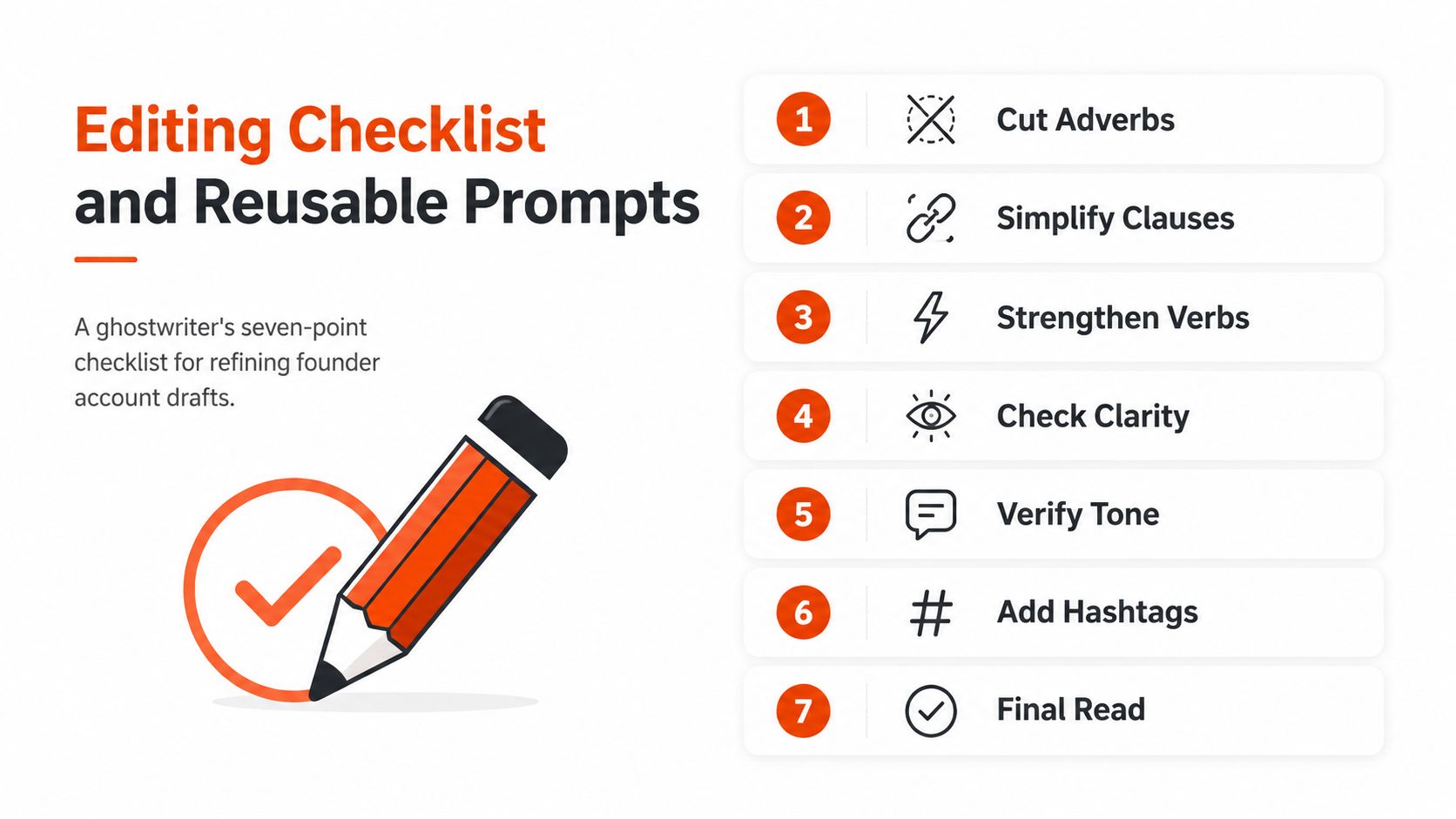
Editing Checklist and Reusable Prompts
Raw drafts usually fail through accumulation. A weak verb sits beside a filler clause, then an abstract claim, then a CTA that asks for too much. Editing turns a technically correct post into something a distracted reader can process quickly.
The seven-point pass
Cut adverbs.
“This strategy is extremely effective” becomes “This strategy works when the audience already understands the problem.”Front-load tension.
“After testing several approaches, I learned…” becomes “The obvious approach failed.”Replace passive voice.
“The draft was edited by the team” becomes “The team edited the draft.”Compress prepositional chains.
“A system for the improvement of the quality of your posts” becomes “A system for improving post quality.”Make the hook stand alone.
“Some thoughts about content” becomes “Your content problem may be structural, not creative.”Give each line one idea.
Separate the claim, explanation, and example so the reader can scan the logic.Stress-test the CTA.
Replace “Check it out and let me know what you think” with “Reply with your biggest objection.”
Read the final draft aloud. If you stumble, the reader probably will too. The best editing pass often removes a clever phrase that delays the actual point.
Prompts you can paste into an LLM
Use these prompts to create ranked alternatives, not to outsource judgment:
Hook sharpening: “Rewrite this opening into three versions using a contrarian, specificity, and pain-based hook. Rank them by clarity. Keep the factual meaning unchanged.”
Thread pacing: “Turn this draft into a connected thread. Give each post one job, preserve the logical order, and add a clear transition without inventing evidence.”
CTA alignment: “Identify the funnel stage this post currently serves. Rewrite the final two lines for reach, replies, DMs, clicks, and sales.”
Voice matching: “Study the supplied examples for sentence length, vocabulary, rhythm, and directness. Rewrite my draft in those stylistic traits without copying phrases.”
Compression: “Compress this idea into three single-post versions. Keep the strongest claim, remove filler, and flag any statement that needs proof.”
A reusable template library can reduce repetitive setup work. This guide on using templates for faster content creation is relevant when several people need to maintain a consistent publishing process.
Timing, Engagement Tactics, and Metrics That Matter
Good copy can still underperform when it reaches the audience at the wrong moment. Timing isn't a substitute for relevance, but it changes the number of people who get a chance to respond.
A large analysis of 8.7 million X posts found the strongest engagement cluster in mid-morning on weekdays. Tuesday at 9 a.m. ranked as the single strongest posting time, with Wednesday at 9–10 a.m. close behind. FrameOS Studio's analysis of X posting times recommends testing nearby 9–11 a.m. windows from Tuesday through Thursday.
Another 2026 study summarized by Sprout Social found stronger engagement from 12–6 p.m. on Tuesdays, Wednesdays, and Thursdays, while Saturday was the weakest day. This timing comparison shows why local audience routines matter more than blindly following one global schedule.

Use the first conversation window
Don't post and disappear. Stay available after publishing so you can answer early replies, clarify the argument, and add useful detail. If the post earns a thoughtful response, quote it with a new insight rather than repeating the original claim.
Track outcomes according to the CTA:
Reach: impressions, reposts, and quote posts.
Conversation: replies and reply-to-impression ratio.
Intent: profile visits, DMs, and follows from relevant readers.
Conversion: link clicks, booked calls, or purchases.
High impressions with weak clicks usually indicate a mismatch between the promise and the destination. Strong replies with weak profile movement may point to positioning or profile friction. Low impressions with strong engagement from the people who do see the post often suggests a distribution or timing problem, not necessarily a copy problem.
For a focused measurement framework, use this guide to track X growth metrics and retrieve the data.
Don't optimize around one universal character target. One large study found that longer posts can increase likes when limits expand, while another comparative analysis concluded that length is a trivial feature for like and quote behavior. The Management Science study on microblogging length reinforces the practical rule: clarity, substance, and action fit matter more than chasing a number.
A Simple Weekly Workflow for Consistent Growth
Consistency becomes easier when you separate thinking from publishing. Start the week by choosing one funnel bottleneck, then make the content serve that bottleneck instead of asking every post to generate awareness, discussion, leads, and revenue at once.
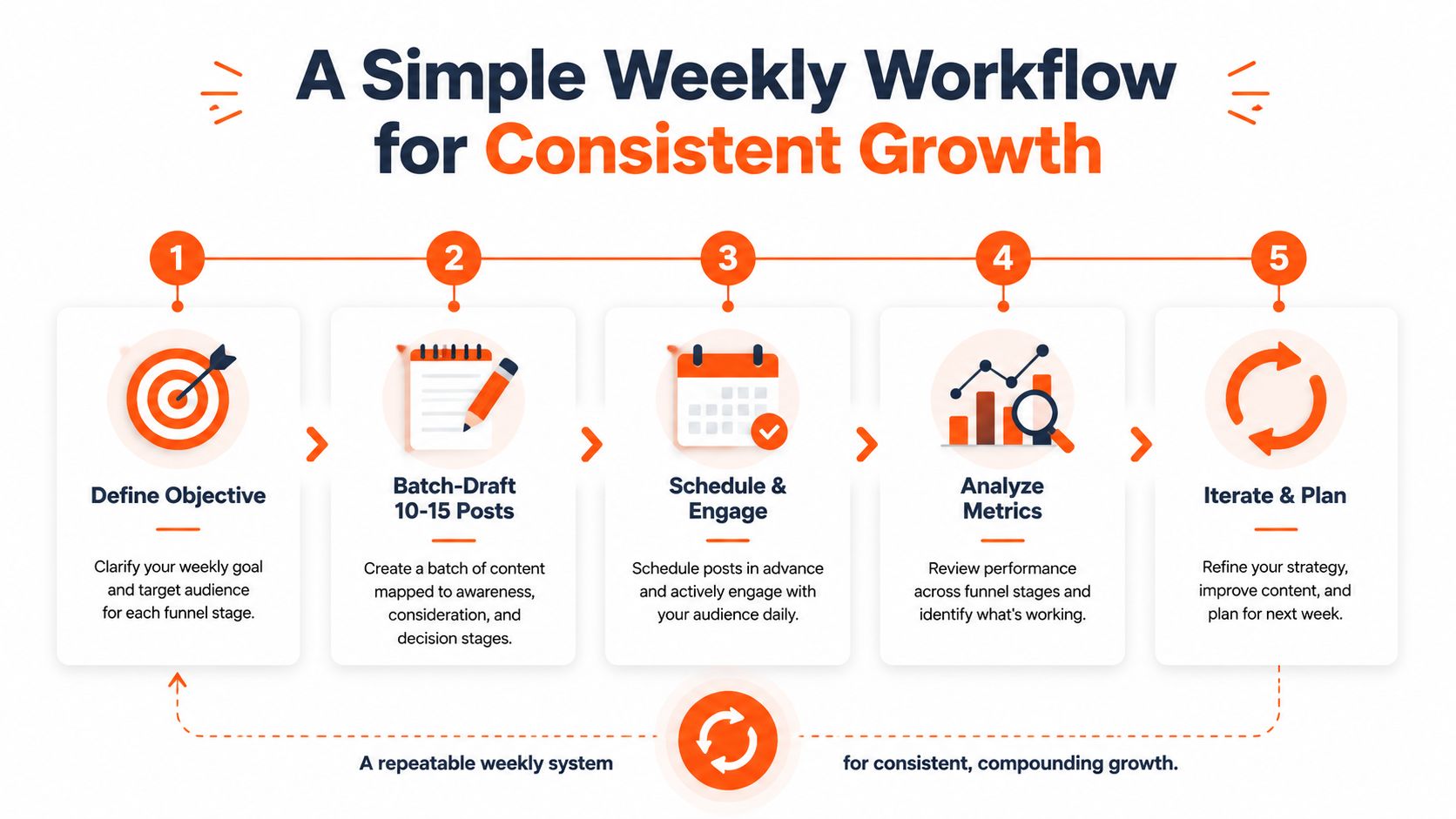
A practical Monday-to-Friday cycle looks like this:
Monday, define and research: Choose the week's objective, collect audience language, and note recurring objections.
Tuesday, batch draft: Write 10–15 posts using different hook patterns and at least two formats.
Wednesday and Thursday, publish and engage: Schedule posts in tested windows, then stay present for replies and follow-up conversations.
Friday, review and archive: Compare impressions, reply rate, profile clicks, and DMs. Save winning structures in a swipe file and rewrite weak posts instead of merely reposting them.
Three habits damage otherwise solid accounts:
Publishing without a CTA, which leaves interested readers without a next step.
Ignoring replies during the opening conversation window, which wastes the chance to develop the idea publicly.
Repeating the same hook pattern, which trains regular readers to scroll past familiar packaging.
A tool can support the routine, but it shouldn't replace editorial judgment. If you're formalizing the process, this resource on how to build a content creation system offers useful workflow context.
At the end of each week, ask four questions: Did the intended audience see the posts? Did readers take the intended action? Which format produced the strongest signal? What should change in the next batch? That scorecard turns Twitter copywriting from a collection of hopeful drafts into an operating system.
SupaBird helps creators, founders, and marketers turn ideas into stronger X posts and threads, surface relevant conversations to engage with, and schedule content across audience time zones. Visit SupaBird to test an AI-assisted workflow that combines post refinement, planning, and practical coaching for your next publishing cycle.

The Reply Guy Strategy: A Growth Guide for X

Why New X Accounts Get Less Reach

ClimbX Review (2026): Features, Pricing, Pros and Cons

How Developer Startups Build a Brand on X Before Launch

30-Day Starting Plan for New X (Twitter) Accounts

How Often Should You Tweet for Maximum Growth?

What Should Your First 10 Tweets Be About?

How to Run X for Ten Clients: The Agency Workflow

How to write a bio that gets people to follow you
