Follower Growth Rate: The Ultimate 2026 Guide for X
Author:

Most advice about X still points creators in the wrong direction. It tells them to chase bigger follower counts, post more, and hope that reach turns into audience. That's backwards. A large follower number is a snapshot. Follower growth rate is the signal that tells whether an account is building momentum with the right people.
A creator with a smaller account that's adding relevant followers consistently is usually in a healthier position than a larger account that has stalled, attracts low-fit followers, or loses attention as fast as it gains it. On X, quality and velocity matter more than vanity. The key question isn't “How many followers are there?” It's “How quickly is the right audience choosing to stick around?”
Table of Contents
From Follower Count to Follower Velocity
Big follower totals get overvalued on X. They look credible in screenshots and media kits, but they hide the question that is key. Is the account gaining the right followers fast enough to create momentum?
Follower velocity is the better operating metric because it combines pace with fit. A jump from 5,000 to 5,500 followers means very different things depending on how quickly it happened, where those followers came from, and whether they engage with the account after they arrive. That is why I treat raw count as context and growth rate as the signal.
Quality matters more than vanity. An account can spike from low-intent traffic, giveaways, or poorly targeted paid pushes and still get weaker. Engagement rate drops. Topic signals get noisier. Future tests become harder to read because the audience is less aligned. A smaller account adding niche-relevant followers every week is often in a stronger position than a larger account with erratic, low-quality growth.
Practical rule: A follower is useful growth when that person is likely to read, reply, repost, click, buy, refer, or strengthen the account's relevance in its niche.
This matters on X because broad platform growth is no longer a reliable tailwind. Backlinko's X user analysis reports about 388 million monthly active users in Q2 2025, alongside a year-over-year decline in the platform's total user base. That changes the playbook. Bigger accounts do not win by default. Better targeting, stronger positioning, and higher follow conversion matter more.
The same discipline shows up on other platforms too. Teams that measure Instagram account performance already track growth rate, reach, and engagement together because total audience size alone does a poor job explaining channel health. X works the same way. If you are only watching followers, you are ignoring the inputs that create follower growth velocity, especially profile conversion and the relationship between reach and follows. A quick review of what impressions on social media actually tell you makes that clear. Attention without follow-through is just traffic.
For founders, operators, and creators, follower velocity gives a cleaner read on whether the account is building real momentum or just looking bigger from a distance.
What Follower Growth Rate Actually Measures
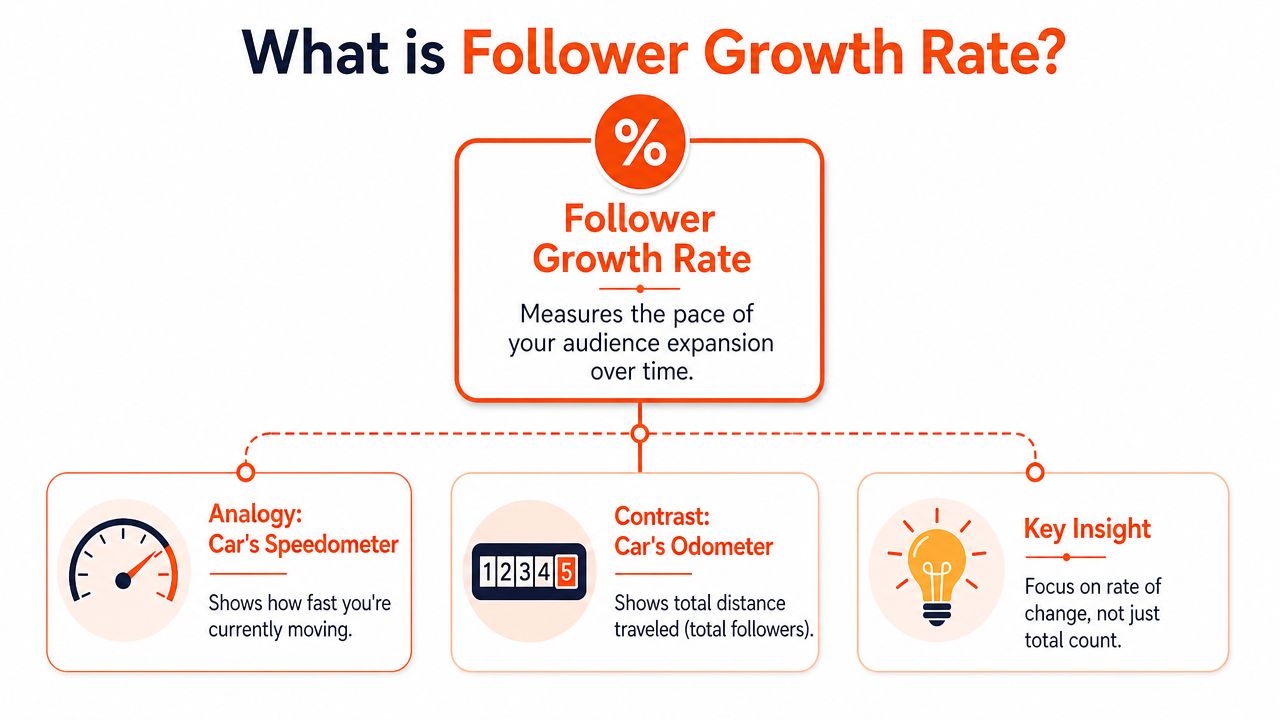
Follower growth rate measures the pace of audience expansion over a defined period. It doesn't care how large the account looks in absolute terms. It measures whether the account is gaining momentum.
Why this metric matters earlier than follower count
The cleanest way to think about it is this. Total followers are like a car's odometer. They show the total distance traveled. Follower growth rate is the speedometer. It shows how fast the account is moving right now.
That's why this metric is more useful for decision-making. According to Operately's KPI example for follower growth rate, the metric serves as a leading indicator of brand popularity and social media strategy effectiveness, while total follower count is a lagging metric. The same source notes that in fast-moving creator environments, a rate below 2% often signals content stagnation or misalignment with audience interests.
That's a sharp diagnostic tool. If growth slows, the account doesn't need more patience. It usually needs a better hook, clearer positioning, stronger visuals, or more relevant conversations.
A good cross-platform habit is to compare this metric with other performance measures instead of treating it in isolation. Teams that already measure Instagram account performance will recognize the pattern. The healthiest accounts track momentum, engagement quality, and content contribution together.
The simplest way to think about it
Follower growth rate answers three practical questions:
Is content converting attention into audience? Impressions without follow conversion usually mean the content is interesting but not identity-building.
Is the account attracting the right people? Fast growth from the wrong niche often weakens later engagement.
Is momentum improving or decaying? A flat growth rate usually appears before a creator feels the plateau emotionally.
For X specifically, impressions still matter because they create the top of the funnel. A creator who wants a cleaner definition of that layer can review what social media impressions mean. But impressions alone don't validate the strategy. Growth rate does, because it reflects actual audience conversion.
Growth rate is where visibility becomes commitment.
That's why serious X operators watch rate, not just count. Count flatters the ego. Rate guides the next move.
How to Calculate Your Growth Rate and Set Benchmarks
Follower count is easy to screenshot. Growth rate is what helps you make decisions.
The formula and a simple example
Use a fixed time window and keep it consistent. Weekly if you are testing aggressively. Monthly if you want a cleaner benchmark with less noise.
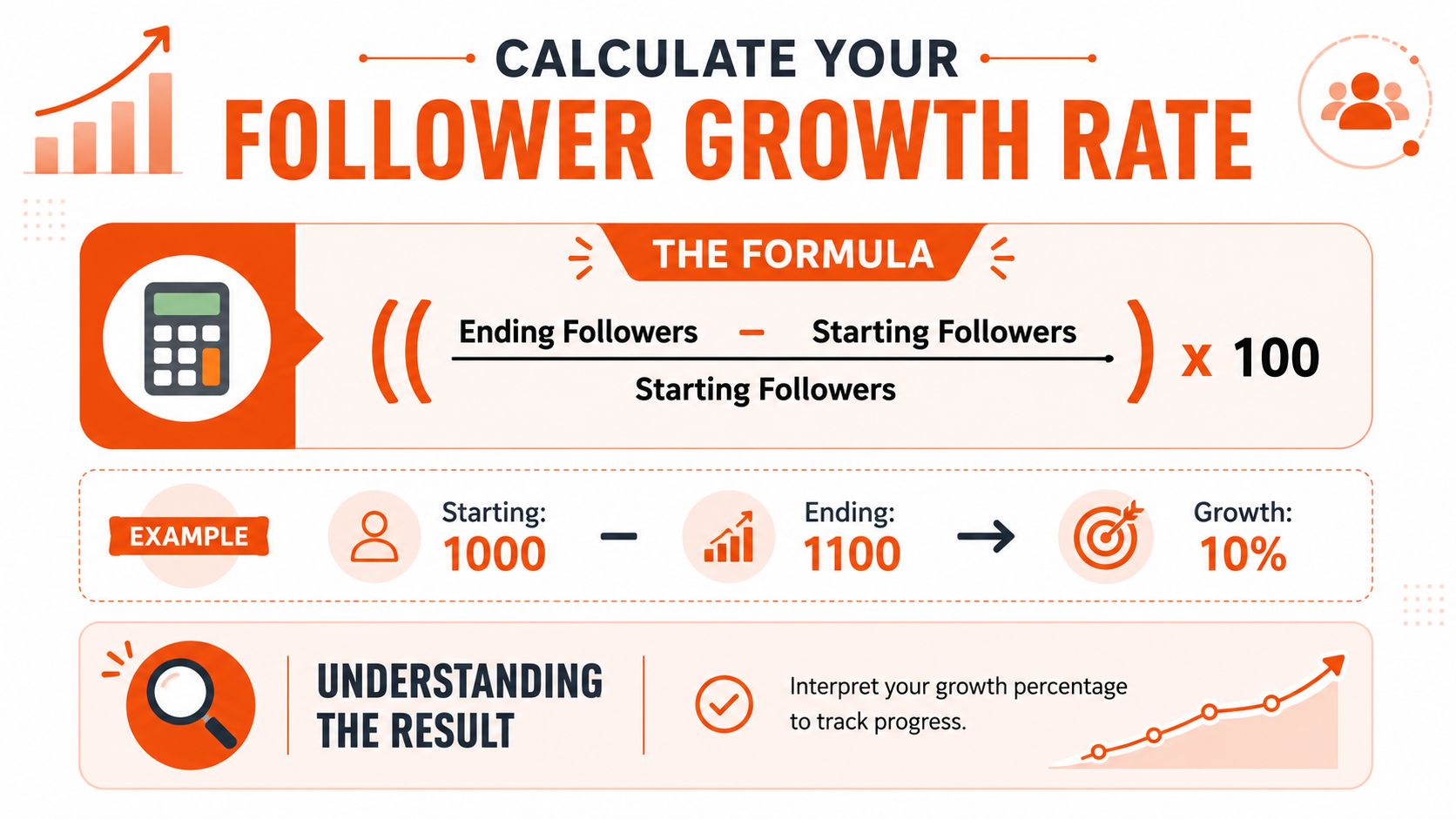
The standard formula is documented in Umbrex's social media follower growth rate analysis: Growth Rate (%) = ((Ending Follower Count - Starting Follower Count) / Starting Follower Count) × 100. Umbrex also notes that 2% to 3% monthly growth is average, 5% or higher is strong, and top ecommerce brands often target 6% to 8% monthly growth.
Here is the basic calculation:
Starting followers | Ending followers | Change | Growth rate |
|---|---|---|---|
1000 | 1100 | 100 | 10% |
The math is simple. The interpretation is where operators usually get sloppy.
A 10% jump on a small account can come from one breakout post, a giveaway, or a short-term spike in the wrong audience. A 3% month on a larger account can be healthier if those followers came from niche-relevant posts, profile visits, and repeat engagement. Velocity matters, but follower fit matters too.
For operators who already work from broader reporting systems, it helps to think about this the same way they'd use a guide to measuring SEO for businesses. Metrics become useful when they are measured on a fixed cadence and tied to action.
How to set benchmarks that actually help
Benchmarks should match account stage, content cadence, and audience quality goals.
A newer X account can post a high monthly rate because the base is small. An established account usually grows more slowly in percentage terms, but with stronger absolute gains. That is why I prefer two benchmark layers: one for percentage growth and one for follower quality. If growth rises while engagement per new post falls, the account is often attracting broad interest instead of the right readers, buyers, or peers.
Use this framework:
Below average range
The account has a conversion problem. Content may earn reach but fail to create enough identity, trust, or curiosity to earn the follow.Average range
The account is growing, but not with much force. This is usually a packaging, positioning, or distribution issue.Strong range
The system is working. Posts are attracting attention and the profile is converting that attention into relevant followers.Top-tier range
The account has content-market fit and repeatable distribution. At this level, the goal is protecting quality while keeping velocity high.
Track this over full months, then review weekly inputs inside that month. Daily follower swings distort judgment. Clean windows make trend changes easier to spot.
To keep the review practical, pair growth rate with post and profile analytics in one dashboard. Tools built for Twitter analytics workflows make it easier to connect follower velocity to specific posts, reply strategy, and campaign timing.
Tracking Growth Sources Organic vs Paid
Not all followers arrive the same way, and they rarely behave the same after they arrive. A follower gained from a high-signal reply often has different intent than a follower gained from an ad, a thread, or a profile visit after someone else quoted a post.
That's why source tracking matters. Without it, an account can look healthy while growth quality is slipping.
What to track every time
The cleanest tracking rule is simple. Use exact time windows and compare like with like. According to Sociality's guidance on competitor growth rate tracking, creators should use fixed windows such as 7 days or 30 days, and for platforms with churn, the more precise method is (New followers − Lost followers) ÷ Total followers × 100.
That matters on X because churn is real. Some followers leave after a controversial post. Others were never a fit in the first place. If the account tracks only gross additions, the strategy can look stronger than it is.
A tight weekly review should log:
Organic post spikes from original posts, threads, visuals, or quote posts
Engagement spikes from replies on larger accounts or conversations in the niche
Paid spikes tied to ad windows or collaboration pushes
Net change so follower loss doesn't disappear in the reporting
How to separate source quality
The practical method is correlation, not guesswork. If follower growth jumps after a thread, note the post format and topic. If a spike appears during an ad run, compare retention and engagement from those new followers over the next reporting window.
This is also where service selection matters. Some creators chase shortcuts and end up buying noise instead of audience fit. Anyone evaluating outside help should understand the difference between automation, targeting, and junk acquisition before using a Twitter growth service comparison.
The best growth source isn't the one that adds the most followers fastest. It's the one that produces followers who keep interacting after the first touchpoint.
That one distinction saves a lot of wasted effort.
Proven Tactics to Accelerate Your Growth Rate
The fastest way to stall on X is to do what most creators do. Post into the void, use broad hashtags, follow random accounts, and hope consistency alone will carry the account. It won't. Growth rate improves when distribution and audience fit get sharper.

Precision engagement beats broad activity
Replying is still one of the most effective moves on X, but most creators waste it by reacting to random posts that attract the wrong crowd. Precision engagement means entering conversations where the audience overlap is already strong.
A practical workflow looks like this:
Identify accounts that already attract the ideal audience.
Watch for posts that are gaining traction, not just posts from large accounts.
Add a reply that is specific, useful, and identity-reinforcing.
Check whether profile visits and follower additions rise after those replies.
The point isn't to be visible everywhere. The point is to be visible in the right rooms.
There's supporting evidence behind this broader idea of engagement-led growth. Alexander Jarvis's follower growth rate analysis notes that posting during peak audience activity windows can increase engagement by 10% to 15%, while targeted social advertising can increase new follower acquisition by 25% and influencer collaborations can accelerate overall growth by 30% within a single month. The mechanism is straightforward. Higher-engagement posts tend to correlate with follower growth spikes.
Strategic following only works when targeting is tight
Following strategies get dismissed due to widespread poor execution. Random following is noisy and usually low return. Precision following is different.
Data from Block AI research reviewing over 10,000 accounts found that accounts using AI-targeted, follower-based following strategies achieved follow-back rates between 14% and 22%, compared with 2% to 5% for untargeted campaigns. The same research found that competitor audience cloning produced 10% to 18% follow-back rates, according to PortoTheme's summary of the research.
That tells a clear story. The edge doesn't come from following more people. It comes from following better people.
A repeatable approach:
Start with competitor overlap
Build a list of several accounts that already own the audience segment the creator wants.Prioritize active followers
Accounts that visibly engage are better targets than silent followers.Review profile fit first
Founders should target founders. SaaS operators should target SaaS-adjacent audiences. Broad niches dilute results.Measure follow-back quality
The useful metric isn't only who followed back. It's who engaged later.
Field test: If a following tactic inflates count but depresses engagement quality, it's not a growth tactic. It's account pollution.
A lot of the same principles show up in other creator ecosystems too. Teams working across platforms can borrow ideas from expert tips for YouTube success, especially around audience fit, packaging, and repeatable content systems.
Here's a short walkthrough that reinforces those ideas:
Format optimization lifts conversion from attention to follow
Many posts get attention and still fail to grow the account. That usually happens because the format delivers information but not identity. People may like the post and move on without seeing a reason to follow.
Format optimization fixes that. The post should make the account legible fast.
Useful formats on X include:
Threads with a clear promise
Best for teaching, breaking down systems, or packaging experience into steps.Short lists with sharp hooks
Strong for busy audiences that want instant clarity.Annotated screenshots, charts, and visual breakdowns
These help stop the scroll and communicate competence quickly.
A creator should test content pillars and packaging separately. One topic may be right while the structure is wrong. Another may have a strong format but weak audience relevance. The best operators don't guess. They test formats against follow conversion and then codify what works inside a broader social media content strategy system.
The best growth tactics all share the same trait. They increase the odds that the next impression comes from the right person, in the right context, with the right reason to follow.
A 5-Minute Audit to Fix Stagnant Growth
When growth stalls, the fix usually isn't more effort. It's better diagnosis. A quick audit can expose the friction points fast.

The profile check
Start with the profile, because every good post sends people there. If the bio is vague, the profile photo feels off-brand, or the header doesn't reinforce the niche, visitors leave without following.
Ask:
Is the account instantly clear? A stranger should understand who the account helps and what it talks about.
Does the profile promise a specific type of value? Broad positioning kills conversion.
Does the pinned post prove authority or usefulness? If not, replace it.
The content check
Then review the last batch of posts. Not for personal favorites. For evidence.
A healthy engagement rate benchmark on X is 0.5% to 1%, and falling below that range suggests the content isn't resonating, while exceeding it correlates with stronger follower growth velocity, according to SupaBird's X follower growth guide. The same source recommends prioritizing reply-based engagement and visual content such as charts and annotated screenshots.
A fast review should check:
Hooks
Do the opening lines create enough curiosity to earn the first pause?Visual support
Are screenshots, charts, or clean visuals helping the post stand out?Topic fit
Are recent posts still aligned with the audience the account wants?
If content gets some reach but weak engagement, the topic may be fine and the packaging may be weak. If it gets neither, the account may be talking to the wrong crowd.
The conversation check
Finally, check behavior outside original posts. Accounts that only broadcast often plateau because they're not participating where discovery happens.
Look at recent replies and asks:
Has the account joined relevant conversations this week?
Has it replied with substance, not filler?
Has it asked questions that invite the right audience to answer?
Stagnant growth usually traces back to one of three problems. Weak profile conversion, weak post packaging, or weak conversation presence. A creator who audits those three areas every week rarely stays stuck for long.
Creators who want a faster system for finding high-impact conversations, generating stronger post ideas, and turning rough drafts into sharper X content can try SupaBird. It's built for people who care about follower growth velocity, audience quality, and repeatable execution instead of vanity metrics alone.

The Reply Guy Strategy: A Growth Guide for X

Why New X Accounts Get Less Reach

ClimbX Review (2026): Features, Pricing, Pros and Cons

How Developer Startups Build a Brand on X Before Launch

30-Day Starting Plan for New X (Twitter) Accounts

How Often Should You Tweet for Maximum Growth?

What Should Your First 10 Tweets Be About?

How to Run X for Ten Clients: The Agency Workflow

How to write a bio that gets people to follow you
