Content Creation Automation: A Guide to Scaling Your Brand
Author:

You're probably feeling it right now. You open X with the intention to post something sharp, useful, and on-brand. Thirty minutes later, you've half-written a hook, saved three posts for “inspiration,” replied to nobody, and pushed publishing to tomorrow.
That cycle burns creators out fast. Founders hit it when they try to market while building. Consultants hit it when client work eats the hours they meant to spend on thought leadership. Marketing teams hit it when every platform wants fresh content, every day, in a different format.
The problem usually isn't a lack of ideas. It's a lack of system.
Content creation automation works when you treat it like an operating model, not a magic prompt box. The point isn't to flood the feed with robotic posts. The point is to remove repetitive friction so you can spend more time on the parts that still need judgment: angle selection, audience empathy, strong opinions, and real conversation.
On X, that matters even more. The people who grow consistently don't just write well. They capture ideas quickly, turn them into formats the platform likes, publish on a rhythm, and engage in the right conversations before the window closes. That's a workflow problem. Workflows can be automated.
Table of Contents
Introduction The End of the Content Treadmill
Most people don't need another AI writer. They need a way to stop rebuilding the same publishing process every morning.
The treadmill looks familiar. You brainstorm from scratch, draft from scratch, edit from scratch, decide when to post from scratch, then wonder why consistency is hard. On X, that manual loop gets punished because the platform rewards regular output, fast reactions, and clear positioning. If your process depends on having spare energy, it breaks the moment work gets busy.
That's why content creation automation matters. Not because it can write a post in seconds, but because it can turn content into a repeatable system. Good automation helps you collect ideas while you're reading, transform rough notes into draft formats, queue posts for the week, and surface conversations worth engaging with before they go cold.
Practical rule: Automate the steps that drain judgment. Keep the steps that require taste.
A founder on X doesn't need software to have opinions about product strategy. They do need help turning those opinions into a thread, three short posts, a reply angle, and a scheduling plan. A coach doesn't need AI to understand clients. They do need a system that captures recurring client questions and spins them into content before the insight disappears into a Zoom call archive.
The creators who scale without sounding hollow usually do one thing well. They separate signal from labor. Signal is the original thought, the pattern noticed, the hard-earned point of view. Labor is formatting, repurposing, scheduling, sorting, and routine polishing. Automation should handle labor.
When that split becomes clear, publishing feels lighter. You stop treating every post like a standalone event and start running content like a pipeline.
What Content Automation Really Means in 2026
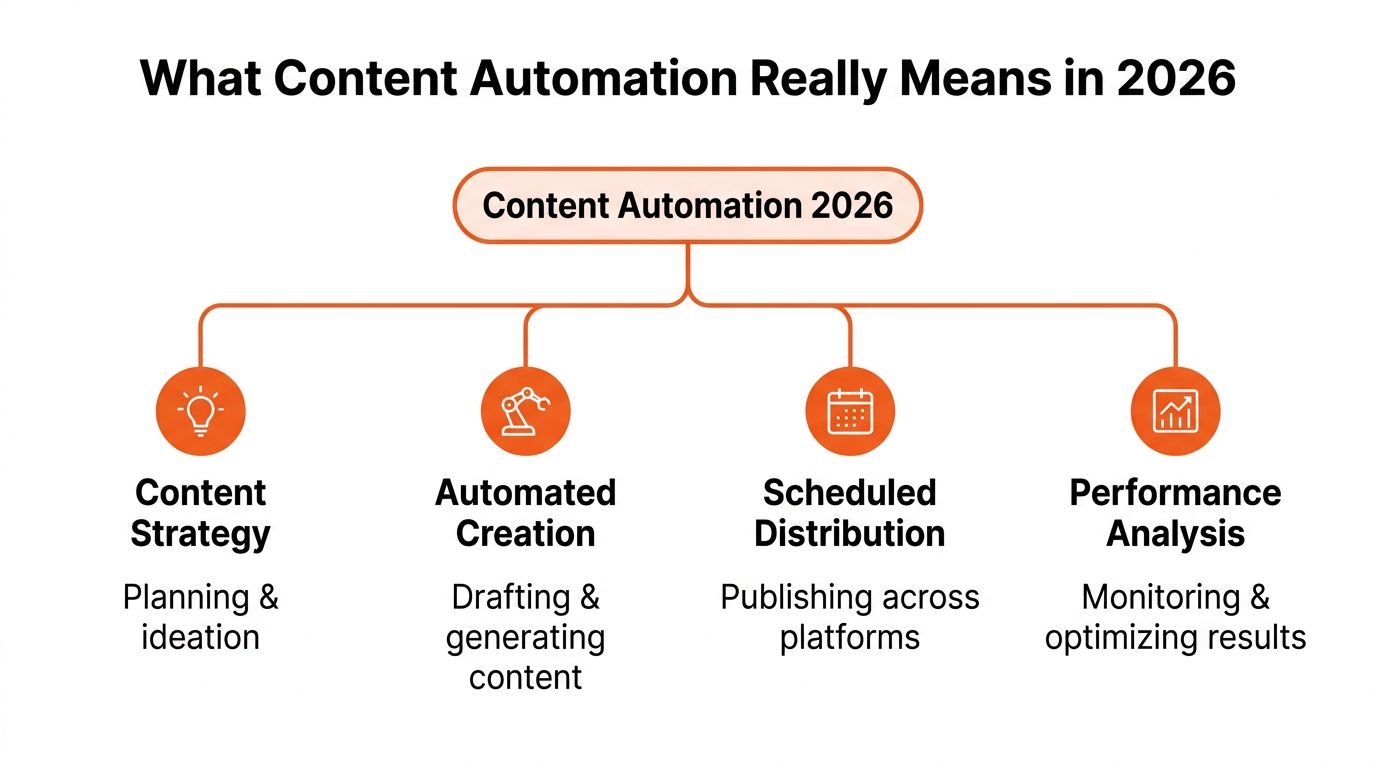
In practice, content creation automation in 2026 means a connected system with four jobs: decide what to say, help create it, publish it on time, and learn from what happened after it went live. It's closer to a content assembly line than a writing assistant.
The assembly line that actually works
Start with strategy. That means collecting themes, audience questions, objections, proof points, and recurring stories. If you skip this part, the machine produces volume without relevance.
Then comes creation. AI proves useful here, yet only when constrained. Give it a strong brief, examples of your voice, and a specific format. “Write a tweet about growth” gives you sludge. “Turn this founder lesson into three X hooks, one contrarian post, and one thread outline” gives you something workable.
Next is distribution. Scheduling isn't just convenience. It's operational discipline. You batch content when your brain is fresh, then let the calendar carry the boring part.
Last is analysis. The system should tell you what got replies, what earned saves, what died on the timeline, and which angles deserve a second version. If analysis doesn't feed ideation, you don't have automation. You have a queue.
One reason this matters now is sheer adoption. In 2026, 85% of marketers actively used AI for content creation, up from 61% in 2023, a 24 percentage point jump according to Affinco's AI content creation statistics.
Basic automation versus real automation
Basic automation is posting a queued tweet.
Real automation is bigger:
Idea automation: Save patterns from your niche, competitor talking points, customer objections, and your own replies.
Draft automation: Rewrite one rough note into hooks, threads, quote posts, and reply starters.
Publishing automation: Match content types to calendar slots instead of guessing every day.
Learning automation: Feed performance back into the next round of ideas.
If you work with executives or B2B experts, structure matters a lot. A useful reference on this is AI content structure for sales leaders, which shows how stronger content framing produces better downstream outputs.
For social workflows specifically, it helps to think in systems instead of isolated posts. A practical example is this guide to social media marketing automation, which mirrors how modern teams connect ideation, scheduling, and performance review.
Automation isn't “AI writes, you publish.” It's “the system prepares options, and you make smarter calls faster.”
Why Your Brand Needs an Automation Strategy
A brand without an automation strategy usually posts in bursts. Two strong days, four quiet ones, then a rushed comeback with recycled takes. On X, that inconsistency makes it harder to build momentum because your audience never learns when to expect you.
Consistency beats occasional brilliance
You don't need every post to hit. You need a publishing engine that keeps your ideas moving.
That's why the ROI case has become hard to ignore. Brands investing in AI content tools have realized a 420% return on investment, according to the earlier Affinco data already cited above. The exact path differs by team, but the common pattern is simple: less manual friction, more output, and better use of skilled time.
A smart strategy also changes how you use human effort:
Manual approach | Automated approach |
|---|---|
Brainstorm from zero each day | Pull from an idea bank tied to recurring themes |
Write one post at a time | Generate multiple formats from one source idea |
Post when you remember | Publish through fixed slots and review windows |
Learn casually | Review outcomes and feed winners back into the system |
If you're comparing software categories before you build your stack, it's worth taking time to discover content automation tools and see how different products handle drafting, repurposing, and scheduling.
The real leverage is mental
The biggest gain isn't just time. It's recovered focus.
When automation handles collection, formatting, queueing, and routine adaptation, you get your best attention back for work that compounds:
Community building: Replying with actual intent instead of dropping generic comments.
Sharper positioning: Saying one memorable thing repeatedly enough that people associate it with you.
Better product feedback loops: Noticing what your audience responds to and using it in offers, onboarding, and sales calls.
Creative depth: Spending longer on a strong thread or original insight because the basic cadence is already covered.
A strong content strategy also needs operating rules. If you post on X, this kind of social media content strategy mindset matters because it keeps automation tied to audience behavior, not just output targets.
The brands that win with content creation automation don't automate because they're lazy. They automate because they know where human energy is most expensive, and they refuse to waste it on repetitive work.
A Practical Automation Workflow for XTwitter
The cleanest way to understand content creation automation is to watch how it changes a normal X workflow. Not in theory. In the daily grind of finding ideas, writing posts, scheduling them, and staying visible in conversations that matter.
Start with idea capture not writing
Most creators get stuck because they open the composer too early.
A better workflow starts upstream. During the week, collect four kinds of inputs: posts you saved, replies that got traction, customer questions, and opinions you repeat in calls or DMs. Those are your raw materials. When you sit down to create, you're not inventing. You're selecting.
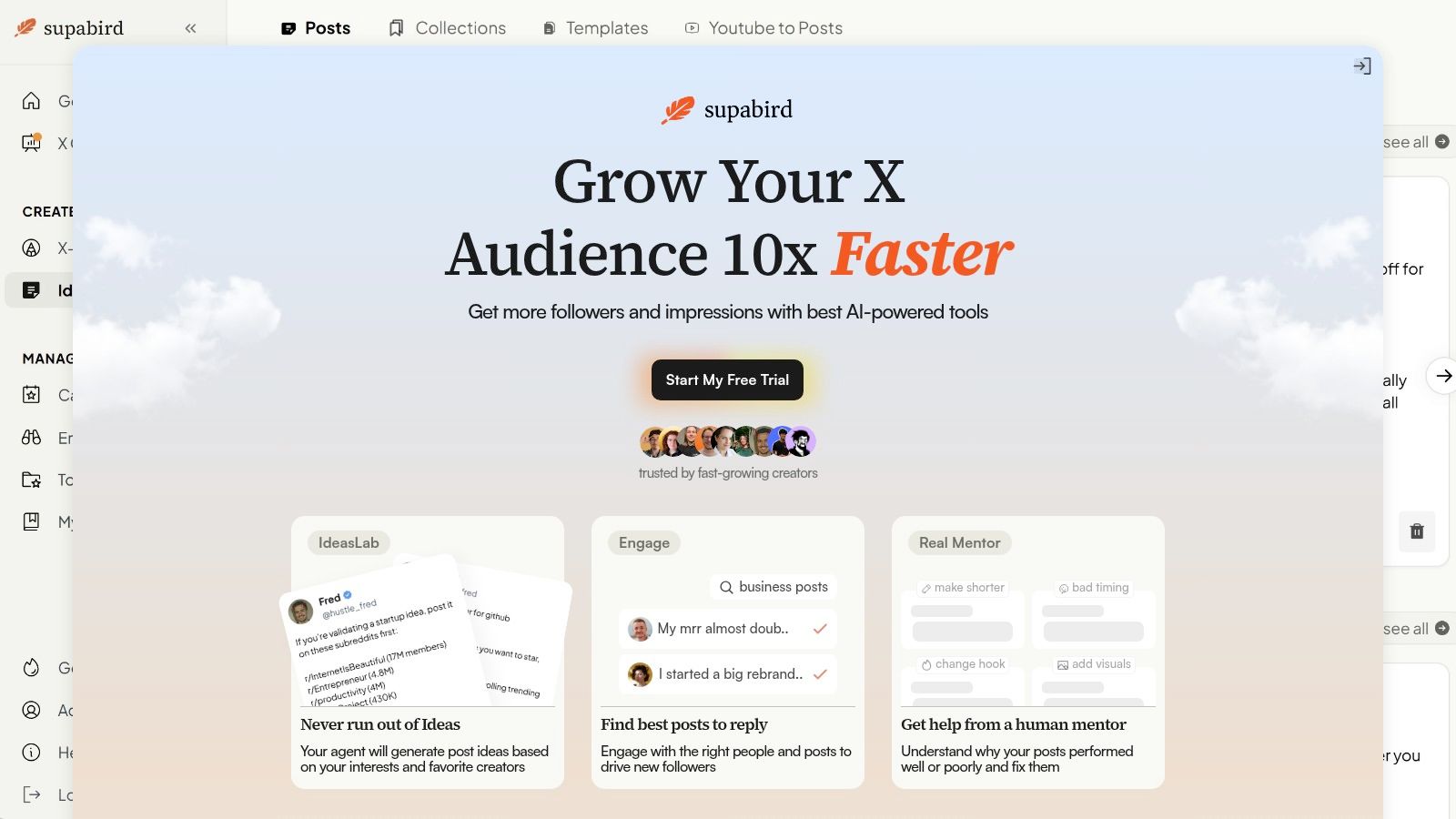
For this stage, specialized X tools can help. One option is SupaBird, which includes idea generation based on niche patterns, draft rewriting, engagement prompts, and scheduling in one workflow. Even if you use a different stack, the model is useful: separate idea discovery from writing.
If you want to build this input habit first, this guide on how to find content ideas is a practical place to start.
A simple weekly board might look like this:
Saved post patterns: Hooks or thread structures that worked in your niche.
Audience pain points: Questions from prospects, users, or comments.
Hot takes: Short opinions you can express in one or two lines.
Proof assets: Screenshots, lessons learned, small experiments, or product observations.
Turn one thought into multiple post formats
Say you run a SaaS product and notice that onboarding calls reveal the same mistake: users ask for advanced features before finishing the basic setup.
That single idea can become:
A short post: “Most churn starts before feature depth matters. Users leave because setup still feels like work.”
A thread: Break down the three onboarding moments where motivation drops.
A reply bank: Use the insight when someone debates feature velocity versus user activation.
A quote post: Add your angle to a founder discussing retention.
AI proves its value. Not by replacing the insight, but by stretching it across formats fast enough that you publish it.
On X, the bottleneck usually isn't insight. It's conversion from thought to format.
Later in the workflow, use a longer-form explainer or walkthrough to generate more assets from the same source. At this point, video-to-post workflows become useful.
Schedule for rhythm and leave room for live posts
Pure spontaneity sounds romantic. It's also why many creators disappear for days.
The better play is a split calendar. Schedule your core content in advance, then leave room for reactive posts when something timely happens in your niche. That gives you stability without turning your account into a robot.
The case for scheduling is strong. Marketing teams that automate social media posting see an average engagement lift of 20 to 30% per post and reduce content-creation time by about 30%, according to Templated's social media marketing automation statistics and trends.
A working weekly rhythm on X often includes:
Anchor posts with your core views.
Lighter observational posts that keep your voice active.
Reply sessions tied to larger accounts in your niche.
One repurposed asset from a video, memo, blog, or customer conversation.
Use automation to find conversations worth joining
This is the part commonly under-automated.
Posting matters, but replies often create the fastest trust. The problem is that manual engagement is noisy. You scroll too long, arrive too late, or end up commenting on threads that won't move anything.
A better system surfaces posts from relevant creators, customers, and adjacent niches so you can join conversations while they're still alive. The automation should handle filtering. You should handle judgment.
Good replies don't sound optimized. They sound specific. Add a counterexample. Share a short lesson. Push the point one layer deeper. That's how content automation supports growth on X without flattening your voice.
How to Implement Your Own Automation System
A good system doesn't start with tools. It starts with decisions. If you automate the wrong workflow, you'll just produce more mess, faster.

Build the system in five moves
1. Define your actual goal
Don't start with “post more.” Start with the business outcome. Maybe you want more qualified inbound leads, more demo awareness, or a stronger founder brand in one niche. That goal shapes the whole workflow.
2. Identify repetitive tasks
Look for the steps you repeat every week and dislike every time. Idea sorting, hook rewriting, caption adaptation, scheduling, performance tagging, and draft QA are common candidates.
3. Choose tools by role
You need roles, not feature overload. Usually that means one place for idea capture, one drafting layer, one scheduler, and one review process. If a tool claims to do everything, test whether it does your core use case well.
4. Build templates and guardrails
Templates save more brands than prompts do. Create a few standard post types, default CTAs, banned phrases, brand terms, source rules, and examples of “sounds like us” versus “sounds generic.”
5. Review, then iterate
A content system gets better only when outputs feed the next cycle. Look at what performed, but also look at what felt right, what attracted the wrong audience, and what created meaningful replies.
Here's the part many teams skip: quality control inside the workflow. Integrating plagiarism detection, AI fact-checking APIs, and brand voice analysis into the review pipeline reduces post-publication quality issues by 45 to 50%, while content output volume increases by 3 to 5x, according to Moonrank's guide to building an automated content creation system.
A simple tool stack that stays manageable
You don't need a giant stack. You need one that your team will use.
A lean setup often looks like this:
Capture layer: Notes app, Airtable, or a simple doc where ideas land fast.
Draft layer: An AI tool that can rewrite into your preferred X formats.
Scheduling layer: A calendar with fixed slots so posting doesn't depend on memory.
Review layer: Checks for tone, duplication, unsupported claims, and formatting.
Analytics layer: A simple review habit, not a dashboard addiction.
For scheduling, consistency improves when you assign post types to recurring windows instead of picking times manually every day. This explanation of what scheduling slots are is useful because it shows how to automate the calendar without giving up control.
Field note: The simpler the workflow, the more likely it survives a busy month.
A practical example: a solo founder can batch ten ideas on Sunday, draft them into different X formats on Monday, queue the strongest ones into fixed slots, and spend the rest of the week responding live. That's content creation automation doing its job. Less decision fatigue, more presence.
Common Pitfalls and Ethical Guardrails
Automation fails in predictable ways. The content gets smoother but less memorable. The account posts more but says less. Replies become formulaic. Statistics appear without sources. Your feed looks active, but trust starts leaking out of it.

What breaks first
The first mistake is over-automating voice. If every post follows the same cadence, the same sentence length, and the same fake-authoritative tone, people feel it immediately. X is especially sensitive to this because timelines are dense and repetition stands out.
The second mistake is automating engagement badly. Auto-replies, generic praise, and canned “great point” comments don't build relationships. They signal that nobody is home.
The third mistake is factual sloppiness, which can lead many AI-heavy workflows to damage a brand. Most tools automate drafting, but few enforce mandatory source links for every statistic, leading to junk output. Rejecting drafts with vague claims and requiring section-by-section generation with traceable citations can filter out 70% of robotic or inaccurate content, according to SEO Autopilot's workflow quality analysis.
Guardrails that keep quality intact
A healthy system has friction in the right places.
Use rules like these:
Require proof for factual claims: If a post includes a number, link, screenshot, or clear source trail should exist before it gets scheduled.
Keep a banned phrase list: Remove filler lines that make AI content feel interchangeable.
Separate drafting from publishing: A draft isn't a post. Add a human checkpoint before anything goes live.
Automate prompts for specificity: Ask for examples, counterpoints, or firsthand observations so output doesn't flatten.
Use human replies for human moments: Product feedback, criticism, and nuanced questions should stay manual.
If automation removes your judgment, it's too aggressive.
There's also an ethical point many creators ignore. If you use AI to accelerate output, you still own the claim, the framing, and the consequences. Automation can help you scale attention. It can't outsource responsibility.
Conclusion Augment Your Creativity Not Replace It
Content creation automation works when it protects your best energy instead of replacing your voice. That's the shift that matters.
The creators and brands getting real value from automation aren't handing the keys to a bot. They're building systems that collect ideas, speed up drafting, maintain a publishing rhythm, and create feedback loops from performance. Then they use the saved time where it counts most: stronger opinions, better conversations, tighter positioning, and more direct contact with the people they want to reach.
If you've been stuck on the content treadmill, don't try to automate everything at once. Pick one stage. Start with idea capture. Or scheduling. Or draft repurposing from one strong post into three follow-ups. Keep it small enough that you'll use it next week.
That's how good systems get built. One useful automation, then another, then a review habit that keeps quality high.
The goal isn't more content for its own sake. The goal is a repeatable way to show up with substance, without burning out.
If you want a focused way to automate idea generation, draft rewriting, engagement discovery, and scheduling for X, SupaBird is built for that workflow. It's a practical fit for creators, founders, and marketers who want a repeatable posting system without turning their account into generic AI output.

The Reply Guy Strategy: A Growth Guide for X

Why New X Accounts Get Less Reach

ClimbX Review (2026): Features, Pricing, Pros and Cons

How Developer Startups Build a Brand on X Before Launch

30-Day Starting Plan for New X (Twitter) Accounts

How Often Should You Tweet for Maximum Growth?

What Should Your First 10 Tweets Be About?

How to Run X for Ten Clients: The Agency Workflow

How to write a bio that gets people to follow you
