AI Powered Content Generation: Proven Workflows for 2026
Author:

In 2026, 38% of all web content published by businesses now involves AI assistance at some stage, up from 14% in 2024 and 26% in 2025 (Presenc.ai research). That shift matters because ai powered content generation is no longer a side experiment, it's part of the publishing stack that many teams now rely on to keep up with demand, consistency, and speed.
For founders, creators, and marketing teams, the key question isn't whether AI can draft text. It's whether you can use it to produce material that still sounds specific, original, and trustworthy when the volume goes up. The difference between a useful workflow and a forgettable one usually comes down to angle selection, human review, and a clean approval process.
Table of Contents
Why AI Powered Content Generation Is Now a Core Business Layer
How Transformer and Diffusion Models Actually Create Content
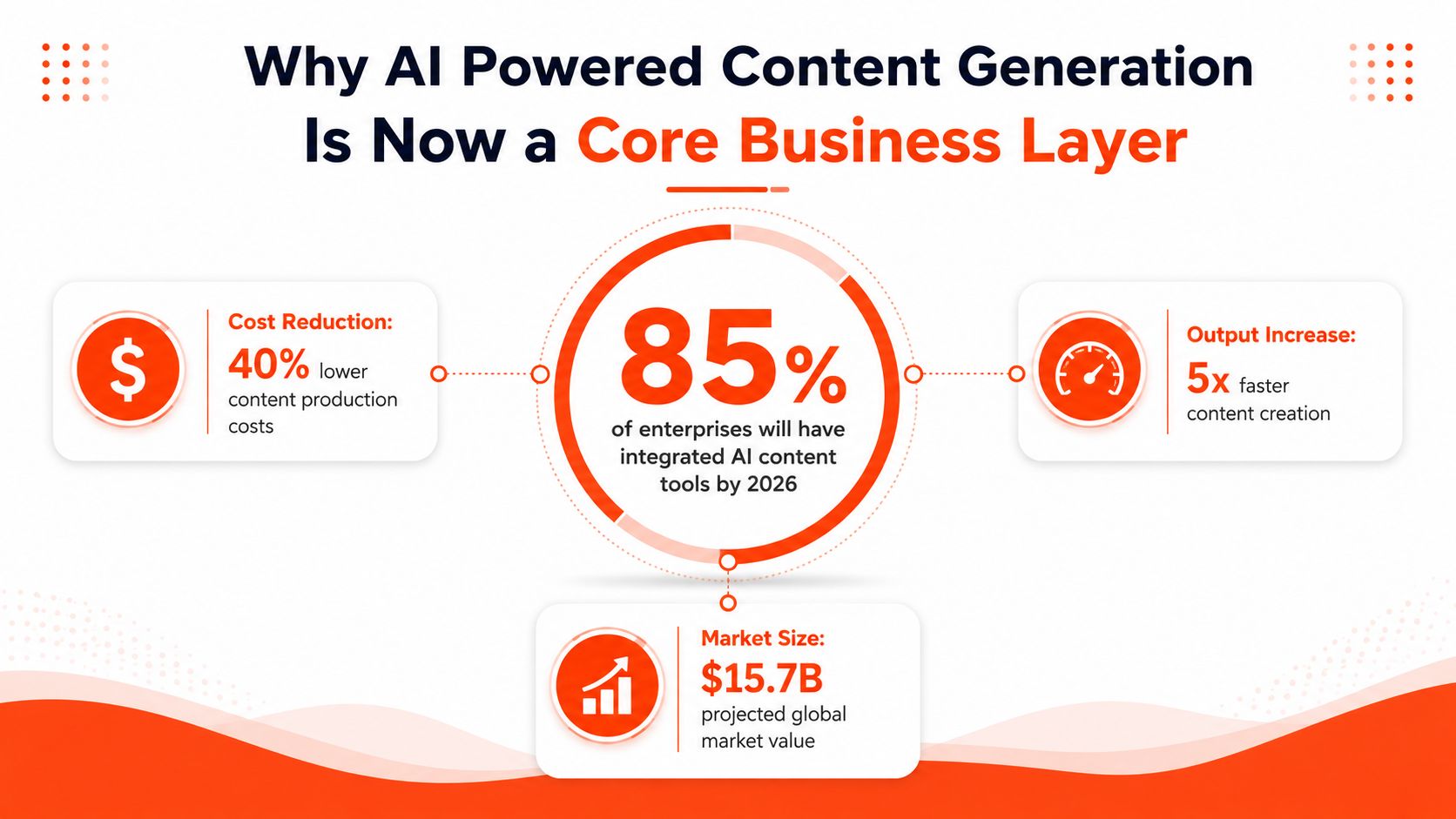
Why AI Powered Content Generation Is Now a Core Business Layer
The clearest sign that this has become mainstream is scale. One industry analysis estimated that 312 million AI-assisted pages are published per month, up from 82 million in 2024, and described that as roughly a 280% increase over two years. The same analysis said 72% of publishers now use AI in editorial workflows, with 31% using it for first-draft generation and 41% using it for research or outline assistance only (Presenc.ai research).
That is why ai powered content generation should be treated as an operating layer, not a novelty. In plain English, it means using AI systems to assist or automate ideation, drafting, editing, and optimization, while a human still decides the angle, verifies the facts, and approves the final version. Older template tools could rearrange copy. Modern systems can learn style patterns from large datasets and generate new outputs from minimal prompts, which changes how entire content pipelines are run (Springer PDF).
What that looks like in practice
A solo founder who needs a week of X posts does not have to start from a blank screen anymore. The practical workflow is to feed the model a product launch note, a customer pain point, and a few strong references, then use AI to produce a dozen rough post options, prune the weak ones, and schedule the strongest four or five after human review. The time savings come from removing repetitive drafting, not from outsourcing taste.
Practical rule: If AI cannot explain the angle in one sentence, it should not be the final draft.
The market reflects that operational shift too. Grand View Research estimated the global AI-powered content creation market at USD 2.15 billion in 2024 and projected USD 10.59 billion by 2033, which implies a 19.4% compound annual growth rate from 2025 to 2033 (Grand View Research). That is enough momentum to make this a real budget line, not a side experiment.
For creators comparing workflows and tools, a useful starting point is this roundup of best AI tools for content creators from Klap, especially if you want to see how different tools fit different production stages. If your content operation also needs a broader planning layer, the structure in this social media content strategy guide is a helpful companion.
The hard part is not generating more copy. It is keeping quality, angle, and governance intact as output scales, because volume without fact-checking quickly creates a backlog of cleanup work that eats the time you thought you saved.
How Transformer and Diffusion Models Actually Create Content
A useful kitchen analogy makes the architecture easier to remember. Transformer models are like a chef who knows which ingredient usually comes next in a recipe, while diffusion models are like a painter who starts with a noisy sketch and gradually sharpens it into a finished plate. One writes, the other renders, but both can now feed the same content pipeline.
Transformer-based large language models are the engine behind most text drafting because they predict the next token in sequence. In practice, that lets them handle long-form articles, social threads, ad copy, summaries, and outline generation. A review of current architectures notes that since 2022, these model families have expanded beyond text into text-to-image, text-to-video, real-time 3D reconstruction, and unified multi-task creative frameworks, which means one model class can now support multiple formats instead of forcing teams to stitch together separate point tools (PMC review).
Diffusion models sit on the visual side of the house. They're the reason prompt-based image generation can start rough and converge toward a polished result through repeated refinement. If you're working on visual prompts, a practical reference is the Stable Diffusion prompt guide from AI Image Detector, because it shows how prompt structure affects style, composition, and output control.
Which model class fits which job
Transformer models: best for hooks, articles, landing page copy, captions, reply suggestions, and thread rewrites.
Diffusion models: best for thumbnails, campaign imagery, social visuals, and concept art.
Combined workflows: useful when a text draft, visual, and short-form clip need to ship together under one message.
That convergence matters because it collapses production timelines. Instead of writing a post, briefing a designer, then waiting for revisions, teams can generate a rough multi-format package from the same creative brief and then refine it with human judgment. The same shift is also visible in workflow design, where generative systems are moving from support tools to workflow engines that automate ideation, drafting, and optimization (Springer PDF).
The best mental model is this. AI doesn't replace creative direction, it replaces the slowest mechanical steps. If the brief is weak, the output will still be weak. If the brief is sharp, the model becomes a force multiplier.
For teams building across both text and visual channels, the internal planning logic in social media AI tools is a useful lens for choosing where automation belongs.
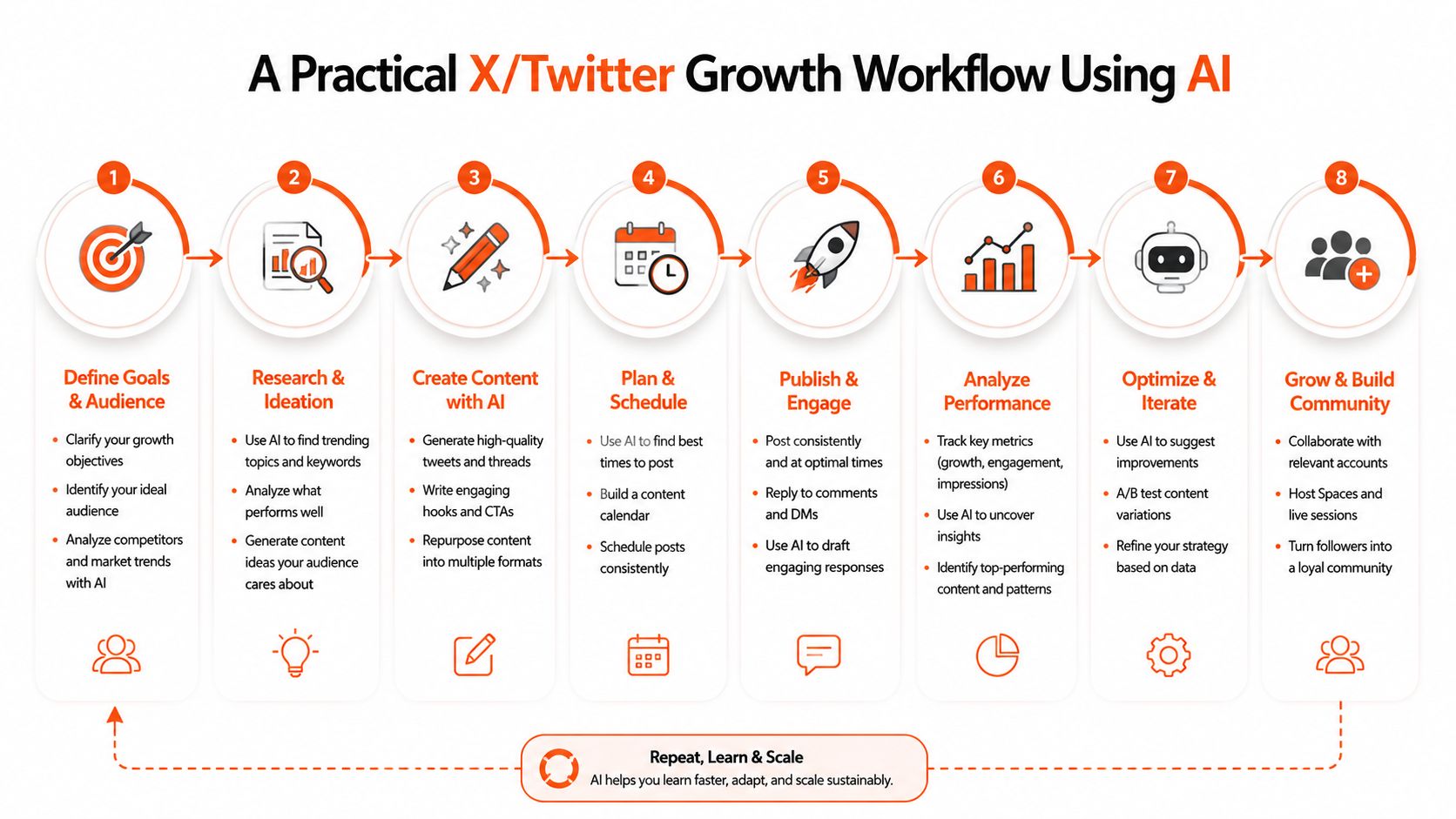
A Practical X/Twitter Growth Workflow Using AI
A good X workflow starts before drafting. The first pass is angle discovery, because if the topic is dull, the post will be dull no matter how polished the wording is. A practical system like this usually begins with an ideas layer that learns from the creators you already respect, then surfaces patterns worth remixing rather than copying.
A weekly loop that actually compounds
One useful pattern is to separate discovery, drafting, engagement, and review.
Collect ideas from the right accounts. Look for posts that created strong discussion in your niche, then sort them by problem, promise, and point of view. The point isn't to copy them, it's to understand which angles people stopped scrolling for.
Draft in a proven format. Use AI to rewrite a rough thought into thread structure, a short contrarian post, or a reply with a sharper hook. If you're using an X-focused writing tool, a module like SupaBird X-GPT fits here, since it rewrites ideas into tweet-formatted posts and can turn a messy draft into something easier to publish.
Reply with intent. The strongest growth usually comes from thoughtful replies to high-visibility posts in your niche, especially when you add a concrete example or a disagreement with reasons.
Schedule across time zones. A good calendar should handle the time slot, but the human should still choose the post that matches the audience context.
Review what resonated. Look at whether the hook earned replies, whether the thread held attention, and whether the account attracted the right followers.
The best AI-assisted workflow for X is not “generate more.” It's “find better conversations, then show up with tighter inputs.”
A useful way to think about the human layer is this. AI can suggest the post, but you still need the lived detail. A short personal anecdote, a contrarian take, or a reply that names a niche pain point is usually what makes the post feel real enough to earn follows. That's why scheduling and drafting tools work best when they're attached to actual operator judgment, not generic trend scraping.
For a deeper look at a specific implementation pattern, the product notes in SupaBird X-GPT AI that writes better X posts for creators and founders show how a writing layer can be connected to ideas, replies, and scheduling without forcing creators into a rigid format.
Strong X growth usually comes from one fresh point of view repeated cleanly, not from twenty average posts published faster.
Avoiding the Generic Content Trap
Most AI content guidance over-indexes on volume. That's backwards. The bottleneck is usually angle selection, because AI can make a sentence faster than you can decide whether the sentence deserves to exist. If your niche has already seen the same "3 tips" framework forty times, your draft will blend in even if it's grammatically perfect.
A better workflow starts with a content audit. Map the posts, threads, and articles people keep repeating, then separate them into three buckets, what's overused, what's unresolved, and what's underserved. That mirrors a practical SEO mindset too, and the structure in how to structure SEO content from Surnex is useful because it forces you to think about hierarchy and intent before generating prose.
A simple originality filter
Use AI to brainstorm hooks, but make the filter human.
Repeated: topics everyone in your niche already covers.
Unresolved: questions people still argue about or ask repeatedly.
Underserved: small audiences, edge cases, or workflows that barely get airtime.
If a draft doesn't hit at least one unresolved or underserved angle, it probably doesn't need to ship. That doesn't mean the post has to be contrarian for the sake of it. It means the post needs a reason to exist beyond “I also have a take on this.”
The same logic works for threads. A long post about “how to grow on X” is generic unless it names the exact audience, the exact constraint, or the exact mechanism. A thread about a founder with no design team, or a consultant who only has 30 minutes a day, is already more useful because it's narrower.
Practical rule: Before you write, list three posts you don't want to accidentally sound like.
That one exercise saves a lot of mediocre output. AI is very good at average synthesis, which is exactly why you need a taste filter before it writes. The goal isn't novelty at any cost, it's specificity that makes the reader feel seen. Once you have that, AI can help you expand the angle without flattening it.
Fact-Checking and Governance for AI Drafts
AI makes production faster, but it also changes the failure mode. The question stops being whether one draft is good enough and becomes whether the whole content system can keep trust intact while shipping at speed. The cleanest answer is fractionation, breaking a draft into discrete claims before publication and checking each one separately.
Start by tagging every checkable unit in the draft. That includes statistics, dates, named studies, quote attributions, product claims, and company performance statements. One workflow guide recommends pulling every factual unit out before publication so reviewers can verify each claim on its own instead of giving the whole draft a vague once-over (eesel.ai fact-checking guide).
What to verify first
Statistics and percentages: trace them back to the original report or study.
Dates and time windows: confirm the exact timeframe, not just the headline.
Quotes and attributions: verify the wording and who said it.
Product claims: check the feature, the scope, and the current documentation.
Performance claims: confirm the measurement method and sample context.
Primary sources matter here. Verification workflows recommend using government databases, academic journals, and original industry reports instead of secondary summaries when the claim matters, and they also recommend checking high-risk statements against at least two independent, recent primary sources before publishing. If the claim still cannot be verified, remove it rather than leaving a shaky fact in place (Recited.io verification guide).
The second layer is governance. Record the source, the decision note, the last-reviewed date, and the editor responsible so the post can be rechecked later. That matters because fast-changing topics age badly, especially when screenshots, interface details, or platform behavior change after publication (SingleGrain fact-checking workflow).
If a claim feels too useful to check, it usually needs checking the most.
A practical flagging system helps. Mark uncertain items with [VERIFY], and mark stats with a source note before they ever hit the draft stage. One checklist also recommends prioritizing exact numbers, limits, dates, locations, original examples, and named people because those are easier to verify and less likely to turn vague in revision (LinkedIn workflow note). That discipline keeps AI from turning a fast draft into a credibility problem, and it also gives you a cleaner handoff when you revise X threads, posts, and rewrites for reach.
If you want a dedicated analytics layer, the overview in Twitter analytics tools is a good way to think about measurement without getting lost in vanity metrics.
Measuring Impact and Planning the Next 90 Days
The wrong metric is follower count in isolation. It's tempting because it's visible, but it doesn't tell you whether the content is earning attention from the right audience. For AI-assisted publishing, the more useful signals are engagement rate per impression, reply-to-follower ratio, thread completion rate, and inbound DM volume, because they show whether the content is creating a conversation.
The next step is to run a 90-day plan in three phases. Weeks 1 to 4 should focus on foundation, meaning your idea pipeline, your angle filter, and your fact-checking checklist. Weeks 5 to 8 should focus on acceleration, with a steadier posting cadence, more deliberate replies, and more consistent use of AI for rewrites and hooks. Weeks 9 to 12 should focus on optimization, where you A/B test hooks, compare formats, and tune your review loop based on what the audience responds to.
A simple operating plan
Foundation: build the brief intake, the claim-check process, and the content buckets.
Acceleration: publish consistently, reply to better posts, and keep the draft turnaround short.
Optimization: test hook styles, trim weak formats, and review what drives replies versus passive likes.
If you want a dedicated analytics layer, the overview in Twitter analytics tools is a good way to think about measurement without getting lost in vanity metrics. The point is not to stare at dashboards all day. The point is to close the loop between what you publish, what the audience signals back, and what you should write next.
Two trends will shape the next wave of ai powered content generation. One is more multi-modal output, where text, images, and short video are produced as part of the same creative system. The other is more personalization at the workflow level, where the model adapts to a brand's tone, topic mix, and audience signals instead of producing generic output for everyone.
If you only change one thing this quarter, make it the review loop. Speed is useful, but speed plus governance is what makes AI content compound instead of drift.
If you want a tighter system for finding ideas, rewriting X posts, and scheduling content without losing control, try SupaBird. It's built to pair AI drafting with human judgment, which is exactly what this workflow needs when trust matters as much as output.

The Reply Guy Strategy: A Growth Guide for X

Why New X Accounts Get Less Reach

ClimbX Review (2026): Features, Pricing, Pros and Cons

How Developer Startups Build a Brand on X Before Launch

30-Day Starting Plan for New X (Twitter) Accounts

How Often Should You Tweet for Maximum Growth?

What Should Your First 10 Tweets Be About?

How to Run X for Ten Clients: The Agency Workflow

How to write a bio that gets people to follow you
