AI Content Idea Generator: Boost Your Brand in 2026
Author:

You've probably had this tab open while staring at your X scheduler, trying to come up with something smart to post that doesn't sound recycled, forced, or obviously AI-written. That's the core problem most creators, founders, and marketers are dealing with. It isn't a lack of ideas. It's the pressure to produce fresh ones on demand, every day, without burning out.
An AI content idea generator helps, but only when you stop treating it like a slot machine. If you throw in vague prompts, you'll get vague content back. If you build a repeatable workflow around it, the tool becomes a content engine for X, not a gimmick.
Table of Contents
Beyond the Brainstorm Your New Content Engine
The old way of brainstorming for X breaks down fast. You jot ideas in Notes, save screenshots, bookmark posts, maybe dump half-finished hooks into Notion, and still end up posting late or skipping the day entirely. That's normal when content depends on mood instead of process.
The shift is already happening across the market. The global generative AI in content creation market was estimated at USD 14.8 billion in 2024 and is projected to reach USD 80.12 billion by 2030, according to Grand View Research's generative AI content creation market report. That growth reflects something practical. Teams want consistency, and they want to reduce the human hours spent trying to think of what to say.
What changes when you treat ideation like infrastructure
A strong AI content idea generator doesn't replace your judgment. It removes the blank page. That matters on X, where the pace is brutal and relevance expires fast.
A founder can use it to turn one product insight into:
A sharp one-liner for a morning post
A thread outline that explains a lesson from building
A contrarian take that starts replies
A story angle that makes the same point feel human
A marketer can use it to pressure-test different hooks before writing the full post. A creator can use it to generate ten angles around one pillar instead of forcing one weak idea to carry the week.
The tool isn't your voice. It's your first draft machine.
That's why it helps to innovate using AI tools in a structured way instead of expecting inspiration to show up on command. The win isn't more raw output. The win is getting to better starting points faster.
The real upgrade is the system
When people say AI content feels generic, they're usually describing a bad workflow, not a bad model. They asked for “10 viral tweets about marketing” and got exactly the level of thinking that prompt deserved.
The better approach is simple:
Define your pillars
Feed the tool context
Generate options
Filter hard
Publish and learn
That turns an AI content idea generator into a working part of your weekly X system. Once that clicks, “what should I post today?” stops being a daily drain.
How an AI Idea Generator Really Works
An AI content idea generator is often perceived as a topic spinner. It isn't. Used properly, it's a creative sparring partner that helps you produce formats that fit X. Hooks. thread structures. replies. hot takes. story-based posts. audience questions. contrarian riffs. campaign angles.
That only works when the tool has enough context to reason from.

What the machine is actually doing
A modern generator usually follows a flow like this:
It takes your input
Your niche, audience, product, tone, post goal, and references shape the direction.It analyzes patterns
The model connects your input with language patterns, common structures, and topic relationships.It synthesizes angles
Instead of one answer, it can generate multiple approaches to the same idea.It returns usable formats
Good tools don't stop at “topic ideas.” They package angles into posts you can test on X.
The difference between a weak result and a useful one usually comes down to input quality. If you say “give me post ideas about SaaS,” the tool has no strategic lens. If you say “give me 12 post ideas for a B2B SaaS founder targeting bootstrapped operators who care about churn, onboarding, and feature adoption,” now it has direction.
Feed it context before you ask for content
Before you generate anything, preload these inputs:
Brand pillars: What do you consistently talk about?
Audience type: Founders, operators, creators, consultants, or marketers?
Content goal: Reach, replies, profile visits, clicks, or authority?
Voice rules: Direct, contrarian, educational, story-driven, understated?
Reference material: Past winning posts, competitors, industry pain points
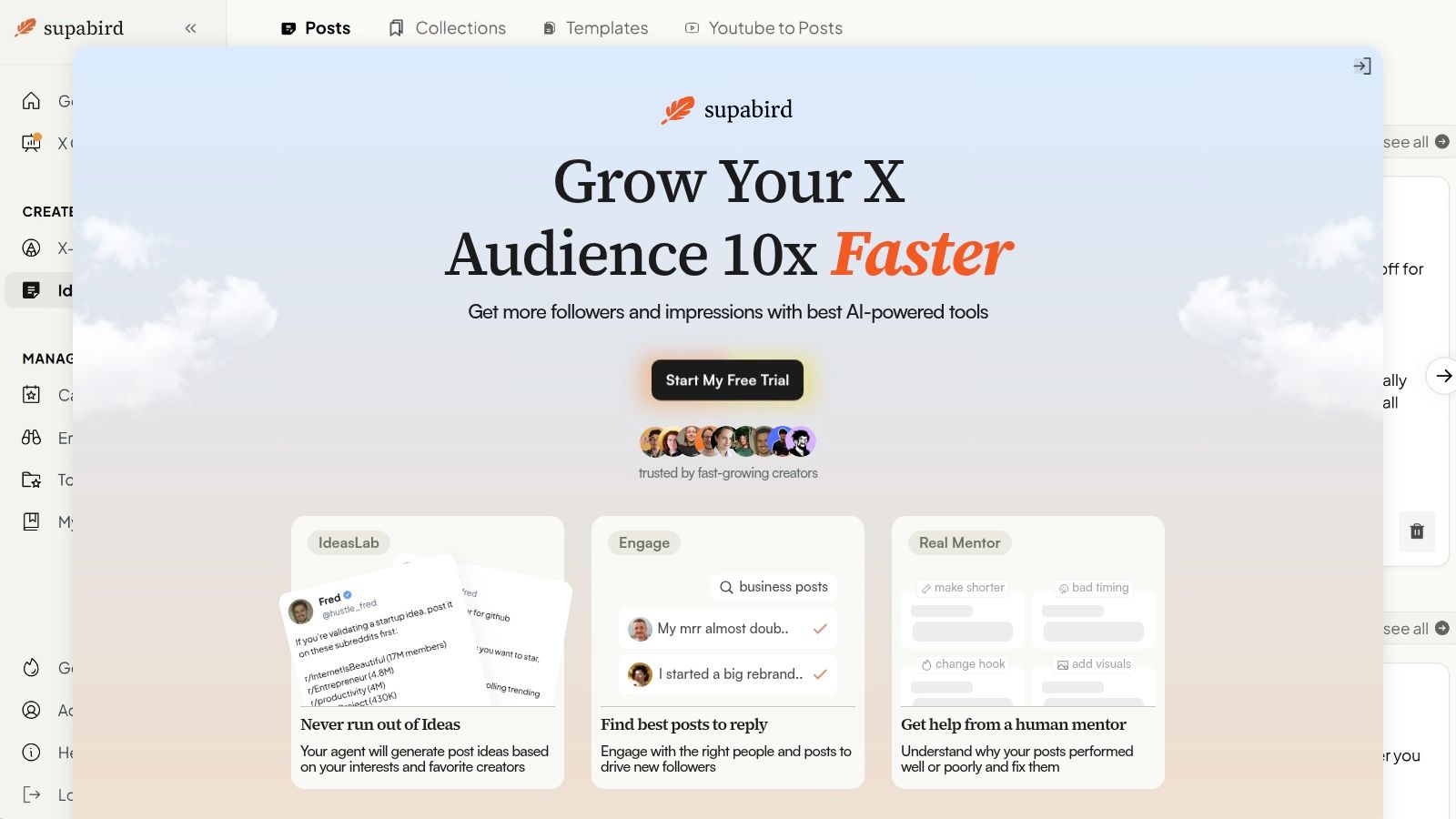
If you want a practical example of this kind of workflow inside a social tool, Ideas Lab for X ideation is built around generating post ideas from patterns that already perform in your niche, not random generic prompts.
One gap most tools still miss
Localization is still weak in a lot of generators. As noted in this discussion of localized content angles, many tools don't prompt for local context like “Dallas homeowners” or seasonal framing like “summer heat,” which matters if your audience lives in Berlin, London, or Mumbai and timing changes what feels relevant.
If your content could apply to anyone, anywhere, at any time, it usually lands with no one.
For X, that means your prompt should include market, geography, season, or current context when it matters. Broad ideas travel poorly. Specific ones get traction.
Crafting Prompts That Deliver High-Impact Ideas
Prompting is often where users go wrong. They ask for “viral tweet ideas,” get stale motivational fluff, then decide AI isn't useful. The tool isn't the problem. The prompt is.
The cleanest way to prompt for X is to use a simple frame:
Persona + Goal + Format + Tone + Constraints
That structure forces the model to think like a strategist instead of a content blender.
The input decides the output
The strongest AI ideation workflows start with quality inputs, not clever wording. As explained in Spectre SEO's breakdown of expert AI ideation, the workflow runs through seed input, data aggregation, SERP and intent analysis, cluster generation, and automated filtering. The takeaway for X is straightforward. Start with strong source material and clear direction, or you'll generate polished nonsense.
If you want to sharpen this skill, it helps to spend time understanding prompt engineering as a discipline, not just a trick for getting longer outputs.
Use this checklist before you prompt:
Persona: Who are you speaking to? Early-stage founders are not enterprise CMOs.
Goal: Do you want engagement, clicks, follows, or qualified replies?
Format: One-liner, thread, list post, story post, contrarian take, or question?
Tone: Sharp, calm, funny, analytical, skeptical, optimistic?
Constraints: Character limits, banned clichés, no jargon, include a hook, reference a pain point
A master prompt that actually works
Copy this and adapt it.
Act as an X growth strategist for a [persona].
My content pillars are [pillar 1], [pillar 2], and [pillar 3].
My audience wants help with [pain points].
Generate [number not specified] X post ideas designed for [goal].
Include a mix of [formats].
Keep the tone [tone].
Avoid generic advice, clichés, and vague motivation.
Make each idea specific, relevant to current audience pains, and easy to turn into a post.
For each idea, include a hook, the core angle, and why it would resonate.
That prompt is useful because it asks for structured outputs. You're not asking for inspiration. You're asking for assets.
A practical example for a SaaS founder:
Persona: bootstrapped B2B SaaS founder
Goal: qualified replies from operators
Format: short post, thread, customer pain-point post
Tone: direct, slightly contrarian
Constraints: no startup clichés, no “just ship” advice
Later, once you've got a usable batch, this video gives extra context on shaping AI-assisted ideas into stronger posts for X.
Example prompts for X Twitter growth
Persona | Example Prompt |
|---|---|
Creator | Generate X post ideas for a creator teaching audience growth to solo creators. The goal is replies and follows. Use story posts, contrarian hooks, and short educational posts. Keep the tone punchy and practical. Avoid generic creator advice and make each idea feel tied to a real creator problem. |
Founder | Generate X post ideas for a SaaS founder building in public. The audience is other founders and operators. The goal is authority and profile visits. Include lessons from product decisions, failed experiments, customer objections, and positioning mistakes. Tone should be direct and credible. |
Marketer | Generate X post ideas for a social media manager at a B2B company. The audience is founders and marketing leads. The goal is clicks and qualified engagement. Include posts on testing hooks, repurposing workflows, campaign insights, and content ops. Keep it analytical and clear. |
Two final prompt rules matter more than fancy wording:
Ask for variations: one idea is fragile, ten ideas reveal patterns.
Ask for exclusions: tell the model what to avoid, not just what to create.
That's how you get outputs that are already close to publishable instead of bloated drafts you'll never use.
From Raw Ideas to Refined Content
The first output from an AI content idea generator is not content. It's inventory.
That's the mistake that floods X with polished-looking posts that say nothing. The model gave you options. Your job is to decide what deserves to become a real post, what needs surgery, and what should be deleted immediately.
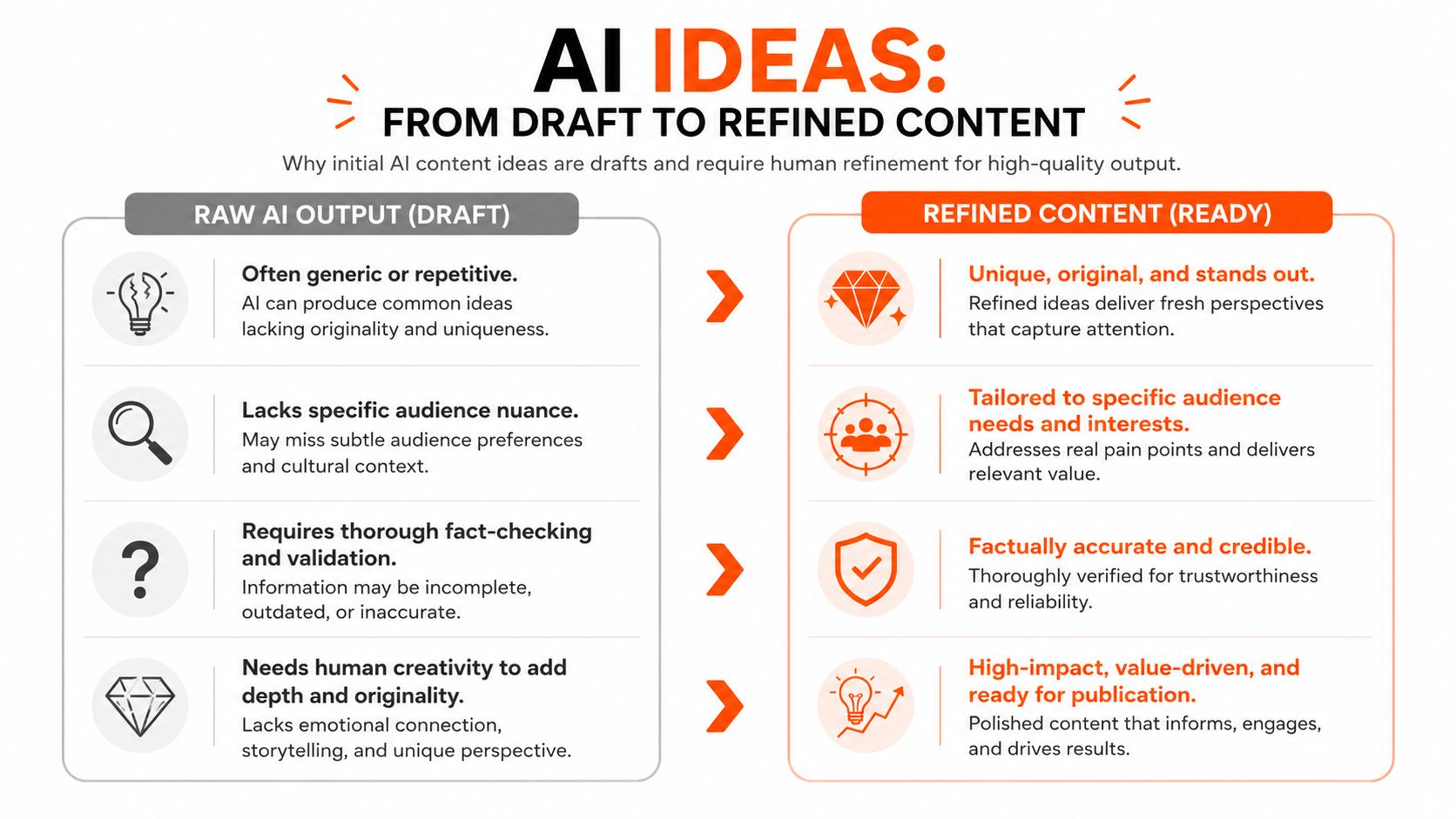
Research highlighted in this piece on filtering AI-generated ideas makes the point clearly. 80% of AI-generated ideas should be filtered out because they miss audience relevance and specificity. Most tools generate volume. Very few help you kill weak ideas fast.
Use the four R filter
Run every idea through these four checks.
Relevant
Does this matter to your audience right now? A strong idea fits the market moment, the platform mood, and your audience's current pain.Resonant
Can you say this in your own voice without sounding like you borrowed someone else's persona? If you wouldn't say it in a live conversation, rewrite it.Reliability
Are the claims true? If the post includes facts, examples, or advice that sounds suspiciously neat, verify it. Guidance from Acrolinx on reliable AI content workflows stresses manual fact-checking and bias review before publishing.Remarkable
Does it offer a fresh angle, a sharper framing, or a stronger example than the average timeline post?
The fastest way to sound generic on X is to publish the first AI draft with only cosmetic edits.
How to turn a bland draft into a strong post
Take a weak AI idea like: “Consistency is important for personal branding.”
That's true, but nobody cares because it's flat. Improve it by changing one of these variables:
Make it situational
“Posting daily didn't grow my account. Posting consistently on one problem did.”Add tension
“Most founders don't have a content problem. They have a point-of-view problem.”Ground it in lived detail
“The week I stopped trying to sound smart and started writing like I talk, replies got better.”Tighten the hook
Cut throat-clearing. Start where the friction is.
If you're building a bigger system around this, content repurposing strategy for social channels becomes useful after refinement because one validated idea can feed replies, quote posts, short threads, and lead-in posts.
A few editing habits make a big difference:
Swap abstractions for specifics: “better distribution” becomes “more qualified replies.”
Remove résumé writing: posts should sound like a person, not a company bio.
Check for repeated phrasing: AI loves loops and stock transitions.
Rewrite the first line twice: the hook usually needs the most human intervention.
Don't aim to humanize every bad idea. Kill bad ideas faster. Human effort should go into the few concepts worth sharpening.
Activating Your Content Schedule and Optimizing Performance
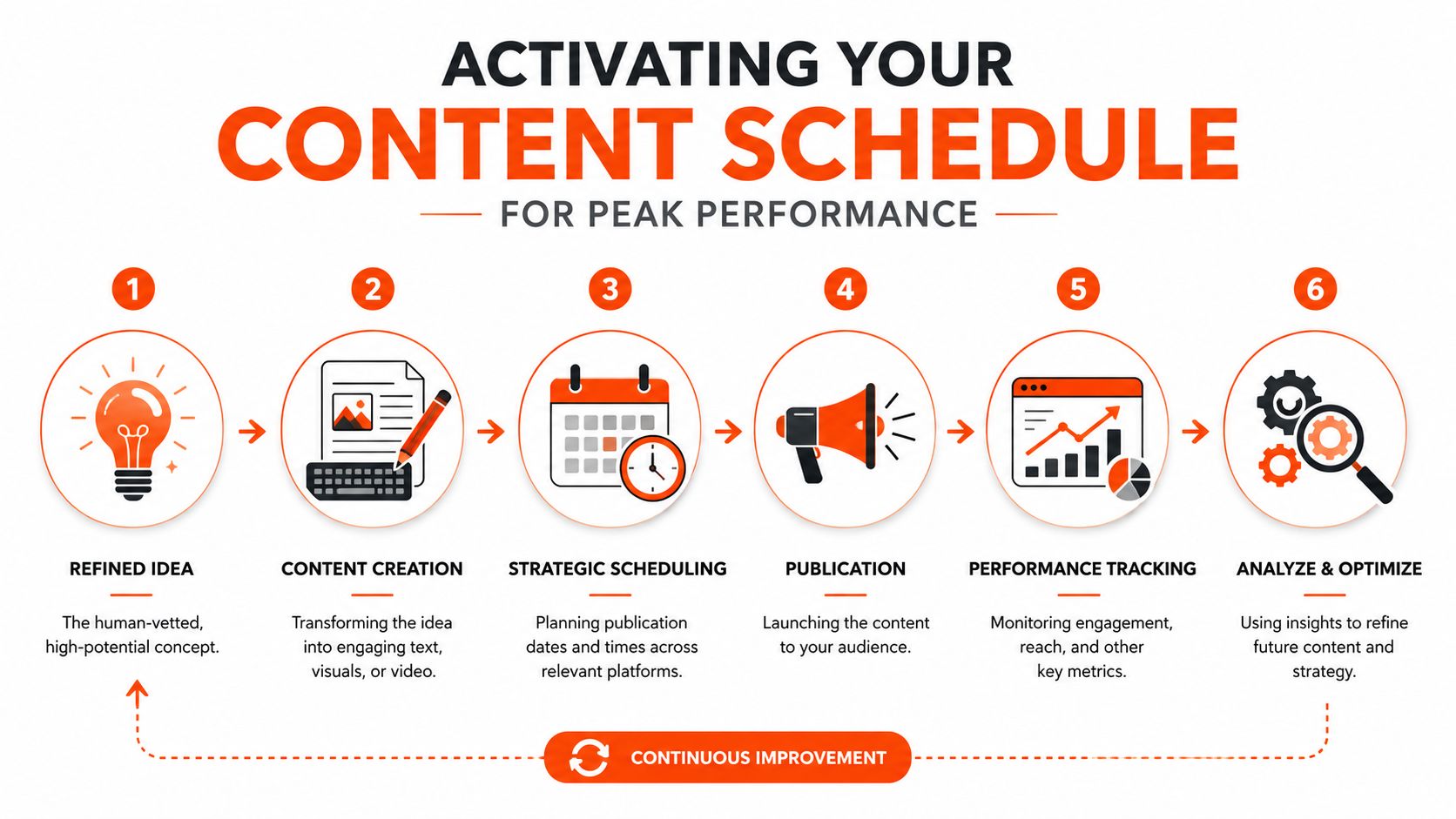
Good ideas still fail when they sit in drafts. X rewards consistency, speed, and timing. That means your workflow has to move from refined idea to published post without depending on last-minute energy.
Publish in batches, not in panic mode
The easiest way to waste a good AI content idea generator is to use it only when you're stuck. Use it during batch sessions instead.
A clean weekly operating rhythm looks like this:
Idea batch: generate and shortlist angles
Draft batch: write posts from the strongest ideas
Schedule batch: load the week into a calendar
Review batch: look at outcomes and extract patterns
That's where automation helps. If you're thinking about the wider system around scheduling, drafting, and repeatable execution, social media marketing automation workflows are what turn scattered posting into a process.
Batch when you're clear-headed. Publish when your audience is online.
For X specifically, don't schedule seven identical educational posts and call it a strategy. Mix formats. Rotate between opinion, story, utility, and conversation starters. Variety makes your account feel alive and gives you better signal on what the audience wants.
Track signals that improve the next prompt
Performance analysis matters because it closes the loop. According to Sozee's guidance on measuring AI content efficiency, well-optimized AI-generated content can achieve roughly 34% higher click-through rates compared to non-optimized content, and a marketer can set a concrete target like moving CTR from 2.5% to 3.5% by testing AI-generated hooks.
That doesn't mean every post needs a spreadsheet. It means each idea should have a purpose.
On X, the useful signals are:
Hook performance: Did people stop and engage?
Replies quality: Are the responses relevant or empty?
Profile actions: Did the post create curiosity?
Clicks: If there's a link, did the framing earn attention?
Saves for reuse: Did this angle deserve a sequel, thread, or reply chain?
You can also sanity-check broader engagement against blog engagement benchmarks used in AI content evaluation, which note a typical range of 1% to 5% and suggest tuning idea generation toward themes that can reach the upper end.
A simple test loop works well:
Write two hooks for the same idea
Publish the stronger one first
Reuse the angle later with a different format
Compare which framing earned better response quality
When you learn that your audience responds to tactical breakdowns more than inspirational posts, feed that back into the next generation session. That's how the AI content idea generator gets smarter in practice. Not because the tool changed, but because your inputs did.
Your System for Never Running Out of Ideas Again
You don't need more random inspiration. You need a loop.
Prompt with context. Generate multiple angles. Vet them hard. Refine the few that deserve to live. Schedule them before the week gets noisy. Analyze what moved people, then feed that learning back into the next round.
That's the whole system:
Prompt. Generate. Vet. Refine. Schedule. Analyze.
When creators say they've solved content, this is usually what they mean. Not that ideas appear effortlessly. They mean the decision-making is no longer chaotic. The blank page stops running the show.
If you want a starting point for building that loop, how to find content ideas for X consistently is the habit to lock in first. Once that part becomes systematic, the rest of your workflow gets lighter.
The primary value of an AI content idea generator isn't speed alone. It's that it gives you a repeatable way to stay relevant on X without sounding like everyone else.
If you want one place to run that workflow, SupaBird combines idea generation, post rewriting, scheduling, and X-focused coaching so you can move from rough angle to published post without juggling a pile of separate tools.

The Reply Guy Strategy: A Growth Guide for X

Why New X Accounts Get Less Reach

ClimbX Review (2026): Features, Pricing, Pros and Cons

How Developer Startups Build a Brand on X Before Launch

30-Day Starting Plan for New X (Twitter) Accounts

How Often Should You Tweet for Maximum Growth?

What Should Your First 10 Tweets Be About?

How to Run X for Ten Clients: The Agency Workflow

How to write a bio that gets people to follow you
