You've got the draft already. It's sitting in your docs, maybe it took half a day, maybe longer, and now the hard part isn't writing it, it's figuring out how to make it earn its keep across the channels you have to feed this week. That's where what is content repurposing stops being a vague marketing phrase and starts becoming a practical way to turn one strong asset into a stack of usable pieces.
Table of Contents
The One Draft That Could Have Been Twelve
Maya spent eight hours on one blog post. She polished the headline, tightened the intro, added examples, and hit publish with the kind of relief that only comes after a long writing session. Then the calendar kept moving, the post sat there, and the next day she was back to wondering what to post on X, what to send in email, and what could possibly become a LinkedIn carousel without sounding repetitive.
That's the moment most creators recognize. You don't need more ideas as much as you need a better way to extract more value from the ideas you already paid for. A single article, webinar, or video often contains enough material to fuel a week of distribution, but many teams treat it like a finished object instead of raw material.
Maya's second version of the same workflow looked completely different. She used the post as a source asset, then broke it into a thread, a few sharp one-liners, a short video script, an email angle, a carousel outline, and even a podcast note. The work didn't become easier because she was producing less, it became easier because each piece started from the same core thinking instead of starting from zero.
If your content calendar feels hungry and your draft folder is full, this is the turning point. A good source asset can keep working long after the original publish button is clicked, especially if you've already got topic ideas you're trying to turn into a repeatable system, like the process described in how to find content ideas.
Practical rule: one strong draft should usually be treated like a raw ingredient, not a final meal.
What Content Repurposing Actually Means
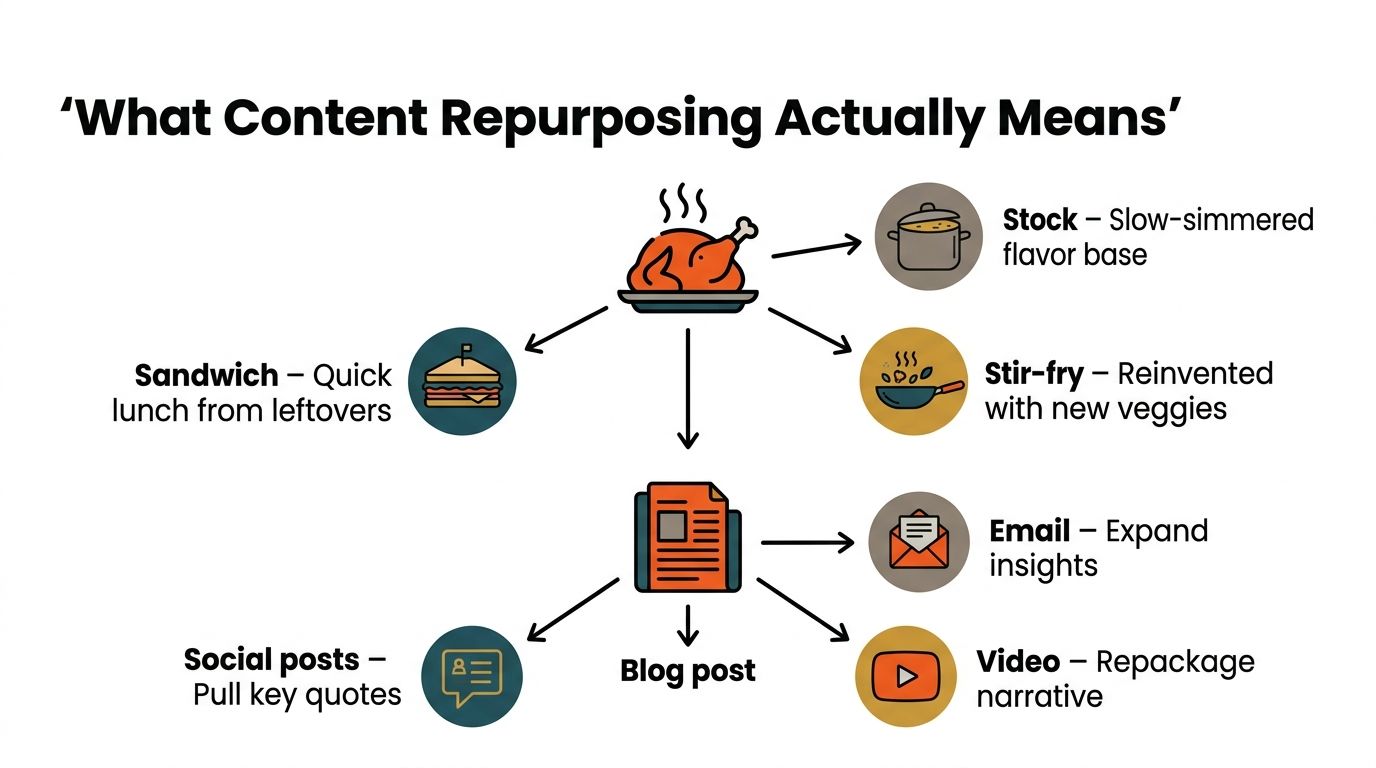
The cleanest way to understand what content repurposing is, think about a roast chicken. You don't call it lazy if the leftovers become sandwiches, the bones become stock, and the extras become stir-fry. The meal is still the same source, but each new plate serves a different moment, a different appetite, and a different format.
Content works the same way. Content repurposing is the practice of taking one piece of content and adapting it into multiple formats or channels, such as turning a blog post into social posts, videos, podcasts, slides, or infographics (Contentmation). The core idea stays intact, but the packaging changes so it fits where people consume it.
Atomization is the real mechanic
The important word here is atomization. Instead of copying the whole asset everywhere, you decompose it into reusable units like a statistic, a framework, a contrarian take, a how-to, or a conclusion. Then you rebuild those pieces into platform-native formats with the right length, hook, and style for each channel, which is different from crossposting the same file unchanged (Dave Chaffey).
A blog post about onboarding, for example, can become a carousel that walks through the framework, an email that expands one insight, and a short video that focuses on the most surprising takeaway. That's not rewriting from scratch, and it's not reposting the same thing everywhere. It's the same master dish, served in several different ways.
A useful tool example here is repurpose blogs into carousels, which is helpful if you already write strong long-form pieces and want a faster route to visual posts. The value is in the transformation, not the duplication.
Repurposing keeps the same underlying idea, but changes the format so the message fits the channel instead of forcing the channel to fit the message.
Why the Numbers Make Repurposing a Growth Lever
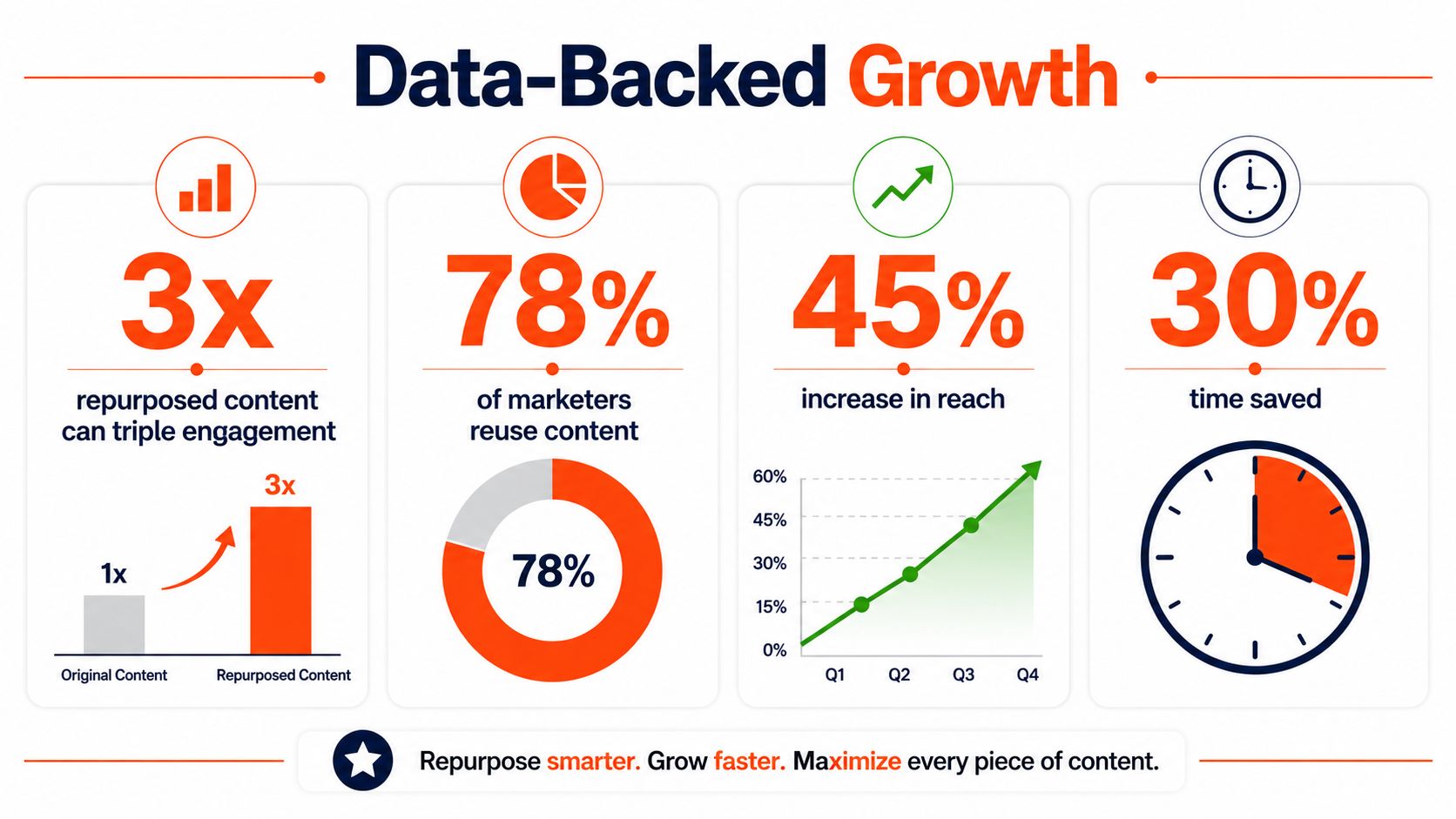
A single source asset can do more than fill one publish slot. It can be broken into smaller units, then rebuilt for the channel where each unit fits best. Industry summaries reported that a single blog post can be repurposed into 8 to 12 different content pieces, repurposed content can generate 60% more engagement than single-format original content, and teams using repurposing workflows produce 47% more content at 35% lower cost per piece. Contentmation Those figures matter because they show repurposing as a way to turn one strong draft into a larger output system, instead of treating it as a one-and-done post.
The adoption gap is the story
A 2026 roundup reported that only 29% of marketers have a systematic content repurposing process, even though repurposing content was cited as increasing results by 75% without a proportional increase in investment. It also reported that 60% of marketers say repurposed content generates more leads than original content, and 46% identify content repurposing as the single best-performing content marketing strategy. SHNO
That gap explains why repurposing has moved from a simple recycling habit to a growth lever. More channels create more native formats, more hooks, and more places where one source asset can stay relevant if you reshape it correctly. The teams that grow faster do not just publish more often, they extract more usable pieces from the same core idea and fit them to the place where they will be read, watched, or shared.
Crossposting and repurposing are different jobs. Crossposting republishes the same asset unchanged. Repurposing decomposes the asset, then rebuilds it so the destination gets something that feels native instead of copied over.
For a practical breakdown of the workflow, revid.ai's repurposing guide is a useful companion because it focuses on distribution as a process, not just reuse as a habit. If you want the planning side to stay organized, a content production workflow helps keep the source asset, derivative formats, and publishing steps in one place.
The Five-Stage Atomization Workflow
1. Audit the source asset
Start with something worth the effort. A source asset should already have some signal, whether that's traffic, conversions, or plain longevity. If a post keeps attracting attention or still answers a durable problem, it deserves more of your time than something timebound and forgettable.
2. Extract the reusable units
Break the asset into parts that can live on their own. Maya's blog post had a framework, two strong examples, one useful statistic, and a contrarian line about what is commonly misunderstood. Those are the atoms. You're not looking for every sentence, you're looking for the parts that can become hooks, slides, captions, or scripts.
3. Adapt for each channel
Now change the shape. X wants a sharp opener and fast pacing. LinkedIn can hold a more structured argument. Video wants visual rhythm and a tighter narrative. The same idea stays intact, but the length, tone, and formatting shift so the post feels written for that destination, not dragged there.
4. Refresh what's stale
If the asset includes outdated examples, old screenshots, or context that no longer fits, update it before you publish the derivatives. New York Times Licensing notes that repurposing can include refreshing outdated content to meet current goals, and that matters because old substance weakens every downstream format if you don't fix it (Prodshort).
5. Schedule with platform timing in mind
Don't drop every derivative at once. Spread them across the week, match the format to the platform, and give each version room to do its job. If you're repurposing a blog post, an X thread, and a short video, they shouldn't all arrive looking identical or sounding like they came from the same file export.
The practical version is simple. One source asset becomes a set of outputs, and each output has a job. If you want a planning reference for the production side of this, content production workflow is a useful internal companion because repurposing works best when the original creation process already anticipates downstream formats.
Build the repurposing plan while you're still writing the source asset. Waiting until after publication usually means you've already lost momentum.
Repurposing Formats That Actually Work in 2026
The best repurposed format is the one that matches the source asset and the channel. A webinar doesn't need to become a thread first if its strongest value is in the transcript. A blog post doesn't need to become a video if the key point is a simple framework that would read well as a carousel. Choice matters more than volume.
Source Asset | Best Repurposed Formats | Why It Works |
|---|---|---|
Blog post | X thread, LinkedIn carousel, email, short video script | The argument can be split into hooks, examples, and takeaways |
Webinar | Video clips, show notes, blog summary, quote cards | Long-form speaking gives you multiple extractable moments |
Podcast episode | Show notes, post snippets, clip captions, carousel summary | Audio becomes searchable and skimmable in text and visual form |
Newsletter | Social posts, quote graphics, short video talking points | Strong opinions and clean takeaways travel well |
YouTube video | Thread, summary post, article outline, quote clips | Spoken structure can be atomized into text-first assets |
X works best when the hook does the heavy lifting
If your source asset is a blog post, the thread usually starts with the most useful claim, not the title. Pull the strongest sentence, turn it into a hook, then break the rest into tight supporting posts. If you want a ready-made method for this kind of transformation, how to repurpose YouTube videos as X posts with AI is a relevant example of how one core asset becomes a set of platform-native posts.
A creator-flavored X playbook looks like this:
Open with the claim. Don't explain the whole idea in the first post.
Use one post per atom. One post for the insight, one for the example, one for the takeaway.
End with a simple direction. Point readers back to the full source if that's the goal.
Carousels and show notes deserve special attention
LinkedIn carousels work well when the source asset has a clear sequence or framework. Each slide can hold one unit, so the logic of the original piece stays visible. Podcast show notes work the same way, which is why WhisperAI's podcast show notes template is useful when you need a structured way to turn one conversation into readable, searchable text.
SupaBird can also fit into this workflow as an X-focused option because its idea generator, rewriting tools, and schedule recommendations help creators turn a source asset into timed posts without rebuilding the workflow by hand. That matters most when you already know the asset is worth recycling and you just need the derivatives to move.
What Not to Repurpose and the Pre-Flight Filter
Not every piece deserves a second life. In fact, some of the worst repurposing work comes from trying to squeeze value out of content that was never built to travel. A news reaction post, a thin listicle, or a highly specific launch note can drain time without producing anything durable.
Filter for reuse before you spend time rewriting
Established guidance says to prioritize content that already performs well, can be refreshed with new data, or remains evergreen, because timebound or overly specific material can waste the effort (Content Marketing Institute). That's the pre-flight test. If the asset can't survive a new context, it probably shouldn't be broken apart.
Use this quick checklist:
Evergreen value: Will the core idea still matter in a few months?
Proven traction: Has the piece already shown signs it resonates?
Refresh potential: Can the examples, screenshots, or data be updated?
Atomizable depth: Can you pull at least a few useful units from it?
Channel fit: Does the target platform reward this format?
If the answer is mostly no, leave it alone and move to something stronger. Repurposing works when it compounds good assets, not when it tries to rescue weak ones.
Measuring Results and Avoiding the Sameness Trap
The scoreboard should be simple. Track reach per derivative, engagement by format, leads attributed to repurposed assets, cost per piece, and whether the asset's lifespan is extending instead of ending at publish day. If a source post keeps generating useful derivatives, that's a sign the system is working.
AI can help here, but it can also flatten everything into the same voice. Semrush describes AI-assisted repurposing as a way to identify the core meaning of an approved asset and generate channel-specific versions that preserve the facts while adapting format, length, and audience fit, which makes the workflow semantic rather than mechanical reformatting (Semrush). That only works if a human still edits for platform fit.
Human edit check: change the hook, match the tone, verify the visual, and make sure the post doesn't read like a copy-paste across channels.
If you want a starting plan, pick one strong source asset today, atomize it tomorrow, turn three derivatives into platform-native versions by day four, schedule them by day six, and review the results on day seven. If you need a quick way to understand whether those posts are getting seen, what are impressions on social media is a useful companion for reading the top of the funnel.
SupaBird helps creators turn X ideas into scheduled posts, threads, and rewrites from a single source asset, so if you want a tighter system for this kind of repurposing, visit SupaBird and try turning one draft into a week of native posts.

How Often Should You Tweet for Maximum Growth?

What Should Your First 10 Tweets Be About?

How to Run X for Ten Clients: The Agency Workflow

How to write a bio that gets people to follow you

Digital Product Launch Strategy

Best Twitter Growth Service for Creators in 2026
From X to Every Platform: Repurpose Without Flopping

How to Get Cited by Grok: Winning X’s AI Search in 2026

5 X (Twitter) Growth Metrics Every Serious Creator Should Track — and How to Get the Data