Twitter Search Engine Optimization: 2026 Guide for X & AI
Author:

Most advice about X growth is still trapped in a feed-first mindset. Post more, chase trends, hope the algorithm gives you a burst of reach, then do it again tomorrow. That works for short spikes. It does not build durable discoverability.
Twitter search engine optimization is the better frame. You're not only trying to win a few hours in the feed. You're building posts and a profile that can surface in X search, in Google, and inside AI answer engines that pull from public web content and platform content. That changes what you optimize for, what you publish, and how you measure whether the work is paying off.
The metric most creators miss is search-driven impressions. X breaks that out in native analytics, and it matters because it isolates discoverability from people actively searching rather than casually scrolling. When search impressions climb while feed impressions stay flat, keyword optimization is doing real work, not just riding a distribution wave, as explained in Ordinal's breakdown of Twitter SEO.
Table of Contents
Why Twitter Search Is Your Untapped Growth Engine
The feed gets attention. Search captures intent.
That difference is why X SEO deserves its own system, not a few scattered posting tips. On X, a strong post can win distribution for a day. A search-optimized post can keep collecting impressions from X search, show up in Google for relevant queries, and become part of the source material AI engines use to answer questions. That includes systems like Grok, Perplexity, and ChatGPT. If you still treat X as an only-in-the-moment channel, you leave a lot of discoverability on the table.
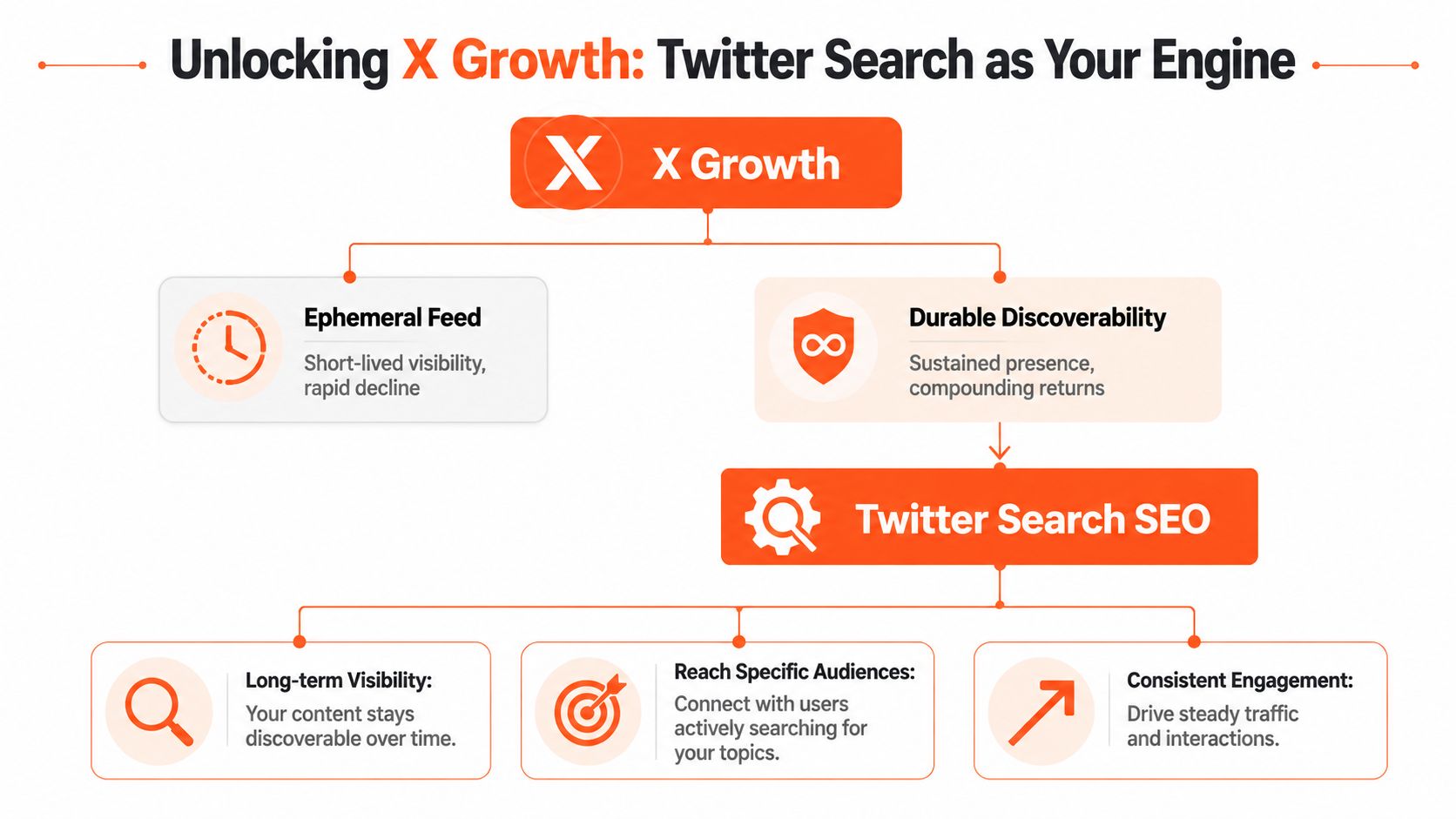
Search visibility compounds differently
Feed reach decays fast. Search reach often does not.
The accounts that keep getting found months later usually share the same pattern. They publish around a narrow set of topics. They use the same core phrases their audience already searches for. They write posts that stand on their own, so someone who finds them outside the main timeline still gets value immediately.
That matters beyond X itself. Public posts can appear when someone searches a founder's name, a product category, or a specific how-to query. AI systems can also surface or cite that content when the language is clear and specific enough to map to the question. If you are tracking the broader future of SEO with AI, X should be part of that discovery stack.
Search changes the quality of attention. You are no longer waiting to be distributed. You are meeting demand that already exists.
The metric that tells you if SEO is working
A lot of creators watch total impressions, likes, reposts, and follower growth. Those metrics matter, but they blur together feed distribution and search demand. The cleaner metric is search-driven impressions.
When search-driven impressions rise after you tighten keyword usage in your profile and tweets, that is a strong sign your wording is improving discoverability through search surfaces, not just getting temporary feed lift. That distinction matters because it tells you whether your system is building an asset or just producing spikes.
Use a simple review loop:
Track search-driven impressions: Look for sustained growth after you update profile language, tweet phrasing, and topic consistency.
Compare intent-based actions: Check whether profile visits, link clicks, and site traffic increase alongside those search impressions.
Review query-language fit: Use X advanced search on mobile to inspect how your phrasing matches real search behavior.
This is the shift many founders miss. Engagement tells you what spread. Search-driven impressions tell you what got found.
Foundation First Optimizing Your Profile for Discovery
Most weak X SEO starts before the first tweet. The profile is vague, the bio is clever instead of clear, and the account gives search systems no reliable clues about topic relevance.
Your profile should answer three things fast: who you are, what you talk about, and why a specific audience should follow. If any of those are fuzzy, discoverability gets harder.

Make your identity fields pull their weight
The biggest mistake is splitting brand clarity from keyword clarity. You need both.
Here is the field-by-field approach that works in practice:
Handle: Use your real name, brand name, or the closest recognizable version. Don't stuff keywords into the handle if it makes the account look fake.
Display name: A light keyword modifier can be helpful. "Jane Doe | SaaS SEO" is clearer than just "Jane Doe."
Profile image: Use a consistent headshot or logo. Search isn't only text. Recognition improves click-through from profile surfaces.
Header image: Reinforce topic focus. A founder building in AI can use a header that signals product, audience, or niche instead of decorative design.
A founder profile like "Alex Kim | B2B SaaS Growth" tells X far more than "Alex, building cool stuff."
Turn your bio into a search filter
Your bio should read like a positioning statement, not a riddle. Search engines and users both prefer plain language.
A solid bio usually includes:
your niche,
your audience,
your outcome,
one proof element or concrete angle.
For example:
Weak bio | Better bio |
|---|---|
Building on the internet. Thoughts on life and business. | Helping SaaS founders improve onboarding, retention, and product messaging. Sharing growth systems and teardown threads. |
The stronger version doesn't sound flashy. It works because it creates alignment between topic, audience, and expected content.
Practical rule: If a stranger lands on your profile and can't predict your next ten posts, the bio is too vague.
Location and website fields also matter more than people think. If your business has local relevance, location helps contextual discovery. Your website link should point to the asset that best matches your current topic, not a random homepage if that homepage doesn't continue the promise of the profile.
Pinned content matters too, but only if it supports the same topic cluster as the bio. A great pinned post acts like a homepage hero section. It should reinforce your core theme, not distract from it.
If you need help tightening the wording, this guide on how to write a strong Twitter bio that gets more followers is a useful reference point.
A good profile doesn't try to appeal to everyone. It makes the right searcher feel like they found the exact account they were looking for.
The Anatomy of a Search-Optimized Tweet
A search-optimized tweet isn't just "good content." It has a structure that helps X understand the topic quickly and helps users decide whether to engage.
The details matter here. Tweets between 71 and 100 characters consistently achieve the highest engagement rates, keywords in the first 50 characters get the most algorithmic attention, and 1 or 2 targeted hashtags are the recommended frequency, according to Userp's Twitter SEO checklist.

What strong tweet structure looks like
The first line carries more SEO weight than most creators realize. If your target phrase appears late, the post may still be readable, but it's weaker for discovery.
A simple structure works well:
Open with the topic keyword: Put the primary phrase near the start.
State one clear payoff: Tell the reader what they'll learn or get.
Keep it compact: Staying within the strongest length range forces clarity.
Use only relevant hashtags: One or two. No pile-on.
End with a direct CTA: Userp notes that simple CTAs like "Share your thoughts" or "Retweet if you agree" can double interaction rates in their checklist.
Here is a practical example for a founder writing about onboarding:
Stronger version:
User onboarding fails when the first win takes too long. Cut friction in the first session. Share your thoughts. #SaaS #Onboarding
That opens with the topic, makes one claim, stays tight, and gives the reader an action.
Bad version versus search-friendly version
A weak tweet usually fails in one of two ways. It either says nothing specific, or it tries to force discoverability by stuffing terms and hashtags.
Compare these in prose.
The weak version:
A long post about product growth, customer success, startup advice, user onboarding, conversion tips, and B2B marketing, plus a trail of hashtags. The keyword appears deep in the tweet. The reader has no idea what the main point is.
The search-friendly version:
"User onboarding tip: remove setup friction before asking for activation steps. Retweet if you agree. #SaaS"
This version is shorter, front-loads the topic, and gives the algorithm a cleaner signal.
A few trade-offs matter:
Shorter isn't always better: Too short can become vague. The best-performing range works because it's compact and complete.
Hashtags help when they're targeted: Irrelevant tags dilute the signal.
Hooks need clarity, not theatrics: Search favors understandable language over abstract cleverness.
If your openings tend to wander, study examples of high-performing hooks for X. Better hooks don't just improve engagement. They improve topic recognition.
The opening should tell both the reader and the algorithm what the post is about before either loses patience.
One more practical note. If you're linking out, don't lead with the URL. Lead with the keyword and value statement, then add the link if it belongs. The best search tweets read naturally first and optimize second. That order matters.
Advanced Signals Media Alt Text and Engagement Velocity
Most creators still treat X SEO like a copywriting problem. It's not. Text matters, but media context and early interaction signals often decide whether a post gets stronger search placement or fades away.
Alt text is not optional metadata
If you post images without alt text, you're dropping searchable context. Alt text helps accessibility, but it also helps the platform understand what the media contains.
A useful primer on the concept is this Alt text definition. On X, the practical move is simple: describe the image in plain language and include the essential keyword naturally.
The weak version says:
"chart"
The better version says:
"Onboarding funnel chart showing drop-off during account setup for SaaS users"
That description gives context, topic relevance, and accessibility at the same time.
Another overlooked point is that visual content can rank for text-based queries only when the platform has enough descriptive information to understand it. If you publish product screenshots, event photos, diagrams, or slides, the alt text should name what the user is looking at and why it matters.
A few rules keep this clean:
Describe the actual asset: Don't write promotional fluff.
Include the core keyword once: Natural placement is enough.
Match the tweet topic: The post and media should reinforce each other.
Do this on every visual: Not just your hero graphics.
The same logic applies to video. Keep overlays readable so muted viewing still communicates the topic, and make the opening frame obvious.
Early replies change ranking potential
A perfectly optimized keyword tweet can still lose in search if it gets no early interaction. That's the part most checklists miss.
According to Tweet Archivist's guide to Twitter SEO optimization, guides often focus on keywords and hashtags but fail to explain that X heavily weights early interaction signals for "Top" results. The same source notes that tweets with genuine questions or polls generate significantly more replies than declarative statements, which boosts visibility in the tabs where search results are drawn.
That changes how you should write.
Instead of ending with a flat statement, invite a response:
"What's the one onboarding screen you'd cut?"
"Which headline would you test first?"
"Agree or disagree?"
"Poll: long thread or short summary?"
Those aren't engagement bait when the question is real. They're ranking support.
A practical publish routine looks like this:
First move after posting | Why it helps |
|---|---|
Reply to the first thoughtful comment quickly | It extends the conversation and increases visible activity |
Seed a genuine question in the post itself | It improves reply likelihood |
Ask for a choice, not a vague opinion | Specific prompts are easier to answer |
Avoid posting and disappearing | Early inactivity hurts momentum |
The first stretch after publishing is not passive distribution time. It's active ranking time.
Indexing Consistency and Authority Building
Random wins happen. Search visibility that compounds does not.
X, Google, and AI engines all need the same thing from your account. Repeated evidence about what you cover, who your content helps, and why your posts should be retrieved for a specific query. One well-optimized post can rank for a term. A consistent account gets indexed with far less volatility, and that shows up over time in search-driven impressions.
Topic drift is the fastest way to slow that process. If an account posts SaaS pricing teardown one day, crypto jokes the next, and generic leadership advice after that, the indexing signal gets muddy. Search systems can still crawl the posts. They have a harder time assigning durable topical authority to the account.
The fix is narrow coverage with enough range to stay interesting.
A structure that works in practice looks like this:
Primary lane: the main subject you want associated with your account
Supporting lane: adjacent questions your audience searches before or after that core topic
Proof lane: screenshots, experiments, case notes, and examples that validate the first two lanes
For a founder, that might mean posting mostly about onboarding, activation, and pricing. For a creator, it might mean audience growth, content systems, and sponsorship breakdowns. Different formats are fine. Different topics are what break authority.
Cadence matters for indexing too, but only if you can sustain it. Buffer recommends posting during weekday windows such as 8 AM to 2 PM and suggests 3 to 5 posts per day as a workable range in its guide on how to use Twitter. I would not treat those numbers as law. They are a starting point for testing, not a universal schedule.
Here is the main trade-off:
Post too rarely: you give search systems fewer chances to classify your account and fewer opportunities to build retrieval history
Post too often: quality drops, topic discipline slips, and replies pile up unanswered
Post inconsistently: you make it harder to spot what is helping indexation versus what is just feed noise
A simple weekly rhythm beats heroic bursts. Three strong posts every weekday on the same subject cluster will usually build more authority than fifteen scattered posts across unrelated themes.
Measurement serves to keep the strategy honest. Use an X analytics tool for tracking search-driven impressions and post patterns so you can compare topic clusters, posting cadence, and impression sources over time. If a lane keeps producing search-driven impressions, keep feeding it. If a lane gets feed engagement but no search lift, it may be entertaining your audience without building discoverability.
Authority on X is not a branding exercise. It is an indexing exercise. Clear topics, repeatable cadence, and enough proof content to confirm relevance across X search, Google results, and AI retrieval systems.
Measuring What Matters and Your Implementation Checklist
The easiest way to misread X SEO is to celebrate vanity metrics. A post can get likes from the feed and do nothing for search. Another can look modest in public engagement and steadily build recurring discoverability.
That's why search-driven impressions should be the north star for this work. They tell you whether search demand is finding your content. If those impressions rise and the post also drives profile visits, link clicks, and site traffic, the system is working.
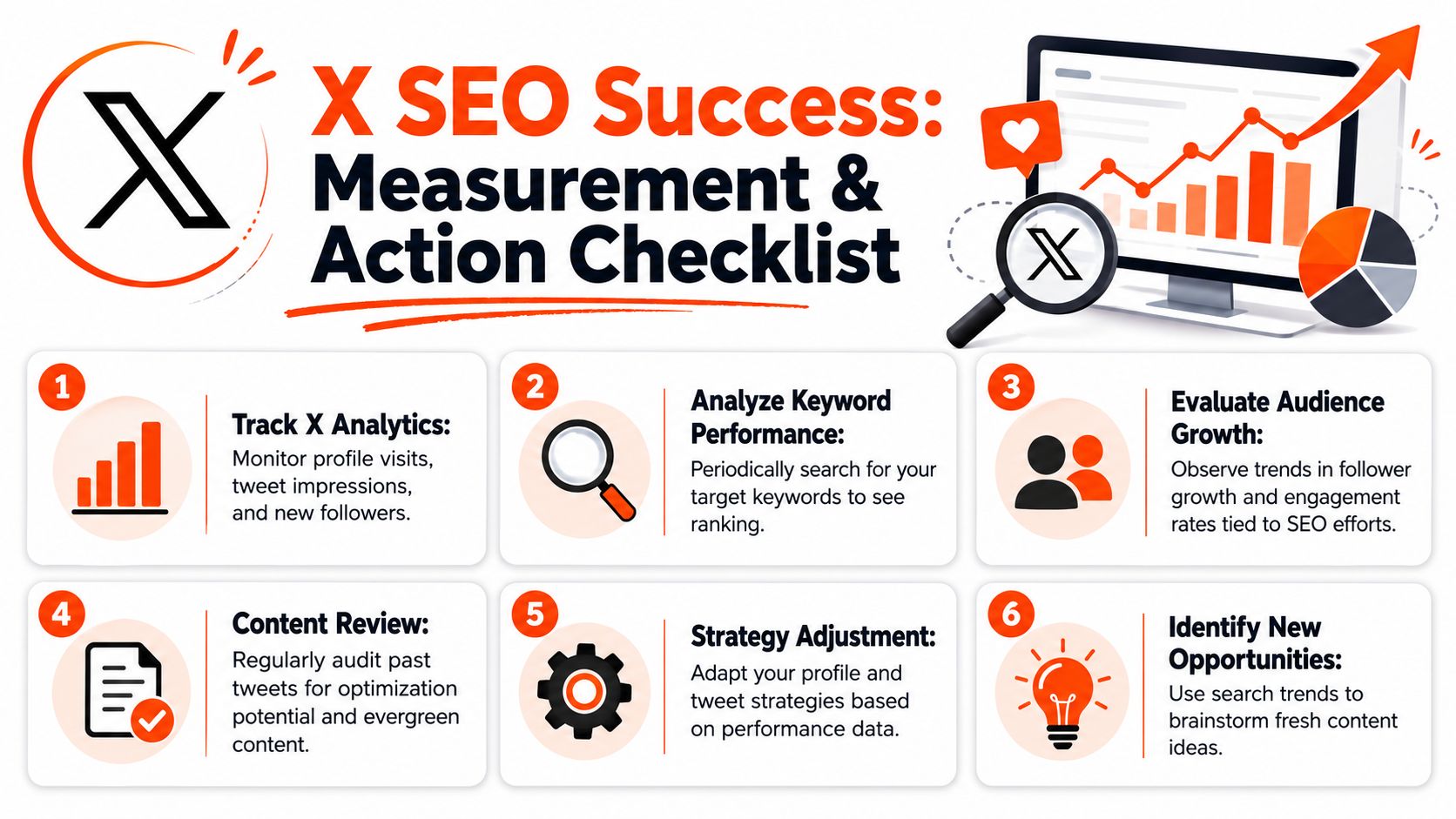
Your real dashboard for X SEO
Open X Analytics and stop starting with likes.
Look first at the metrics tied to search and intent:
Search-driven impressions: your direct visibility signal from query behavior
Profile visits: whether searchers want to know who you are
Link clicks: whether the post creates enough trust to earn action
Site traffic: whether X SEO contributes beyond the platform
The full funnel matters. A search impression by itself is not ROI. It's the top of an intent path. You want to see whether a better-ranked post also creates profile curiosity and downstream traffic.
A useful review rhythm is simple:
Look at which posts earned search-driven impressions.
Check the wording in those posts. Especially the opening phrase.
Compare what happened after the impression. Profile visit, follow, click, or nothing.
Rebuild future posts around the patterns that produced qualified actions.
If you want a better toolkit for ongoing review, these Twitter analytics tools are a practical starting point.
Implementation checklist
Most accounts don't need more ideas. They need a repeatable operating system. Use this checklist to tighten the whole stack.
Profile clarity: Make sure your handle, display name, bio, header, and pinned content all point to the same topic.
Keyword placement: Put the primary topic in the opening of the tweet, not buried in the middle.
Tweet length discipline: Stay concise enough to keep the post readable and easy to share.
Hashtag restraint: Use only the tags that reinforce the query you want to rank for.
Alt text coverage: Add descriptive alt text to every image and visual asset.
Reply design: End more posts with genuine prompts that invite discussion.
Topic consistency: Post within a clear niche often enough to build authority.
Time discipline: Publish on a schedule you can maintain and review, not one you abandon after a week.
Measurement habit: Track search-driven impressions before you obsess over public engagement.
Funnel validation: Watch what search traffic does after discovery. Profile visit, click, and site action tell the story.
One final distinction matters. Feed growth can look loud and still be fragile. Search growth often looks quieter while it's forming. Then it compounds because your profile, your wording, and your topic authority start reinforcing each other.
That is the promise of Twitter search engine optimization. Not more noise. More discoverability from the people already looking for what you know.
If you're serious about building an X growth system instead of winging every post, SupaBird is worth a look. It helps creators and founders generate stronger ideas, rewrite drafts into sharper formats, find smart engagement opportunities, and stay consistent with scheduling and coaching that explains why a post worked or flopped.

The Reply Guy Strategy: A Growth Guide for X

Why New X Accounts Get Less Reach

ClimbX Review (2026): Features, Pricing, Pros and Cons

How Developer Startups Build a Brand on X Before Launch

30-Day Starting Plan for New X (Twitter) Accounts

How Often Should You Tweet for Maximum Growth?

What Should Your First 10 Tweets Be About?

How to Run X for Ten Clients: The Agency Workflow

How to write a bio that gets people to follow you
