You've written a strong thread, saved every post, and picked the moment your audience is most likely to be online. Then the scheduled time arrives. The first tweet publishes, the second appears late, and the rest either land out of order or remain stuck in drafts. Or you post manually at what feels like a reasonable hour, only to discover that your audience in New York, London, Berlin, or Mumbai saw the thread at a completely different point in their day.
The phrase Twitter schedule a thread sounds like a simple composer feature. In practice, it's a publishing workflow involving copy preparation, reply sequencing, time-zone handling, media uploads, and recovery planning. The reliable approach separates writing from delivery, then treats the thread as a controlled chain rather than one large post.
Table of Contents
Why Scheduling a Thread Beats Posting Live
A creator can spend an hour shaping a useful thread and still lose momentum by publishing it at midnight in the audience's local time. The opening post may receive a few early impressions, but the people most likely to read, reply, and expand the thread are asleep. By the time they return, the thread has already moved down the feed.
That timing problem matters more for threads than for standalone posts. The first tweet acts as the entry point, and its early response influences whether readers continue to the replies. If the opening arrives during a quiet period, the later posts don't get the same opportunity to build attention. Manual publishing also introduces avoidable pressure. You're watching the clock, copying each post, checking that every reply attaches to the correct tweet, and trying not to introduce a typo halfway through the sequence.
Independent timing research supports planning around a narrower weekday-morning window instead of publishing randomly. One 2026 analysis of 8.7 million X posts identified Tuesday at 9 a.m. as the single strongest slot, with Wednesday at 9 to 10 a.m. close behind, as reported in large-scale X posting-time analysis. Broader summaries place the strongest overall window around 9 to 11 a.m. local time on weekdays, particularly from Tuesday through Friday, though your own audience should remain the final judge.
Practical rule: Schedule the opening post for the audience's local peak, not for the hour when you happen to finish writing.
A planned workflow also makes consistency possible. You can develop several ideas while you're focused, refine them without a live deadline, and place each thread into a calendar that accounts for different cities. A useful social media marketing automation workflow should reduce repetitive publishing work without hiding the risks of connected posts.
The important distinction is that scheduling isn't merely convenient. It protects the thread's opening moment and reduces the chance that a rushed manual sequence breaks the reader's path.
What Native X Scheduling Can and Cannot Do for Threads
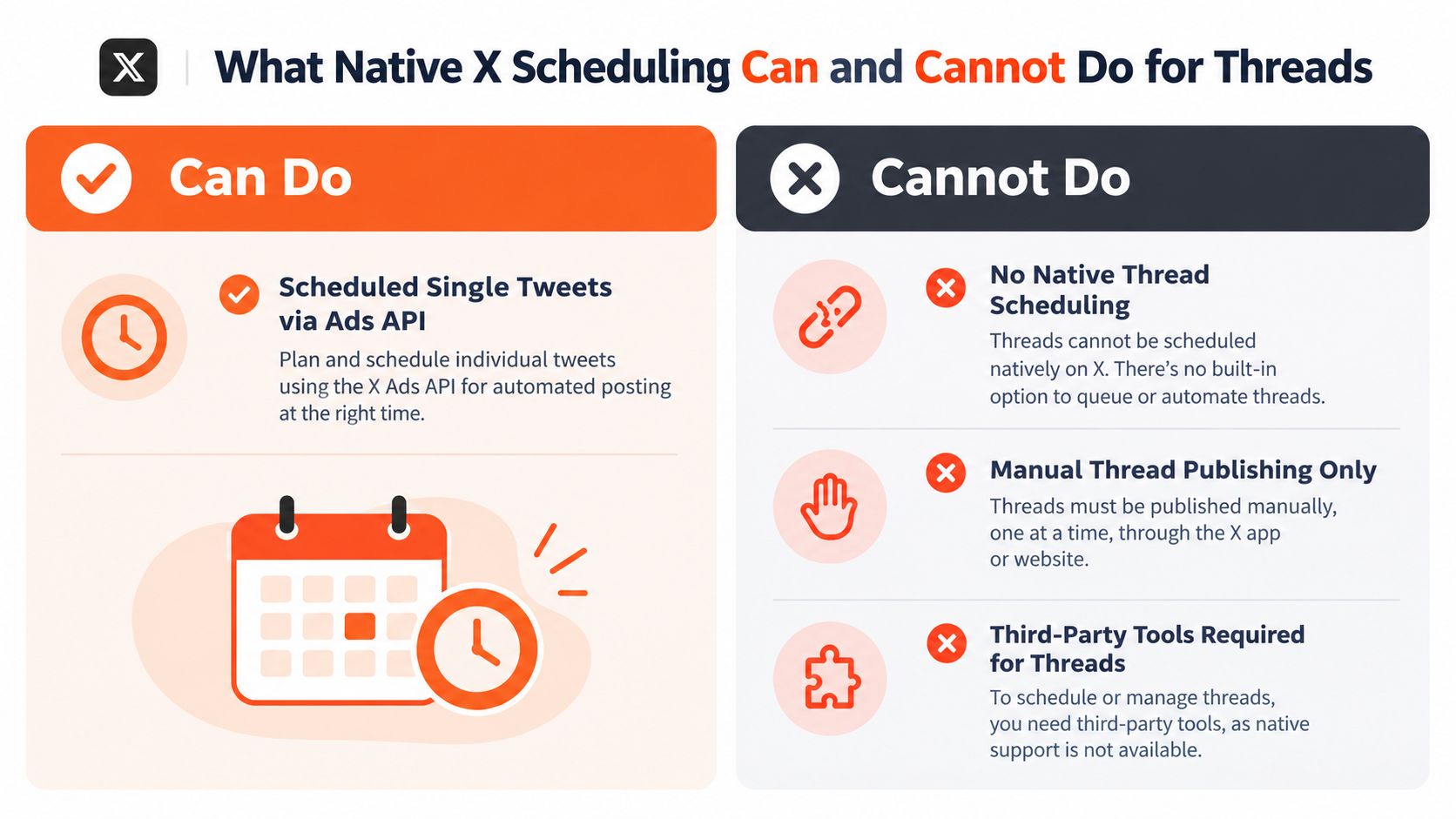
X supports scheduled Tweets as part of its broader publishing infrastructure. Its Ads API documentation includes endpoints to create, list, retrieve, modify, and delete Scheduled Tweets, and the documentation for that capability has existed since 2017, with the current page last updated in 2025, according to X's official Scheduled Tweets developer documentation.
That support creates understandable confusion. A creator sees scheduled publishing in X's ecosystem and assumes the same feature can schedule a connected thread from the standard composer. The practical limitation is different. X API v2 doesn't provide a native scheduled_at field for standard tweet creation, and it doesn't offer a dedicated thread-creation endpoint. A thread scheduler therefore has to coordinate each post independently.
Publishing option | What it handles | Where it stops |
|---|---|---|
Native single-post scheduling | Future delivery for individual posts through supported X publishing infrastructure | It doesn't turn multiple posts into one scheduled thread |
Native thread composer | Building and publishing connected posts immediately | It doesn't provide a future publish time for the complete sequence |
API-based orchestration | Posting each segment in order, usually as a reply to the previous segment | Timing, failures, and sequencing must be managed above the basic post endpoint |
Third-party scheduler or X Pro | A practical interface for preparing and queuing connected posts | Reliability depends on the tool's queue, media handling, and recovery controls |
The distinction is simple: native scheduling can handle a scheduled post, but a reliable scheduled thread requires orchestration. The scheduler publishes tweet one, records its identifier, uses that identifier to create tweet two as a reply, then continues through the chain. It isn't one atomic publish action.
That's why the right decision comes before drafting. If you only need one future post, native scheduling may be enough. If you need a connected sequence that publishes while you're away, look for a dedicated thread workflow. A scheduling support resource can help you evaluate that difference before you commit a finished thread to a tool.
How to Prepare Your Thread for Reliable Scheduling
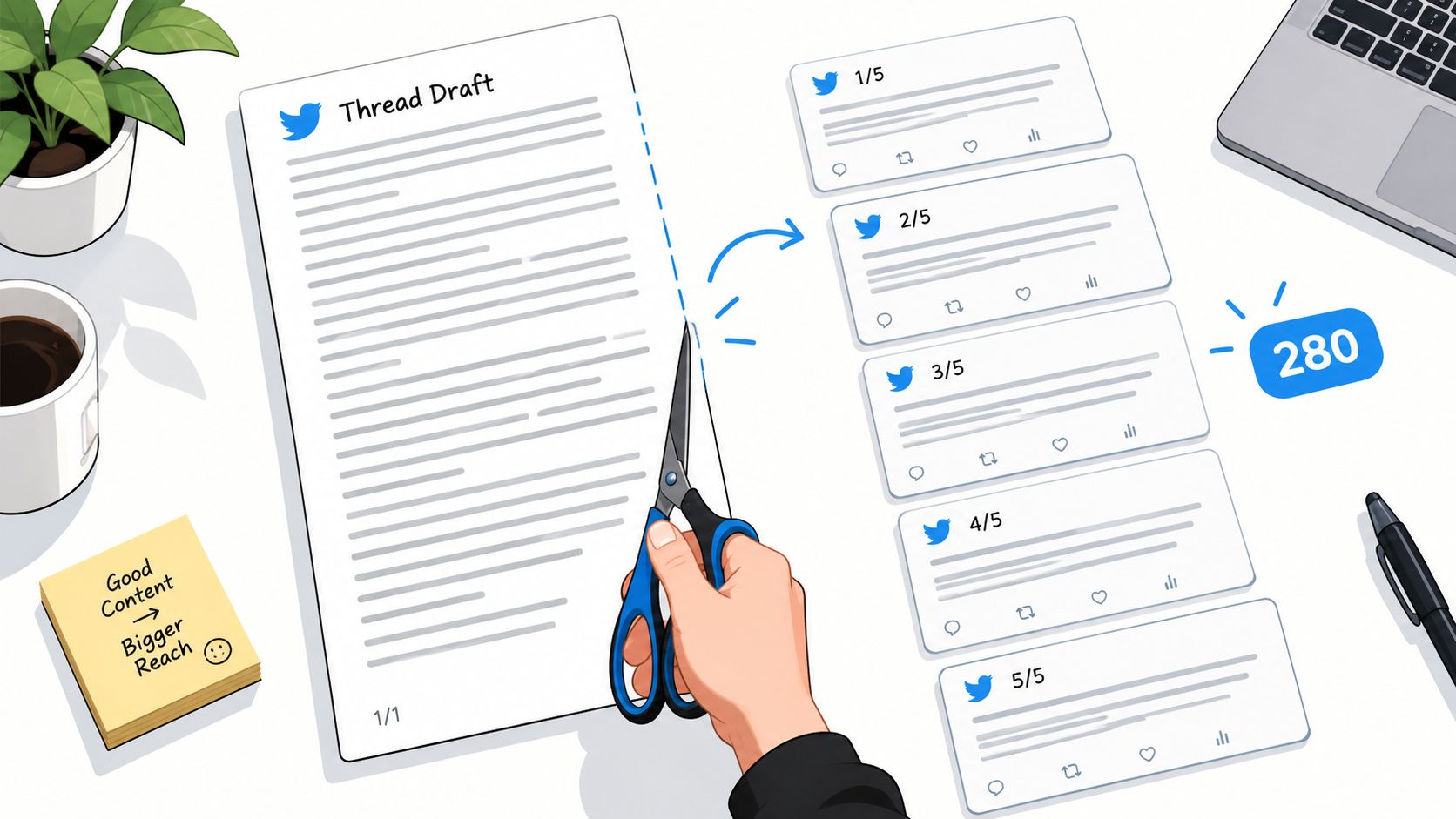
A scheduler can't repair a thread that was written as one oversized block. Prepare each post as an independent segment, then test whether the sequence still reads naturally when connected.
When a third-party tool schedules a thread, it publishes each segment as an individual tweet in sequence, not as one monolithic post. The 280-character limit applies to each segment, and each tweet can include up to 4 images or exactly 1 video or 1 GIF, as documented in this guide to scheduling Twitter threads.
Build the sequence before opening the scheduler
Start with a plain-text outline. For a practical 7-to-10 tweet thread, give every segment one job:
Hook: State the problem, promise, or surprising point.
Context: Explain why the reader should care.
Development: Deliver the main points in a logical order.
Example: Show how the idea works in practice.
Payoff: Resolve the tension created by the opening.
Action: Tell the reader what to do next.
For example, a weak draft might begin with a long paragraph about scheduling, API limitations, audience timing, and media uploads. A stronger sequence separates those ideas:
Post one: “Your X thread didn't fail because the idea was weak. It failed because the publishing chain was fragile.”
Post two: Explain why standard scheduling handles one post but not a connected sequence.
Post three: Show the reply relationship between each segment.
Post four: Explain how local-time delivery changes the opening moment.
Post five: Give a short checklist for preventing partial publication.
Final post: Offer the next action, such as saving the workflow or testing a scheduled draft.
Write the text-only version first. External links can interrupt the reading flow, so keep them out of the main thread body and place them in a follow-up reply after the first-hour scoring window when that fits your strategy. Add media only after the narrative works without it. A screenshot can clarify a process, while a video can carry a demonstration, but neither should compensate for a weak transition.
Run a preflight check
Read each tweet on its own, then read the full chain aloud. Check that the opening makes sense without a prefix, every post advances the argument, and the final post feels like a conclusion rather than an abrupt stop. A Twitter thread template can speed up outlining, but you should still edit the language for your own voice and audience.
Before scheduling, confirm:
Character fit: Each segment remains within its platform limit.
Reply order: The posts are arranged from hook to payoff.
Media match: Every image, video, or GIF supports the specific post.
Link placement: Outbound links don't dominate the early reading experience.
Recovery copy: You can repost a failed segment without rebuilding the entire thread.
How to Schedule Your Thread for Peak Local Time
If your audience is in Berlin while you schedule from New York, your preferred posting hour can put the thread in front of readers at the wrong part of their day. Set delivery around the audience's location, then test separate windows when your readers span several time zones.
A practical starting point is Tuesday through Thursday, 9 to 11 a.m. local time. Queue the thread 5 to 10 minutes before peak activity, giving the opening post time to collect early interaction before the busiest period, consistent with this X thread timing synthesis. For broader planning guidance, compare your slot with these recommendations for the best time to post on X.
Use a calendar that shows each delivery in the audience's local time. A Berlin-focused thread might go out shortly before the city's morning peak, while a New York version may need a separate queue if the argument depends on current discussion. Converting every slot from your own time zone is a common way to publish when the intended audience is unavailable.
A practical queue workflow
Select the audience: Identify the primary city, region, or time zone.
Choose a test window: Begin with a weekday morning slot instead of an arbitrary hour.
Place the thread early: Queue it 5 to 10 minutes before the expected peak.
Set the thread sequence: Verify that every post replies to the immediately preceding post.
Add the follow-up: Prepare a self-reply for 3 to 5 minutes after publication to keep discussion active.
Review the queue: Check dates, local-time settings, media, and account permissions before leaving the thread unattended.
A cadence of 1 to 3 threads per week supports a regular publishing habit without forcing every idea into a thread. Batch the creative work, then distribute publication across the calendar so each test has a clear audience and time window.
A short walkthrough shows how calendar-based planning fits into a broader X workflow:
Treat the first few scheduled threads as controlled tests. Keep the topic, format, and audience consistent enough to compare results, then adjust the time zone or delivery window using actual reader behavior.
Troubleshooting When Your Scheduled Thread Fails or Breaks
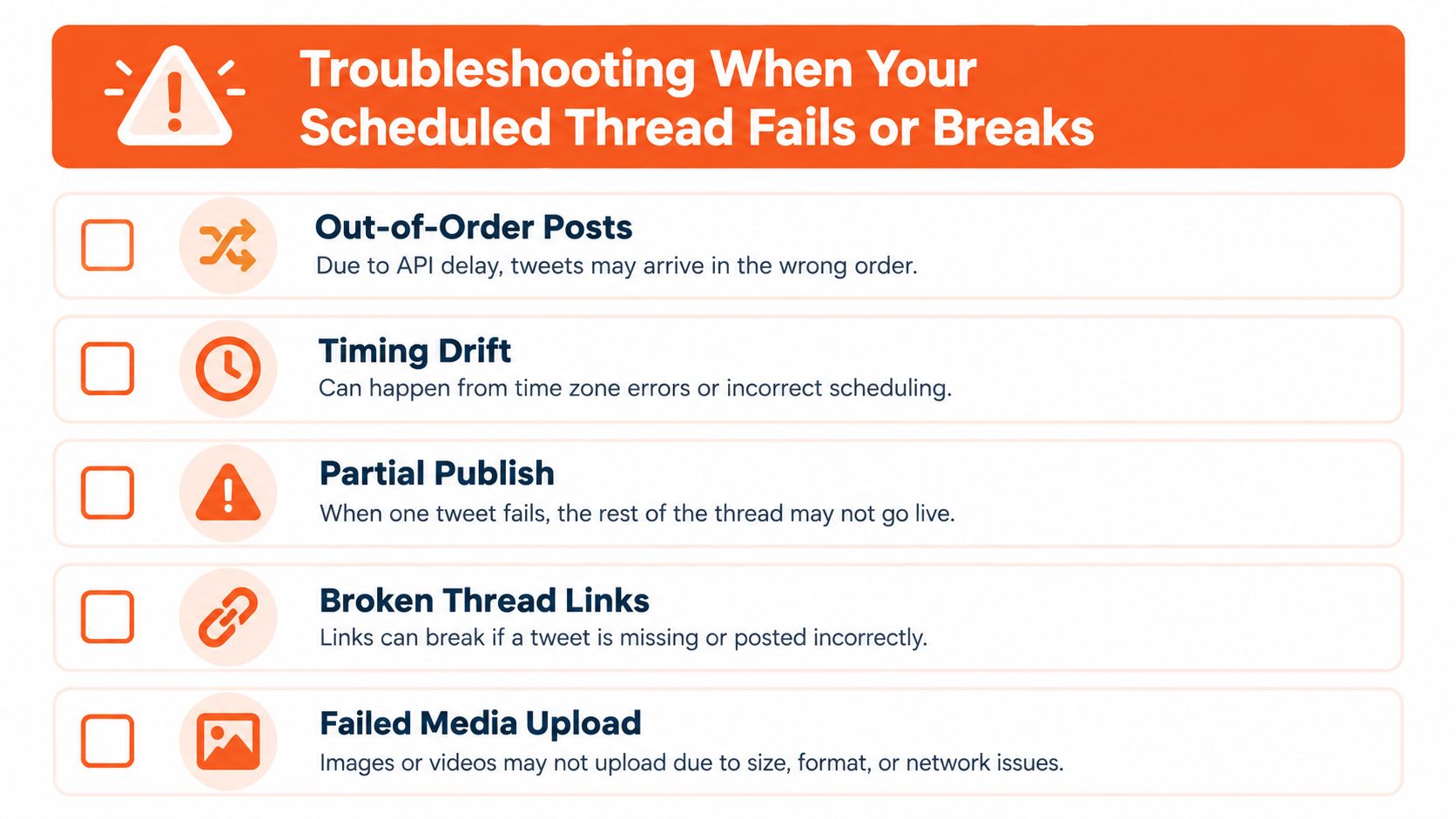
A scheduled thread is a chain of separate publishing actions. That architecture creates failure points that don't exist when you publish one post. A delayed API response can affect the reply relationship, a time-zone setting can shift delivery, and a failed media upload can leave one segment incomplete.
Operational risk is often underexplained. Recent guidance notes that connected-thread tools publish posts in sequence, and some recommend spacing posts by only seconds or minutes, but it rarely quantifies why that spacing matters. The important point is that short spacing doesn't eliminate dependency risk. The next post still needs the prior post's identifier and a successful publishing response.
Diagnose the failure by symptom
Out-of-order posts: Check whether the scheduler created every post as a reply to the immediately preceding tweet. If one segment was posted independently, stop the queue before the chain becomes harder to repair.
Timing drift: Review the account's time zone, daylight-saving handling, and the calendar's displayed local time. Don't rely on a copied timestamp from a different tool.
Partial publication: Find the last successfully published tweet, then save its URL and identifier. You can manually publish the missing continuation as a reply instead of reposting the entire thread.
Broken links between posts: Open the live chain from the first tweet and verify each reply relationship. A visually adjacent post isn't necessarily part of the same thread.
Media failure: Confirm that the media finished uploading before the scheduled item entered the queue. If a visual fails, publish the text continuation first and add the media in a follow-up where appropriate.
Recovery rule: Preserve the live chain first. A clean continuation is usually better than deleting everything and restarting while the audience is already reading.
Before the next scheduled run, make a small test with nonessential copy. Verify the tool's spacing behavior, queue limits, account authorization, and media handling. Keep a plain-text backup of every segment so you can recover without reconstructing the thread under pressure.
If part two publishes late, don't immediately flood the account with duplicate versions. Check whether the original scheduler is still retrying, identify the last valid reply, and intervene only after you understand the queue state. The goal is to restore coherence, not create multiple competing continuations.
Your Repeatable System for Consistent Thread Growth
Consistent thread growth comes from separating production decisions from publication decisions. Write when you have clarity, edit when you can be critical, and schedule when your audience is most likely to pay attention. That separation prevents the common mistake of treating inspiration time as the correct publishing time.
Build a lightweight operating rhythm:
Capture ideas continuously: Keep a running list of problems, lessons, and observations that can support a complete argument.
Batch the structure: Turn related ideas into hooks, supporting points, examples, and conclusions during one focused writing session.
Edit for sequence: Remove repetition, shorten weak openings, and make every segment understandable on its own.
Schedule locally: Test weekday morning delivery in the audience's time zone before expanding to other windows.
Review the chain: Check whether the thread stayed connected, whether the hook earned attention, and where readers stopped responding.
Add human judgment: Use daily feedback to decide whether the next draft needs a sharper hook, clearer visuals, or a different publishing time.
The timing evidence is useful, but it isn't universal. A major academic and industry analysis found that morning posts produced about 8.8% more link clicks than afternoon posts and 11.1% more than evening posts, while boosted afternoon posts achieved about 21% more clicks than boosted morning posts, according to the social content scheduling analysis. That difference matters because native text threads and link-heavy or boosted formats shouldn't be judged by the same assumption.
Keep external links out of the early thread when the primary goal is conversation and reading depth. Put the destination in a follow-up reply when appropriate, then compare the quality of replies, saves, profile visits, and clicks rather than chasing one universal posting hour.
The repeatable advantage isn't pressing Publish at the perfect moment. It's preparing a coherent chain, delivering it in the audience's local morning, and learning from every run.
SupaBird gives you a calendar for timezone-aware X scheduling, a connected thread composer, Ideas Lab for developing new angles, Engage for finding relevant conversations, and X Coach feedback from AI tips plus a human mentor. Visit SupaBird, prepare your next thread, and queue it for the audience's local peak before the idea goes cold.

How Often Should You Tweet for Maximum Growth?

What Should Your First 10 Tweets Be About?

How to Run X for Ten Clients: The Agency Workflow

How to write a bio that gets people to follow you

Digital Product Launch Strategy

Best Twitter Growth Service for Creators in 2026
From X to Every Platform: Repurpose Without Flopping

How to Get Cited by Grok: Winning X’s AI Search in 2026

5 X (Twitter) Growth Metrics Every Serious Creator Should Track — and How to Get the Data