More posting alone doesn't create stronger engagement. It creates more opportunities to be ignored.
Effective Twitter engagement tips work as a connected operating system. Replies put you in high-intent conversations. Formats make your ideas easier to recognize. Timing helps the right people see them. Visuals improve comprehension. Community habits build familiarity. Measurement tells you which activity attracts meaningful conversations instead of empty impressions.
The strongest system also separates attention from intent. A post can earn likes because it provokes a reaction, yet fail to generate profile visits, qualified followers, or useful replies. Research on X's recommendation changes highlights this tension, with ranking systems favoring interaction signals that can maximize time and activity, while creators still need to protect trust and brand quality (CEPR's analysis of X's algorithm shifts).
The ten tactics below are designed for execution. Each includes a practical scenario, a trade-off, and a repeatable implementation move. You'll also see where SupaBird's Engage, Ideas Lab, X-GPT, calendar, video-to-post, and X Coach features can reduce the friction between knowing what to do and doing it consistently.
Table of Contents
3. Leverage Storytelling to Build Emotional Connection and Recall
6. Post Consistently at Optimal Times Across Global Audiences
7. Use Visuals Images Videos and Carousels to Increase Click-Through and Retention
8. Engage with Your Audience's Content Regularly to Build Reciprocal Relationships
9. Share Data Findings or Case Studies to Establish Credibility and Drive Engagement
10. Share Authentic Behind-the-Scenes and Daily Wins to Build Relatability
1. Reply to High-Intent Conversations Within the First Hour
A strong reply is often more valuable than another standalone post. It places your expertise inside a conversation where people already care about the subject, which is especially useful when the original post comes from a creator, buyer, or industry voice your audience follows.
Suppose a SaaS founder notices an industry leader discussing onboarding friction in the morning. A generic response such as “Great point” disappears. A better reply adds a short observation from customer conversations, asks one precise follow-up question, or offers a useful counterexample. Readers who open the thread can then discover the founder through the quality of the contribution.
X activity is especially sensitive to early momentum. One 2026 algorithm-focused analysis says X evaluates posts most aggressively during the first 30 to 60 minutes, and contrasts 20 replies in the first 30 minutes with 50 replies spread across 24 hours, arguing that concentrated reply velocity can outperform delayed volume (Neil Patel's X analysis). Treat that as an operating principle, not a promise of a fixed result.
Practical rule: Prepare to contribute quickly, but never trade relevance for speed.
Use this workflow:
Build a watchlist: Follow target customers, respected specialists, competitors, and creators whose audiences overlap with yours.
Prepare reply angles: Keep prompts for a question, a contrasting experience, and a practical example. Don't publish them unchanged.
Reserve monitoring blocks: Check conversations during the opening part of your chosen posting window, then return later for follow-up replies.
Review the thread: Prioritize conversations where people are asking for clarification or sharing problems you can solve.
SupaBird's Engage workflow for finding and replying to the right posts on X faster can reduce discovery time. The tool matters only if you still add a specific, human contribution.

2. Use Proven Viral Formats and Templates Consistently
Random thoughts make content creation feel spontaneous, but they make learning difficult. If every post uses a different structure, you won't know whether a weak result came from the idea, the hook, the format, the timing, or the audience match.
Recognizable formats solve that problem. A contrarian opinion can introduce a debate. A framework can organize a complicated idea. A personal story can create recall. A thread can support a sequence of lessons. The format doesn't replace originality. It gives the original insight a structure people already know how to read.
A marketing manager might publish a recurring “lessons from a career in marketing” series, while a founder uses an “unpopular opinion” post to challenge a familiar growth assumption. A coach could turn one recurring audience problem into a concise three-step framework. Each format creates a clear expectation, but the examples, evidence, and point of view must change.
Build a small format portfolio
Start by reviewing your strongest posts. Don't focus only on likes. Note whether the post earned replies, reposts, profile visits, or clicks. Then record the structural features:
Opening style: Did it begin with a claim, question, story, or surprising observation?
Delivery format: Was it a single post, thread, image, video, or quote post?
Conversation trigger: Did readers debate, explain their experience, or ask for more detail?
Conversion path: Did the post make people visit your profile or request help?
Keep a swipe file of formats that fit your niche, then test one variation while retaining familiar structures. SupaBird's Twitter post templates for 2026 can help generate starting structures, while X-GPT can reshape a draft without removing your underlying argument.
The trade-off is obvious. Templates improve consistency, but overuse makes your feed predictable. Change the story, evidence, visual treatment, and conclusion, not just the nouns inside a copied formula.
3. Leverage Storytelling to Build Emotional Connection and Recall
Advice gives people instructions. Stories show why those instructions matter and make the lesson easier to remember.
A founder describing a failed launch can identify the decision that caused the problem, the signal they missed, and the process they changed. A coach sharing a moment of doubt can connect a business lesson with an experience readers recognize. An indie hacker documenting an uncertain build gives followers a reason to return, because they are following an outcome as it develops rather than reading isolated tips.
Choose stories that serve the audience. Open with a situation readers recognize, add a constraint, mistake, or uncomfortable realization, then resolve it with an action and a usable lesson.
Build the story around one correction
Use a simple sequence:
Setup: “Our trial users kept abandoning the product after the first session.”
Conflict: “We assumed the interface was confusing, so we kept redesigning screens.”
Resolution: “Customer conversations showed the issue was unclear activation guidance. We changed the onboarding sequence instead.”
The structure gives readers a problem, a mistaken assumption, and a practical correction. It also creates natural conversation. Readers can describe a similar mistake, question the interpretation, or ask how the change was implemented.
Add a visual when the story involves a process, product change, or behind-the-scenes moment. A screenshot, short video, or annotated image can make the sequence easier to follow, while the written post carries the context and lesson.
The trade-off is exposure. Vulnerability can strengthen connection, but publishing every setback may blur your positioning or disclose information that should remain private. Remove confidential details, choose an experience with a clear audience benefit, and finish with an observation readers can apply rather than a request for sympathy.
SupaBird's Ideas Lab can turn one recurring experience into several story angles. X Coach can tighten the opening, clarify the lesson, or suggest a stronger visual treatment without making the account sound manufactured. Test different openings and visuals, then track replies, profile visits, and clicks to identify which stories deserve another format.
4. Create Threads That Teach or Break Down Complex Topics
Threads earn attention when the idea needs a sequence, framework, or careful explanation. Use the format to show how a decision was made, how a process works, or why a common approach fails.
For example, a SaaS founder can explain how they compare pricing options. A marketing manager can audit a landing page from headline to proof, objections, and call to action. A coach can turn a transformation story into the decisions behind the result, giving readers a method they can examine rather than a motivational conclusion.
Start with the payoff. “Here's how we think about onboarding” leaves the value unclear. “Most onboarding audits start with screens. We start with the moment a new user first understands the product” creates tension and states the thread's point of view.
Build the sequence around the reader's next decision:
Write the conclusion before the opening post.
Arrange the supporting ideas in a logical order.
Cut points that repeat the same lesson.
Add a concrete example where the advice feels abstract.
Finish with an action readers can try or a question about their experience.
Numbered posts make the progression easier to scan. Give each post one job, then move from the problem to the framework and its application. A thread template can help organize that structure before drafting: Twitter thread template. SupaBird's video-to-post feature can also turn a spoken explanation into a draft thread, though the draft still needs editing for clarity, pacing, and emphasis.
Review the first post separately from the rest. A strong explanation cannot compensate for an unclear opening, and thread production takes more planning than a single post. Reserve the format for ideas with meaningful progression instead of expanding every observation into a long sequence.
After publishing, record replies, profile visits, and clicks, then test a different hook or visual treatment when the idea deserves another pass. Repurpose the finished thread into a newsletter section, short video script, or visual summary. That extends the thinking without repeating identical copy across channels.
5. Ask Genuine Questions to Spark Conversation and Feedback
Questions create an opening for the audience to contribute. Statements can earn agreement, but a well-designed question gives readers a clear role in the post.
The quality of the question determines the quality of the replies. “What do you think about marketing?” asks too much and provides no useful direction. “Which part of your onboarding creates the most confusion, setup, activation, or reporting?” gives people an easy way to respond while producing information you can use.
A product manager might ask which feature customers would remove from their current tool. An indie hacker could ask what prevents people from starting a side project. A consultant might ask which reporting task consumes the most time each month. These questions don't merely chase replies. They reveal language, objections, priorities, and opportunities for future content.
Make participation easy, then continue the conversation
Use one clear question per post. Prefer prompts that ask what, why, or how, because they invite richer answers than a simple yes or no. Multiple-choice questions can work when the options represent real trade-offs rather than an obvious correct answer.
The best question posts are research instruments disguised as conversation.
When replies arrive, respond with a follow-up that shows you read the answer. Ask for context, compare experiences, or explain what you've seen. Then turn recurring themes into a follow-up post or thread. That closes the loop and gives contributors a reason to participate again.
The trade-off is moderation effort. An open question can attract comments you can't answer individually, and a controversial prompt may produce attention without useful insight. Set a clear boundary around the subject, avoid manipulative outrage, and prioritize replies from people who resemble the audience you want to serve.
Schedule questions when your audience has enough attention to think, not merely scroll. Timing supports the conversation, but the prompt still has to earn it.
6. Post Consistently at Optimal Times Across Global Audiences
Posting time is an operating choice, not a universal shortcut. Set it according to audience location, browsing habits, and the job of each post, then validate the choice with account-level results.
A 2026 analysis of 8.7 million X posts ranked Tuesday at 9 a.m. as the strongest single time, with Wednesday at 10 a.m. and 9 a.m. close behind. It also found weekday activity concentrated between 9 a.m. and 11 a.m., a useful starting point for work-focused audiences (Buffer's analysis of the best time to post on X).
Another analysis of 707,338 posts identified 7 p.m. to 11 p.m. local time as the strongest overall window. Sunday at 7 p.m. generated about 17% more impressions than an account's typical post (SocialBee's posting-time research). The different findings are practical evidence against copying a single global schedule.
Turn timing into a controlled workflow
Start with local audience time rather than your own workday. A Berlin-focused account may need a different schedule from one serving New York. A global SaaS company can rotate morning slots across regions, then check whether replies and clicks come from target markets or incidental audiences.
Record each test using:
Local publishing time
Post format
Audience region
Replies and reposts
Profile visits and link clicks
A 2026 synthesis of more than 1.7 million posts, alongside the Buffer analysis, also identifies Tuesday through Thursday morning, especially 8 a.m. to 11 a.m. local time, as a reliable cluster (Sent2X's 2026 posting-time analysis). Use that cluster for the first test, then adjust based on meaningful actions rather than impressions alone.
SupaBird's calendar supports planning across cities such as Berlin, New York, London, and Mumbai, alongside this guide to the best time of day to post on X in 2026. Scheduling improves consistency, but it can leave a feed disconnected from live conversations. Reserve reply blocks and monitoring time, particularly for posts intended to start discussion.
7. Use Visuals Images Videos and Carousels to Increase Click-Through and Retention
Text can explain an idea. A visual can make the idea immediately legible.
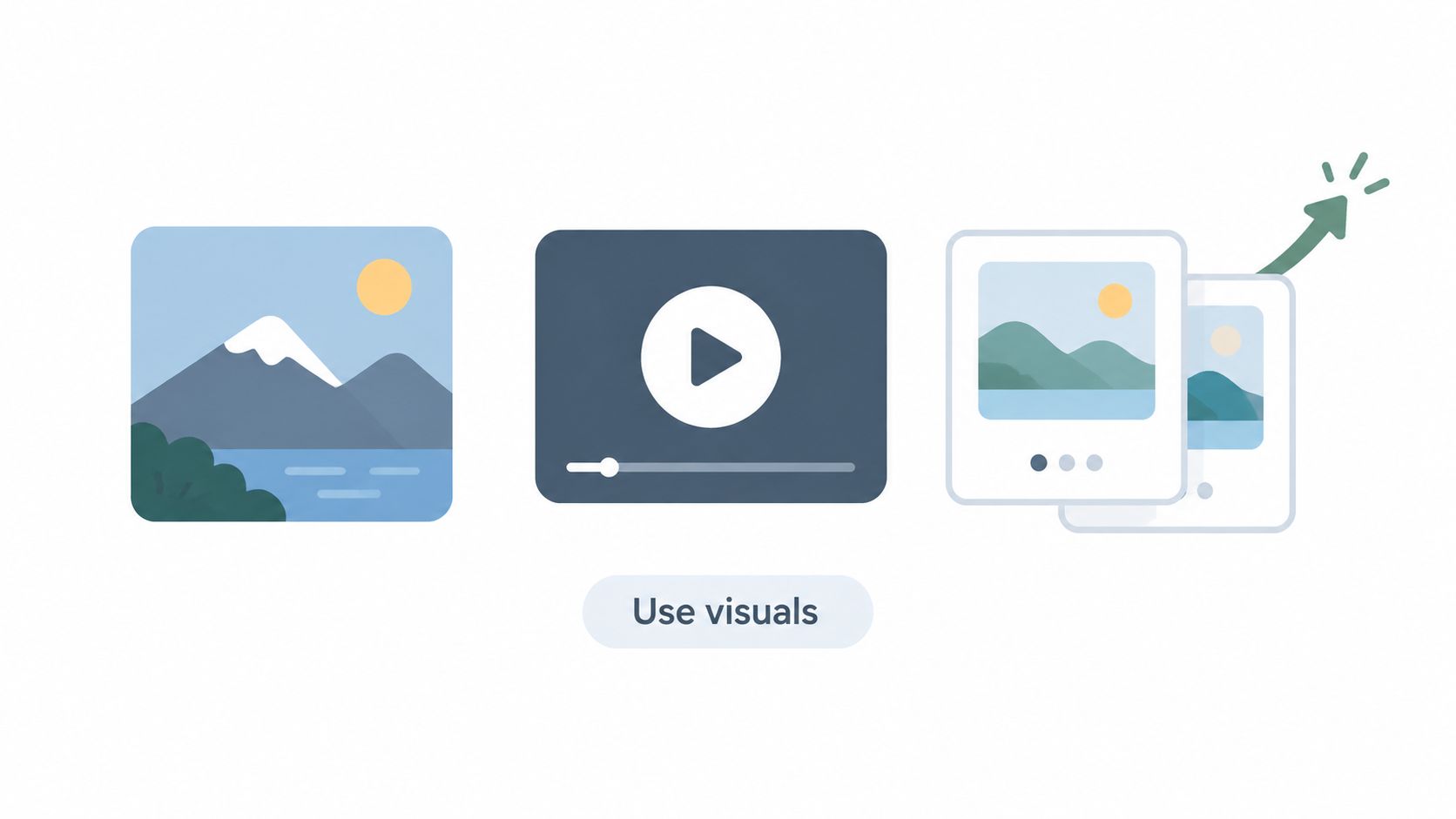
A product team might share a before-and-after interface screenshot. A consultant could turn a framework into a carousel with one principle per card. A founder might record a short walkthrough showing the exact problem a feature solves. These formats reduce the reader's interpretation burden and make technical or operational ideas easier to scan.
Visual consistency also helps recognition. Use a restrained set of colors, repeatable typography, and a layout that leaves enough space around the main point. The goal isn't to make every post look like an advertisement. It's to help people identify your content quickly and understand its value without reading a dense paragraph.
Match the medium to the job
Use screenshots for proof, diagrams for systems, carousels for sequences, and video for demonstrations or personal explanation. Add captions or text overlays when the message depends on spoken words. A phone-recorded explanation can feel more credible than an overproduced advertisement when the audience wants direct access to the operator.
SupaBird's video-to-post feature can turn a recorded explanation into text ideas, while X-GPT can help create shorter hooks and captions. If you outsource motion work, research motion graphics studios that can work within your brand system.
A short video can also support a text post without replacing it.
The trade-off is production overhead. Visuals take time, and visual polish can become a distraction from the underlying insight. Start with screenshots, simple diagrams, and direct phone video. Track profile visits, clicks, replies, and meaningful retention signals rather than assuming every extra design element improves performance.
8. Engage with Your Audience's Content Regularly to Build Reciprocal Relationships
Your audience is already publishing questions, launches, problems, and working notes. Those posts reveal intent more clearly than a passive follower count, so engagement should begin with the people and topics closest to your business.
A marketer who replies to target customers can become familiar before making an offer. A founder who contributes to product discussions may earn warmer introductions than one who only announces features. A coach who responds to audience members' work builds trust through repeated, useful contact.
Regularity matters more than occasional bursts. One thoughtful reply may start a relationship. Relevant participation over time makes your name recognizable.
Use a simple relationship queue rather than browsing at random:
Customers and prospects: People whose problems shape your product or service.
Peers and collaborators: Specialists who can challenge your thinking or support future partnerships.
Distribution partners: Creators and communities where a useful contribution can reach a relevant audience.
Review this queue during a defined daily block. Like selectively, repost content that merits wider reach, and write replies containing a practical example, a useful question, or a respectful disagreement. A reply should make the original post more useful. Repeating one generic sentence across several accounts signals that you are collecting visibility instead of contributing.
SupaBird's Engage module surfaces relevant conversations and reply opportunities, reducing search time. You still choose whether the conversation fits your audience and whether your contribution deserves attention.
“Be consistently useful in public, then let familiarity do part of the selling.”
Measure the workflow by qualified profile visits, direct conversations, introductions, and collaborations. Likes left behind are activity, not necessarily progress.
The trade-off is time. Engagement competes with writing, customer work, and product development, so set a fixed block and review the outcomes regularly. Keep the accounts that produce meaningful conversations, adjust the topics that attract the right people, and stop spending time on interactions with no clear relationship value.
9. Share Data Findings or Case Studies to Establish Credibility and Drive Engagement
A result earns discussion when readers can examine the question behind it. Share the decision the evidence was meant to inform, then show what changed and where the conclusion may not apply.
Start with a specific operating question: Which churn reasons appeared in customer feedback? Which landing-page headline performed better in a comparison? Which client-work pattern justified changing a coaching process? Protect private information, remove identifying details, and explain whether the material came from interviews, product analytics, a survey, or a controlled comparison.
Keep the evidence easy to audit. Name the metric, comparison, or observation, then separate what happened from what you believe it means. A chart without interpretation gives readers a visual, not a useful decision.
Make the finding useful
Build the post around five points, but vary the presentation across formats:
Context: The question you wanted to answer.
Method: How you gathered or compared the information.
Finding: The pattern that appeared.
Caveat: What could make the result incomplete.
Action: The next step another operator can test.
Explain how the result affects onboarding, pricing, or content decisions. Then ask readers whether their experience matches the pattern. That question creates a clearer reply path than asking for general opinions.
The trade-off is credibility risk. Selective evidence can support a weak argument, while confidential details can expose customers or business information. Anonymize sensitive material, state the limits of the sample, and avoid presenting one account's outcome as a universal rule.
Treat the research as a small content system. Publish the core finding, adapt it into a visual, explain the method in a thread, and ask a focused question about whether others observed the same pattern. SupaBird's Ideas Lab and calendar can reduce the planning work, while X-GPT can help reshape the same evidence without changing its meaning. Review replies and saves, then use those signals to choose the next experiment.
10. Share Authentic Behind-the-Scenes and Daily Wins to Build Relatability
Behind-the-scenes posts earn attention by showing the decisions behind a result. Share what changed, why it changed, and what remains unfinished. The audience can then follow progress instead of seeing only polished expertise.
Start with a concrete moment. A founder could describe a difficult customer call, the lesson it revealed, and the product change that followed. A coach might show a new delivery process, a client win, and the obstacle still slowing implementation. A content creator can publish a draft, revision, and final version, making the work visible rather than presenting every post as effortless.
Specific details create credibility. “Working hard today” offers no clear response path. “Spent the morning removing a feature because new users found it confusing, then rewrote the setup instructions” gives readers something to assess and discuss.
Use a simple update rhythm:
Process: What you are building or testing.
Constraint: What is slowing the work.
Decision: Which option you chose and why.
Progress: What changed since the previous update.
Lesson: What others can apply.
Keep private customer, employee, and business information out of the post. Openness works best when it has direction. A setback can humanize an account, while repeated crisis updates can reduce confidence in delivery. Pair the problem with the response, the next action, or the result you are watching.
Match the format to the moment. A short video or voice note can convey immediacy, while a screenshot can verify the work. Use SupaBird's calendar to maintain a steady cadence, then review replies and saves to identify which updates deserve a follow-up. The goal is a repeatable loop: document the work, explain the choice, invite a specific reaction, and use that feedback to shape the next update.
Twitter Engagement: 10-Tip Comparison
Strategy | Implementation complexity | Resource requirements | Expected outcomes | Ideal use cases | Key advantages |
|---|---|---|---|---|---|
Reply to High-Intent Conversations Within the First Hour | Medium, time-sensitive monitoring and fast responses | Alerts/tools or dedicated monitoring sessions (15–30 min); templates | Higher visibility in threads, more replies/retweets, follower growth | Rapid authority building, audience engagement, discovery via conversations | Maximizes algorithmic reach; sparks high-impact threads |
Use Proven Viral Formats and Templates Consistently | Low–Medium, choose and adapt templates regularly | Template library, occasional testing and tracking (1–2 hrs setup) | Predictable engagement, faster content production | Scaling content, maintaining consistency, niche growth | Reduces decision fatigue; reliably improves engagement |
Leverage Storytelling to Build Emotional Connection and Recall | Medium–High, craft compelling, vulnerable narratives | Writing time, planning emotional arcs; periodic testing | Deeper follower loyalty, higher shareability and recall | Personal branding, long-term audience retention, authentic marketing | Creates strong emotional resonance; memorable content |
Create Threads That Teach or Break Down Complex Topics | Medium, requires structure and pacing for multi-tweet threads | Research and outline (5–10 tweets), editing time | Increased profile time, authority, shares/bookmarks | Educational content, thought leadership, product explainers | Demonstrates expertise; drives discoverability and reference traffic |
Ask Genuine Questions to Spark Conversation and Feedback | Low, simple to post but needs good phrasing and follow-up | Minimal prep; active reply management in first hour | More replies, richer audience insights, higher thread visibility | Market research, community building, validating ideas | Encourages participation; yields actionable feedback |
Post Consistently at Optimal Times Across Global Audiences | Medium, requires analysis and scheduling discipline | Analytics, scheduling tools, batching content | 2–4x engagement uplift, predictable reach and habit formation | Global audiences, habitual engagement, content scaling | Maximizes first-hour signal; builds follower expectations |
Use Visuals (Images, Videos, Carousels) to Increase Click-Through and Retention | Medium, needs design/video skills or templates | Design/video tools (Canva, phone camera), extra production time | Higher CTR, longer attention, better conversions | Product demos, tutorials, attention-grabbing announcements | Grabs attention quickly; highly repurposable across platforms |
Engage with Your Audience's Content Regularly to Build Reciprocal Relationships | Low–Medium, routine daily engagement | Time (15–30 min/day), curated lists or discovery tools | Stronger relationships, referral growth, collaboration opportunities | Community building, partnership development, network growth | Low-effort visibility; builds authentic, reciprocal connections |
Share Data, Findings, or Case Studies to Establish Credibility and Drive Engagement | Medium–High, requires valid data and clear presentation | Data sources, analysis, visualization tools, careful framing | High shares, credibility, media interest, qualified leads | B2B marketing, product launches, evidence-based thought leadership | Proof-driven persuasion; attracts serious followers and partners |
Share Authentic Behind-the-Scenes and Daily Wins to Build Relatability | Low, easy to create but requires vulnerability and balance | Minimal tools (phone, notes), consistent posting cadence | Increased loyalty, frequent engagement, community investment | Personal brands, early-stage founders, creator communities | Humanizes brand; fosters strong parasocial loyalty |
Turn Engagement Into a Repeatable Growth Loop
The ten tactics work best as a rhythm, not as isolated experiments. Start by deciding which audience you want to attract and which conversations already contain that audience. Select priority accounts, identify recurring questions, and record the language people use to describe their problems. That research becomes the raw material for posts, replies, threads, visuals, and follow-up questions.
Use a two-week operating rhythm with a clear division between creation, publishing, and participation. During the first few days, build a small queue of educational posts, stories, questions, visual explainers, and evidence-backed observations. Include formats you already understand, then reserve space for one deliberate test. If you need help generating angles, SupaBird's Ideas Lab can learn from favorite creators and suggest directions, while X-GPT can help reshape drafts into clearer formats.
Schedule around the audience's local time zones rather than publishing whenever a draft is ready. The large 2026 timing studies disagree on the single universal best period, but they consistently show that timing varies by audience, region, and content type. Use the weekday morning cluster as a starting hypothesis for a work-focused audience, then compare it with evening or weekend behavior when your community has different habits.
Daily reply blocks complete the system. Reply to high-intent conversations before and after your own posts. Return to your threads when people respond. Ask follow-up questions that show you're interested in the answer, not trying to increase a count. A scheduled post without participation is a broadcast. A scheduled post with thoughtful replies becomes a conversation asset.
Posting volume needs discipline too. One 2026 benchmark recommends 1 to 5 posts per day, with 3 to 5 posts per day described as a practical range for community-driven accounts, while warning that around 10 posts per day can become a fatigue threshold where per-post impressions may decline (Adpicto's 2026 posting-frequency benchmarks). A separate usage study reports an average global frequency of 12 posts per week and identifies Wednesday as the strongest day, followed by Tuesday and Thursday (Prestyj's platform-frequency study). Treat both as reference points, not targets you must copy.
Measure intent, not vanity
X benchmarks vary sharply by methodology and audience size. One 2026 benchmark guide places median engagement around 0.03%, another large cross-platform study reports around 1.11% overall, and Hootsuite's 2026 summary cites 1.8% on X across more than one million social posts (Apaya's X engagement benchmark guide). Those differences make a universal “good rate” less useful than a consistent internal baseline.
For every experiment, compare:
Reply quality: Did people describe real problems, decisions, or experiences?
Conversation depth: Did replies continue after your first response?
Profile visits: Did the post attract people curious about your broader work?
Follows: Did relevant people choose to stay?
Reposts and shares: Did readers distribute the idea to similar audiences?
Clicks: Did the post move interested readers toward the next step?
Format performance: Did the thread, visual, story, or question produce the strongest intent?
Keep a simple record of the post, format, time zone, hook, conversation quality, and downstream action. Don't declare a winner from one post. Look for a pattern across comparable experiments, then keep the tactic that produces the best combination of meaningful conversation and qualified audience growth.
The most useful growth loop is straightforward: listen to the audience, create a response, publish at a sensible time, participate quickly, inspect the resulting behavior, and feed the learning back into the next draft. Likes can be part of that picture, but they shouldn't be the entire scoreboard.
SupaBird combines Ideas Lab, X-GPT, Engage, a time-zone-aware calendar, video-to-post transformations, and X Coach support to help you turn these Twitter engagement tips into a repeatable workflow. Visit SupaBird to explore the platform, organize your publishing and reply routine, and start building a more measurable growth system on X.

How to write a bio that gets people to follow you

Digital Product Launch Strategy

Best Twitter Growth Service for Creators in 2026
From X to Every Platform: Repurpose Without Flopping

How to Get Cited by Grok: Winning X’s AI Search in 2026

5 X (Twitter) Growth Metrics Every Serious Creator Should Track — and How to Get the Data
Best Twitter (X) Scheduling Tools in 2026

Best X (Twitter) Growth Tools in 2026

Twitter Growth Hacking Tips 2026