
Most advice about how to quote a tweet is too small to be useful. It treats the feature like a button tutorial when it should be treated like a publishing format.
That overlooks a crucial benefit. A quote tweet isn't just a repost with extra text. It's a way to borrow context, add interpretation, and place that interpretation in front of both the original conversation and a fresh audience. For creators, founders, and marketers on X, that makes it a growth move, not a convenience feature.
Table of Contents
Why Quoting a Tweet Is a Power Move for Growth
The popular misconception is simple: retweeting shares, quote tweeting comments. That's mechanically true and strategically incomplete.
A quote tweet gives the creator control over framing. Instead of forwarding someone else's post without comment, the creator can attach an opinion, a correction, a sharper example, or a niche-specific interpretation. That changes how the post is received because the audience doesn't just see the original idea. They see the creator's lens on that idea.
A large research synthesis found that quote tweets account for around 10% of all tweets, and that usage varies by country, which makes the format relevant across markets while still unevenly adopted (research synthesis on quote-tweet usage). That matters for a practical reason. Quote posts are common enough to deserve a real strategy, but not so common that they blend into every feed.
Why the format has leverage
X also treats quote posts as a separate retrieval surface in its product and developer model, which is one more reason they should be treated as a distinct content type, not a minor variation of reposting. For growth, that creates three advantages:
Borrowed context: the original tweet supplies the setup.
Instant positioning: the quote establishes expertise, taste, or disagreement fast.
Distribution beyond a reply chain: the creator isn't trapped in a one-to-one exchange.
Practical rule: If the creator wants to be known for thinking, not just sharing, a quote tweet usually beats a plain repost.
That's also why quote tweeting fits broader audience-building systems. A strong engagement strategy on X depends on showing up in active conversations with substance. Teams working on that often benefit from a larger framework for how to improve social media engagement, because the quote itself is only one part of the loop.
Creators trying to build from a smaller base should also study how audience growth compounds through consistent posting, replies, and selective redistribution, which is laid out well in this guide on growing on X from 0 to 10,000 followers.
How to Quote a Tweet on Any Device
The mechanics are easy. The mistake is rushing them.
On X, the native workflow is straightforward: open the target post, tap or click the repost icon, select Quote, add commentary, then publish. The quoted post appears as a smaller embedded card below the creator's text, and X supports this flow on desktop and mobile, with optional photos or GIFs attached to the quote post (practical quote-post workflow).
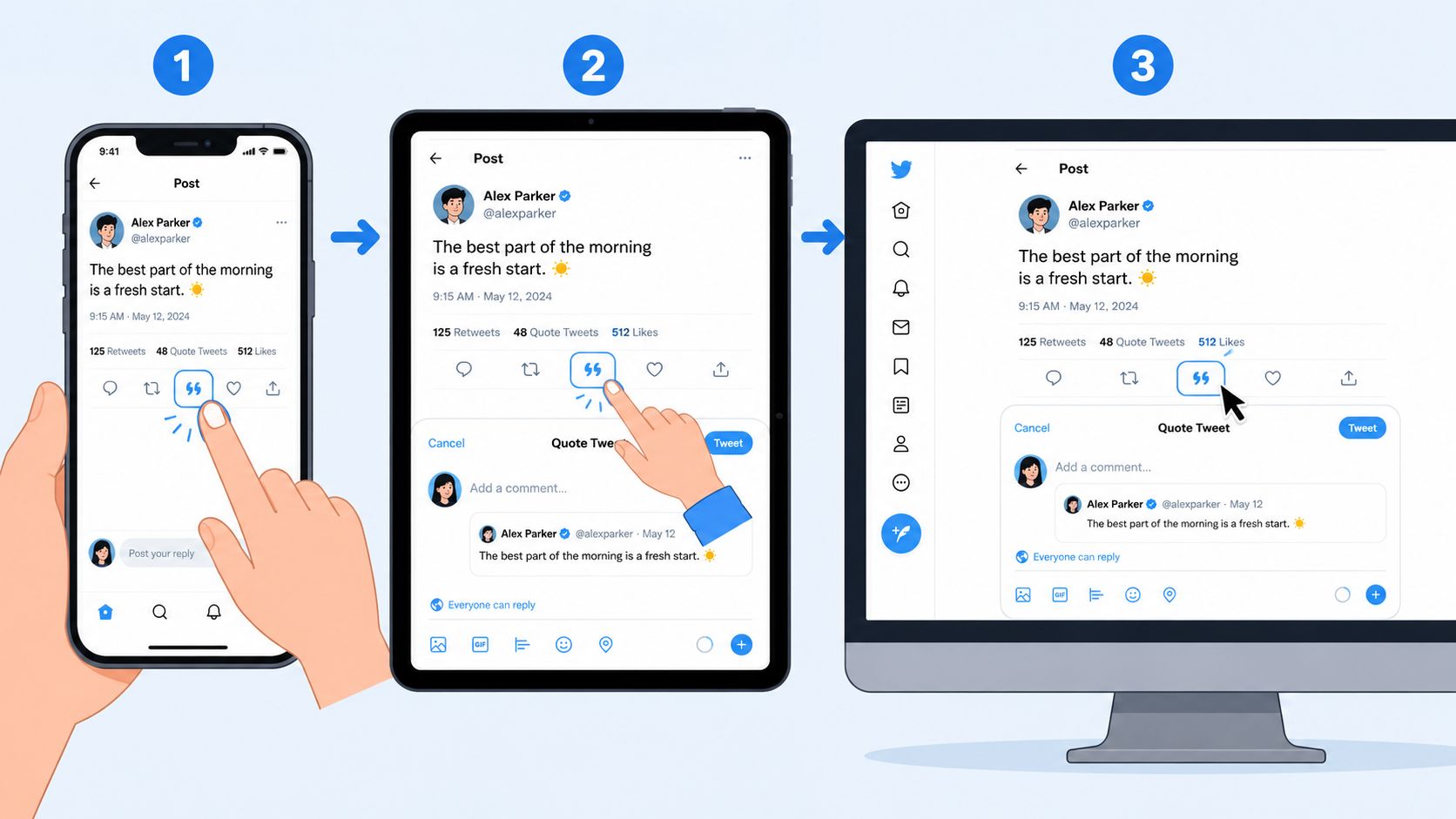
Desktop workflow
On desktop, the cleanest flow starts from the post itself, not from the timeline skim. Open the tweet, click the repost icon, and choose Quote from the menu. X then opens the composer with the original tweet embedded underneath the draft area.
That embedded card matters because it changes how much explanation the creator needs to write. The quote doesn't need to restate the original post line by line. It needs to add a useful layer on top of it.
A strong desktop habit is to pause before publishing and ask one question: does the added text make sense if a follower sees it without prior context? If not, the draft probably needs one clarifying sentence.
iPhone and Android workflow
On iPhone and Android, the flow is nearly identical. Tap the post, hit the repost icon, select Quote, type the commentary, and publish.
Mobile users often make two mistakes. First, they quote too fast and post a reaction that reads like private group chat shorthand. Second, they write too much and force the reader to process a wall of text plus the original tweet. Mobile quote tweets usually work better when the commentary is tight, specific, and easy to scan.
Here's a short visual walkthrough for creators who prefer to see the interface in action:
What to add before hitting post
The button flow is simple. The framing work is where the result changes.
Before publishing, creators should check for these three things:
Clear stance: Is the quote agreeing, challenging, translating, or extending the original idea?
Reader payoff: Does the added text give a follower a reason to stop?
Tone match: Is the draft sharper than necessary, or flatter than the moment requires?
The best quote tweets don't just attach commentary. They create a better reason to read the original post.
That's why knowing how to quote a tweet technically is only step one. The larger skill is deciding when a quote deserves to become its own post.
Quote Tweet vs Retweet The Strategic Decision
A retweet says, “this is worth seeing.” A quote tweet says, “this is worth seeing, and here's how to interpret it.”
That difference isn't cosmetic. X's own API documents quote activity as a dedicated object through the “Quote Posts” endpoint at /2/tweets/:id/quote_tweets, which reflects how the platform treats quote behavior as a distinct conversation surface, not a simple repost variation (X API quote posts documentation). Earlier comparative research also found replies were more often directed at the original author, 73.5% vs. 43.3%, while quote tweets were more likely to broadcast the root tweet's message outward to a wider audience in that same source.
When a retweet is the right move
Sometimes adding commentary weakens the post.
A plain retweet is usually the right choice when the original tweet already says exactly what needs to be said, when the creator wants to signal endorsement without hijacking the frame, or when timing matters more than personal spin. News sharing often falls into this bucket. So does boosting a teammate, customer, or founder announcement that shouldn't be overshadowed.
Retweets also work when the creator's account already has a clear brand and doesn't need to inject opinion into every share.
When quoting wins
A quote tweet is stronger when the creator has something specific to add. That might be context, a respectful disagreement, a tactical example, or a niche translation for a different audience.
It also wins when the creator wants the audience to remember the commentary, not just the source. That's the branding edge. The creator isn't only distributing information. The creator is showing taste, judgment, and point of view.
For teams trying to boost the redistribution side of this equation, resources about how to get more real Twitter reposts can help clarify when direct amplification matters more than commentary.
A scheduling system matters too. Consistent reposting and selective quote timing work better when the creator isn't doing everything manually, which is why this guide on why scheduling retweets on X matters for growth-why-it-matters-and-how-to-use-it-for-growth) is useful alongside a quote-tweet strategy.
Quote Tweet vs. Retweet: Which to Choose?
Goal | Best Action | Why It Works |
|---|---|---|
Support a message without adding friction | Retweet | Keeps focus on the original post |
Add expertise or interpretation | Quote tweet | Turns distribution into positioning |
Share breaking news fast | Retweet | Reduces delay and avoids clutter |
Challenge an idea constructively | Quote tweet | Lets the creator frame disagreement publicly |
Translate a broad idea for a niche audience | Quote tweet | Makes the original post relevant to a specific group |
Spotlight someone else's work with extra proof or example | Quote tweet | Adds a reason for followers to care now |
The Art of the Quote Tweet Crafting Compelling Commentary
“Add value” is common advice and weak instruction. It's too vague to use under deadline.
A better approach is to choose a specific angle before writing the quote. That matters because the strongest guidance on quote-tweet strategy points to concrete patterns like adding missing context, offering a respectful counter-example, translating the idea to a specific audience, backing it with proof, or updating an older take with new context (practical quote-tweet angle patterns). Substance beats filler, and specificity beats generic reaction.
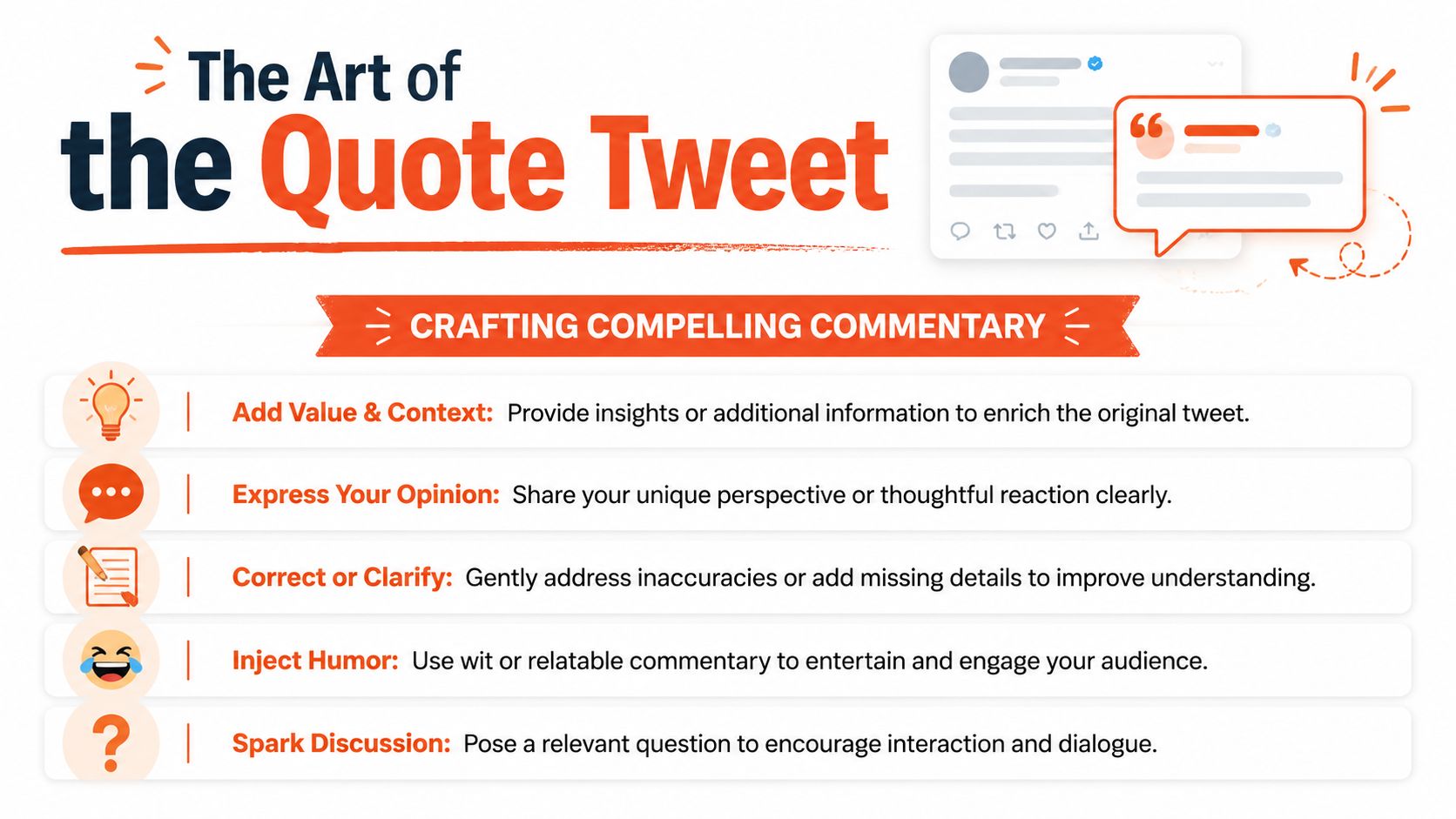
Five copywriting angles that actually give the post a job
The missing context
Use this when the original tweet is directionally right but incomplete.
Example:
“True for enterprise teams. Less true for solo creators, where speed usually matters more than process depth.”
Why it works: it doesn't reject the source. It completes it.
The respectful counter-example
Use this when the claim is too broad and a concrete exception sharpens the conversation.
Example:
“Mostly agree. One exception: this breaks down when the buyer already knows the category and only needs implementation help.”
Why it works: disagreement feels useful, not performative.
The niche translation
Take a broad point and adapt it for one audience.
Example:
“For SaaS founders, this usually means the onboarding email matters less than the first in-app success moment.”
Why it works: the audience instantly knows who the post is for.
The proof layer
Add evidence from experience, product workflow, observed customer behavior, or a visible example. Keep it qualitative unless verifiable numbers exist.
Example:
“This matches what many launch posts get wrong. The promise is clear, but the proof is missing, so the post sounds polished and forgettable.”
Why it works: it upgrades opinion into analysis.
The update
Use this on older advice, old screenshots, or recurring ideas that need a fresh lens.
Example:
“Still useful, but the stronger play now is shorter setup and faster payoff in the first line.”
Why it works: it lets the creator join a familiar conversation without sounding recycled.
Copy check: If the quote could be pasted under almost any tweet, it's too generic to publish.
A related skill is writing strong openings. Creators who struggle with the first line of a quote post should study these hook-writing patterns for X posts, because the first sentence often determines whether the audience reads the quote or skips past it.
What weak quote tweets usually get wrong
Weak quote tweets usually fail in one of four ways:
They restate the obvious: “Great point” adds no frame.
They perform intelligence: the draft sounds clever but doesn't help the reader.
They over-explain: the quote becomes longer than the value it adds.
They posture: the creator reaches for dunk energy when precision would do more.
A useful test is to ask whether the quote changes the meaning, usefulness, or audience of the original tweet. If it doesn't, a retweet was probably enough.
High-Impact Quote Tweets Examples and Breakdowns
The strongest quote tweets feel like small editorial decisions. The creator chooses the angle, the tone, and the audience all at once.
That's why examples matter. Academic work has shown quote posts function as a distinct conversational framing device rather than a simple substitute for replies, and that quote-tweet sentiment is often misread when teams rely on shallow engagement or naive sentiment analysis alone (ACM research on quote posts as framing devices). In practice, wording and stance change the outcome.
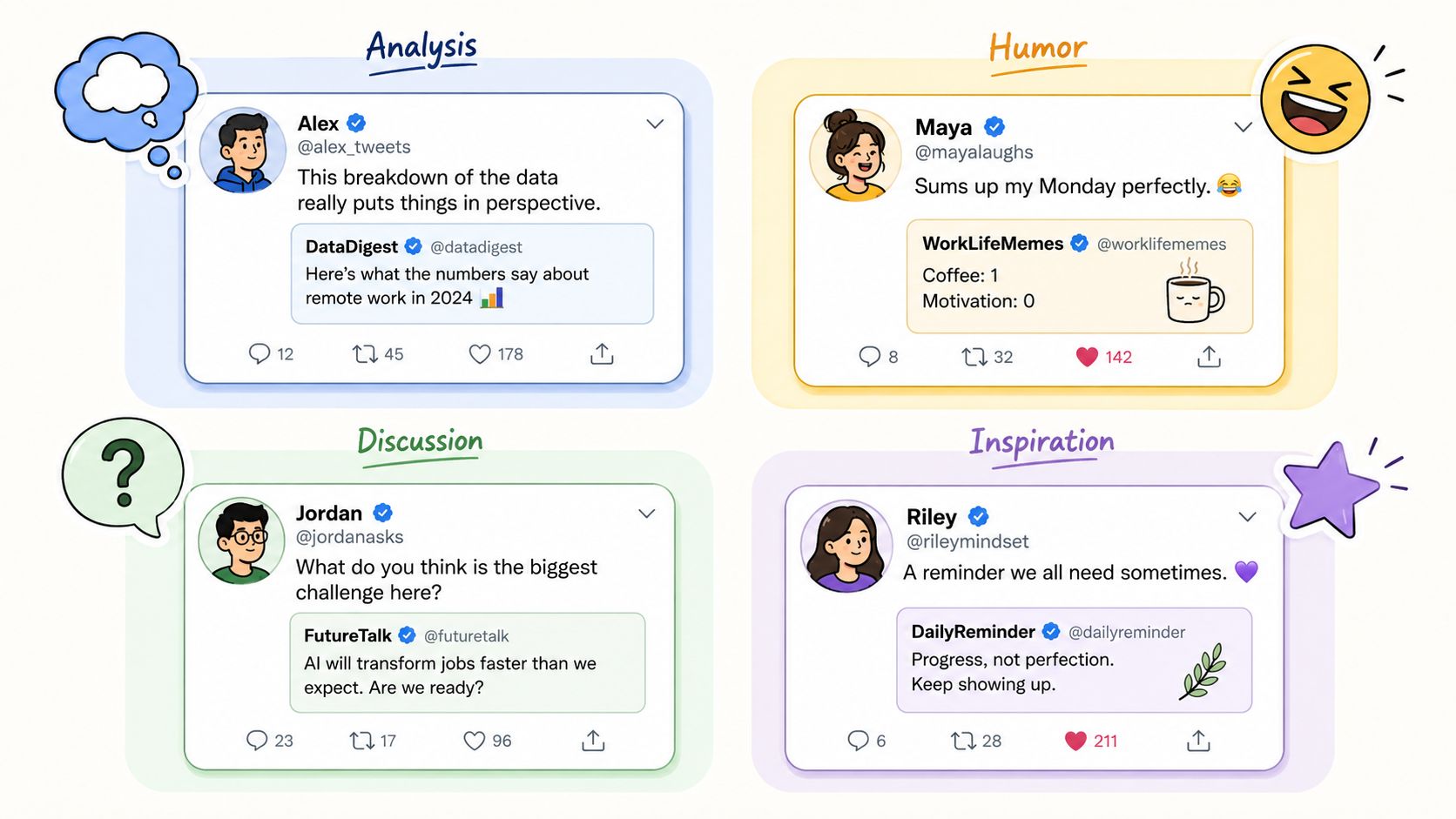
Example one analysis beats applause
Original tweet:
“Most creators don't need more content ideas. They need more consistency.”
Quote tweet:
“Accurate, but consistency gets easier when the format list is fixed. One opinion post, one response post, one proof post. Repeat.”
Why it worked: this quote agrees, then improves the idea with a usable framework. It turns a broad statement into an action plan. Followers can apply it immediately.
Example two disagreement without hostility
Original tweet:
“Long threads are the best way to build authority on X.”
Quote tweet:
“Sometimes. For many founders, a sharp single post with one concrete lesson does more than a thread that reads like a workshop transcript.”
Why it worked: the creator doesn't attack the source. The quote narrows the claim and reframes it for a different use case. That creates a higher-quality discussion than a blunt dunk.
A quote tweet should create a stronger interpretation, not just a louder reaction.
Example three audience translation creates reach
Original tweet:
“Your landing page should answer the user's first question immediately.”
Quote tweet:
“For consultants, that first question is often ‘who is this for?’ before it's ‘what does this do?’ Same principle, different buying context.”
Why it worked: the quote takes a generic conversion idea and translates it for a specific market. That attracts consultants who might have ignored the original as too broad.
These examples also show a practical truth. The strongest quote tweets are usually concise, but they aren't empty. Each one does a clear job: extend, narrow, or reinterpret.
Advanced Tactics Power Up Your Strategy with SupaBird
A creator can quote well occasionally with instinct alone. Doing it consistently requires a workflow.
The repeatable version starts with source selection. Not every high-visibility post deserves a quote. The best opportunities usually come from accounts that already sit near the creator's niche, publish claims with room for extension, and trigger visible discussion without becoming chaotic.

A repeatable workflow for finding quote opportunities
A practical workflow looks like this:
Track a focused source list: creators, founders, operators, customers, and niche analysts.
Save posts with tension: claims that feel right but incomplete usually produce the best commentary.
Draft multiple angles: agreement, counter-example, niche translation, and update.
Publish the cleanest version: pick the angle that adds the most clarity with the fewest words.
Tools can help with both discovery and drafting. In that category, SupaBird's X-GPT workflow for writing better X posts is relevant because it combines idea support with rewriting around proven formats, and its Engage module is designed to surface posts worth responding to.
Creators building an AI-heavy operating stack may also want a broader view of the AI tools solopreneurs are using across content and business workflows, because quote tweeting works better when it sits inside a larger publishing system.
Where AI helps and where it hurts
AI is useful for angle generation, hook compression, and tone cleanup. It's less useful when it writes in generic agreement language that sounds polished and empty.
The fix is simple. The prompt should ask for framing options, not finished thought leadership. A stronger instruction is: generate three quote-tweet angles, one that adds context, one that disagrees respectfully, and one that translates this for SaaS founders. That keeps the machine in a support role instead of letting it flatten the voice.
Frequently Asked Questions
Can a creator quote their own tweet
Yes. Quoting a personal post is useful when the creator wants to revive an older point, add new context, or turn a past post into a fresh conversation. It works best when the quote adds something new instead of repeating the original claim.
Does the original author get a notification when someone quotes their tweet
X typically surfaces quote activity to the original author through its normal product experience around post interactions. From a practical etiquette standpoint, creators should assume the original author may see the quote and write accordingly.
Can a quote tweet be hidden or blocked
The original post author can still use normal account controls and moderation settings on X, but a quote tweet is its own post on the quoting account's timeline. That means creators should think of it as a public statement, not a semi-private reply.
Should a creator reply or quote when disagreeing
Reply when the goal is direct conversation with the original author. Quote when the goal is public framing for a wider audience. If the disagreement needs nuance and broader context, quoting is often the better format.
Creators who want a more systematic way to find strong conversations, draft sharper quote tweets, and keep posting consistently can explore SupaBird. It's built for people using X as a growth channel, not just a publishing outlet.

How Developer Startups Build a Brand on X Before Launch

30-Day Starting Plan for New X (Twitter) Accounts

How Often Should You Tweet for Maximum Growth?

What Should Your First 10 Tweets Be About?

How to Run X for Ten Clients: The Agency Workflow

How to write a bio that gets people to follow you

Digital Product Launch Strategy

Best Twitter Growth Service for Creators in 2026
From X to Every Platform: Repurpose Without Flopping
