You're staring at a blank doc, a vague brief, and a familiar problem. The internet is full of how-to guides that start with steps nobody asked for, drag on too long, and still don't earn the click. The fix isn't “write more.” It's choosing the right format, building the guide like a product, and measuring whether it moves people to act.
Table of Contents
Why Most How to Guides Fail Before the First Word
A search result page makes the problem obvious. The same page title appears over and over, followed by a long intro, generic subheads, and a thin conclusion that never earns the click or the scroll. The reader came for a fix, not for a recycled template.
Start with the job the reader is trying to complete, then choose the format that fits it. A writer who skips that decision usually ends up forcing one idea into the wrong container, which is why so many guides feel bloated before the first useful sentence. That same discipline shows up in other forms of structured work, including the way history of statistics moved from record-keeping toward definitions, collection, and analysis before the field could be useful.
Practical rule: if you can't state the reader's outcome in one sentence, the guide is still an idea, not a plan.
A five-minute fix calls for a checklist. A messy problem with context calls for a scenario walkthrough. A choice between tools or methods calls for a decision guide. Generic advice fails because it treats every topic like the same shape, and readers can tell when the structure does not match the job.
The strongest guides start with a constrained angle, then grow only as far as the topic demands. That is the same logic behind better brainstorming, where the goal is not a pile of ideas but a usable angle worth shipping, the kind of discipline described in SupaBird's brainstorming techniques. It also matches visual planning work, where a guide about composition, such as golden spiral tips for creators, works because it solves one specific reader problem instead of pretending to cover everything.
The best how-to content picks a lane, states the result, and earns trust fast. That is the standard this article uses, from format selection through headlines, threads, SEO, and engagement.
Picking the Right Format for Your Audience
Start with intent, not structure. If someone searching your topic wants speed, make the guide short and obvious. If they want confidence through context, give them a deeper tutorial. If they're deciding between options, build a comparison-driven guide. The wrong container turns a useful idea into a skim-and-bounce page.
Read the signals before you outline
Search results tell you a lot. If the top pages are thin listicles, there's probably room for a more complete tutorial. If the comments on competitor posts are full of “but what if…” questions, readers want scenario coverage. If people keep asking the same clarifying question in replies or community threads, they don't need more breadth, they need precision.
The cleanest rule is this. Pick the smallest container that solves the job. Then expand only when the topic demands depth. That keeps you from padding a page just to satisfy some imaginary word count.
Format | Best for | Typical length | Shareability |
|---|---|---|---|
Checklist | Fast action, repeatable steps, simple tasks | Short | High |
Scenario walkthrough | Edge cases, context-heavy problems, real-world decisions | Medium | Medium |
Deep tutorial | Complex processes that need explanation and sequence | Long | Medium |
Comparison-driven guide | Choosing between tools, methods, or paths | Medium to long | High |
A checklist is the right move when the reader already understands the goal and just wants execution. A scenario walkthrough works when the same action looks different depending on the situation. A deep tutorial earns its length when the reader needs both why and how. A comparison guide wins when the task is choosing, not doing.
For a practical benchmark, remember that controlled experimentation in digital products is often humbling, with an open A/B-testing guide reporting that average experiment success is only about 33%, and roughly one-third of tests improve the target metric, one-third do nothing, and one-third hurt it (NN/g on success rate). That doesn't mean your guide is an experiment in the lab sense, but it does mean many content variants won't outperform the baseline. Choose the format that gives you the highest odds before you spend time polishing.
A good topic becomes a great guide when the container fits the audience's urgency. That's the difference between content people bookmark and content they use.
Planning the Guide Before You Write
The strongest guides are outlined twice and drafted once. Start by defining the change you want in the reader, then work backward into the steps, examples, and proof points that make that change believable. If the outcome is fuzzy, the draft will be fuzzy too.
Write one sentence that names the reader, the task, and the finish line. Then break that finish line into sub-questions. Those sub-questions become your sections. Anything that does not answer one of them gets cut.
A useful planning habit is to pair your outline with a quick source check. CUNY's fact-checking guidance is blunt about this, verifiable claims should be checked against primary sources whenever possible, because secondary summaries repeat mistakes (CUNY fact-checking guide). That matters in how-to writing because the moment you include a claim about process, tools, or outcomes, you are making a promise that needs backing.
Write the guide as if every step will be audited later. That mindset kills fluff fast.
Here's a simple planning workflow:
Define the job to be done. What does the reader need to complete, decide, or fix?
Name the success state. What should be true by the end of the guide?
Draft three angles. One beginner-friendly, one speed-focused, one scenario-based.
Pick the angle with the least wasted motion. Choose the one that answers the reader's real question fastest.
Build the outline from questions, not sections. Every heading should earn its place.
Mark where examples or sourcing are needed. Do not wait until the draft to find gaps.

A practical example helps. If you are planning a guide on repurposing one blog post into a week of X content, the outline should start with the reader's questions, not a generic step list. What becomes the anchor post? What gets turned into a thread? What gets cut because it does not work in social form? What proof do you need to show the angle holds up?
Planning also means deciding what the guide is built to do. If the goal is to turn a how-to article into a social asset that can raise impressions into clicks, the outline should reflect that job from the start. A tutorial, a checklist, and a scenario-based guide do not pull the same weight. Pick the format that fits the reader's intent, then shape the outline around that choice.
Keep drafting separate from planning. A structured content production workflow gives the team a clean handoff from outline to draft without turning the process rigid. The goal is simplicity that keeps the work on track.
By the time you start writing, the guide should already know what it is. That is what makes the draft fast.
Headline Formulas and Hook Patterns That Earn Clicks
A strong guide can still flop if the headline is dull and the opener drags. Readers do not need more information. They need a reason to care right away. The headline and first paragraph do that work, or they waste the page.
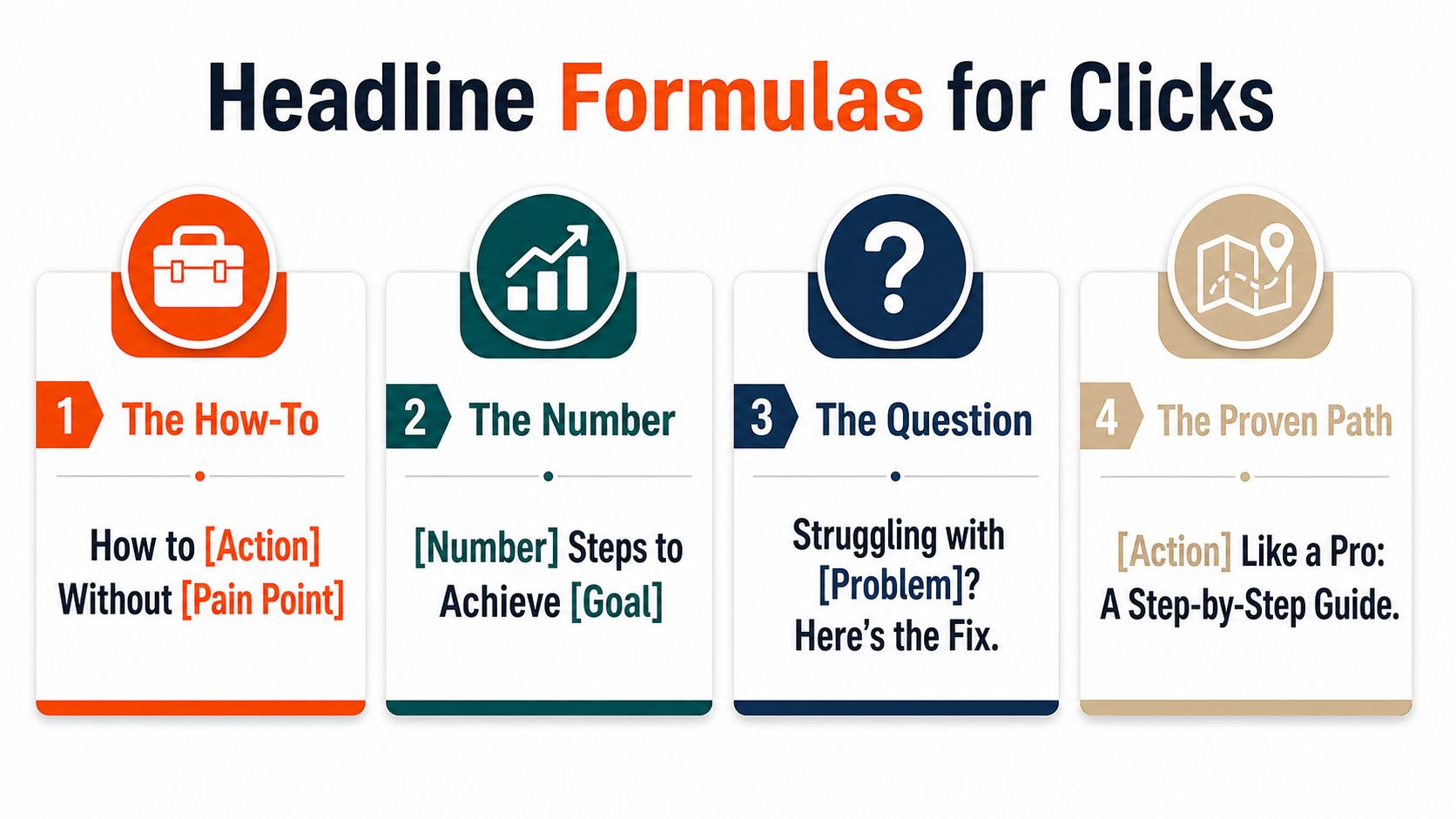
Use formulas that promise a clear outcome
The best headline patterns are boring in the best way. They are clear, specific, and easy to scan.
Outcome-led: Focus on the result first. “Get More Replies From Your X Posts Without Posting More Often.”
Time-bound: Make the time cost visible. “Build a Simple How-To Guide in 30 Minutes.”
Audience-specific: Name who it is for. “How to Write Guides for Creator Brands.”
Contrarian: Push against lazy norms. “Why Long How-To Guides Keep Failing.”
Each formula works because it cuts uncertainty. The reader can tell what the page will deliver before they click. That is the job.
Make the first 80 words do something useful
The hook should not wander. It should open with one of four patterns.
Scenario open: Start with a moment the reader recognizes.
Mistake callout: Name the common failure first.
Stat anchor: Use a verified number only if it strengthens the point.
Story open: Briefly show a real moment and move on.
A flat opener looks like this:
Flat: “Writing how-to guides can be challenging, but there are several ways to improve them.”
Stronger: “Your guide is failing because the format, hook, and angle were chosen too late.”
The second version names the problem, creates tension, and promises a fix. That is the standard.
If you want a useful outside reference for headline thinking, SponsorRadar's CTR optimization guide is worth studying because it keeps the focus on turning impressions into clicks. A clever title means nothing without an open rate to back it up.
Good hooks reduce uncertainty fast. They tell the reader who the page is for, what it solves, and why it matters now.
The headline and the hook need to match. If the headline promises speed and the opener sounds academic, the page feels broken. If the headline is broad and the opener is narrow, the reader gets confused. Alignment beats flair every time.
For a closer look at opener mechanics, how to write hooks is a useful companion. Keep the standard simple. If the headline does not name the reader, the outcome, and the time or effort involved, it is not ready.
Turning a Guide into an X Thread That Spreads
A guide earns attention on X only after it is stripped down to its strongest angle. Threads require a tighter spine, fewer moving parts, and a clearer promise up front. Every post has a job. If a post does not move the reader forward, cut it.
Build the thread as a sequence of jobs
Use a simple flow.
Hook post. Name the reader, the outcome, and the curiosity gap.
Problem post. State the pain or mistake the reader already feels.
Framework post. Give the first meaningful step.
Framework post. Give the second step.
Example post. Ground the method in a real application.
Framework post. Add the next move or rule.
Closer post. Offer a soft call to action, not a hard shove.
That structure works because it respects attention. People on X want a sequence that rewards the next tap, not a block of text that asks for patience the platform does not give.
SupaBird's X Coach is built around that kind of feedback loop. Users have produced over 40,000 posts with SupaBird, and the X Coach combines AI tips with human mentor feedback to explain why a post worked and to suggest edits to hooks, visuals, and timing (SupaBird). That combination matters because thread writing is partly craft and partly judgment.
Here is the discipline that makes threads easier to read.
One idea per post. If a post needs two ideas, split it.
Short lines. Line breaks are rhythm, not decoration.
No filler transitions. Every post should push the reader forward.
Reply bait only at the end. Invite conversation after the value is obvious.
The best opener follows the same logic as a strong guide headline. Name the reader, name the outcome, then create a gap they can close by reading on. That is plain, but it works because it feels earned.
If you are repurposing a guide, the thread should compress the article, not copy it. The thread on content repurposing strategy should feel native to the platform, not like a chopped-up blog post wearing a thread costume.
A good thread ends with momentum. The last post should make the next action obvious, whether that is clicking through, saving the thread, or replying with a specific example. Do not make the closer shout. Make it useful.
For a related example of repackaging a topic into a platform-specific format, the TransClipper content strategy guide shows how a narrow distribution goal changes the shape of the content itself.
A sample seven-post structure
Post 1. “Most how-to guides fail before the first step because the writer picks the format too late.”
Post 2. “A checklist, tutorial, and scenario guide solve different jobs.”
Post 3. “If the reader needs a quick win, choose a checklist.”
Post 4. “If the problem changes by context, choose a scenario walkthrough.”
Post 5. “If the task needs explanation and sequence, choose a tutorial.”
Post 6. “Here is how that looks in practice with a repurposed X thread.”
Post 7. “If you want more guides that get read, reply with the format you are stuck on.”
That is tight, readable, and easy to adapt.
On-Page SEO for How to Guides
A great guide nobody finds is a private journal entry. Search still rewards clarity, structure, and usefulness, and how-to content needs all three. Search visibility comes from making the page unmistakably about the reader's problem, not from keyword stuffing.
Make the page easy to parse
Start with an intent-matched title tag and a first paragraph that answers the main question fast. Google's helpful-content guidance is plain about the direction, write for people, show first-hand usefulness, and make the content helpful (Google helpful content). For how-to guides, the opener should remove doubt immediately.
Use subheadings that mirror the questions the reader is already asking. If the reader wants format selection, don't bury it under a clever heading. Say it plainly. If they need a decision rule, give them one. If they need an example, keep it close to the section where the problem shows up.
Structured data helps when it fits the page, especially HowTo and FAQ markup. It does not replace substance. If the guide is thin, schema will not save it.
Internal linking should feel like a cluster, not a random trail. Link the guide to relevant pillar pages, related comparison posts, and practical follow-up resources so the topic has depth across the site. That way, the guide does not stand alone, it sits inside a useful system.
SEO for how-to content is mostly about matching intent, structure, and next-step clarity.
The most common mistakes are easy to avoid.
Thin intros: Do not spend three paragraphs warming up.
Vague subheads: Use the reader's language, not internal jargon.
No next step: End with a useful action, not a generic sign-off.
Weak internal links: Connect the guide to the rest of the topic cluster.
Missing CTA placement: Put the call to action where it makes sense, not buried after fluff.
For a practical example of a page that connects instruction with content operations, SupaBird's content production workflow is worth studying alongside your own cluster map. The lesson is simple. Search visibility improves when the page solves a real task and points to the next one.
Measuring Engagement and Iterating the Guide
Publishing is the halfway point. A guide isn't finished when it goes live, it's finished when you know whether readers used it. Pick one engagement signal that matters most, then track it consistently. That might be time on page, scroll depth, replies on the thread version, or conversion to the next step.
Set your baseline before publishing. Then review the guide at 7, 30, and 90 days. If the intro is weak, rewrite the opener. If one section gets skipped, tighten it or add an example. If the whole piece underperforms, the format may be wrong, not the prose.
A clean success-rate mindset helps here. Don't judge a guide by whether it felt strong to you. Judge it by whether readers completed the action you wanted. “Worked for me” is not evidence. It's a starting point, nothing more.
Keep a simple iteration checklist:
Check the first paragraph. Does it earn the scroll?
Check the weakest section. Does it need an example or a cut?
Check the CTA. Is it specific enough to matter?
Check the thread version. Does it carry the same promise without bloating?
Check the cluster. Does the guide belong with related content, or should it be split?
The smartest editors don't chase every metric. They watch for the signal that matches the job of the page, then improve that one thing. That's how how-to guides stop being content filler and start behaving like assets.
If you want a system for turning ideas into guides that ship, SupaBird can help with templates, hook rewriting, and X-ready repurposing built for creator workflows. Visit SupaBird if you want a practical way to turn one useful idea into a guide, a thread, and a repeatable content system without starting from scratch every time.

How Often Should You Tweet for Maximum Growth?

What Should Your First 10 Tweets Be About?

How to Run X for Ten Clients: The Agency Workflow

How to write a bio that gets people to follow you

Digital Product Launch Strategy

Best Twitter Growth Service for Creators in 2026
From X to Every Platform: Repurpose Without Flopping

How to Get Cited by Grok: Winning X’s AI Search in 2026

5 X (Twitter) Growth Metrics Every Serious Creator Should Track — and How to Get the Data