
The best time for posting on X is 9 AM on Tuesday in one large 2025 analysis of more than 8 million posts. That sounds definitive, but it isn't the full answer, because other large studies point to different weekday morning windows depending on audience and location.
Posting-time research on X keeps pointing to the same broad pattern, weekday mornings outperform late nights, but the exact hour shifts once you look past headline summaries. That's why the core question isn't “What single hour wins?” It's “Which local-time window is most likely to catch my audience before the day fragments their attention?”
Table of Contents
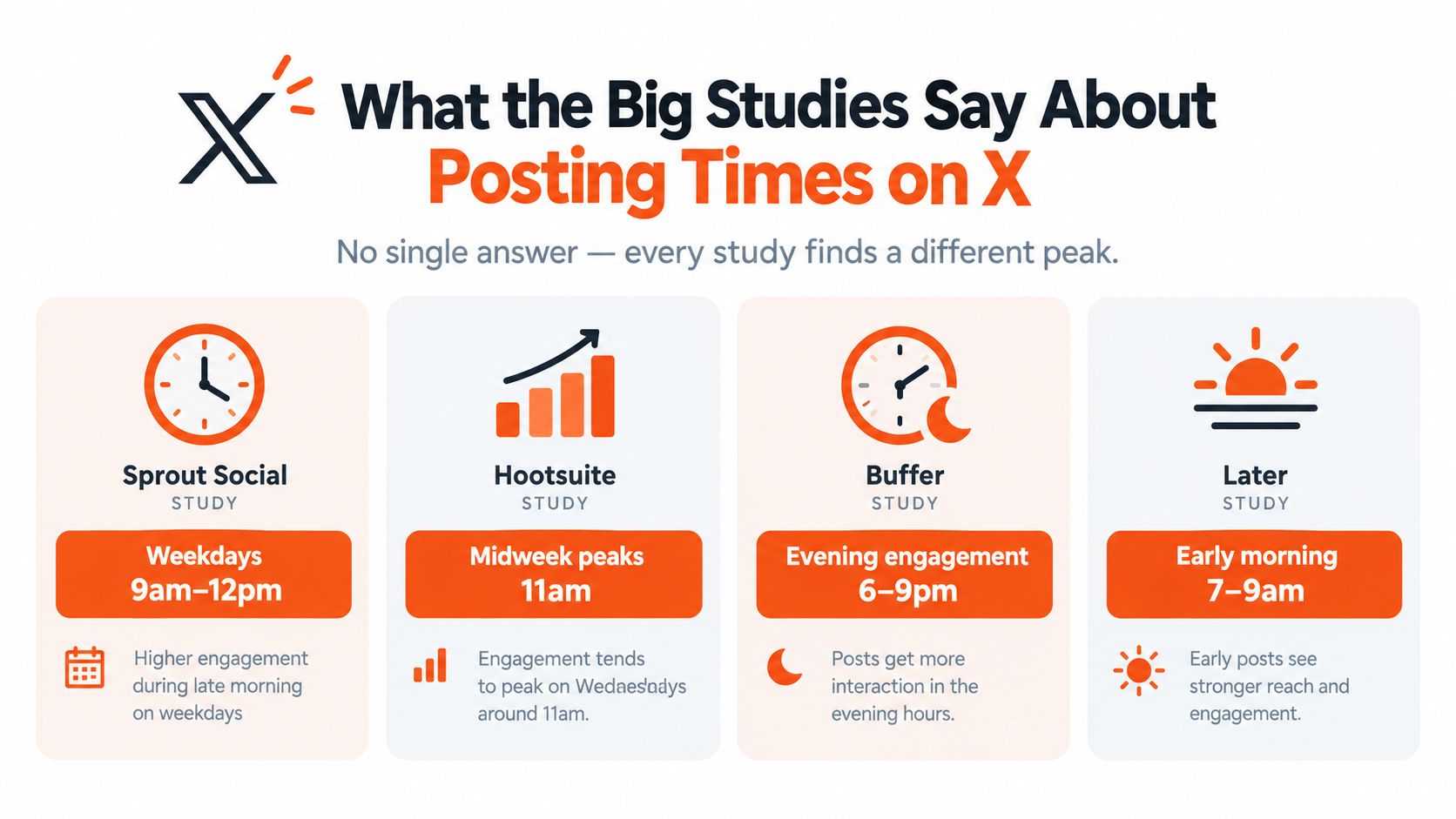
What the Big Studies Say About Posting Times on X
Across large X datasets, the strongest signal is a weekday morning window, with the exact peak depending on the study. One 2025 analysis of more than 8 million posts identified 9 AM on Tuesday as the best time to post on X. Engagement began rising around 8 AM and peaked between 9 AM and 11 AM on weekdays, according to Buffer's review of the data best time to post social media.
A separate 2025 study produced a different weekday pattern. It found that X performed best from 9 AM to 11 AM on Wednesdays, Thursdays, and Fridays, while activity was weakest before 5 AM across the week social media benchmarks. The important finding is the shared morning concentration. The weekday and hour vary, yet both studies place stronger performance near the point when users begin checking updates and reacting to new posts.
What the shared pattern really means
Use mid-morning local time on weekdays as the first test window, especially when your audience is concentrated in business hubs such as New York, London, and Berlin. Buffer's findings support that starting point, while the difference between Tuesday and the later-week peaks shows why a fixed global schedule can mislead. A post scheduled for 9 AM in one city may reach another region during its commute, overnight period, or late workday.
X functions largely as a news-catchup channel. Users often check it briefly, scan current posts, and respond before other activities divide their attention. A morning window therefore gives a post a plausible opportunity to collect early reactions, while the audience's local clock determines whether that window is actually active.
Short-form viewing research follows the same practical principle. Coachful documents it in its guide on when to post shorts for engagement, where timing aligns with periods of active audience use.
The false comfort of one perfect hour
“Post at 9 AM Tuesday” is a useful benchmark, not a universal schedule. It fits an audience concentrated in one time zone more closely than a mixed audience spread across regions, industries, and content habits.
Start with a range: weekday mornings first, then compare later-day and weekend slots against that baseline. Record results by audience location and weekday rather than treating one winning post as proof. This approach preserves the evidence from large studies while making room for the local behavior that determines your actual optimal window.
Why the Best Time for Posting on X Changes Across Studies
Posting-time studies disagree because they measure different outcomes across different account portfolios and audience mixes. One analysis may prioritize impressions, while another weighs replies, clicks, or total engagement. The broad pattern remains consistent, weekday activity is stronger, but the best hour changes with audience geography, platform behavior, and the response a post needs.
A cross-platform analysis of 7 million posts from over 50,000 accounts identified several strong mid-week windows, including 7 AM to 9 AM, 1 PM to 3 PM, and 7 PM to 9 PM. Its X-specific guidance placed greater weight on Tuesdays, Wednesdays, and Thursdays from 12 PM to 6 PM local time. A separate study covering 20 billion engagements found the strongest universal window across platforms was Tuesday through Thursday from 9 AM to 12 PM in the audience's local time zone, while late nights and early mornings were weaker HubSpot's summary of cross-platform timing research.
Compare the major guidance side by side
The disagreement is concentrated in the clock time, not the general direction:
Buffer identifies weekday mornings as a useful starting point, including a Tuesday 9 AM peak and an 8 AM to 11 AM weekday range best time to post social media social media benchmarks.
Hootsuite places its strongest window at 9 AM to 11 AM from Wednesday through Friday and identifies before 5 AM as the weakest period across the week best time to post on social media.
Sprout Social reports a later X window, 12 PM to 6 PM from Tuesday through Thursday. It also identifies Monday peaks at 2 PM to 3 PM and 5 PM, with Saturday performing lowest best times to post on Twitter.
SocialPilot's cross-platform timing research also favors mid-week activity, while treating X timing as a set of local-time weekday blocks rather than one universal hour.
These findings describe different samples, definitions of success, and geographic distributions. A dataset dominated by North American business accounts can favor morning activity, while a globally distributed audience may produce stronger midday or evening windows. Algorithmic distribution matters too. X gives early engagement opportunities more weight, so the relevant question is whether the target audience is active when the post first appears. The analysis of X's algorithm and growth mechanics explains why timing should be evaluated alongside early distribution signals.
Use a range, then narrow it. Start with the morning window, compare it with early afternoon, and segment results by audience location, weekday, format, and objective. A conversation-led post may benefit from an active midday audience, while a post judged mainly by first-hour impressions may deserve an earlier test.
Practical rule: test the narrowest weekday morning window first. Expand into early afternoon only when location-level results show sustained response later in the day.
How City-Specific Timing Changes Your Posting Schedule
A single “best time” can represent four different audience moments. A post sent at 9 AM ET reaches New York during the morning, London in the afternoon, Berlin later in the afternoon, and Mumbai in the evening. That difference changes who can respond during the first hour and whether the post enters a busy or quiet period for each audience.
The practical rule is to interpret research windows as local-time guidance, not as one universal timestamp. If Tuesday at 9 AM performs well for a city segment, schedule that hour in the segment's own time zone. If one city contains the largest share of high-value followers, use that city as the primary schedule and treat other regions as separate tests.
Converting study windows across cities
The table below uses representative standard-time conversions from Eastern Time. London and Berlin shift during daylight-saving periods, so confirm the date-specific offset before scheduling.
Study window in New York | New York (ET) | London (GMT) | Berlin (CET) | Mumbai (IST) |
|---|---|---|---|---|
Tuesday morning anchor | 9 AM | 2 PM | 3 PM | 6:30 PM |
Weekday morning window | 8 AM to 11 AM | 1 PM to 4 PM | 2 PM to 5 PM | 5:30 PM to 8:30 PM |
Midday weekday window | 12 PM to 6 PM | 5 PM to 11 PM | 6 PM to midnight | 10:30 PM to 4:30 AM |
Mid-week universal window | 9 AM to 12 PM | 2 PM to 5 PM | 3 PM to 6 PM | 6:30 PM to 9:30 PM |
The conversion exposes the conflict between studies. A morning recommendation for New York can become an afternoon recommendation for London, an evening recommendation for Mumbai, and a different part of the workday for Berlin. A broad midday window may overlap with active hours in Europe while reaching Mumbai outside normal waking or work periods.
For a primarily New York audience, a 9 AM Tuesday schedule aligns directly with the cited morning recommendation. For London or Berlin, convert the target hour to local time instead of copying a New York timestamp. For Mumbai, the same New York morning post may arrive during the evening, so local audience activity should determine whether that timing is useful.
Early attention matters because a post needs responsive followers soon after publication to develop momentum. Local-time scheduling increases the chance that the intended audience is available when the post appears, although it cannot compensate for weak relevance, an unsuitable format, or a quiet day for that audience.
A city-specific schedule gives each audience segment its own opportunity to respond before attention fragments.
SupaBird's calendar feature maps posting windows across cities such as Berlin, New York, London, and Mumbai. That can reduce manual timezone conversions, but the schedule should still be checked against audience location data and tested by region. The strongest operating model is usually one primary city window, plus separate local-time slots for regions that contribute meaningful engagement.
How to Test Your Own Posting Time on X in 14 Days

The cleanest way to find your own best time for posting is to test one variable at a time. Keep the topic, format, and cadence steady, then change only the posting slot. That gives you a signal you can trust instead of a mix of unrelated results.
A practical 14-day setup looks like this:
Choose two time windows. Start with one morning slot and one early afternoon slot, because recent studies keep clustering around weekday mornings and midday windows.
Post similar content in each window. Keep thread length, hook style, and topic category as close as possible.
Track first-hour metrics. Look at impressions, replies, and profile clicks in the first hour, because early momentum often decides whether X gives a post more reach.
Repeat by city segment if needed. If your audience spans regions, run the same test in the local time zone that matters most.
If your content mix includes video, the same slot-testing logic applies when you schedule YouTube video uploads.
Recent coverage makes the key point clearly. The best time for posting on X is not a single universal hour, because studies conflict from 9 AM Tuesday to 12 PM to 6 PM on weekdays, and one report also shows a Sunday 9 AM to 10 AM peak best time to post on Twitter X. That gap comes from audience geography, industry, and content goal. A New York audience, a London audience, and a Mumbai audience do not enter the day at the same local hour.
What to record
Use a simple table in your notes or spreadsheet:
Post time: the exact local time you published
Audience segment: city or timezone
First-hour impressions: the distribution signal you care about
First-hour replies: useful when conversation matters
Profile clicks: a good proxy for curiosity and intent
The point is not to pick one permanent slot and stop testing. The point is to see whether your audience responds better in the morning, midday, or later in the workday. Once that pattern is clear, your calendar becomes a repeatable system instead of a guess.
For ongoing measurement, the internal guide on tracking your growth and improving performance with SupaBird X Coach is a practical companion because it keeps the review loop focused on what changed.
What First-Hour Engagement Means for Reach
First-hour engagement acts as an early distribution test. Replies, reposts, clicks, and sustained reading soon after publication indicate whether a post is earning attention from the audience online at that moment. Strong early activity can keep a post visible while conversation is active, but it does not guarantee broad reach.
Timing affects the conditions around the content, not only its publication timestamp. A strong post in a quiet local window may receive too few initial interactions to build momentum. The same post in an active window has more opportunity to collect responses from the intended city or timezone. Measure first-hour performance alongside audience location so you can distinguish weak creative from weak timing.
The studies compared earlier in this article point to different daily peaks. That variation is useful rather than contradictory. A later window may suit one audience segment, while morning activity suits another. Use your own first-hour results to identify the segment you are reaching and whether its response reflects local working hours, commuting patterns, or another recurring routine.
Use timing to protect the first hour
For a multi-city audience, schedule priority posts when the first hour overlaps with the active period of your highest-value segment. Apply this to launches, announcements, and opinion posts where rapid discussion can extend visibility. If one slot cannot serve every city, assign separate local-time windows instead of averaging them into a low-activity compromise.
A practical rule:
Post important content in your strongest local window, then use weaker slots for lower-stakes updates.
This preserves the best conditions for posts that need fast attention while giving routine updates a safer testing role. Review impressions with clicks, replies, and early reach behavior. The guide to what impressions are on social media helps define that metric, while timing analysis connects it to engagement and audience location.
Common Mistakes When Choosing Your X Posting Schedule
The costliest scheduling error is optimizing for a generic audience instead of the people you need to reach. A creator may copy a reported peak hour, publish it across every region, and then blame the content when engagement varies. The underlying problem is often local-time misalignment. A slot that reaches New York during an active period may reach Mumbai or Berlin while much of the audience is offline.
Scheduling also does not make an unsuitable hour effective. As noted earlier, Hootsuite identifies before 5 AM as the weakest period across the week, so a scheduled 4 AM post remains a poor slot best time to post on social media.
Mistakes that cost you reach
One timezone, many regions. If impressions are acceptable but replies come from only one city, separate the schedule by audience location instead of using a single global slot.
A study's peak treated as a rule. If your first-hour results disagree with a published peak, test the study's window against your own audience before adopting it.
The same time every day. If weekday and weekend performance diverge, vary the schedule by day and compare like-for-like posts.
A test ended too soon. If results swing sharply after only a few days, extend the test before changing the schedule. Short samples can reflect noise rather than a stable pattern.
Review more than impressions. Replies, profile clicks, and the locations of early engagers show whether a post reached the intended segment. A high impression count with weak response from the target city points to a distribution problem, not necessarily a creative problem.
If the chart looks strong but replies come from the wrong time zone, the schedule is misaligned.
The practical question is therefore, “Which hour fits the people I want to reach?” That answer comes from audience geography and repeated first-hour comparisons, not from a universal X posting hour.
How to Build a Repeatable Local-Time Posting System
A repeatable schedule starts with one primary city or timezone. Choose a weekday morning window that matches that audience, then keep the timing consistent enough to reveal a pattern in first-hour results. Once that segment performs consistently, add a second city and compare results without rebuilding the entire schedule.
Use three operating steps:
Select one local-time window and test it for two weeks.
Schedule posts for that window, so publishing matches audience activity rather than your own availability.
Review first-hour impressions, replies, and clicks. Change the schedule only when the pattern is clear.
A scheduling platform can turn these decisions into fixed publishing slots. SupaBird's smart way to automate your posting calendar for maximum engagement supports this workflow by organizing posts around repeatable timing slots instead of daily manual choices.
A simple operating rule
Start with one city segment.
Test weekday mid-morning slots for two weeks.
Record first-hour impressions, replies, and clicks.
Add another city only after the initial pattern settles.
This approach replaces a universal posting-hour assumption with a schedule tied to audience geography and observed response. It also makes comparisons easier, because each city can be evaluated against its own local-time window.
For a workflow that keeps timing connected to audience data, visit SupaBird. Its city-based calendar, scheduling slots, and X growth tools can turn a weekday-morning hypothesis into a schedule you can repeat and refine.

The Reply Guy Strategy: A Growth Guide for X

Why New X Accounts Get Less Reach

ClimbX Review (2026): Features, Pricing, Pros and Cons

How Developer Startups Build a Brand on X Before Launch

30-Day Starting Plan for New X (Twitter) Accounts

How Often Should You Tweet for Maximum Growth?

What Should Your First 10 Tweets Be About?

How to Run X for Ten Clients: The Agency Workflow

How to write a bio that gets people to follow you
