SupaBird vs XBeast: X Growth in 2026
SupaBird vs XBeast compared in detail. Find out which X (Twitter) growth tool is right for you in 2026.

If you've spent any time trying to grow on X (formerly Twitter) in the last year, you've probably run into both of these names. SupaBird and XBeast are two of the most-recommended AI-powered growth tools for creators, founders, and solopreneurs right now, and they both promise the same thing: more followers, more engagement, less time spent staring at a blank compose box.
But "AI growth tool" is a broad label, and these two products approach growth from almost opposite directions. One is built around AI-assisted writing and organic, human-reviewed posting. The other is built around deep automation that can run your account with minimal daily input. Neither approach is objectively wrong, but one of them is probably wrong for you, depending on how hands-on you want to be and how much risk you're willing to take with your account.
This is a full, feature-by-feature SupaBird vs XBeast comparison: content creation, scheduling, automation depth, safety, analytics, pricing, and who each tool is actually built for. By the end, you'll know exactly which one fits your growth strategy.
What Is SupaBird?
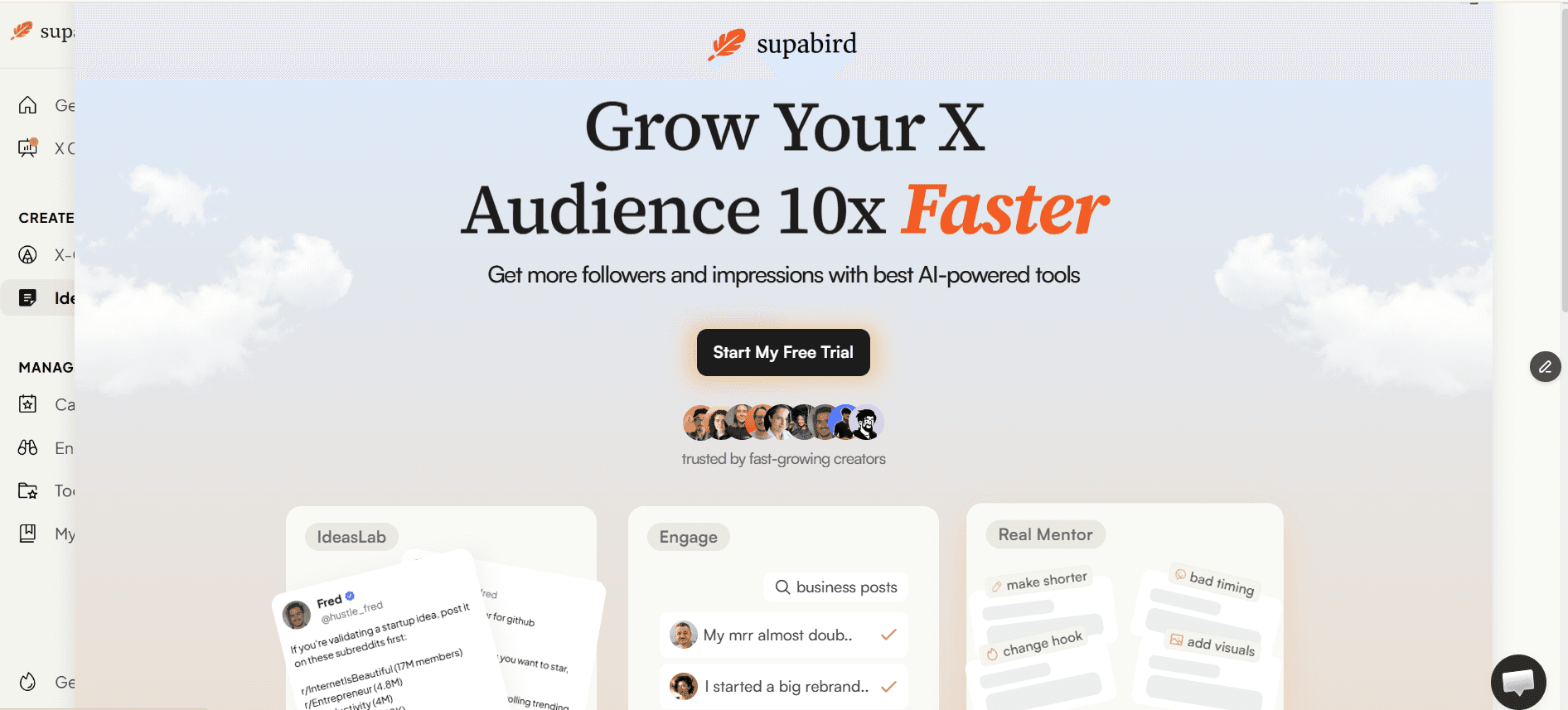
SupaBird is an AI-powered growth platform built specifically for X. Rather than trying to be a general social media manager, it focuses on solving three problems that stall most X accounts: running out of ideas, posting inconsistently, and getting no engagement even when you do post.
Its core toolkit includes IdeasLab (personalized post ideas based on your niche and the creators you admire), X-GPT (an AI writing agent that rewrites your drafts into more engaging, X-native posts), Video-to-Posts (turns a YouTube link into ready-to-publish tweet ideas), a smart scheduling calendar, and a Post Finder / Reply Finder that surfaces relevant conversations worth joining. It also includes an AI Coach that mixes human-style mentor feedback with daily growth tips, so you're not just producing content blindly, you're learning what actually works for your account over time.
The product is bootstrapped and built by an indie founder, and it's positioned squarely at solo creators, founders, and indie hackers who want quality-driven, organic growth without paying enterprise prices.
What Is XBeast?

XBeast is an AI agent for X built around automation. You point it at your own account (or an account whose style you admire), lock in your topics and voice, and it generates and schedules "presets", batches of AI-written tweets, including AI-generated images, that post automatically within time windows you define.
Beyond content generation, XBeast's standout features are its automation tools: auto-reply (AI responds to comments on your posts around the clock), auto-retweet (your best-performing tweets get reshared automatically at peak hours), and auto-plug (once a tweet crosses an engagement threshold, XBeast automatically appends your link, offer, or thread). It also offers a free X analytics and profile analyzer tool, and it supports managing multiple accounts from one dashboard.
XBeast is positioned as a "set it and forget it" growth engine, aimed at creators, influencers, and businesses who want to minimize the daily time investment as much as possible.
Quick Comparison Table
SupaBird | XBeast | |
|---|---|---|
Core philosophy | AI-assisted writing + organic growth | Full automation of posting & engagement |
Best for | Creators who want quality content and control | Users who want a hands-off, autopilot account |
Content generation | IdeasLab, X-GPT rewriting, Video-to-Posts | AI tweet presets, AI image generation |
Scheduling | SupaCalendar (optimal-time scheduling) | Preset scheduling + full auto-posting windows |
Engagement automation | Reply Finder / Post Finder (manual join) | Auto-reply, auto-retweet, auto-plug |
Multi-account support | Limited | Yes, built for managing several accounts |
Analytics | Performance tracking + AI Coach insights | Dedicated analytics + free profile analyzer |
Free plan | Yes | Yes |
Starting price | From $39/mo, or ~$8.25/mo billed annually | Free, with paid tiers (Basic - 12$, Pro -24$, Ultra - 72$) |
Platform risk profile | Lower (human-reviewed posting) | Higher (heavier automation footprint) |
Content Creation: AI Writing Assistant vs AI Autopilot
This is the single biggest philosophical difference between the two tools, so it's worth going deeper on it.
SupaBird's content tools are designed to solve writer's block without removing you from the process. IdeasLab studies the creators you admire and returns dozens of angles you could write from, far more than you'll ever publish, but useful as a filterable idea bank rather than a rigid queue. X-GPT then takes a rough idea or draft and rewrites it into something more X-native: tighter hooks, better pacing, a structure that's proven to perform. Video-to-Posts is particularly useful if you already create long-form content elsewhere; paste a YouTube link and get back several tweet-sized ideas pulled from it. In every case, the final post still passes through you before it goes live.
XBeast's approach is preset-based generation. You configure a preset once, topic, tone, posting frequency, time window, and XBeast then generates and publishes tweets (and AI images) against that preset automatically, on an ongoing basis. Some users review a batch on a set day each week; others let it run continuously. The AI is trained to match a voice you specify, and reviews suggest it does this reasonably well, but the defining feature is throughput and hands-off operation, not iterative writing help.
The practical takeaway: if you think of yourself as a writer who wants a faster first draft and smarter ideas, SupaBird's workflow fits better. If you think of your X account primarily as a marketing channel that should run itself, XBeast's preset system does more of the work for you, at the cost of less granular control over each individual post.
Scheduling and Consistency
Both tools solve the "I forgot to post" problem, but differently.
SupaBird's SupaCalendar builds posting slots around data on when your specific audience is most active, and the goal is to make consistency effortless without removing you from the loop, you're still choosing what goes in each slot, just with smarter timing guidance.
XBeast's scheduling is tied directly into its preset system: once a preset is live, posts go out automatically within your chosen window, no manual placement required. For managing three, four, or more accounts at once, this hands-off model scales better than a calendar you have to fill yourself.
Automation and Engagement Features
This is where XBeast pulls ahead on raw feature count. Its auto-reply feature means every comment on your posts gets an AI-generated, on-brand response, useful if you're getting real engagement volume and can't reply to everything yourself. Auto-retweet gives your best-performing tweets a "second life" by resurfacing them at peak hours, extending their reach without new content. Auto-plug is arguably its most commercially interesting feature: once a tweet crosses a like threshold, XBeast automatically appends a link, offer, or thread, turning organic virality into a lead-gen moment without you having to catch it in real time.
SupaBird deliberately doesn't go this far. Its Post Finder and Reply Finder surface high-value conversations and posts worth engaging with in your niche, but a human still writes and sends the reply. The tool also tracks your reply streak to help you stay consistent with genuine engagement, rather than automating it away entirely.
If "growth on autopilot" is exactly what you're looking for, XBeast's toolset is more complete. If you want AI help finding opportunities to engage authentically, while keeping your actual voice in every reply, SupaBird's lighter-touch model is the better fit.
Account Safety and Platform Risk
This is an underdiscussed part of most "growth tool" comparisons, but it matters. Any feature that posts, replies, follows, or unfollows automatically on your behalf carries some inherent platform risk, X's systems (and its users) are increasingly good at spotting accounts that behave like bots, even when the content itself is well-written.
Tools built around heavier automation, always-on auto-reply, auto-retweet loops, and auto-engagement, carry a larger automated footprint, simply because more of what happens on your account is machine-triggered rather than human-triggered. That doesn't mean XBeast is unsafe to use; it means the risk profile is higher by design, and it's worth understanding how any automation feature interacts with X's terms of service before turning everything on at once.
Tools that keep a human in the review loop for every post and reply, which is SupaBird's default model, naturally carry a smaller automated footprint and, by extension, lower platform risk. If you've already built a valuable, established account, that's a real factor to weigh against the convenience of full automation.
Analytics and Growth Tracking
XBeast includes a dedicated analytics suite (and a free-standing profile analyzer tool anyone can use) that tracks follower gains, engagement rates, and best-performing tweets across multiple accounts, with visual growth trends.
SupaBird's analytics are tied more closely to its AI Coach, rather than just showing you numbers, it aims to surface what's actually working and give you daily, actionable tips to adjust your content strategy, mixing automated insight with a more mentor-style feedback loop.
If you want raw dashboards and multi-account tracking, XBeast's analytics are more built-out. If you want fewer numbers and more direct "here's what to fix" guidance, SupaBird's coaching layer does more of that translation for you.
Pricing Breakdown
SupaBird keeps things simple and predictable:
Monthly: $39/mo
Annual: $99/year (~$8.25/mo)
No free tier, but a 7-day money-back guarantee on new sign-ups
XBeast uses a freemium model:
Free plan available to start
Paid tiers Basic, Pro, and Ultra - unlock more accounts, more presets, and deeper automation as you scale
At face value, XBeast looks cheaper because of the free plan, but the real cost comparison depends on how many accounts you're managing and how much automation you actually need, XBeast's paid tiers can climb as you add accounts and unlock more automation. SupaBird's flat annual rate is easier to budget against from day one since there's no tier-shopping involved.
Ease of Use and Onboarding
Both tools are built for non-technical users and connect directly via your X account, with no complicated setup. SupaBird's onboarding centers around telling it your niche and favorite creators so IdeasLab has something to work from immediately. XBeast's onboarding centers around building your first preset, picking a style, topic, and schedule, which takes a bit more upfront configuration but pays off once it's running, since you won't need to return to it as often.
Beginners who aren't sure yet what their "voice" or niche even looks like may find SupaBird's guided idea generation easier to start with. Users who already know their content pillars and just want distribution handled will likely be comfortable setting up XBeast's presets right away.
Who Should Use SupaBird?
Solo creators, founders, and indie hackers who want AI help writing, not an autopilot account
Anyone who prioritizes organic, spam-free growth and wants to stay in control of every post and reply
People who want a predictable, flat monthly or annual cost
Writers who want a faster first draft, not a fully automated pipeline
Accounts where authenticity and community trust matter more than raw posting volume
Who Should Use XBeast?
Users managing multiple X accounts who need automation to scale
Creators and businesses comfortable letting AI handle replies and re-shares with minimal daily oversight
People who want to test a tool for free before committing to a paid tier
Anyone whose priority is maximizing posting volume and engagement automation over hands-on writing
Real-World Use Cases
A solo SaaS founder building in public typically has strong opinions and a distinct voice but limited time. SupaBird's IdeasLab and X-GPT are well-suited here, they speed up writing without replacing the founder's actual voice, which matters a lot for building-in-public credibility.
An agency managing five client accounts has the opposite problem: too many accounts, not enough hours to hand-craft every post. XBeast's preset system and multi-account support are built for exactly this kind of scale, even if it means less per-post customization.
A newsletter writer repurposing content for X benefits specifically from SupaBird's Video-to-Posts and IdeasLab, turning existing long-form work into a steady stream of X-native posts without starting from scratch each time.
An influencer focused purely on engagement volume replies, retweets, DMs, is the clearest fit for XBeast's auto-reply and auto-retweet stack, since the entire point is maximizing visible activity with minimal manual work.
Final Verdict
SupaBird and XBeast are solving the same underlying problem, growing on X without burning hours into it every day, from two different philosophies. XBeast is the stronger choice if what you actually want is maximum automation: multi-account management, auto-replies, auto-retweets, and a free plan to start. SupaBird is the stronger choice if you want AI-powered content that still sounds unmistakably like you, backed by consistent, data-informed scheduling and organic engagement, without stacking up the platform risk that comes with heavier automation.
For most solo creators and founders whose priority is sustainable, long-term audience growth, the kind of following that actually converts into readers, customers, or community, SupaBird's content-first, human-reviewed approach tends to build a more genuine audience than automation alone can. If your goal is scale across many accounts with minimal daily input, XBeast's automation depth is hard to match.
FAQ
Is SupaBird or XBeast better for beginners? SupaBird's guided IdeasLab and X-GPT rewriting make it easier for beginners to go from a blank screen to a finished post without already having a content strategy in place.
Which tool is safer for my X account? Tools that emphasize human-reviewed, content-first posting, like SupaBird, generally carry a lighter automated footprint and lower platform risk than tools running heavy, continuous automation such as auto-reply and auto-retweet loops around the clock.
Can SupaBird or XBeast manage multiple X accounts? XBeast is built with multi-account management as a core feature, making it a better fit for agencies or anyone running several accounts. SupaBird is more focused on a single, well-crafted account.
Which tool is cheaper? XBeast is cheaper to start thanks to its free plan, but costs can grow with more accounts and automation. SupaBird has no free tier but offers a flat, predictable price at $39/mo or ~$8.25/mo billed annually.
Does either tool guarantee follower growth? No growth tool can guarantee results, actual growth depends on niche, consistency, and content quality. Both tools are designed to remove friction from the process, not replace the fundamentals of good content and genuine engagement.
Read More Stories

SuperX vs Tweet Hunter: Which Tool Is Better?

SupaBird vs Postwise: The Ultimate Comparison

SupaBird vs Brandled: X Growth Tools Comparison

SupaBird vs Brand Brain: A Detailed Comparison
SupaBird vs XBeast: X Growth in 2026

SuperX vs SupaBird: SuperX's Top Alternative

SupaBird vs Postel: Which Is Better for X Growth?

SupaBird vs Typefully: Which X Growth Tool Is Right for You?

SupaBird vs TweetHunter: Which Is Better?
