
On X, gm usually means good morning, and in crypto and creator circles it often works more like a casual social ritual than a literal greeting tied to your local clock. If you're staring at a feed full of “gm” posts and wondering whether people are saying hello, chasing reach, or signaling club membership, the answer is often all three at once.
That confusion is normal. Two letters can look trivial, but on X they carry tone, context, and intent. A simple “gm” can mean “I'm here,” “I know this culture,” “I want to start conversations,” or “I'm posting out of habit.”
If you searched Whats a GM, you probably don't just want the dictionary meaning. You want to know whether it still matters, how people use it, and whether posting it helps or hurts your account in 2026.
Table of Contents
What GM Actually Means on X
On X, gm is shorthand for good morning. In casual digital communication, people often use “gm” as a compressed form of that greeting, especially in texts, DMs, and social posts where speed and low-friction interaction matter, as explained in this guide to decoding GM in messages.
But on X, the phrase usually does more than greet.
It's a presence signal
A lot of first-time readers assume gm must match the poster's actual morning. On X, that's often not how it works. Global audiences are online at different times, and readers usually infer meaning from tone and platform context rather than the literal clock, which is why slang guides treat “gm” as strongly context-dependent in chat-heavy environments (Promova's gm slang explainer).
A quick wave over a digital fence. You're not delivering a deep message. You're showing up where your community can see you.
Practical rule: If “gm” feels like a warm check-in, it works. If it feels like empty autopilot, people can tell.
It also has other meanings
Readers get tripped up.
In some settings, GM can mean general manager, game master, or genetically modified, depending on the domain and surrounding words (SlangSense explains the context shift). In business, GM is a standard shorthand for general manager, a role associated with broad operational responsibility across revenue, costs, staffing, budgeting, and day-to-day execution. In sports, the title has a documented historical marker in 1927, when Billy Evans was widely identified as the first Major League Baseball general manager with the Cleveland Indians (general manager background).
That's why context matters so much. If someone on X posts “gm builders,” it's almost certainly “good morning.” If someone writes “our GM approved the budget,” it's a title.
For creators, the useful part is this: on X, your audience usually reads “gm” as a social opener. If you want examples of stronger post structures around short hooks, this collection of tweet examples for different goals is a helpful reference point.
How GM Became a Daily Ritual on X
“Gm” didn't become culturally loaded because the phrase itself is special. It became important because communities repeated it until it turned into a ritual.
Web3 made it feel communal
NFT and crypto Twitter helped popularize GM as an identity signal. One glossary points to a 2021 thread by @punk6529 explaining NFT Twitter slang that received about 1,800 likes in two months, which gives a concrete snapshot of how visible the term had become in that scene (HackQuest glossary entry).
That mattered because crypto communities needed lightweight ways to feel present together. Not every post could be a market thesis, product launch, or long thread. “Gm” was easy. It invited replies. It signaled optimism and membership without demanding much from the writer or reader.
Here's the rough cultural arc:
Early community use: small circles used gm as a quick hello
NFT and DAO adoption: the term became a daily roll call
Creator spread: non-crypto users copied the warmth and consistency
Mainstream normalization: gm became recognizable far beyond Web3

Repetition turned it into a habit loop
Daily rituals work because they lower the effort required to participate. You don't need a hot take to type “gm.” You just need to show up.
That's why the format spread beyond crypto. Creators realized a short morning check-in could start reply chains, remind followers they're active, and create a predictable touchpoint. The value wasn't in originality. The value was in familiarity.
A gm post is often less about saying something new and more about opening the door for interaction.
If you want that habit to work, consistency matters more than randomness. A practical way to do that is learning how to schedule social posts smartly so your check-ins don't disappear on chaotic mornings. And once people do reply, the bigger win often comes from continuing the conversation. That's why this guide on how replying to tweets grows your account faster fits the way gm behaves on X.
GM Variations and What Each One Signals
Once you notice gm, you start seeing its relatives everywhere. Those slight variations carry different social cues.
Small changes, different vibes
Some versions are straightforward. Some are community-coded. Some sound warm. Others sound ironic or lazy depending on punctuation and who's posting them.
A lowercase “gm” feels casual. “GM” can feel more emphatic or more brand-like. Add an emoji and it softens. Add five emojis and it can start to feel performative.
GM Variations Compared
Variation | What It Signals | Best Time to Post | Typical Reply Energy |
|---|---|---|---|
gm | Simple check-in, light presence | Early in your audience's day | Short replies, reciprocal greetings |
gmn | Flexible greeting, often reads like “good morning/night” or a loose midday check-in | Midday or mixed-time-zone posting | Casual replies from global audiences |
gn | Closing the loop, signing off for the day | Evening or late-night audience windows | Softer replies, fewer threads |
gm frens | Community warmth, especially in online-native circles | Morning community check-in | Friendly reciprocation |
gn frens | Cozy sign-off, signals familiarity | Nighttime wrap-up | Lower volume but warmer tone |
gmwagmi | Greeting plus optimism, often tied to crypto culture | Morning, especially in Web3 circles | Positive replies, morale-building tone |
Tone markers matter more than people think
Use these cues carefully:
Lowercase gm: feels natural and native to X
All caps GM: can feel energetic, ironic, or community-coded
Emoji add-ons: can make the post friendlier if they fit your style
Excess punctuation: often reads forced unless your audience already knows your voice
A few examples:
“gm” reads neutral
“gm ☕” reads warmer
“GM EVERYONE!!!” can read enthusiastic, or a little try-hard
“gm frens” signals you're speaking to a group, not broadcasting at strangers
Where people misread it
The biggest mistake is treating every variation as interchangeable.
If you're a SaaS founder posting to mostly business-minded followers, “gmwagmi” may feel out of place unless you already live in crypto culture. If you're active in Web3, it can sound perfectly natural. The phrase isn't good or bad on its own. Your audience decides whether it feels native.
When GM Feels Authentic and When It Flops
The difference between a good gm post and a bad one usually isn't the word. It's the context around it.
Format one, the standalone gm post
Sometimes this works. Usually, it works best when people already know you and expect your daily check-in.
Example that can land:
gm
Why it might work:
regular followers recognize your routine
replies come from mutuals who already engage with you
your account has a clear personality outside the greeting
Why it often flops:
it looks copy-pasted
strangers have no reason to reply
there's no conversation path
Format two, gm with a hook
This is the safer format for most creators.
Example that lands better:
gm. what's one landing page tweak you're testing today?
That post gives people something to do. It narrows the audience, invites useful replies, and tells new readers what niche you're in.
Better examples:
For indie hackers: “gm. what are you shipping before lunch?”
For marketers: “gm. which headline are you rewriting today?”
For designers: “gm. serif or sans for dashboards?”

Format three, gm inside replies
This is underrated. A thoughtful gm reply in the right thread can feel more human than a standalone post.
Example reply that works:
gm. your point about onboarding friction is dead on. where do you think teams lose users first?
That works because it does three things at once. It greets, references the person's idea, and pushes the conversation forward.
A weak version looks like this:
gm
That's not engagement. That's tapping the glass.
If your gm doesn't give the other person a reason to continue, it's decoration.
A fast self-audit before you post
Ask yourself:
Would I reply to this?
Does this sound like me, or like a borrowed habit?
Is there a topic, cue, or callback attached to it?
If someone answers, am I willing to continue the thread?
Authenticity on X isn't magic. It's effort plus relevance.
Is GM Still Worth Posting in 2026
Yes, but not in its laziest form.
The useful contrarian take is this: gm still works, but generic gm is crowded. Recent glossary coverage still treats it as a recognized community signal across X, Discord, and Web3 into 2026, while also hinting that the standalone format has become normalized rather than fresh (Ledger glossary on gm).
What still works now
A plain “gm” can still do something if you already have a tight network. For everyone else, the better move is attaching identity or conversation to it.
Here are the stronger 2026 formats:
GM Format | Reach Potential | Effort Required |
|---|---|---|
Standalone gm | Low unless your audience already expects it | Very low |
Identity-led gm | Stronger because it signals who the post is for | Low to medium |
gm with a question | Strong because replies have an obvious entry point | Medium |
gm in a thread opener | Strong for niche discussion and callbacks | Medium |
gm as a thoughtful reply | Strong for visibility in relevant conversations | Medium |
The identity-led version is the sweet spot
Instead of posting only “gm,” try these:
“gm indie hackers. what are you shipping today?”
“gm SaaS founders. what's your hardest retention problem right now?”
“gm creators. what content are you repurposing this week?”
Those posts do more than greet. They filter the room.
Why generic gm can read as noise
People don't dislike short posts. They dislike empty ones.
A community-focused explainer on gm usage points out that on X and crypto timelines, the post often functions less as a literal greeting and more as a sign of presence, optimism, and membership (XAutoDM's gm meaning article). That's exactly why generic use can go stale. If the signal of membership is all you offer, and everyone else offers the same signal, the post stops feeling distinct.
The word still gives you an opening. The reach comes from what you attach to it.
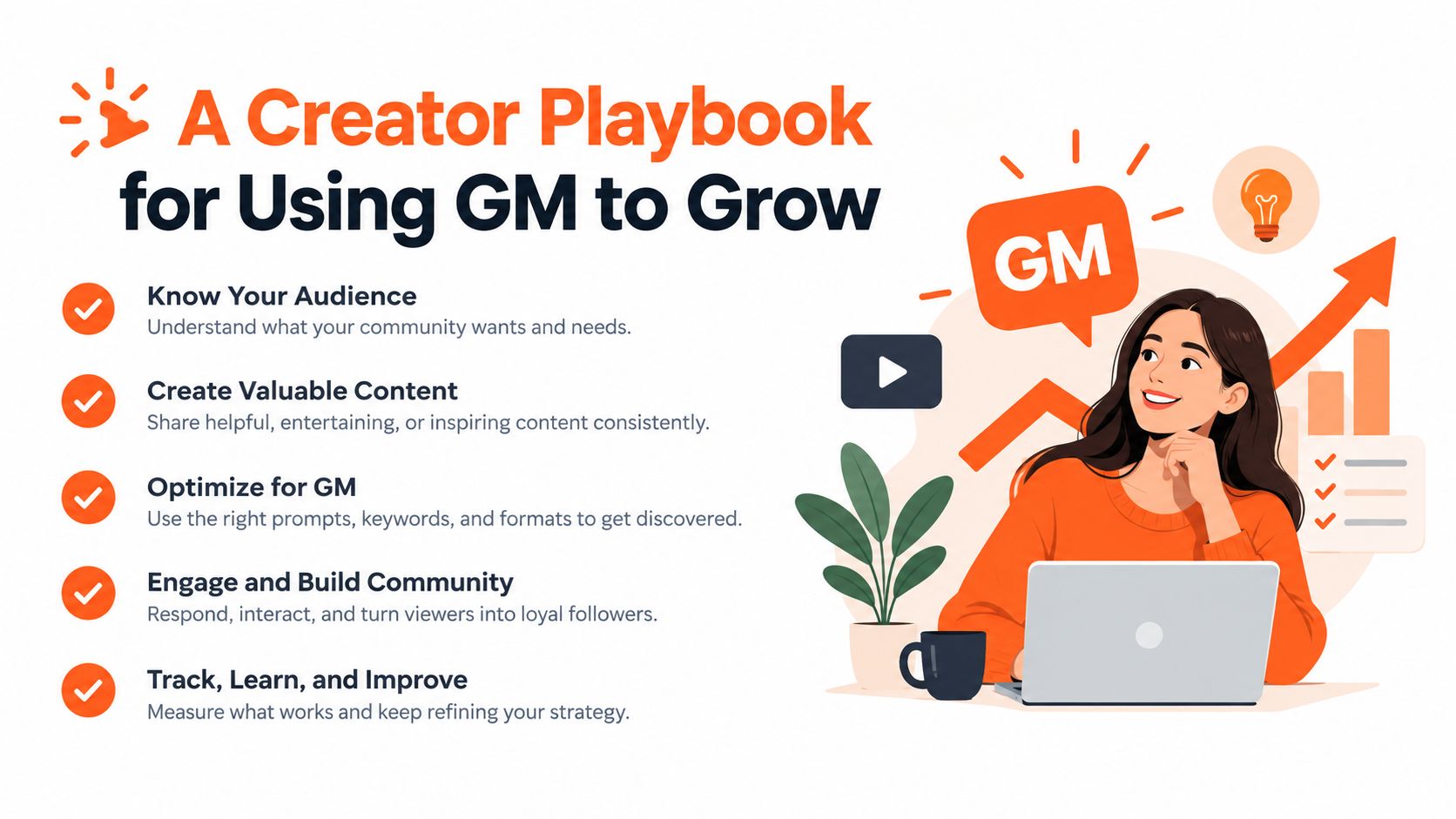
A Creator Playbook for Using GM to Grow
You don't need a complicated system to test gm well. You need a repeatable routine.
Start with timing that matches your audience
Post when your audience is likely easing into the day, not when your own schedule happens to allow it. If your followers are spread across regions, choose the window that overlaps best with your core community and stick with it long enough to notice patterns.
If you want a more structured approach, a tool like SupaBird's content strategy guidance can help map posting habits to audience behavior instead of pure guesswork.
Pair gm with a hook
This is the part many skip.
Good hooks for gm posts include:
A question: “gm. what are you building today?”
A niche frame: “gm founders. what are you delegating this week?”
A one-line observation: “gm. most onboarding copy is too polite to be clear.”
These formats make the greeting useful. They also help random visitors understand your corner of X fast.
Use replies as your second move
After you post, don't vanish.
Try this simple sequence:
Post your own gm with a hook
Reply to a few relevant creators
Continue any thread that gets traction
Visit profiles of good responders and build from there
Your reply style matters. Don't paste the same “gm” under ten posts. Write to the person in front of you. Mention their topic. Ask one real follow-up. Keep it short enough to feel native.
Creator habit: Treat gm as the opener, not the whole performance.
Track patterns lightly
You don't need a giant analytics dashboard for this test. A simple weekly note works.
Track things like:
Which gm post format you used
Whether it was standalone, hooked, or a reply
What kind of responses came back
Which version sparked profile visits, follows, or useful conversations
Do this for a few weeks and you'll spot your own pattern. Some audiences like direct questions. Others respond better to opinionated one-liners. Some barely care about morning posts but love threaded replies.
That's the lesson with Whats a GM. The phrase itself is small. The behavior around it is where growth happens.
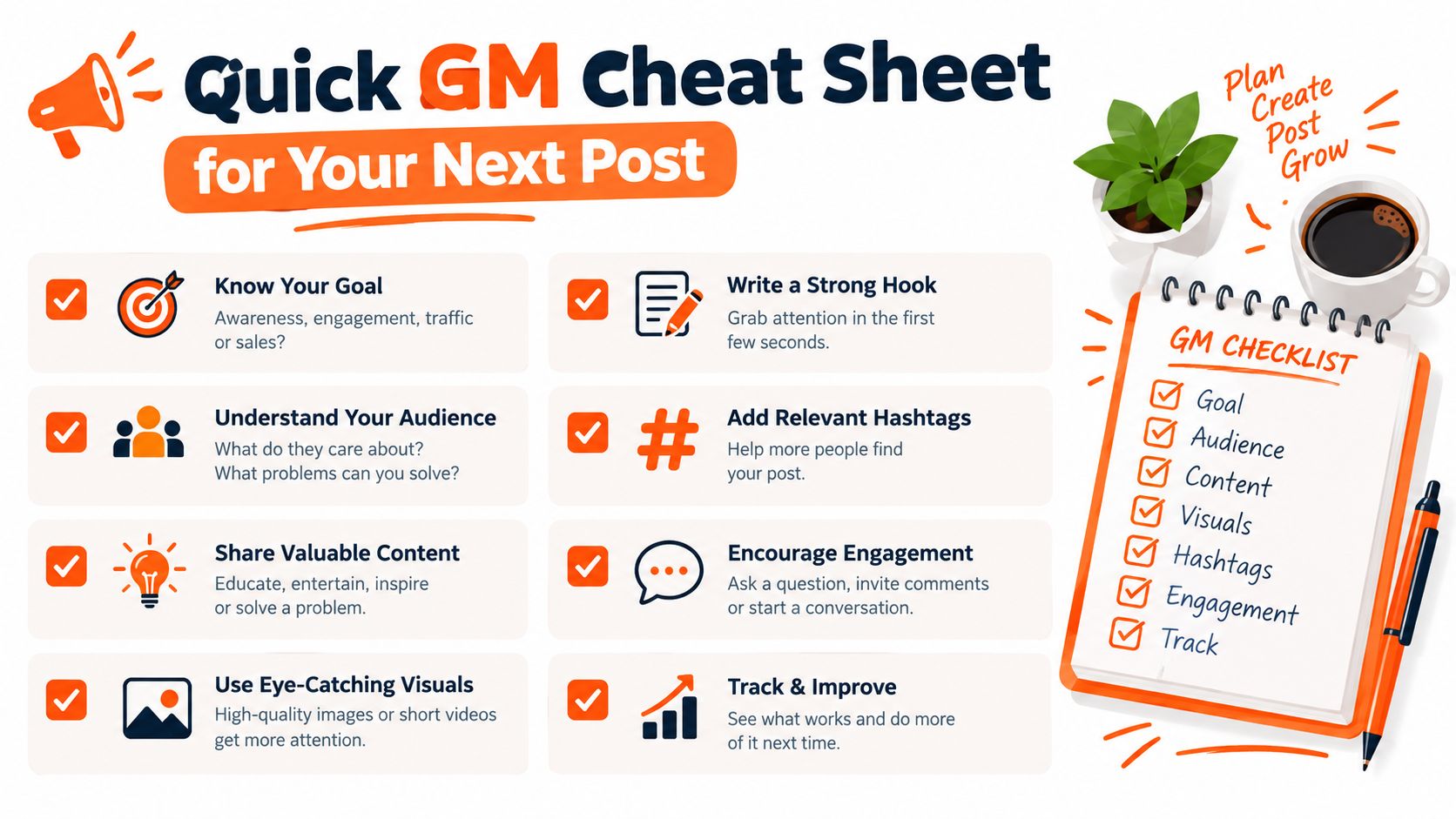
Quick GM Cheat Sheet for Your Next Post
If you want the shortest practical answer, here it is. Gm means good morning on X, but it works best as a social ritual and conversation opener, not just a literal greeting.
Five things to do
Match your audience's morning: post when your core readers are starting their day
Add a hook: tie gm to your niche, question, or daily observation
Reply with intent: answer two or three relevant posts with real context, not copy-paste filler
Use the lighter variation that fits: if it's later in the day, a flexible version can feel more natural
Keep the conversation going: the follow-up matters more than the greeting
Three things to avoid
Don't repeat the exact same gm every day: people notice autopilot fast
Don't drop gm under serious posts: if someone's venting or asking for help, lead with the topic, not ritual language
Don't attach it to obvious bait: “gm + giveaway + tag 3 friends” usually feels transactional
A copy-ready formula
Use this template tomorrow:
gm + niche cue + simple question
Examples:
“gm marketers. what campaign are you fixing today?”
“gm founders. what are you shipping before noon?”
“gm creators. what post idea are you turning into content today?”
If you want more formats beyond gm posts, this set of Twitter post templates for 2026 gives you more plug-and-play structures to test.
If someone asks, “Whats a GM?” you now have the better answer. It means good morning, yes. On X, it also means presence, tone, and a chance to start a conversation that goes somewhere.
If you want help turning small rituals like gm into real growth habits, SupaBird gives creators tools for idea generation, scheduling, and finding relevant conversations to reply to on X. It's useful when you want your morning post to lead somewhere better than a one-word check-in.

How Developer Startups Build a Brand on X Before Launch

30-Day Starting Plan for New X (Twitter) Accounts

How Often Should You Tweet for Maximum Growth?

What Should Your First 10 Tweets Be About?

How to Run X for Ten Clients: The Agency Workflow

How to write a bio that gets people to follow you

Digital Product Launch Strategy

Best Twitter Growth Service for Creators in 2026
From X to Every Platform: Repurpose Without Flopping
