Twitter Shadowban Test: Detect & Fix Visibility Issues
Author:

Your latest X post is live, but the replies have gone quiet. A post that normally reaches non-followers barely appears anywhere, and searching for your own handle shows an incomplete trail of recent tweets. The natural reaction is to ask, “Am I shadowbanned?”
That question is useful, but it's too narrow to diagnose the problem. A real visibility restriction can hide posts from search or reply surfaces, while algorithmic drift can reduce distribution because your content looks repetitive, your posting behavior resembles automation, or your audience has stopped responding. The right Twitter shadowban test doesn't just produce a yes or no. It helps identify which visibility surface changed and which variable you should address first.
Table of Contents
Understanding Visibility Filtering on X
Low reach does not by itself show that X restricted an account. A post may underperform because its timing, topic, format, or audience fit changed. Restriction is more specific: content can remain visible on the profile and to some followers while disappearing from discovery surfaces used by people who do not already know the account.
X uses visibility filtering rather than “shadowban” as its official language. Its stated framework, “Freedom of Speech, Not Reach,” permits the platform to limit discoverability without removing a post. X may exclude content from search results, trends, and recommended notifications, while leaving the original post on the author's timeline. X's visibility filtering framework explains why a creator can still view a post that non-followers cannot find.
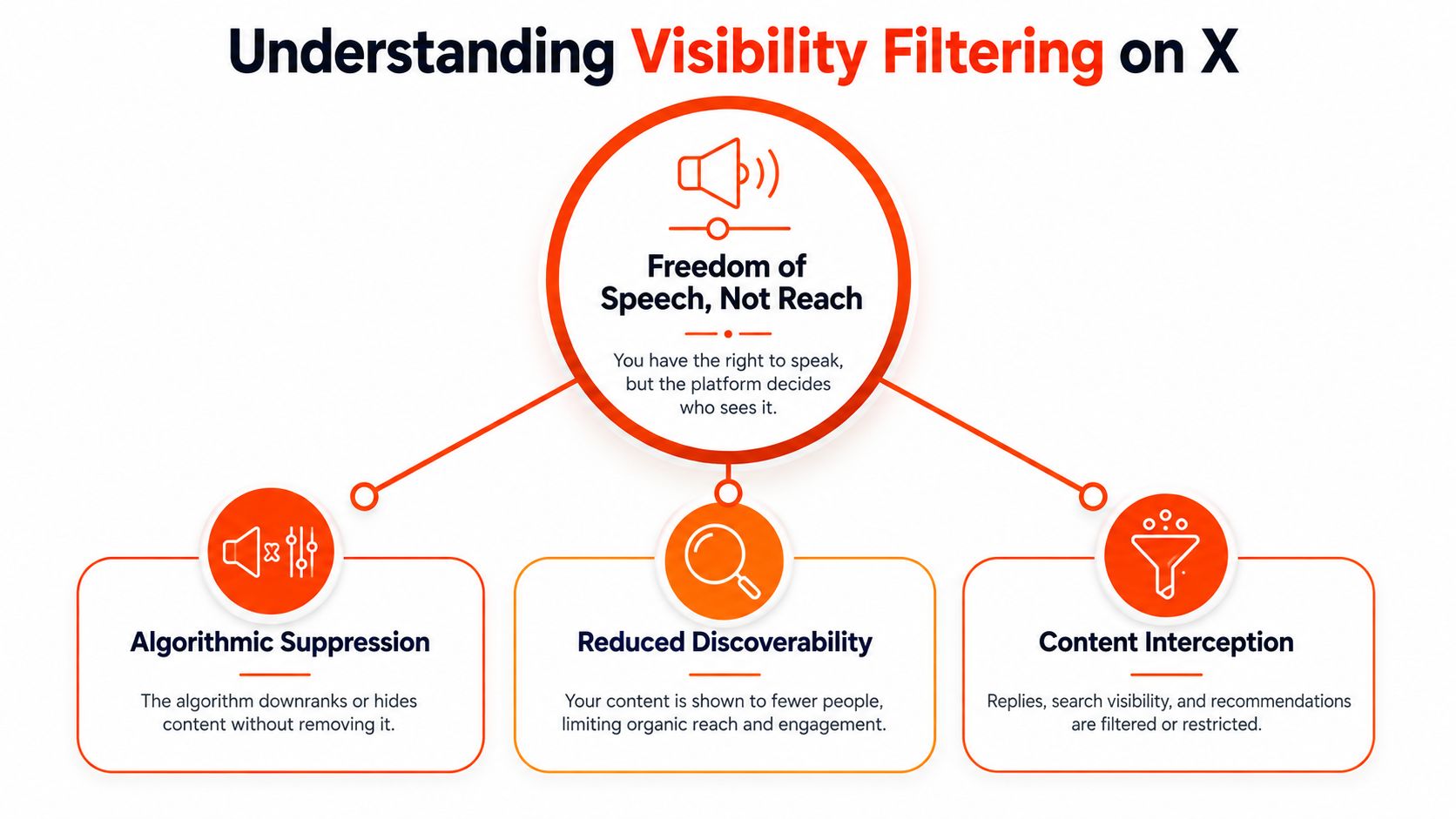
What restriction looks like
Visibility operates across several independent surfaces: the profile timeline, search indexing, reply areas, and recommendation feeds. A profile can function normally while search indexing fails. Followers may receive a reply notification even when other users cannot find that reply beneath the original post. Recommendations and trend placement can shift separately as well.
That makes “shadowban” useful for describing the experience but imprecise as a diagnosis. The term can imply one hidden penalty when X may be filtering only one surface. Track profile visibility, search visibility, reply visibility, and recommendation reach separately. Total impressions alone cannot identify which part of distribution changed.
Posting style can create a similar pattern without a formal restriction. Templated or AI-assisted posts may remain searchable yet receive less recommendation reach when they appear repetitive, predictable, or poorly matched to audience response. Compare surface-level results with engagement quality and audience behavior. Sift AI on social metrics provides broader measurement context for reading those signals.
A 2023 analysis in the Journal of Communication found evidence that these restrictions are not purely anecdotal. The study examined five Twitter shadowban checks and recorded 2,476 shadowbans affecting 1,731 accounts. During its year-long observation window, 6.2% of 27,718 active accounts were shadowbanned at least once, with search bans the most common restriction type. (Read the study in the Journal of Communication)
Running the Core Shadowban Tests
Start with a clean observation. Don't test while logged in to your own account, because X can personalize results and show you content that other users can't see. Use a logged-out browser or an incognito window, and test a post published recently enough that it should reasonably appear in search.
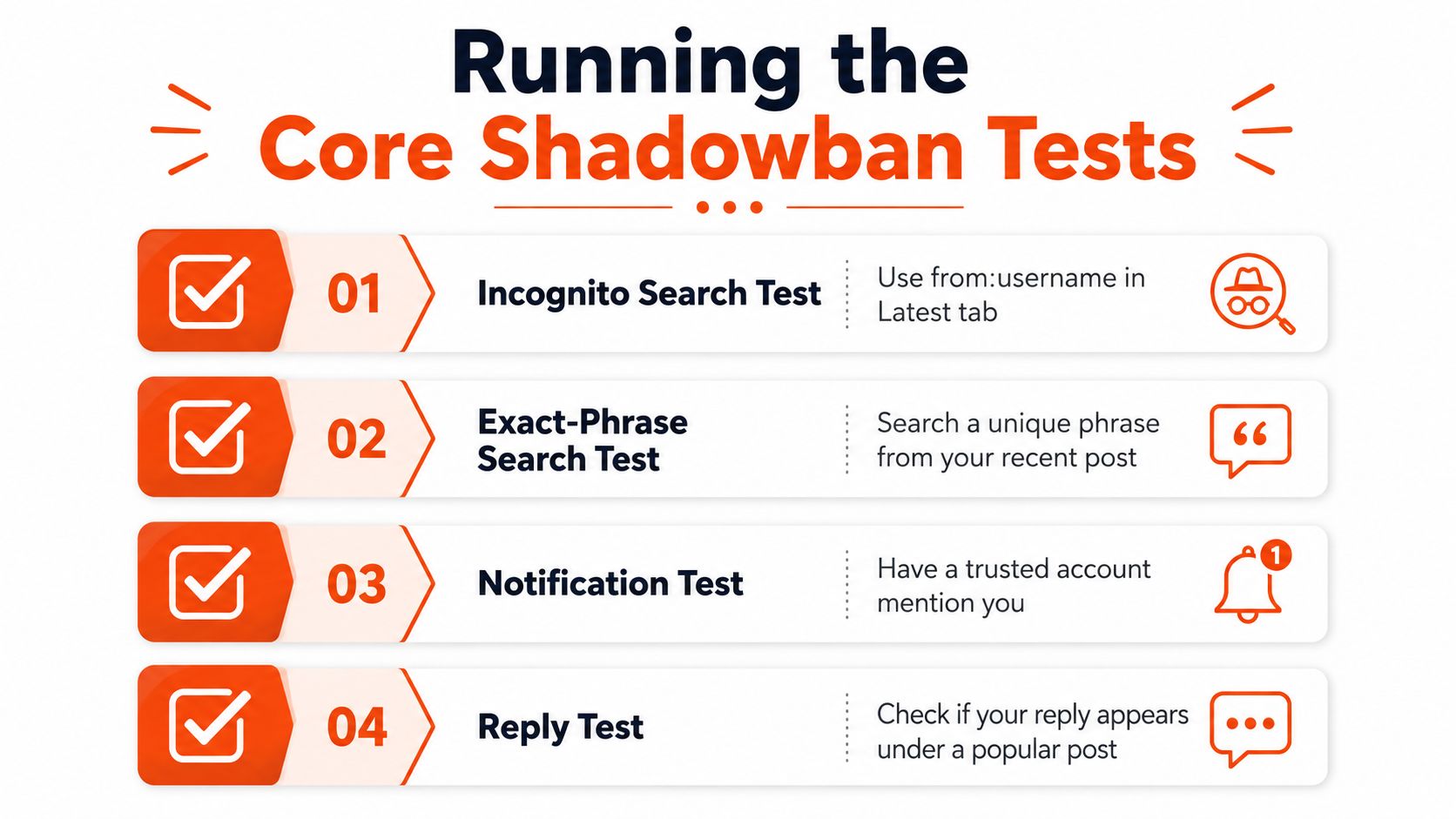
1. Run the incognito search test
Open a private or incognito browser window.
Visit X without logging in.
Search for
from:yourusername, replacing the handle with the account name.Select the Latest tab.
Look for a recent post that you know exists on your profile.
If several recent posts appear, your account likely isn't under a complete search ban. If recent posts exist on your profile but the logged-out from:username search returns nothing, that's a strong signal that search visibility is being filtered. The practical X shadowban test guide recommends this approach and warns that a single result can mislead you when the post is old or the account hasn't posted enough recently.
A search ban is narrower than a total account restriction. You may still receive follower engagement while losing discovery from non-followers.
2. Search an exact phrase
Copy a distinctive phrase from a recent post. Avoid common words, stock hooks, or a phrase likely to appear in thousands of tweets. Log out, search the phrase in quotation marks if X supports the query cleanly, and check the Latest results.
A missing result strengthens the search-suppression signal, but it isn't conclusive on its own. X may delay indexing, personalize results, or omit a post for reasons unrelated to an account-level restriction. Run this test alongside the handle query, not instead of it.
3. Check a hashtag feed
Open a hashtag used in the recent post from the logged-out browser. Switch to recent or latest content if the interface provides that option, then look for the post.
A missing post can indicate reduced discoverability, but hashtag tests are easy to misread. An inactive hashtag, an old post, or minimal recent activity can produce the same result. Treat the test as supporting evidence.
4. Test replies and mentions
Reply to a relevant public post, then view the conversation while logged out or from a trusted account that doesn't follow you. Check whether the reply appears normally, is buried behind an additional reply layer, or is absent from the visible conversation.
You can also ask a trusted account to mention you and verify whether the notification arrives. This helps separate reply visibility from search visibility. A search result can fail while replies remain visible, or the reverse can happen.
The National University of Singapore research group documented repeated shadowban audits between June 12, 2020 and June 9, 2021, using account search behavior as a measurement method. One audit snapshot included 28,925 tweets posted in the ten days before data collection, showing that this kind of testing can be applied to a substantial active sample rather than a single anecdotal account. (Review the NUS shadowban methodology)
For a structured review of your account's content and activity patterns, use the X analysis tool. It shouldn't replace the logged-out checks, but it can help you organize the evidence before changing your strategy.
Distinguishing Real Bans from Algorithmic Drift
The most expensive diagnostic mistake is treating every reach decline as an enforcement problem. A true visibility restriction usually affects a defined surface. Algorithmic drift is broader and less binary. It often appears as a gradual change in how quickly new posts earn distribution, how often non-followers encounter them, or how much engagement a familiar format produces.
Compare the pattern, not just the feeling
A sudden disappearance from logged-out search, combined with invisible replies and absent hashtag placement, points toward a visibility filter. A gradual decline across otherwise normal search results points more toward distribution changes. The distinction matters because deleting posts or filing an appeal won't fix audience fatigue or repetitive content.
Signal | More consistent with a restriction | More consistent with algorithmic drift |
|---|---|---|
Search | Recent posts fail a logged-out | Recent posts remain searchable |
Replies | Replies don't appear normally to non-followers | Replies appear, but receive less interaction |
Timing | Visibility changes abruptly | Reach changes after a format or cadence shift |
Content | A specific post or behavior may trigger filtering | Similar posts lose novelty or audience response |
Recovery path | Review activity and consider support | Change structure, topic, timing, or media |
AI-assisted writing creates a particularly difficult false positive. A tool may help you draft quickly, but repeated hooks, identical paragraph shapes, predictable calls to action, and high-volume posting can create a recognizable behavioral fingerprint. The account might not have received a formal policy penalty. Its posts may receive less distribution because the content and activity resemble low-value or automated behavior.
Recent coverage of AI-assisted posting points to behavioral fingerprints, connection patterns, and content similarity as relevant visibility signals, not only overt policy violations. It also describes X's controls as increasingly granular, with different labels or restrictions attached to content and behavior. (Read the analysis of AI-assisted content and X visibility)
Diagnostic question: Which distribution signal changed, and what content or timing variable changed at the same time?
Check your posting history before assuming enforcement. Look for a new cadence, repeated templates, identical replies, a sudden increase in automation, or a shift from conversation to broadcast-only publishing. If search visibility remains intact and only reach has softened, adjust the content system first. The X analytics tools guide can help you compare these patterns without reducing the diagnosis to one impression number.
Recovering Your Reach After a Confirmed Restriction
Once multiple logged-out tests point to the same failure, stop trying random fixes. Recovery works better when you remove possible triggers, restore varied human activity, and document what changed.
Start with the highest-impact actions
Pause automated posting first. Stop tools that publish, reply, follow, or engage without a deliberate review. Don't add more activity to a system that may already be interpreting your behavior as repetitive or automated.
Review recent content next. Look for duplicate posts, repetitive replies, misleading claims, aggressive engagement patterns, and content that could violate X's rules. Don't mass-delete everything in panic. Preserve a record of questionable posts and make targeted edits where appropriate.
Change the content mix. Replace a run of templated text posts with original observations, useful replies, images, short videos, and threads where each post adds a distinct point. The objective isn't to manufacture activity. It's to make your publishing pattern reflect genuine authorship and audience value.
Engage manually and selectively. Spend time in relevant conversations, especially with accounts in your niche, but avoid copying the same response across multiple threads. A thoughtful reply that responds to a specific argument is safer and more useful than a batch of interchangeable comments.
Rebuild evidence of authentic activity
Audit your profile for consistency. Check the bio, pinned post, links, recent topics, and public conversations. A profile that clearly explains who it helps makes it easier to evaluate whether the content being distributed matches a coherent account purpose.
Then rebuild with a sustainable calendar. Vary the structure of posts, leave room for real replies, and review performance by format rather than chasing one successful template. This guide to increasing impressions on Twitter can help with the broader reach strategy, but don't use reach tactics as a substitute for resolving the visibility signal.
If the restriction persists after you've removed likely triggers and confirmed the issue across independent tests, contact X support. Keep the appeal factual:
“My recent posts remain visible on my profile, but logged-out searches using
from:usernamedon't return them. I tested an exact phrase and a hashtag feed as well. Please review whether search or reply visibility has been limited on my account.”
Include post links, test conditions, and dates if you have them. Avoid claiming certainty about an invisible penalty. A clear description of what a non-follower can and can't see gives support a more useful starting point.
Preventing Future Visibility Restrictions
The safest growth system doesn't maximize output. It creates a recognizable human pattern that combines original ideas, varied formats, and real participation in a niche community.
Use scheduling tools for consistency, not for unattended behavior. Drafting a post in advance is different from automating a stream of identical replies, follows, likes, or reposts. Review every scheduled post, vary the language, and leave space to respond to the conversations your content creates.
AI writing assistants need editorial control. Ask the tool for angles, counterarguments, outlines, or alternative hooks, then add your own examples, judgments, and phrasing. A human fingerprint comes from specificity, not from adding random imperfections. If five posts could be swapped between accounts without changing their meaning, the system is producing too much sameness.
Build a safer operating rhythm
Vary formats: Mix observations, questions, short text posts, threads, media, and detailed replies.
Vary openings: Don't repeat one hook formula across every topic.
Respond specifically: Mention the idea you're addressing instead of using generic praise.
Review integrations: Remove tools that perform actions you didn't explicitly approve.
Watch search visibility: Run occasional logged-out checks instead of waiting for reach to collapse.
Avoid aggressive follow and unfollow behavior, mass replies, and engagement exchanges. The risks of bot-like activity are discussed in this guide to Twitter auto-follow bots, but the practical rule is broader. If a workflow can publish or interact at a speed and consistency no human could reasonably maintain, redesign it.
Authentic engagement also improves diagnosis. When you participate in real discussions, you can tell whether people are ignoring a topic, reacting poorly to a format, or failing to see the post at all. That information is more valuable than a dashboard that only reports a lower number.
Your Weekly Visibility Health Routine
A useful routine should be short enough to repeat and specific enough to reveal a real change. Once a week, use a logged-out browser to search from:yourusername and confirm that a recent post appears under Latest. Then check one hashtag feed connected to a current post.
Review two or three replies on high-engagement conversations from a non-following account. Confirm that your replies appear in the thread and aren't consistently hidden. Finally, scan your analytics for an unusual change in impressions, profile visits, or non-follower interaction, then compare that change with your posting cadence and content format.
Use a simple decision rule
Search and replies fail suddenly: Preserve examples, pause automation, review recent activity, and consider contacting support.
Search works but reach declines gradually: Adjust topics, hooks, formats, timing, and audience fit before treating it as enforcement.
Only one post fails: Recheck indexing, freshness, hashtag activity, and query wording before drawing conclusions.
Several surfaces fail together: Run the tests again from a separate logged-out environment and document the results.
The value of a weekly check isn't the label “shadowbanned.” It's early visibility into whether your distribution system is healthy, whether your content has become repetitive, and whether a platform restriction deserves escalation. Track the surface that changed, not just the total reach that fell.
SupaBird helps creators build a repeatable X workflow with idea generation, thoughtful engagement discovery, AI-assisted rewriting, scheduling, and practical coaching. Use SupaBird to plan varied posts, review your publishing habits, and grow without relying on repetitive automation that can make visibility problems harder to diagnose.

The Reply Guy Strategy: A Growth Guide for X

Why New X Accounts Get Less Reach

ClimbX Review (2026): Features, Pricing, Pros and Cons

How Developer Startups Build a Brand on X Before Launch

30-Day Starting Plan for New X (Twitter) Accounts

How Often Should You Tweet for Maximum Growth?

What Should Your First 10 Tweets Be About?

How to Run X for Ten Clients: The Agency Workflow

How to write a bio that gets people to follow you
