Twitter Marketing Strategy: A Practical 2026 Blueprint
Author:

Most advice about X makes the same mistake. It treats a twitter marketing strategy like a checklist of random tactics, post more threads, use hashtags, reply sometimes, and hope the feed notices. That isn't strategy, it's motion without a system, and on a platform with about 557 million monthly active users and 251 million daily active users in 2026, that's a waste of reach (Sprout Social).
The accounts that keep growing don't chase one-off spikes. They build a repeatable operating system where goals shape content, content shapes engagement, and analytics shape the next week's decisions. That's the difference between a feed that burns out and a channel that compounds.
Table of Contents
Why Your Twitter Strategy Is Probably Just a To Do List
A lot of brands say they have a strategy because they have a posting schedule. That's not a strategy, that's a calendar. A real twitter marketing strategy connects the account's job to the content it publishes, and then uses performance data to decide what survives.
X works because it's still a real-time conversation layer for the internet, not just a content shelf. With 500 million tweets sent each day, user attention moving in tight windows, and strong adoption in markets such as the U.S., Japan, and India, the platform rewards teams that publish consistently and respond quickly (Measure Studio). If you're still treating each post as a standalone asset, you're ignoring the way distribution compounds.
Practical rule: if a post can't be tied to a business outcome, an audience need, or a clear test, it's probably busywork.
That's why tools matter less than the operating model. A scheduler like PostPulse for Twitter automation can help keep publishing steady, but it won't rescue a fuzzy plan. The plan has to decide what the account is for, who it's speaking to, and what success looks like before the first draft goes live.
The cleanest way to think about X is as a loop. Publish, observe, respond, refine. If that loop is missing, the account becomes a bucket of disconnected posts. If it's tight, even modest gains in engagement can build meaningful reach over time because the audience is large enough for small improvements to matter.
Laying the Foundation North Star Metrics and Audience
Start with one outcome, not five. A founder does not need “more followers” as the main goal, because followers only matter if they lead somewhere. If the account exists to book sales calls, grow a newsletter, or drive product signups, the metric should match that job.
A practical objective sounds specific. It can be “1,000 followers in the next month” or a defined number of qualified profile visits tied to a campaign. That kind of target is testable because it can be tracked with links, coupon codes, or other attribution methods (ContentStudio). It turns a vague publishing habit into a measurable campaign.
The audience work needs the same discipline. “Marketers” is too broad to guide useful content. “Early-stage SaaS founders who are struggling to generate leads without paid ads” gives you something to write toward, reply to, and test against.
A simple founder persona keeps the strategy grounded:
Role: early-stage founder with limited time
Pain point: wants attention without sounding salesy
Goal: turn posts into conversations and inbound interest
Behavior: checks X for ideas, distribution, and market signal
When that persona is clear, the account audit becomes sharper. You can review which topics already resonate, which posts attract the right people, and which formats create meaningful replies. If you want a deeper framework for this kind of audience work, the internal guide on building your Twitter audience is worth reading alongside your own notes.
The account's job also needs a follower-growth reference point. If your growth goal is follower-based, the practical checklist in Contesimal's Twitter follower guide can help you separate vanity growth from accounts that attract the right people.
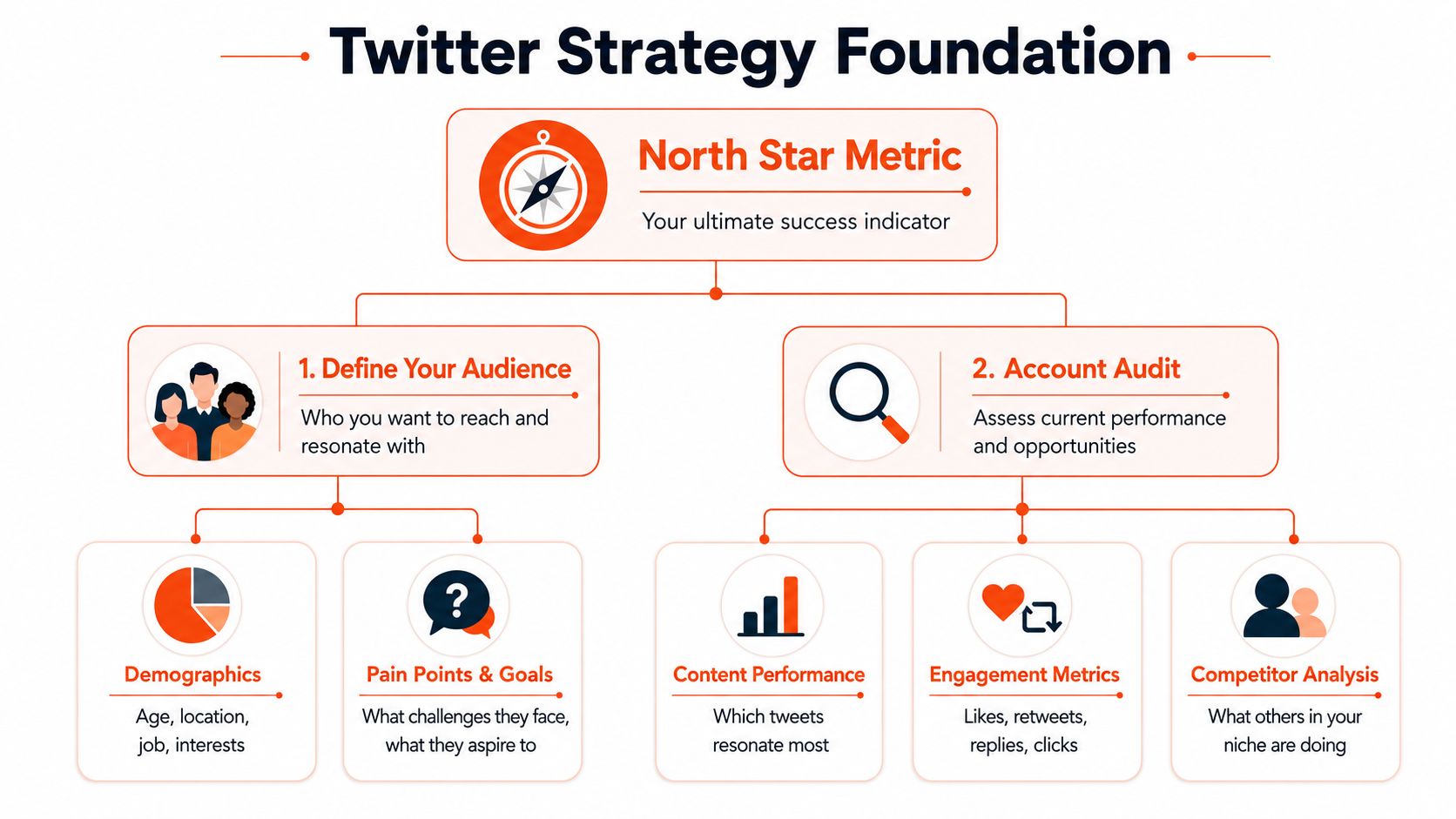
Useful filter: if a tweet would not help your named persona think, act, or reply differently, it does not belong in the main feed.
The most useful account audit question is simple. What type of post already proves you know what this audience cares about? Once you answer that, the rest of the strategy gets easier because content starts serving the audience instead of chasing random attention.
Designing Your Content Machine Pillars and Formats
A stable X account isn't built on inspiration. It's built on content pillars, the recurring themes you can return to without sounding repetitive. For a solopreneur, that might be bootstrapped growth, solopreneur psychology, and building in public. For a SaaS founder, it might be product lessons, customer objections, and market observations.
The point is to make the feed recognizable. When someone lands on the profile, they should understand what kind of value they'll get if they follow. That doesn't mean every post looks the same. It means every post fits a pattern the audience can trust.
Use the 80/20 rule as your guardrail. Hootsuite's framing is direct, 20% promotional, 80% informative, educational, or entertaining (Hootsuite). That balance protects the account from turning into a sales desk with a social handle.
A good pillar system maps cleanly to format choices:
Atomic tweets for sharp opinions, single lessons, and quick reactions
Threads for teaching, case breakdowns, and step-by-step explanation
Polls for lightweight market research and conversation starters
Short video for founder presence, product demos, or quick lessons
Short vertical video deserves more attention than many teams give it. One recent guide notes that it can produce about 14% lower CPMs for early adopters, which makes it worth testing when native reach matters (Whitehat SEO). If you need a partner reference for production or repurposing, video marketing companies can help turn existing ideas into native clips without rebuilding the whole content process from scratch.
The thread format should stay structured. A clean sequence, hook, setup, body, summary, CTA, makes content easier to scan and easier to improve. That's also where one of the most overlooked trade-offs shows up, because a thread can educate thoroughly, but a short post can travel faster when the idea is crisp.
Many teams often get lazy. They publish one-off takes with no link to the pillar, then wonder why the account feels incoherent. A better move is to decide whether each pillar needs a teaching format, a proof format, or a conversation format, then rotate deliberately.
For ideation support, the internal guide on how to find content ideas fits naturally into the pillar-building process. Use it to maintain a steady backlog, then sort ideas by pillar before anything gets drafted.
The Daily Workflow Idea Generation and Engagement
A working X account needs a daily operating rhythm, not sporadic bursts of effort. The strongest creators I've seen keep two habits alive every day, they capture ideas continuously and they spend focused time engaging in conversations that matter. That keeps the account from running dry and keeps the algorithm from seeing it as a ghost town.
One useful model is a day built around a few short blocks. In the morning, collect raw ideas from customer calls, support questions, competitor posts, or your own notes. In the afternoon, turn one or two of those ideas into tweets or thread outlines. Finally, spend time in replies where your audience already hangs out.
Here's a simple workflow template you can adapt:
Day | Morning (30 mins) | Afternoon (30 mins) | End of Day (15 mins) |
|---|---|---|---|
Monday | Capture ideas from recent replies | Draft a value post | Reply to niche accounts |
Tuesday | Review saved posts and notes | Outline a thread | Add thoughtful replies |
Wednesday | Collect objections from audience | Write a short take | Answer mentions |
Thursday | Pull one customer story | Refine thread hooks | Join relevant conversations |
Friday | Review top-performing ideas | Batch a few posts | Comment with useful context |
Benchmark guidance from 2026 practitioner guides suggests that accounts seeking faster growth often maintain roughly 3 to 5 posts per day, with threads posted about 2 to 3 times per week and replies reserved for at least 30 minutes of daily engagement (SocialRails). That cadence matters less as a universal rule and more as a stress test. If you can't sustain it, your system is too heavy.
The reply block should be intentional, not random. Don't drop generic praise or copy-paste comments. Add a new insight, a useful counterpoint, or a concrete example. That's the kind of engagement that gets remembered.
Answer the question under the post, then add the detail the original author left out.
If reply work feels ambiguous, the internal guide on how replying to tweets grows your account faster is the kind of operational reference that keeps the habit honest. It reinforces the idea that engagement isn't filler, it's distribution work.
A founder workflow can be extremely simple when it's disciplined. Save ideas as they appear, batch draft when your brain is fresh, and reserve a daily block for high-signal replies. That's enough to keep the account alive without turning X into a second full-time job.
Scheduling and Measurement The Growth Feedback Loop
Scheduling is useful because consistency beats random effort. A queue keeps the account active when meetings run long or travel disrupts posting time. But scheduling without measurement is just organized guessing, and guessing is expensive when your audience spans different regions and routines.
The biggest mistake is copying generic timing charts. Existing guides disagree on posting windows, some push mornings, others lean late, and that inconsistency is exactly why a measurement-first system wins (Conbersa). The answer isn't to chase a universal best time, it's to find when your audience responds by region, content type, and daypart.
A useful testing method is straightforward. Pick two time slots for the same type of post, keep the topic and format similar, and compare replies, clicks, and bookmarks after a few rounds. That gives you a better read than a one-week spike ever will.
The metrics that matter are the ones tied to the job of the post. If the goal is conversation, look at replies. If the goal is traffic, watch clicks. If the goal is authority, pay attention to how often people reuse your wording, respond with depth, or come back later with follow-up questions.
There's a reason many high-performing teams audit weekly instead of monthly. Weekly review is fast enough to catch drift and slow enough to avoid overreacting to a single post. That's also the right time to remove weak formats, keep winners, and refine hooks that aren't pulling attention.
Decision rule: don't ask whether a post “did well.” Ask whether it did the job you assigned it.
The internal reference on Twitter analytics tools fits here because measurement only matters when the data is easy to read. A clean dashboard should help you answer three things quickly, what to post more of, what to stop, and when your audience tends to show up.
If you're managing multiple markets, timing should be tested by geography, not assumed from a single timezone. A founder in New York and a buyer in Mumbai don't behave the same way, and a strategy that respects that difference will usually outperform one-size-fits-all posting habits.
Conclusion From Plan to Action
A strong twitter marketing strategy is built in four layers. First, the foundation, where you define the goal and audience. Second, the content machine, where you turn that audience into pillars and repeatable formats. Third, the workflow, where daily idea capture and engagement keep the account moving. Fourth, the feedback loop, where analytics decide what stays and what gets cut.
That order matters. Skip the foundation and your content drifts. Skip the workflow and your ideas never ship. Skip measurement and you keep repeating posts that only feel productive.
The practical takeaway is simple. Build a system you can run on a normal week, not a fantasy week. Make the account useful to a specific person, publish consistently, engage like a human, and adjust based on what the data shows.
The best X accounts don't look lucky from the inside. They look disciplined. The people behind them know what the account is for, what to post next, and what signal tells them to change course.
If you want a cleaner way to keep that system running, SupaBird gives creators, founders, and marketers tools for ideas, engagement, and scheduling in one place. It's built for the exact problem this article solves, turning X growth into a repeatable routine instead of a daily scramble. Visit SupaBird and use it to build a posting system you can stick with.

The Reply Guy Strategy: A Growth Guide for X

Why New X Accounts Get Less Reach

ClimbX Review (2026): Features, Pricing, Pros and Cons

How Developer Startups Build a Brand on X Before Launch

30-Day Starting Plan for New X (Twitter) Accounts

How Often Should You Tweet for Maximum Growth?

What Should Your First 10 Tweets Be About?

How to Run X for Ten Clients: The Agency Workflow

How to write a bio that gets people to follow you
