
X influencer marketing is often dismissed as yesterday's playbook, while TikTok and Instagram receive most of the creator budget. That advice is too broad. X isn't the obvious choice for every product, but it remains unusually effective when influence depends on expertise, fast-moving conversation, founder credibility, and audience trust rather than polished lifestyle content.
The platform also rewards a different operating model. The strongest campaigns don't rent a large audience for one sponsored post. They combine creator authority with brand publishing, prioritize meaningful replies over inflated reach, and treat disclosure as part of campaign design rather than legal cleanup. The result is a channel built less on viral luck and more on repeatable participation.
Table of Contents
The Untapped Reality of X Influencer Campaigns
The assumption that X is a dead channel for influencers usually comes from comparing it with visual-first platforms on their terms. That misses what X does well. A creator can introduce a product through an opinion, answer objections in replies, join an unfolding industry conversation, and turn a single post into a discussion that other accounts continue carrying.
Adoption data makes the opportunity clearer. Only 5.5% of marketers use X for influencer campaigns, far behind TikTok at 58.9% and Instagram at 35.2%, according to Hootsuite's reported influencer marketing statistics. At the same time, X users watched 8.3 billion videos daily in 2024, a 40% year-over-year increase, according to Influencer Marketing Hub's X strategy coverage.
That gap doesn't prove every X campaign will outperform a TikTok campaign. It does show that marketer saturation and user behavior aren't aligned. Brands have fewer competitors competing for creator attention, conversation share, and recognizable positions in specialist communities. For a SaaS company, research product, media brand, or founder-led business, that can matter more than broad entertainment reach.
X also has a meaningful history as a persuasion channel. A 2016 Twitter and Annalect study reported by Adweek found that around 40% of respondents had purchased an item online after seeing it used by an influencer across Instagram, Twitter, Vine, or YouTube. One-third of millennials said they followed a creator on Twitter or Vine, and 20% said they had shared something they saw from an influencer. The lesson isn't that an old study predicts current performance. It's that creator-driven persuasion was already measurable on Twitter before the platform became X.
Why authority beats polish
X works especially well when the buyer wants a point of view. A developer may care about a creator's product teardown. A founder may respond to a detailed comparison. A finance audience may engage with an argument that invites scrutiny rather than a flawless product montage.
That behavior creates room for high-frequency testing. A creator can test a hook in a short post, expand the strongest response into a thread, answer objections in replies, and turn the winning angle into a video. Teams looking for practical prompts can use these ideas for your X content strategy as a starting point, then adapt them to the creator's actual voice.
Practical rule: Use X when your product benefits from explanation, debate, or timely relevance. Don't force it to behave like a catalog of polished social ads.
The strongest opportunity in 2026 isn't “influencer marketing on X” as a generic category. It's niche authority at the moment a conversation is active. A useful next step is to identify what niche is actually winning on X in 2026, then recruit creators who already participate in that community without brand prompting.
Choosing the Right Campaign Models and Formats
A single sponsored post is the easiest X campaign to buy and often the easiest to waste. The format may deliver visibility, but it gives the creator little room to establish context, demonstrate the product, or respond to doubts. The right model depends on whether the campaign needs awareness, authority, conversation, or conversion.
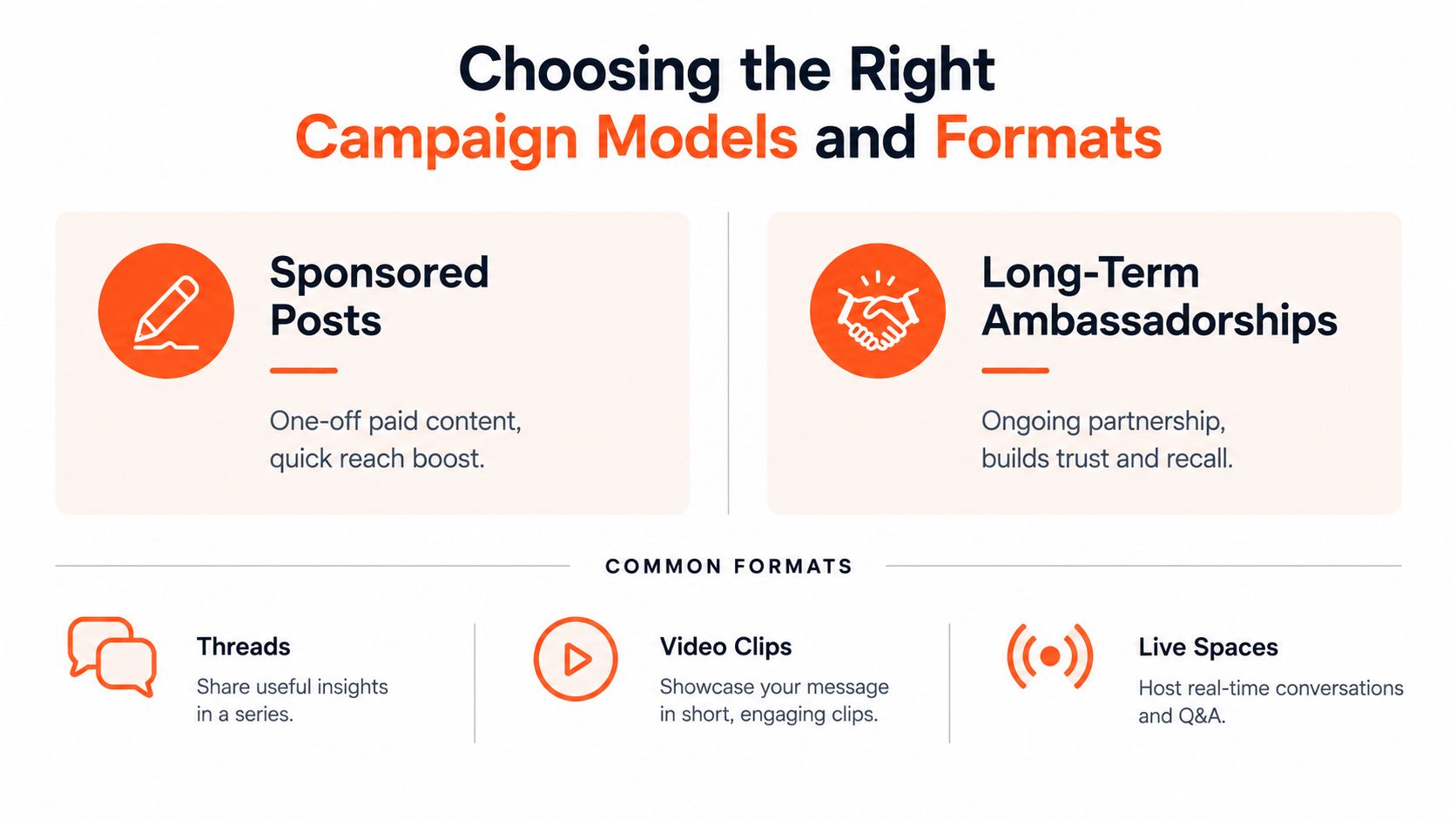
Campaign model | Best use | What it needs to work | Common weakness |
|---|---|---|---|
Sponsored post | Fast awareness or a simple announcement | A sharp hook and a clear next action | Little space for proof or objections |
Sponsored thread | Product education, analysis, and qualified traffic | A useful narrative that earns attention before the pitch | Weak writing makes the promotion obvious |
Reply-driven activation | Community visibility and trust building | A creator who can add insight to live conversations | Harder to control message timing |
Quote-tweet cascade | Amplification and social proof | Several relevant accounts with genuine interest | Can look coordinated or artificial |
Short-form video integration | Demonstration and emotional recall | A strong visual opening that still feels native to X | Production quality can overwhelm credibility |
Long-term ambassadorship | Repeated association and durable trust | Consistent usage and a clear editorial relationship | Poor fit becomes more visible over time |
Match format to buying friction
For a product that needs explanation, a thread usually creates more useful space than a single post. A creator might open with the problem, show the workflow they used before, demonstrate the product, explain one limitation, and invite specific questions. That structure feels closer to an informed recommendation than an interruption.
Reply-driven campaigns suit brands that want to enter a community carefully. Instead of asking a creator to publish a generic endorsement, give them room to respond to relevant posts with a real observation. For example, a cybersecurity creator could join a discussion about onboarding friction and explain how a product changes the process, without dropping a link into every reply.
Short-form video has a role, especially because video consumption on X has grown, but it shouldn't automatically replace text. A founder demonstrating a feature in a concise screen recording may outperform a polished commercial because the audience can see the product in context. A thought leader explaining why the feature matters may create more qualified discussion than the demonstration alone.
Build combinations, not isolated placements
The most effective campaigns often sequence formats. A creator publishes an analysis, the brand responds with a useful visual or data explanation, and the creator follows up in replies. Another option is a short video supported by a text post that explains the practical takeaway. The creator supplies credibility, while the brand supplies continuity and conversion infrastructure.
For teams building a broader social media content strategy, X should be treated as a conversation layer, not merely a distribution slot. Repurpose the insight, not just the asset. A thread can become a landing-page section, a product FAQ, or a sales enablement example, while the replies reveal which objections deserve a direct answer.
Hootsuite recommends publishing 1–2 times per day on X, with no more than 3–5 times per day, and keeping hashtags to 1–2 per post, as stated in its social strategy guidance. Those are operating guardrails, not a reason to flood the feed. The campaign should leave enough room for creators and customers to respond.
Finding and Evaluating the Right Creators
Follower count is a distribution estimate, not a measure of persuasion. On X, the difference between a creator with a visible audience and a creator with a responsive community can determine whether a campaign produces clicks or merely produces a screenshot of impressions.
The engagement decay is steep. A benchmark of 100,000+ influencer profiles found that Twitter/X accounts with fewer than 1,000 followers averaged about 1.4% engagement, while accounts with more than 100,000 followers averaged roughly 0.3% according to Influencer Marketing Hub's benchmark report. A separate benchmark reports that nano-influencers with 1,000–10,000 followers average roughly 1% engagement on X, compared with about 0.3% for accounts above 1 million followers, as detailed by SQ Magazine's Twitter statistics.
Those figures don't mean small accounts always win. A large creator can provide valuable awareness, cultural relevance, or access to a community that smaller accounts can't match. They do mean the marginal interaction often becomes less efficient as an account scales, especially when the campaign depends on replies, questions, and discussion.
Audit the audience before negotiating
Start with the creator's last several weeks of activity, not the media kit. Look for:
Relevant conversation: Do followers discuss the creator's subject, or do they leave generic praise with no evidence of attention?
Reply quality: Are responses specific, skeptical, and useful? A post surrounded by meaningful questions is more valuable than one surrounded by empty reactions.
Topic consistency: Does the creator regularly cover the problem your product solves, or did the topic appear only after your outreach?
Link behavior: Does the audience click and discuss resources, or does every promotional link disappear without response?
Voice credibility: Can the creator explain why they use or recommend something, including where it may not fit?
A smaller specialist who answers questions personally may drive stronger intent than a much larger account whose audience rarely receives a response. Review quote tweets too. They often reveal whether other knowledgeable users consider the creator a source worth extending, challenging, or referencing.
Score fit, not fame
Use a simple internal scorecard with qualitative ratings for audience fit, topical authority, reply depth, consistency, disclosure discipline, and conversion relevance. Ask each creator for examples of previous posts that generated thoughtful discussion, not only their highest-reach post. Then compare the quality of interactions with the size of the audience.
The best creator is often the person whose followers already ask the question your product answers.
Don't rely on a single engagement rate supplied by the creator. Ask how the rate was calculated, inspect the underlying posts, and separate replies from low-intent reactions. Also check whether the creator can follow a brief without sounding scripted. A perfect audience fit loses value if the creator can't explain the product in their own language.
Structuring Deals, Pricing, and KPIs
A good X creator agreement buys more than a post. It defines the creator's role in the conversation, the brand's publishing commitments, the approval boundaries, the disclosure language, the tracking method, and the period during which both sides will monitor responses.
Start with the campaign outcome. If the objective is qualified traffic, use a creator-specific landing page or tagged link. If it's product education, measure engaged replies, meaningful questions, video completions where available, and assisted visits alongside clicks. If the goal is demand creation, track branded conversation and the quality of accounts joining the discussion rather than treating impressions as the final answer.
Use a clear deal structure
A practical agreement should specify:
Deliverables: Define the post, thread, video, reply follow-up, quote tweet, or live conversation precisely.
Editorial control: Give the creator room to use their voice, but document claims they must support and claims they must avoid.
Timing: Agree on a publishing window and a response period. X campaigns lose value when the creator posts and immediately disappears.
Usage rights: Separate organic publication from permission to reuse the content in paid media, email, or a website.
Measurement: Assign unique links, landing pages, codes, or campaign labels before publication.
Payment conditions: Tie payment to agreed deliverables and disclosure compliance, not to an invented guarantee of virality.
Pricing should reflect audience fit, content complexity, exclusivity, usage rights, and the creator's expected participation after publication. A thread that requires research and follow-up shouldn't be valued like a short mention. Likewise, a niche expert with a smaller audience may be more commercially relevant than a generalist with far greater reach.
Measure the brand and creator together
The strongest argument for coordinated publishing comes from an experimental study cited by X. It reported a 2.7x lift in purchase intent from brand Tweets alone, rising to 5.2x when brand Tweets were paired with influencer Tweets, as reported by MarTech's coverage of B2B marketing on X. Treat that as evidence of possible synergy, not a promise for every campaign.
Publish the brand's supporting post close enough to the creator's message that audiences can connect the two. Give the brand account a useful role, such as answering a product question, showing a feature, or clarifying an offer. Then compare creator-only activity with the combined sequence.
For a practical measurement framework, use this guide to track five X growth metrics and get the data. The key is to record baseline conversation quality, not just post-campaign totals. Otherwise, a campaign can appear successful because it generated attention while failing to create any commercial movement.
Navigating Compliance and Disclosure Rules
Disclosure isn't a decorative hashtag added after creative approval. It tells the audience why the creator is discussing a product and protects the credibility that made the partnership valuable in the first place.
The compliance gap is substantial. A 2025 study of more than 100 million brand-related posts on X found that over 95% of sponsored influencer posts were not disclosed, with undisclosed posts more common among younger brands with large followings, as reported by TweetFull's analysis of X marketing trends. That behavior may be common, but it doesn't make it safe or strategically sound.
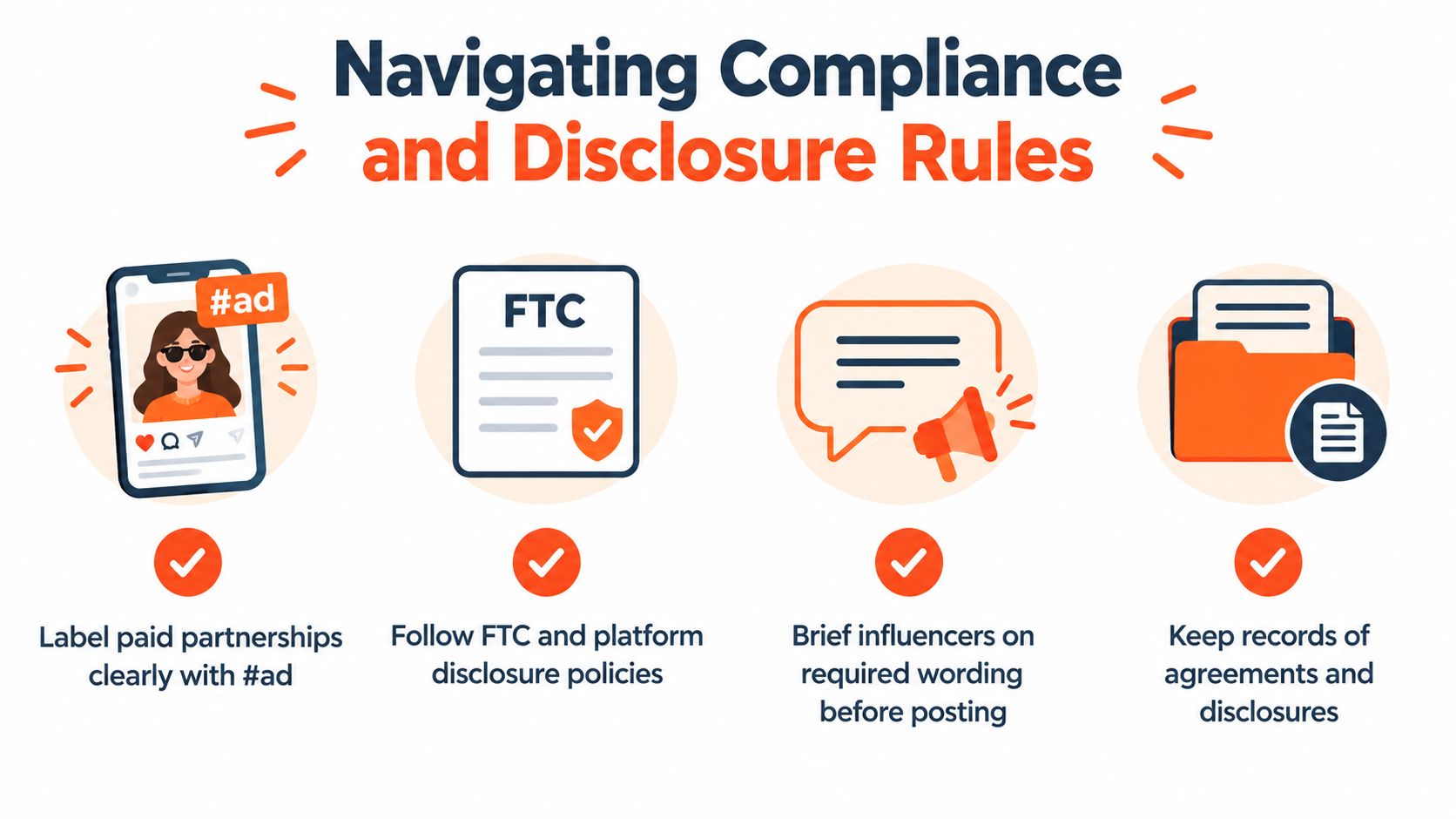
The FTC says an endorsement must make the material connection between creator and brand obvious. Its Disclosures 101 guidance for social media influencers says the disclosure should appear in the post itself, where viewers notice it immediately, rather than being hidden in a profile or behind a click. The FTC gives clear labels such as “Ad:” or “#ad” as practical examples that would likely be effective.
Make the disclosure visible
On X, short copy and fast scrolling make concealment particularly easy. A vague label, buried disclosure, or ambiguous phrase such as “partner” may leave viewers unsure whether the creator received payment, free products, an affiliate benefit, or another incentive.
Use a clear disclosure at the start of the post when the relationship is commercial. Apply the same standard to the first post in a thread, the text accompanying a video, and live conversation descriptions where applicable. If a creator adds follow-up posts that continue the endorsement, the brand should decide in advance whether those posts need their own disclosure.
Put compliance in the workflow
Brief before drafting: Give creators approved disclosure wording before they write.
Review for visibility: Check the disclosure on mobile, not only in a desktop preview.
Keep records: Store the agreement, final copy, approvals, publication time, and any edits.
Monitor live posts: Confirm that the disclosure remains present after publication and that replies don't create a misleading impression.
Escalate claims: Send health, financial, performance, or comparative claims through the right review process.
Compliance principle: A transparent post may reduce the appearance of spontaneity, but hidden sponsorship can reduce trust far more.
Treat disclosure as a quality signal. Audiences are more likely to understand the recommendation, and the brand gets cleaner interpretation of engagement because viewers know the commercial context. Short-term stealth is a poor trade for long-term authority.
Scaling Campaigns and Content with SupaBird
One campaign can run from a spreadsheet. A continuous creator program needs an operating system. Someone has to identify relevant conversations, brief contributors, adapt strong ideas, schedule supporting posts, monitor replies, and document what should change in the next cycle.
A focused X workflow can connect those jobs without turning every post into an automation exercise. The useful division is simple: software surfaces opportunities and reduces repetitive work, while people decide whether a conversation deserves a brand response and whether a creator's recommendation feels credible.
Turn discovery into a daily habit
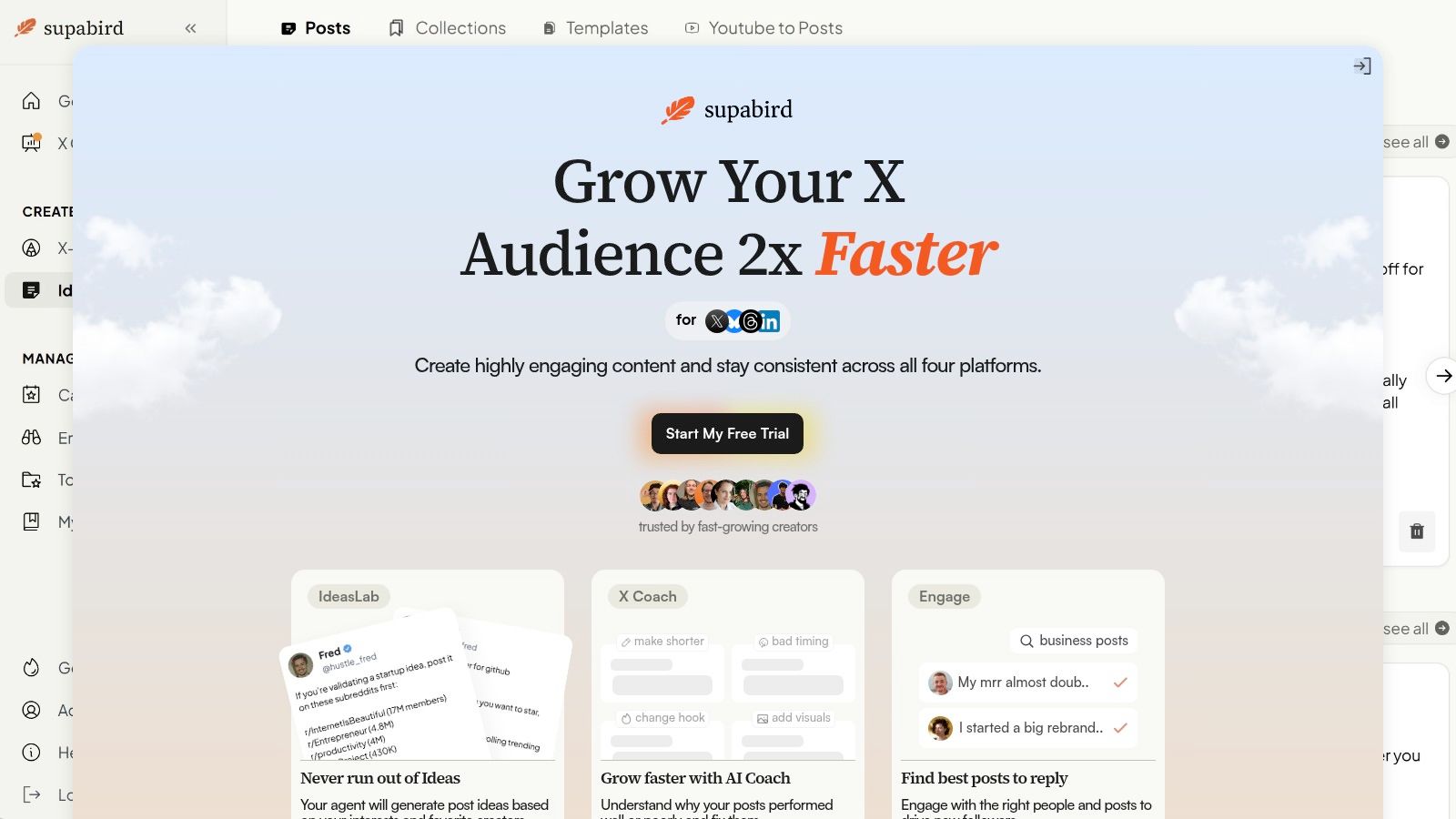
The Ideas Lab can help creators and teams generate post directions based on favorite creators and recurring themes. That matters for influencer programs because the brand doesn't need to hand every partner a finished script. It can provide a problem, audience, proof point, and compliance boundary, then let the creator develop a native angle.
An Engage module can surface high-impact posts to reply to. Used carefully, that supports the reply-driven model described earlier. The aim isn't to leave generic comments under popular posts. It's to find conversations where the creator or brand has a legitimate contribution, then respond with a useful explanation, counterpoint, example, or resource.
X-GPT can rewrite drafts into different post and thread formats, while a built-in calendar can help schedule publishing across cities such as Berlin, New York, London, and Mumbai. Those functions are useful when several people need to maintain a consistent publishing rhythm, but human review still matters. No tool can manufacture topical authority where the creator has no real experience.
A team can also use a content repurposing strategy to transform a creator interview into a thread, short video prompt, reply bank, and brand follow-up. Repurposing should preserve the original insight while changing the format for the conversation. Copying the same paragraph into every channel usually weakens it.
Create a controlled campaign loop
Use a weekly review to answer four questions:
Which conversations produced substance? Identify replies that raised objections, requested demonstrations, or introduced qualified users.
Which hooks earned attention? Compare the opening claim, question, example, or visual, then retain the structure that created discussion.
Where did the process fail? Note missed disclosures, slow responses, broken links, unclear briefs, or creators who weren't a fit.
What should the next creator test? Turn observations into a small set of new angles rather than asking for random creative variation.
The platform can support a predictable growth engine only when the team treats it as a system of decisions. Discovery, drafting, publishing, engagement, compliance, and measurement must connect. Automation can make that loop faster, but credibility still comes from the humans who choose what to say and where to participate.
Building a Repeatable X Influencer Playbook
A repeatable campaign starts before creator outreach. Write the audience problem, commercial objective, acceptable claims, and conversion action in one brief. If the team can't explain what the campaign should change, it won't know which creator or format to select.
Follow the operating sequence
Define the buying moment. Decide whether the campaign supports discovery, evaluation, activation, or retention. Match the call to action to that stage.
Map the conversation. List the topics, objections, communities, and recurring posts where the target audience already gathers.
Build a creator shortlist. Review authority, audience fit, reply quality, consistency, and disclosure habits. Start with relevance, then assess reach.
Request useful evidence. Ask for examples of discussion quality, link activity, and audience responses. Don't accept follower count as the whole media kit.
Choose a native format. Use a short post for a simple point, a thread for explanation, video for demonstration, and replies for community participation.
Structure the agreement. Document deliverables, timing, approval limits, disclosure wording, usage rights, tracking, and payment conditions.
Prepare the brand account. Publish supporting context, respond quickly, and make sure the landing page fulfills the promise in the creator's post.
Review every sponsored asset. Check claims, links, tone, and visible disclosure before publication.
Stay present after launch. The creator and brand should answer serious questions and correct confusion rather than treating publication as the finish line.
Analyze the full sequence. Compare attention, replies, clicks, conversion quality, and assisted activity. Record what to repeat and what to stop.
The best campaigns become easier to run because each activation creates reusable learning. Keep a library of effective hooks, creator-specific audience notes, approved claims, disclosure examples, common objections, and post formats that fit your market. That library gives the next partnership a stronger starting point without turning the creator's voice into a template.
Don't optimize for the post that looks most impressive in a report. Optimize for the collaboration that produces a credible recommendation, a useful conversation, and a measurable next action.
SupaBird offers X-focused idea generation, draft rewriting, engagement discovery, scheduling, and coaching workflows for creators, founders, and marketing teams building repeatable influencer campaigns. Use SupaBird to organize your next creator activation around better conversations, consistent publishing, and clearer learning.

The Reply Guy Strategy: A Growth Guide for X

Why New X Accounts Get Less Reach

ClimbX Review (2026): Features, Pricing, Pros and Cons

How Developer Startups Build a Brand on X Before Launch

30-Day Starting Plan for New X (Twitter) Accounts

How Often Should You Tweet for Maximum Growth?

What Should Your First 10 Tweets Be About?

How to Run X for Ten Clients: The Agency Workflow

How to write a bio that gets people to follow you
