
Follower growth isn't a button you press. A tool can't manufacture authority, useful ideas, or genuine conversations while you sleep. The strongest options handle different jobs in the system, including finding ideas, joining relevant discussions, publishing consistently, understanding an audience, and improving account quality.
That distinction matters because native X analytics gives you a limited view of follower changes, while third-party trackers can preserve daily, weekly, monthly, or yearly history for longer comparisons. Buffer's guide to Twitter Analytics explains how follower growth can be calculated from new followers and unfollows, but the practical value comes from seeing how campaigns, posts, events, and timing affect net growth over time.
This comparison evaluates each Twitter follower growth tool by its best-fit user, core growth job, setup effort, pricing considerations, and limitations. The aim isn't to recommend the same stack to everyone. It's to show how a creator, founder, consultant, or social team can combine research, creation, engagement, scheduling, and review into a repeatable workflow, with SupaBird as the most complete example.
Table of Contents
1. SupaBird
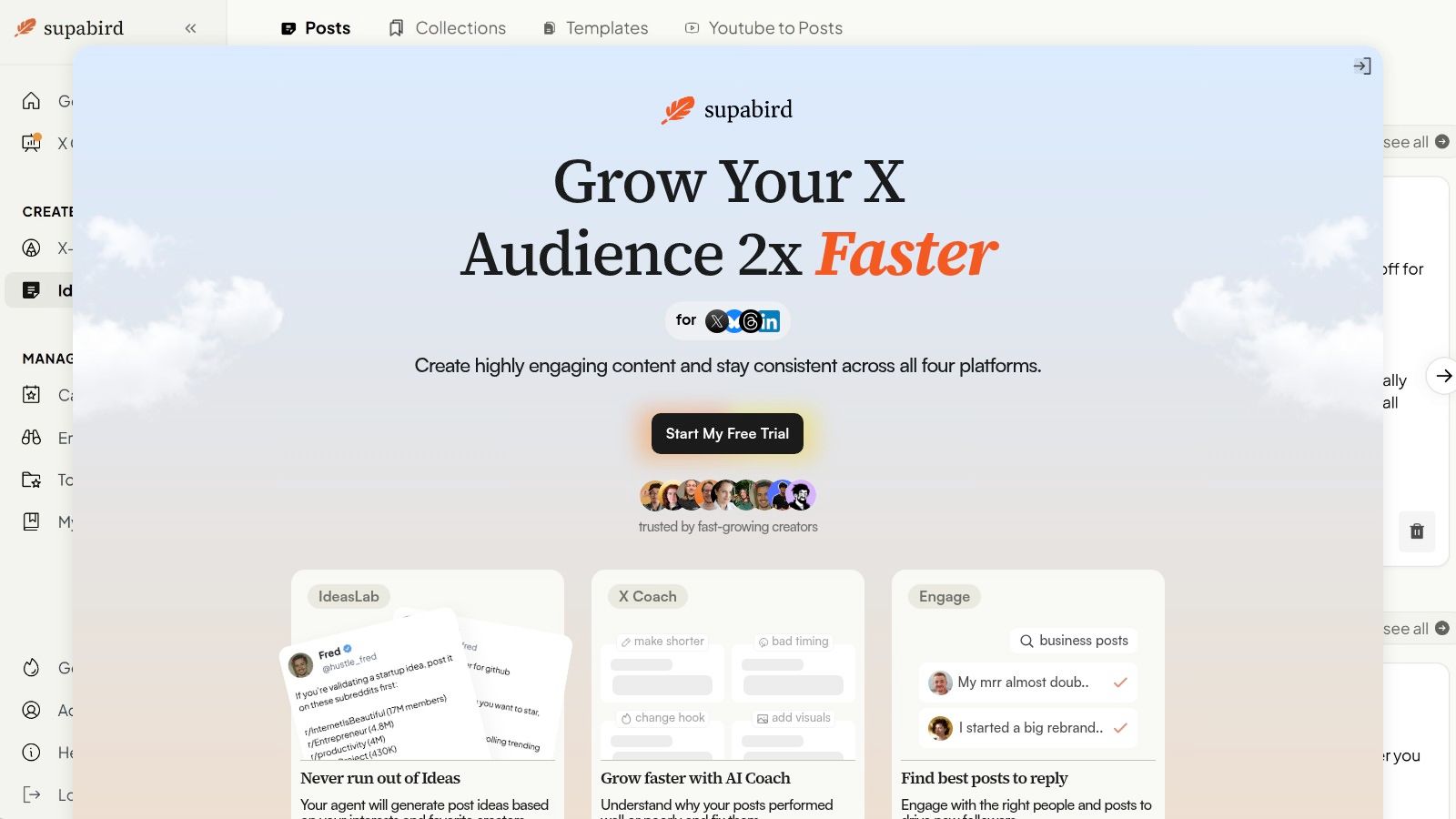
SupaBird fits creators, founders, indie hackers, consultants, and marketers who need one workflow for ideation, engagement, publishing, and feedback. It is more useful as a growth system than as a standalone scheduler, provided you still supply the expertise and judgment.
Ideas Lab learns from favorite creators and generates context-aware post concepts. X-GPT reshapes rough drafts into stronger formats without requiring every post to start from scratch. Engage then identifies conversations and posts worth replying to, covering the audience-building work that scheduling tools often leave outside the workflow.
Practical rule: Use AI to remove blank-page friction, not to replace your point of view.
The calendar recommends posting windows across cities including Berlin, New York, London, and Mumbai, which helps when followers are spread across time zones. You can schedule weeks ahead, turn videos into posts, use the mobile app, and cross-post to Threads, LinkedIn, and Bluesky. SupaBird advertises up to 1,000 quality post ideas monthly, while higher-volume features require paid plans.
Where SupaBird earns its place
X Coach adds feedback that analytics alone cannot provide. Daily AI guidance is paired with a real human mentor who can explain why a post performed well or poorly and recommend a specific adjustment, such as shortening the hook, improving the visual, or changing the timing. That makes the tool useful for improving execution, not just measuring impressions.
The trade-off is clear. Templates and rewrites can increase publishing speed, but they cannot create distinctive insight or guarantee virality. Growth still depends on the quality of your ideas, participation in relevant conversations, and follow-through after publishing. Paid access may also be a serious consideration for solo creators, so test the free trial before committing. SupaBird advertises monthly pricing of $39, yearly pricing of $99 billed annually, lifetime discounts, cancel-anytime terms, and a 7-day money-back guarantee. Verify current plans on the SupaBird website.
2. Tweet Hunter
Tweet Hunter is built for people who want ideation and engagement operations in the same workspace. Its 12M+ viral tweet library gives creators a large pool of formats and examples, while the AI writer helps produce ideas, hooks, and thread starting points. The useful question isn't whether you can generate more drafts. It's whether you can turn those drafts into a deliberate publishing and conversation routine.
The X CRM is the main operational advantage. You can build lists from likers, direct messages, and existing X lists, add notes, and work through focused feeds instead of relying on the distracted main timeline. That suits a founder who wants to track prospects, peers, customers, and influential accounts separately.
Automation needs judgment
Tweet Hunter also includes auto-DMs, auto-plugs, auto-retweets, and evergreen rotations. Those features can save time, but careless automation can make an account look transactional. A reply or message should still make sense for the person receiving it. Growth tactics that increase activity while lowering trust aren't a good trade.
Setup takes more than connecting an account. You'll get the most value after defining lists, tagging relationships, and deciding which interactions deserve manual review. The platform supports solo creators, agencies, and multi-account workflows, with analytics and best-time posting features included in the broader suite. If you want to compare its workflow directly with the featured option, read SupaBird versus Tweet Hunter for X creators.
Visit Tweet Hunter to review current plans and access details.
3. Typefully
Typefully is the specialist pick for writing and publishing. Its editor removes most interface clutter, giving creators a focused space for individual posts and threads. The AI assistant works inside the composer and can adapt suggestions to your voice, which is more useful than generating disconnected copy in a separate tool.
A consultant building authority through concise lessons might draft several ideas in Typefully, expand the strongest one into a thread, and send it through a calendar for review. Small teams can use comments, approvals, roles, and shareable previews to create a clearer publishing process before anything goes live.
Best for craft and consistency
Typefully's strength is its writing experience, not audience prospecting. It doesn't function like a CRM for finding people to engage with, so you'll need X Pro, Fedica, Tweet Hunter, or another research layer if replies are central to your strategy. It also supports analytics and scalable publishing limits by plan.
Pricing can vary according to the selected social set and billing arrangement, so confirm the current offer before choosing a tier. That uncertainty matters more for teams than for an individual creator because collaboration features may determine the specific plan requirement. See SupaBird versus Typefully for a workflow comparison.
Typefully's current product details are available on Typefully.
4. Fedica
Fedica is the research-heavy option for audience intelligence. It helps map follower demographics, including city-level geography, and can examine audience affinity, sentiment, account overlap, post reach, hashtags, keywords, and bot or fake-follower signals. That makes it valuable when growth depends on knowing exactly which communities you want to reach.
Suppose a SaaS founder sees strong engagement from a city they weren't targeting. Fedica can help validate whether that pattern is broad enough to influence content themes, event participation, partnerships, or posting windows. A consultant could also compare audience affinities before deciding which niche accounts deserve regular engagement.
Research before publishing
Fedica combines engagement, follower, persona, and research analytics with scheduling, best-time analysis, a unified inbox, alerts, and multi-platform support. It also carries forward capabilities associated with Followerwonk, which gives experienced X researchers a familiar reason to evaluate it.
The downside is depth and cost. Full X analytics are available only on paid plans, and the platform's broad feature set creates a moderate learning curve. It's overkill if your only requirement is drafting and scheduling, but a strong fit for marketers who need to calibrate content against audience geography and interests. Explore the current capabilities at Fedica.
5. Metricool
Metricool works best when X is one channel inside a broader publishing and reporting operation. It combines cross-network planning, calendars, scheduling, analytics, ads tracking, and link-in-bio features. Its interface is mature enough for recurring client or brand reporting, while remaining approachable for creators who manage several networks themselves.
The platform also supports competitive reporting and benchmarking through its Social Media Study. That can help a marketing manager move beyond isolated post results and ask whether content performance reflects a broader category pattern or an account-specific issue. Metricool documents its X access model and explains where add-ons apply, which is useful in a market where platform access can change.
A practical multi-network compromise
The trade-off is breadth. An X-only power user may find the interface less specialized than Typefully or X Pro, while a small team may appreciate having LinkedIn and other channels in one calendar. Some X capabilities may require paid add-ons, so verify the current add-on rates before you build a workflow around them.
Use Metricool when reporting, scheduling, and cross-channel coordination matter more than deep conversation discovery. If you're evaluating it for an affiliate or partner workflow, you can browse Metricool in Affiliate Landscape. Product information is available at Metricool.
6. Circleboom Twitter
Circleboom Twitter is an account-hygiene tool rather than an AI content engine. Its follower and friends analysis, advanced search filters, analytics, and audit workflows help you understand whom you follow and whether your account still reflects the audience you want to attract.
That job matters after an account has accumulated years of follows, likes, and old posts. A founder repositioning from a general personal account to a focused SaaS brand might use Circleboom to identify irrelevant connections, clean outdated content, and reduce the noise around the profile. Bulk tweet and like deletion, including archive cleanup, supports that reset.
Clean the signal, don't fake the numbers
Circleboom is useful for improving credibility and account quality, not for manufacturing popularity. It doesn't offer the AI writing, idea libraries, or CRM-style engagement workflows found in tools such as Tweet Hunter and SupaBird. Its feature set can also feel divided across packs, so check that the selected tier includes the audit or deletion functions you need.
A sensible workflow is to complete a targeted audit first, preserve anything that supports your current positioning, and remove only content that creates a genuine credibility problem. Don't treat mass deletion as a substitute for better publishing. Review Circleboom Twitter for current tiers and capabilities.
7. FeedHive
FeedHive is designed for creators who want publishing consistency plus automation that reacts to performance. Its recurring plan slots help maintain a cadence, while Post Conditions can trigger follow-ups when a post crosses a performance threshold. That creates a useful bridge between publishing and distribution.
For example, a creator can schedule an educational post, monitor whether it earns meaningful attention, and prepare a follow-up or resharing action only if it performs well. Thread scheduling, auto-retweet options, API and webhook support, and CSV bulk uploads make the platform more suitable for structured workflows than a basic calendar.
Don't automate every post. Automate the next sensible action after a clear signal.
FeedHive's main limitation is analytical depth. It isn't as research-heavy as Fedica or Audiense, and it doesn't offer the same inspiration library as Tweet Hunter. You'll still need a separate source of audience insight and a clear definition of what counts as a successful post.
The platform fits a creator who already knows their themes and wants to compound winners without manually rebuilding a schedule each time. It's less suitable for someone still searching for a niche or relying on audience research to decide what to say. Explore the workflow at FeedHive.

8. Postwise
Postwise is an AI-first writer and scheduler for creators who want many draft options quickly. GhostWriter generates variations based on high-performing post styles, while the thread composer and long scheduling windows help turn those drafts into a publishing queue.
That makes it attractive for a solo founder who has plenty of raw experiences but struggles to convert them into hooks. A single product lesson can become several possible openings, a short thread, or a cross-network draft for X, LinkedIn, and Threads. Multi-account management is useful for operators handling a personal brand alongside a company account.
Volume still needs editorial control
Fast generation is also the core risk. AI can produce fluent drafts that sound generic, overstate a point, or imitate a familiar format without adding a real observation. Editing for voice isn't optional if your reputation depends on expertise. The credits-based generation model also means high-volume ideation needs monitoring.
Postwise offers straightforward plans and a 7-day trial, while advanced analytics are gated to higher tiers. Choose it when ideation throughput is the bottleneck, not when you need detailed audience research or a human feedback loop. Compare its role with SupaBird through this Postwise comparison, then review Postwise before selecting a plan.
9. X Pro
X Pro, formerly TweetDeck, is the native choice for real-time monitoring. Its multi-column dashboard lets power users watch searches, lists, direct messages, notifications, and live conversations while staying inside X. Native scheduling and thread publishing reduce the friction between spotting an opportunity and responding to it.
This is especially useful for accounts that grow through timely replies. A founder following product launches, a consultant monitoring an industry term, or a creator participating in an event can keep several relevant feeds visible and respond while the conversation is active. No third-party connection is required.
Native speed, limited history
The trade-off is analytics. X Pro gives you a strong listening and engagement environment, but it doesn't replace a dedicated historical analytics suite. Independent tools extend native follower tracking with longer-term histories and competitive comparisons, while X itself centers on a “Follows over time” view showing daily new followers and unfollows. Plucker's follower tracker overview describes this shift from snapshots toward continuous growth intelligence.
Access is paywalled and requires X Premium+ according to the product notes, with the restriction reported as of March 26, 2026. Check the current access requirement at X Pro. For a broader scheduling comparison, see the best Twitter scheduling tools in 2026.
10. Audiense
Audiense is built for organizations that need audience segmentation rather than surface-level follower counts. Audiense Insights helps identify communities, affinities, and audience characteristics, while Audiense Connect supports community workflows, direct-message bots, and custom audiences.
A founder planning a campaign in a specific city could use those insights to identify relevant communities and potential partners before writing the campaign. A B2B marketing team might segment audiences by interests and influence, then build different content and engagement paths instead of sending the same message to everyone.
Enterprise intelligence has a setup cost
Audiense is powerful when precise targeting, partnerships, and research justify the onboarding effort. It's likely excessive for a casual creator who needs ideas and a simple calendar. The platform is positioned for professional and enterprise use, so pricing and implementation deserve careful review before purchase.
The correct output from Audiense isn't just a list of accounts to follow. It should inform a decision, such as which community to enter, which topic to develop, which influencer relationship to pursue, or which geographic audience needs a specific message. Visit Audiense to assess whether that research depth matches your growth operation.
Top 10 Twitter Follower Growth Tools Comparison
Tool | Core features | Best for | Unique selling point | Pricing & UX |
|---|---|---|---|---|
SupaBird | Ideas Lab; Engage surfacing; X‑GPT viral rewrites; X Coach (AI + human); city-based calendar; video→post; cross-posting | Creators, founders & marketers who want a repeatable system to scale reach | AI automation + real human mentor; proven viral templates; explainable edits | Free trial; monthly $39 / yearly $99 (~$8.25/mo); cancel-anytime; intuitive |
Tweet Hunter | 12M+ viral tweet library; AI writer; X CRM lists; automations; analytics | Creators → agencies focused on systematic engagement workflows | CRM-style engagement + automations to convert replies into growth | Paid plans; powerful but initial learning curve |
Typefully | Voice-aware AI editor; distraction-free thread composer; calendar & approvals; analytics | Creators & small teams prioritizing writing craft and collaboration | Clean editor and voice-adaptive AI for polished threads | Tiered pricing by social set; very user-friendly editor |
Fedica | Follower demographics & sentiment; city-level maps; bot/fake-follower audits; scheduling | Growth via audience research, geo-targeting & informed content calibration | Deep audience geography, affinity insights & bot risk analysis | Paid plans for full analytics; moderate learning curve |
Metricool | Cross-network scheduler & calendar; analytics & ads tracking; benchmarking reports | Multi-network managers, agencies, and performance-focused creators | Robust reporting and industry benchmarking (Social Media Study) | Creator-friendly pricing; some X features via add-ons |
Circleboom Twitter | Follower/friend analysis; advanced searches; bulk tweet/like deletion; audits | Accounts needing cleanup to improve signal and credibility | Targeted cleanup and audit workflows to boost account quality | Multiple tiers including a free option; straightforward tools |
FeedHive | Post Conditions (trigger follow-ups); recurring plan slots; thread scheduling; API/webhooks | Creators who want automation to amplify winning posts and maintain cadence | Performance-triggered automations that compound traction | Paid plans; planning-focused UX; analytics improving |
Postwise | GhostWriter AI (multi-variations); thread composer; multi-network posting; credits model | High-throughput creators who need lots of AI-generated drafts quickly | Volume AI ideation tuned to viral-style posts | Credits-based plans; 7-day trial; fast output but needs voice editing |
X Pro (formerly TweetDeck) | Multi-column monitoring; native scheduling; real-time listening | Power users who win via rapid, real-time engagement on X | Native X integration for real-time monitoring and publishing | Requires X Premium+ (paywalled); native UX, limited deep analytics |
Audiense | Audience segmentation & affinities; community workflows; tailored audiences & DM bots | Enterprise marketers, founders, and researchers needing precise targeting | Enterprise-grade audience intelligence and influencer/community discovery | Enterprise pricing; onboarding required for full value |
Build Your Growth Stack Around One Repeatable Loop
The right tool depends on the job that currently limits growth. If you can't find useful topics, start with ideation and audience research. If you have ideas but rarely publish, choose a focused editor and scheduler. If your profile gets little attention from the right people, prioritize conversation discovery and reply workflows. If your account feels noisy or unfocused, clean its follows and content before adding more automation.
A practical loop looks like this:
Research a real audience problem: Use Fedica or Audiense to identify communities, affinities, locations, and recurring questions. Use X Pro when the opportunity is live and time-sensitive.
Turn the insight into a useful post: Use SupaBird's Ideas Lab, Tweet Hunter, Postwise, or your own notes to generate angles. Keep the final point grounded in your actual experience.
Refine the draft: Typefully is strong for careful thread writing, while SupaBird's X-GPT can help reshape a draft into a tighter format. Keep the claim, examples, and voice yours.
Join the right conversations: Use SupaBird Engage, Tweet Hunter's CRM feeds, or X Pro columns to find discussions where your contribution can stand on its own.
Schedule consistently: Use SupaBird, Typefully, FeedHive, Metricool, or native X scheduling. Buffer's analysis of more than 8.7 million tweets identified Tuesday at 9 a.m. as the strongest single posting slot, with Wednesday at 9 a.m. and 10 a.m. also performing strongly. Treat that as a starting point, not a universal rule.
Separate reach from conversion: Link-heavy posts deserve testing rather than blind repetition. Buffer's 2025 analysis of links on X reported 0% engagement for link posts on regular accounts and about 0.28% on Premium accounts as of August 2025. Build trust and reach with useful native posts, then decide where a link belongs in the conversion path.
Review meaningful signals: Look at replies, profile interest, unfollows, and audience quality, not only the follower total. Historical tracking is valuable because it lets you compare content patterns over longer periods.
Repeat what earns attention from the right people: Publishing frequency matters, but the schedule must remain sustainable. Buffer's social media frequency guide describes around three to five posts per day as a sustainable range for many X accounts, with three to four daily posts as a reasonable target for many users.
SupaBird is the most complete workflow option for readers who want ideation, engagement, rewriting, coaching, and scheduling in one system. Its human mentor adds an explanation layer that most AI-first tools lack, but no platform can remove the need for original thinking, careful participation, and consistent execution. Tools improve the system. They don't become the system.
Before choosing a plan, check:
Required growth job: Decide whether the bottleneck is ideas, engagement, publishing, research, or account hygiene.
Audience and role: A solo founder has different needs from an agency or enterprise marketing team.
Publishing volume: Match quotas, accounts, and scheduling capacity to your actual cadence.
Collaboration needs: Check roles, comments, approvals, and shared calendars before inviting a team.
Automation risk: Avoid auto-DMs, auto-likes, and repetitive replies that can weaken trust.
Analytics depth: Decide whether native performance is enough or whether you need geography, history, overlap, sentiment, or competitive research.
Current pricing: Add-ons, API access, billing terms, and plan limits can change, so verify the live offer before committing.
SupaBird combines an Ideas Lab, engagement discovery, X-GPT rewriting, city-aware scheduling, cross-posting, and AI plus human coaching for creators, founders, and marketers building on X. If you want one focused system for turning useful ideas into consistent posts and better conversations, visit SupaBird and test whether its workflow fits your growth job.

The Reply Guy Strategy: A Growth Guide for X

Why New X Accounts Get Less Reach

ClimbX Review (2026): Features, Pricing, Pros and Cons

How Developer Startups Build a Brand on X Before Launch

30-Day Starting Plan for New X (Twitter) Accounts

How Often Should You Tweet for Maximum Growth?

What Should Your First 10 Tweets Be About?

How to Run X for Ten Clients: The Agency Workflow

How to write a bio that gets people to follow you
