How to Find Trending Hashtags on X for Faster Reach
Author:

You open X, spot a tag climbing, and the instinct hits fast. Do you post now and ride the wave, or wait, verify, and risk missing the window? That hesitation is exactly where most creators lose reach, because trending hashtags are only useful when they still point to a live conversation and your post belongs there.
The old habit was simple, paste the biggest tag you could find and hope for discovery. That doesn't work the same way on X now. The better move is faster and narrower, find the trend, validate the audience fit, publish inside the short attention window, then measure whether the tag brought in people who didn't already follow you.
Table of Contents
The Moment You Spot a Trend and Hesitate
A creator sees a tag on X that's clearly moving. The post draft is ready, the topic fits loosely, and the question becomes whether using that tag will help or just make the post look opportunistic. That's the decision point, not the endless hunt for a perfect list.
Hashtags still matter on X because they're part of how people cluster around live topics, events, and recognizable ideas. The history matters here. Twitter formally introduced hashtags in July 2009 after Chris Messina proposed the symbol for grouping conversations, then added features like Trending Topics by 2010, and the mechanic spread across Instagram, TikTok, and LinkedIn. That shifted hashtags from a user habit into a global discovery layer, and creators still search for them today, which is visible in sustained interest around Instagram hashtags in a 2025 Google Trends analysis cited in the brief (Accio's 2025 hashtag trend analysis).
Practical rule: if a tag feels alive but your post won't add anything useful to the conversation, skip it.
The useful way to think about trending hashtags on X is as a 24 to 72 hour decision window. You are not building a long campaign around a tag. You're checking whether the topic is still rising, whether the people seeing it are the people you want, and whether your post can earn replies or profile visits before the feed moves on. That's the game, speed with selectivity, not volume for its own sake.
Why Most Trending Hashtag Advice Fails on X
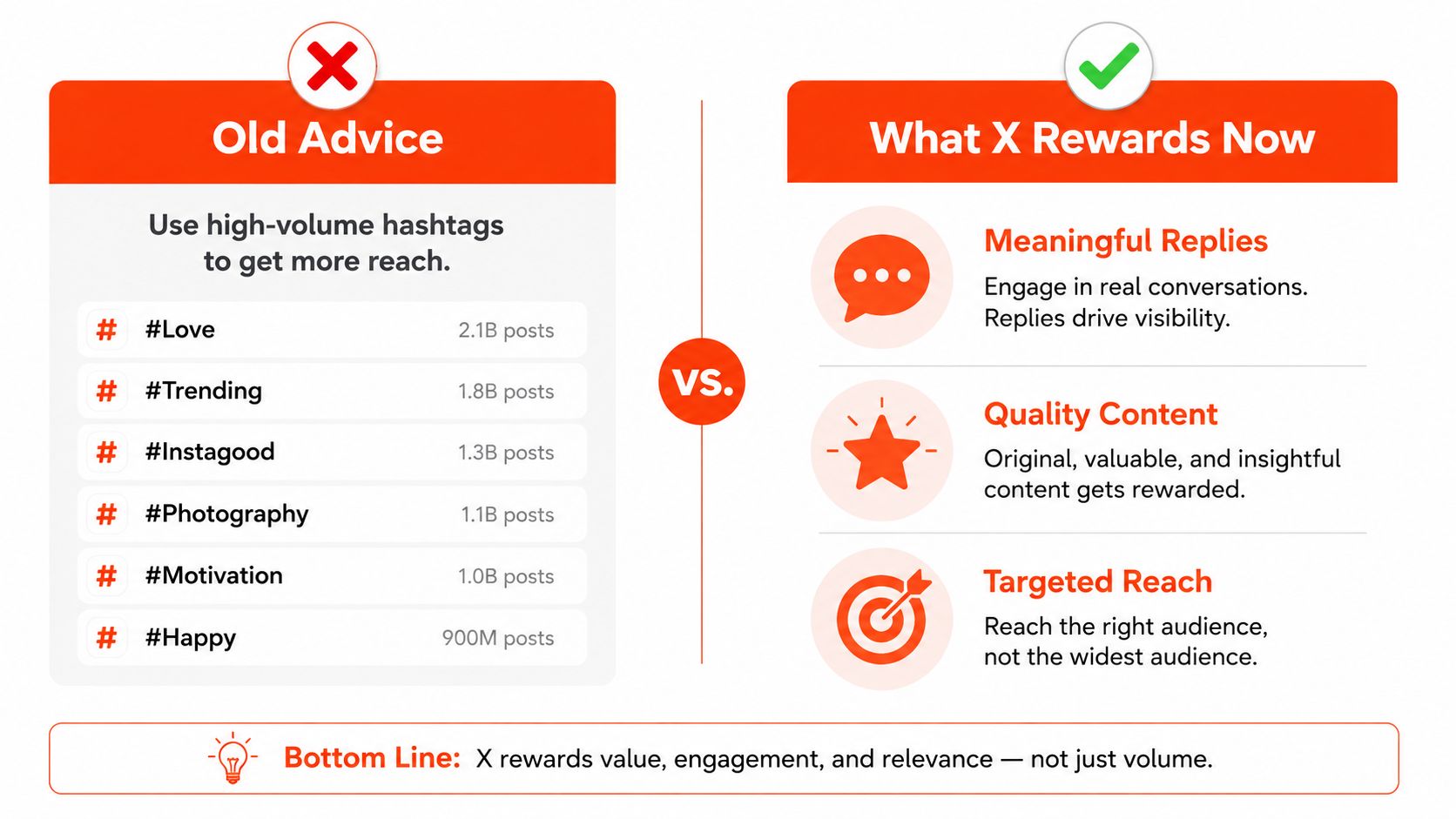
Most hashtag advice still sounds like it was written for Instagram, not X. It tells people to grab the biggest tag, stack a pile of related labels, and assume visibility will follow. On X, that usually produces noisy reach, not qualified attention.
The problem is twofold. First, the biggest tags are often too broad to be useful, especially when they're already buried under huge post volumes. Second, X now rewards posts that generate real interaction, so a hashtag can't rescue weak framing or low-relevance content. One practical result is that a repeatable weekly tag like #MondayMotivation can still outperform a generic discovery chase when it matches the audience's habit and context, while raw volume alone rarely tells you whether the people watching are the people who might reply.
Broad reach is not qualified reach
A tag with massive volume can look attractive and still be strategically weak. Broad discovery labels create exposure, but they also drown your post in unrelated content. That's why niche fit matters more than size when your goal is replies, follows, or clicks.
The brief's usage data makes this clear in a different context. Instagram's largest tags, like #love and #instagood, sit in billion-post territory, while business-oriented labels like #business, #realestate, #technology, and #science are still large but much more specific (Jeevan Garg's 2025 hashtag ranking). The lesson transfers to X, broad tags are a category signal, not a guaranteed growth engine.
A tag can be popular and still be wrong for your account.
Trend velocity changes the math too. A 2026 roundup reports that the average lifespan of a trending hashtag is 72 hours (GITNUX hashtag statistics roundup). That means late posts often arrive after the conversation has already peaked. If you keep copying the same public lists without checking timing and fit, you're not doing strategy, you're just arriving after the room has emptied.
Where to Actually Find Trending Hashtags
A good trend search on X doesn't start with a giant list. It starts with a quick scan, then expands outward only if the tag still looks useful for your audience. I treat it like a layered search, native first, then outside tools, then community context.
Start with X itself
Use X's Explore tab and the trending panel for your region first, because it tells you what's moving right now in the exact feed environment you're posting into. That matters more than a generic global list. If the local conversation is already crowded with unrelated replies, the tag may be visible but not useful.
Add breadth with third-party trend trackers
After that, check a trend tracker to see whether the tag is part of a wider pattern or just a burst. Tools like Hootsuite and RiteTag are useful here because they expose fast-moving tags and, in RiteTag's case, show how raw volume can diverge from engagement signals, which helps you avoid tags that are busy but weakly qualified (RiteTag hashtag search).
Pull relevance from niche feeds
Your own lists, communities, and recurring creators matter more than anyone admits. If the top posts around a tag come from accounts your audience already trusts, that tag has a better shot at producing replies and follows. If the top posts are off-topic, spammy, or purely event driven, move on.
For advanced searching on mobile, this X advanced search guide for mobile is worth keeping handy because it helps you look beyond the headline trend and inspect the posts behind it.
Use AI to spot patterns, not replace judgment
AI assistants can help you surface related tags, recurring phrasing, and the creators who keep showing up around the same topic. SupaBird's Ideas Lab and X content tools can support that pattern scan, but the judgment still has to come from you. The point is to narrow the field fast, not to outsource the decision.
Validating a Hashtag Before You Post

Validation should take minutes, not hours. The goal is to decide whether a tag deserves a place in today's post, not to build a spreadsheet that outlives the trend. I use four checks, and each one answers a different question.
Volume band. You want enough activity to indicate momentum, but not so much that your post disappears instantly. Extremely broad tags can signal a crowd rather than an opportunity.
Recency. Look at the newest posts, not just the biggest ones. If the conversation is already stale, the tag is probably dead for practical purposes.
Audience fit. Read the top posts. If the content around the tag matches your niche, you have a shot at qualified reach.
Event or bot noise. Watch for sudden spikes, repetitive phrasing, or posts that obviously don't belong. Inflated tags can look active and still be low value.
The peer-reviewed hashtag recommendation study in the brief is useful because it measures success rate as the percentage of posts where predicted popularity after hashtag assignment beats the ground-truth popularity. In that paper, AUFP reached 79.33% success in low-popularity posts and 16.98% in average-popularity posts, while AUFWP improved to 82.81% and 18.81%, with weaker baselines at 60.51%/11.63% for AUP and 72.52%/14.44% for AFP (PMC hashtag recommendation study). The signal is simple, low-popularity content leaves more room for hashtag choice to matter.
Practical rule: if the top posts around a trend don't look like the audience you want, the tag is probably not worth forcing.
For a fast internal check, I'd rather see a tag that is small but aligned than a tag that is huge and sloppy. If you want a quick way to inspect your own tag choices, the X hashtag analysis tool is a useful place to start.
Writing the Post Around the Trend
The mistake is writing a normal post first, then bolting on a hashtag at the end like an afterthought. On X, the hook has to carry the topic, and the tag has to support it. That means the post should feel native to the trend, not pasted onto it.
A simple rule works well here. Use 1 to 2 hashtags, not a pile, and place them where they don't break the rhythm of the sentence. Sometimes that means the tag goes at the end, sometimes it sits in the opening line when the trend itself is the hook. If you're trying to sharpen the opening, this hook writing guide for X posts is a solid companion, and for a structure-based reference, the hook structures for LinkedIn posts page is useful because strong hooks translate across platforms even when the formatting changes.
Draft the hook first
Write the first line so it would still work without the hashtag. Then add the tag only if it clarifies the context or connects the post to the live conversation. If the hashtag becomes the most interesting part of the post, the post is too weak.
That's also where X-GPT-style rewriting helps in practice, not by stuffing in more tags, but by reshaping the draft into a tighter format that naturally absorbs the trend. The better the hook, the less you need to lean on the hashtag to do the heavy lifting.
Post early enough to matter
Timing is where most creators lose the advantage. The brief's industry guidance says trend participation is most effective in the first 2 to 4 hours after a hashtag starts rising, before volume peaks and the post gets buried (Social-0 hashtag strategy). That's the window you want to hit.
I also like to think across time zones, especially if the topic has a global audience. A post can land differently in Berlin, New York, London, and Mumbai, so scheduling isn't just about convenience. It's about catching the rising edge while people are still actively scanning the tag.
Plugging Trends Into Your Weekly Workflow
Trend chasing gets exhausting when it's treated as a daily scramble. It becomes manageable when it's part of a weekly content system, with one block for discovery, one for drafting, one for review, and one for scheduling. That turns a reactive habit into a repeatable habit.
A practical rhythm looks like this. Early in the week, collect ideas and likely tags. Midweek, check which tags still have real movement and which have already gone stale. Then draft the post around the strongest option and queue it for the right city-specific slot.
If you build content around repeatable workflows, this guide to maximizing social media presence for projects is useful because it connects posting consistency with broader visibility planning. The point isn't to publish more for the sake of it. The point is to make sure your strongest trend posts go out while the conversation still has room to carry them.
A calendar tool helps because it removes the “I'll post later” problem. SupaBird's calendar recommends city-specific post times and lets you schedule weeks ahead, which matters when a good tag appears and you know the right moment may hit while you're away from your desk. That's the kind of system that keeps trend participation consistent without forcing you to live inside the app.
Measuring Whether the Hashtag Worked
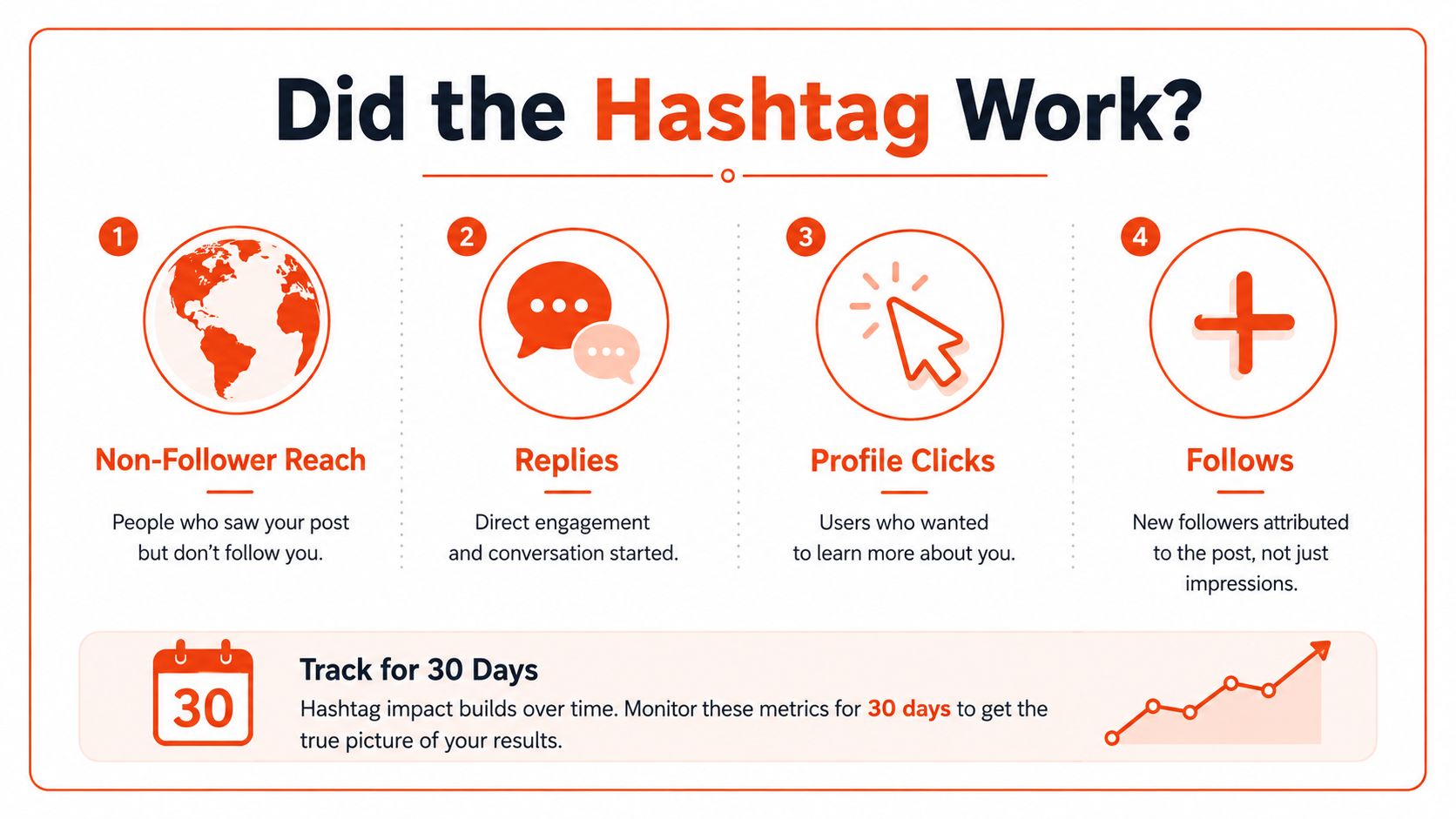
A hashtag worked when it changed who saw the post and what those people did next. Likes can look encouraging, but they do not show whether the tag brought in new attention. Track non-follower reach, replies, profile clicks, and follows tied to the post instead.
The clearest way to judge performance is a 30-day test-and-track loop. Record the hashtag set, the post topic, the timing, and the outcome for each post. Keep the tags that consistently beat your baseline and cut the ones that do not. That matters more than chasing a single viral hit, because one lucky post does not prove a tag will keep working.
What to avoid when reading the data
Do not judge a tag by impressions alone. High reach with no replies or follows can mean the post was visible but irrelevant. Do not treat a single spike as proof either, especially if the topic was already naturally interesting.
Good measurement starts with the same discipline used in X analytics tools guides, track the tag set, compare it with the result, and prune what underperforms over time. Before you decide a trend worked, ask three questions. Did it reach people outside your follower base? Did it start conversation? Did it earn a follow or profile visit from someone new?
If the answer is no, the tag added visibility but not growth.

The Reply Guy Strategy: A Growth Guide for X

Why New X Accounts Get Less Reach

ClimbX Review (2026): Features, Pricing, Pros and Cons

How Developer Startups Build a Brand on X Before Launch

30-Day Starting Plan for New X (Twitter) Accounts

How Often Should You Tweet for Maximum Growth?

What Should Your First 10 Tweets Be About?

How to Run X for Ten Clients: The Agency Workflow

How to write a bio that gets people to follow you
