How to Quote Tweet on Twitter: The Creator's Guide

A lot of new creators hit the same wall on X. They see smart people using quote tweets to join bigger conversations, add context, and get noticed, but when they try it themselves, they either write too much, say too little, or default to a plain retweet.
That's where most growth stalls. A reply can disappear inside a thread. A retweet can feel passive. But a strong quote tweet on Twitter gives a creator something better: borrowed context plus original perspective. That combination is one of the fastest ways to show taste, judgment, and relevance without starting from a blank page.
Table of Contents
Why Quote Tweets Are a Creator's Secret Weapon
A reply is mostly for the original poster and the people already reading the thread. A retweet is simple distribution. A quote tweet on Twitter does something different. It lets a creator publish a take to their own audience while keeping the original post attached as context.
That difference matters because context is half the work on X. The original tweet gives the setup. The quote tweet gives the interpretation. When that pairing is done well, the creator doesn't need to explain the whole topic from scratch.
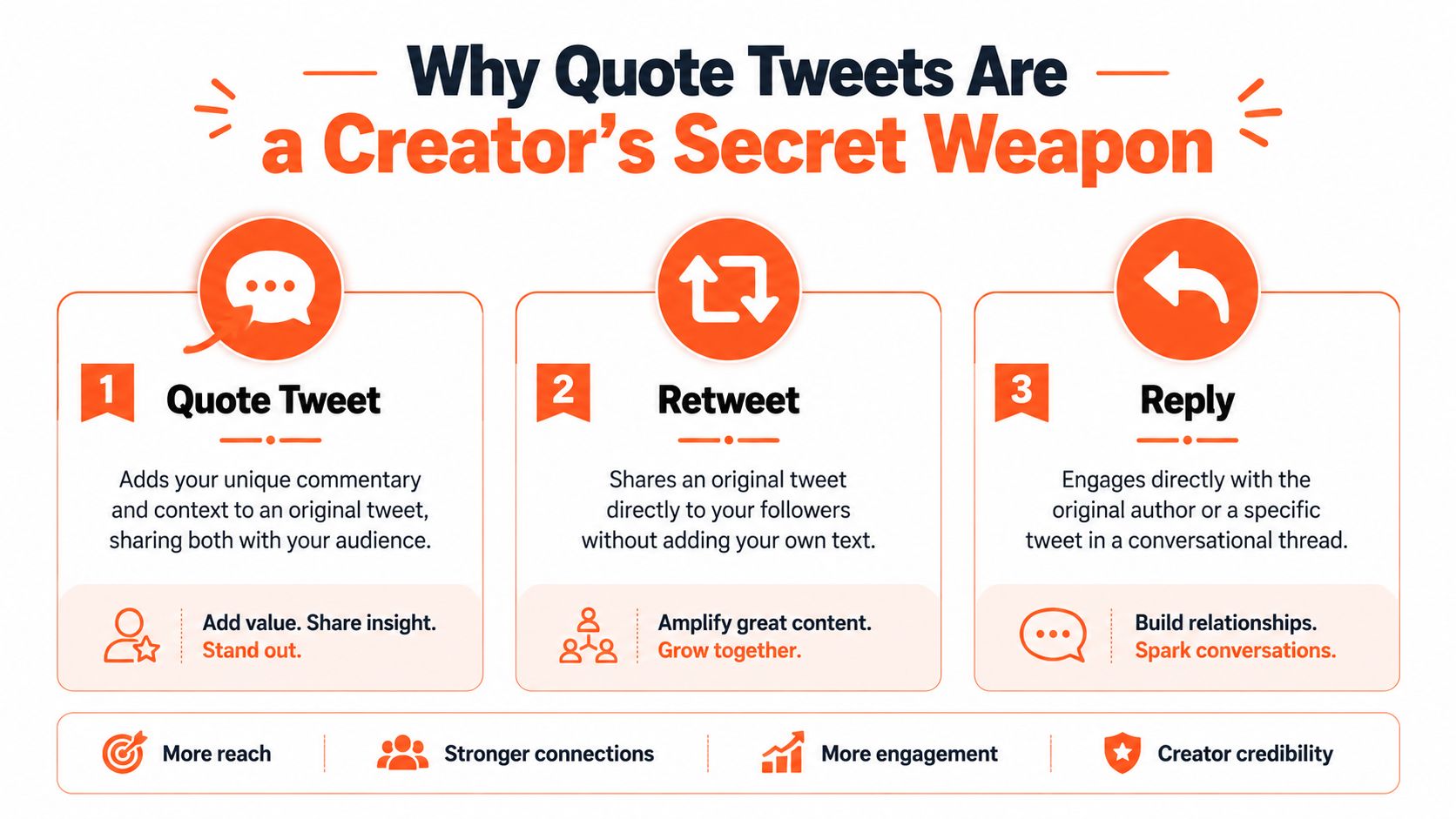
An academic study on conversational framing found that quote tweets work differently from replies because they let users add public commentary while preserving the original post's context, making them a distinct interaction mode on the platform, as described in this ACM research on conversation framing on X.
Three actions that look similar but behave differently
Format | Best use | What usually happens |
|---|---|---|
Reply | Direct conversation | Useful for relationship-building, but often buried in threads |
Retweet | Quick amplification | Shares someone else's point with no added signal from the creator |
Quote Tweet | Commentary plus distribution | Lets the creator shape how followers interpret the original post |
A creator who understands this starts using quote tweets less like a button and more like a positioning tool.
For example:
A founder can quote tweet a product opinion and add one lesson from a launch.
A marketer can quote tweet industry news and explain what teams should do next.
A coach or consultant can quote tweet a common misconception and clarify the practical version.
Practical rule: If a post is worth sharing but needs your framing, it's usually a quote tweet, not a retweet.
This is also why quote tweets help with authority. They reveal how a creator thinks. The audience doesn't just see what content gets shared. They see what gets noticed, what gets challenged, and what gets translated into useful advice.
Creators who need a broader system for deciding what to post alongside quote tweets usually benefit from a stronger social media content strategy framework. The quote tweet works best when it supports a clear niche, not random commentary on everything in the feed.
The Mechanics of a Quote Tweet on Desktop and Mobile
The action itself is simple. The confusion usually comes from where X hides the option on different devices. Once a creator knows the click path, the feature becomes second nature.
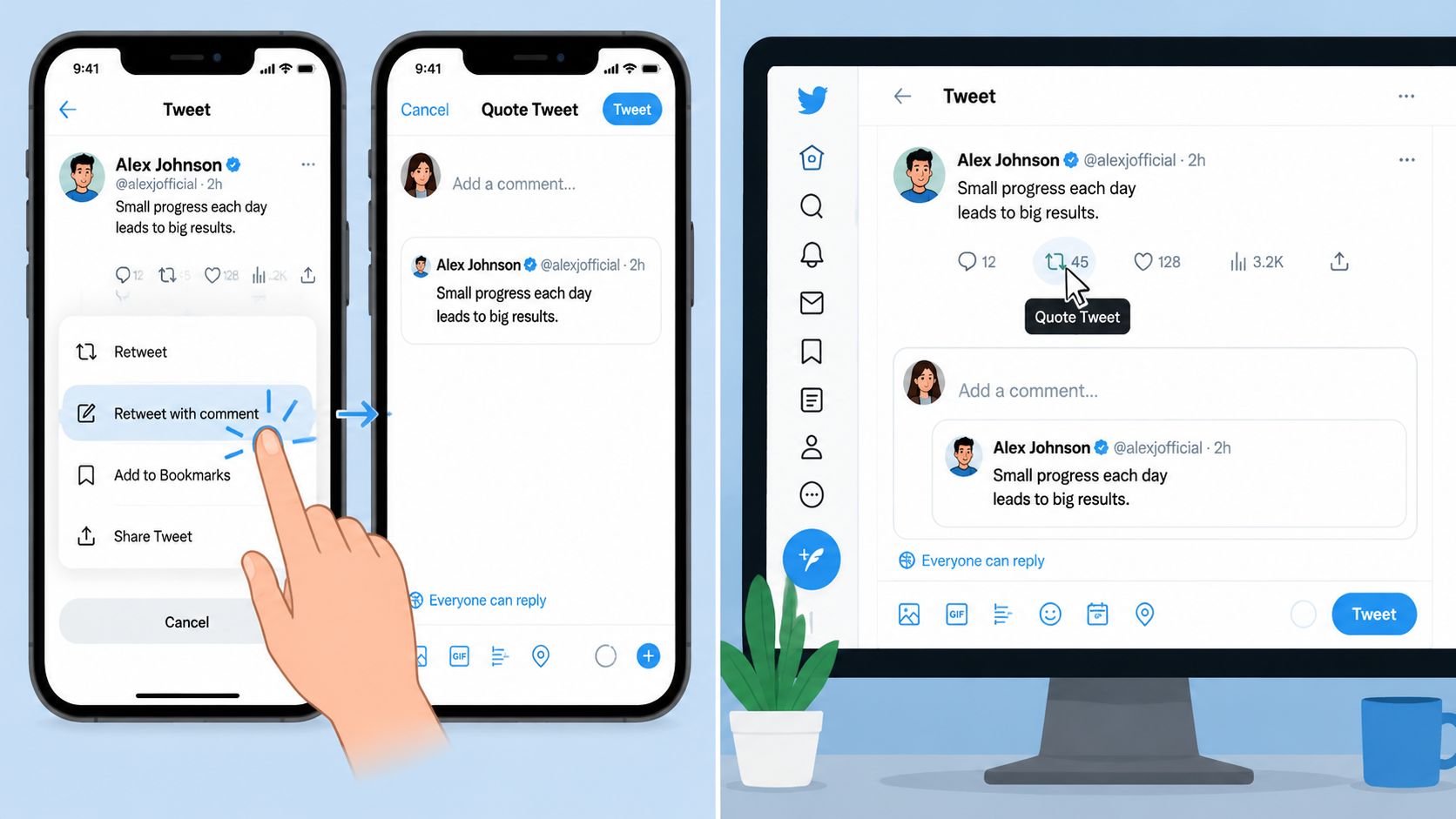
On the Web or Desktop App
Open the post that should be shared. Under the tweet, click the retweet icon, which looks like two arrows forming a square. X will usually show a small menu with options such as reposting directly or quoting the post.
Choose Quote. A composer window opens with the original tweet embedded underneath the text box. Type the commentary above it, then publish.
A few practical notes help here:
Write before posting, not after opening tabs. The easiest way to lose momentum is to start researching side points mid-draft.
Check the embedded post once more. Creators sometimes quote the wrong tweet in a fast-moving thread.
Read it as a follower would. If the first line isn't clear without extra explanation, tighten it.
For creators who batch content, it also helps to understand timing. A separate guide for scheduling tweets is useful when quote tweets are part of a weekly posting routine instead of a one-off reaction.
On Your Mobile Device
On iPhone or Android, the process is almost the same. Tap the retweet icon under the tweet. When the menu appears, tap Quote. The app opens a text field with the original tweet attached below, ready for commentary.
Mobile quote tweeting works best when the comment is concise. Long mobile drafts are harder to edit, easier to overstuff, and more likely to bury the original post.
A clean mobile workflow looks like this:
Save the tweet first if the idea needs more thought.
Draft the first line in notes if the hook matters.
Paste and polish inside X only when the wording is ready.
Shorter usually wins on mobile because the creator is competing with speed, not just quality.
Some creators also pair quote tweets with recirculation tactics so strong posts keep working after the first publish. For that workflow, this resource on scheduling retweets to extend reach is a practical reference.
Best Practices for High-Engagement Quote Tweets
Most weak quote tweets fail for one reason. They add no new value. If the audience can get the same takeaway from the original post, the creator's commentary becomes clutter instead of contribution.
Lead with a point, not a summary
The strongest quote tweets open with a judgment, lesson, objection, or sharp reaction. They don't waste the first line summarizing what the embedded tweet already says.
Weak version:
“This is interesting.”
Better version:
“This is the mistake most early-stage founders make when they copy enterprise playbooks.”
The second version gives the audience a reason to stop. It promises interpretation.
Twitter's own research found that quote tweets are often brief, with 45% containing single-word affirmations and 70% under 25 characters, showing they're often used as lightweight reactions rather than long commentary, according to this review of quote tweeting research. That should reassure creators who think every quote tweet needs to become a mini essay.
Keep the format easy to scan
A quote tweet already contains two layers of content. That means the added text should be easier to read than a standalone post.
Useful formatting habits:
Use a sharp first line. This is the hook. It should carry the opinion.
Break long thoughts into short lines. Dense blocks lose readers fast.
Use one clear angle. Trying to make three points in one quote tweet usually weakens all three.
Link only when it helps. If a deeper article, product page, or example supports the point, add it. If not, leave it out.
Creators who struggle with the first line should study stronger openers. A focused resource on writing hooks helps because the first sentence decides whether the quote tweet gets read or skipped.
A good quote tweet doesn't compete with the original post. It sharpens it.
Know when to amplify and when to challenge
Not every quote tweet should agree. Not every quote tweet should attack either. The creator's timeline gets stronger when it shows range.
Use a quote tweet to amplify when:
The original post is strong but incomplete
The creator can add a practical example
The audience needs the idea translated into a specific niche
Use a quote tweet to challenge when:
The post is directionally right but overstated
The creator has firsthand operational context
The disagreement teaches something useful
The key is tone. Public disagreement can build credibility if it's precise and fair. It damages trust when it turns into cheap dunking.
Examples make that clear:
A marketer quote tweets “brand matters more than distribution” and adds, “Only after the offer is clear. Weak positioning can't be rescued by reach.”
A SaaS founder quote tweets a launch thread and adds, “Good thread. The missing piece is support load. Early traction breaks teams that only plan for signups.”
That kind of response earns attention because it contributes, not because it performs.
Proven Quote Tweet Formulas You Can Steal Today
Templates help when a creator knows they want to join a conversation but doesn't want to improvise every time. The formulas below are simple enough to reuse and flexible enough to sound original when adapted well.
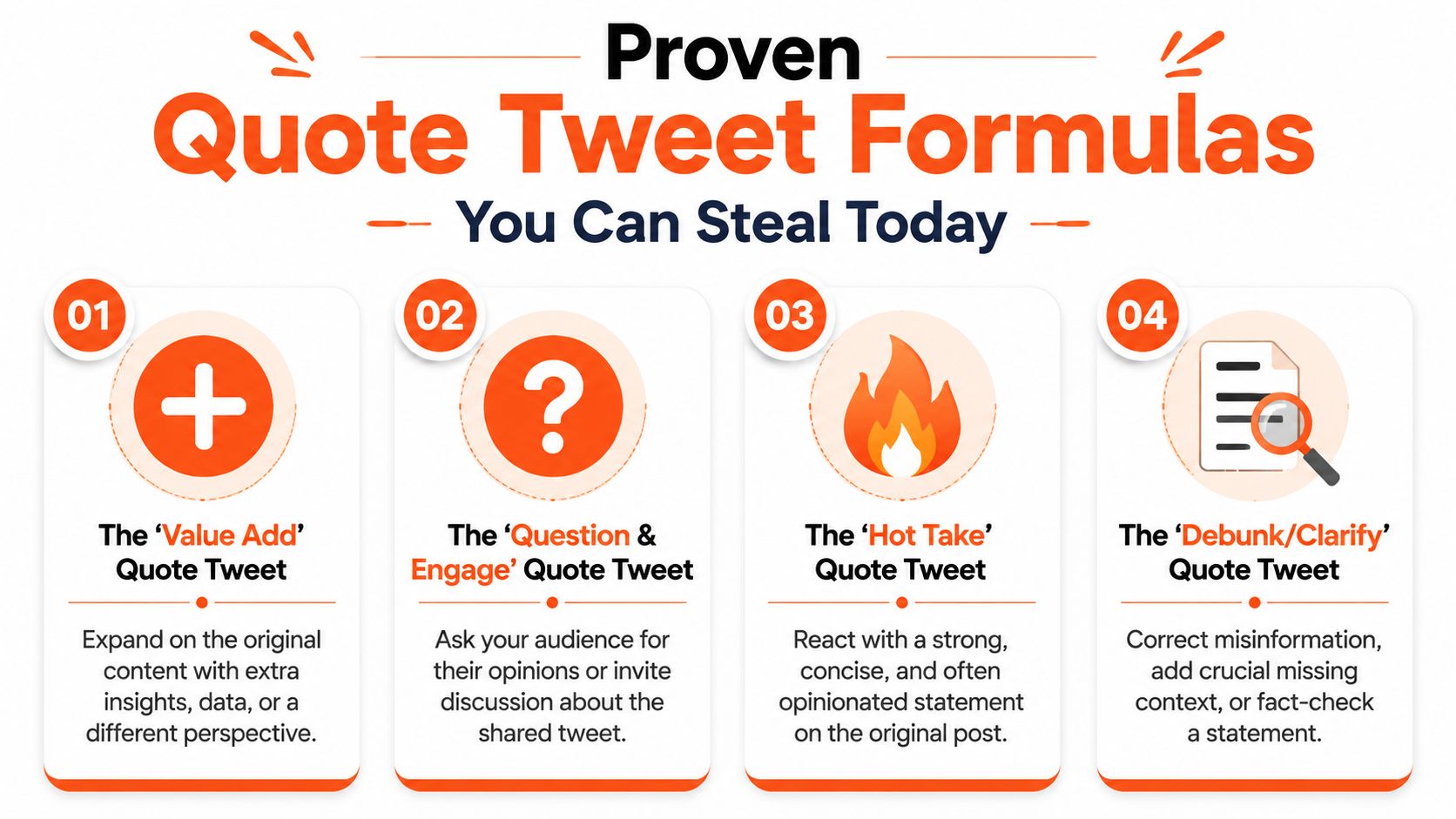
The Value Add
Best when the original post is solid but incomplete.
Original tweet
“Founders should talk to users more.”
Quote tweet “Correct, but teams often ask the wrong questions. Skip feature fishing. Ask what broke, what was confusing, and what they tried before your product.”
This formula works because it turns agreement into usefulness.
The Contrarian Take
Best when a popular opinion needs a respectful correction.
Original tweet
“Posting more is the only way to grow on X.”
Quote tweet
“More volume helps, but weak positioning just creates more forgettable posts. Better angle first. More reps second.”
This formula is strong because it creates tension without becoming hostile.
The Personal Anecdote
Best when the creator has lived through the exact problem.
Original tweet
“Most product launches fail because nobody cares.”
Quote tweet
“One common reason is simpler. The post assumes the audience already understands the problem. If the pain isn't obvious, the launch reads like noise.”
Even without using first-person framing, the lesson still feels grounded in operator knowledge.
The Question Hook
Best when the creator wants replies from followers, not just impressions.
Original tweet
“AI tools are changing how solo creators work.”
Quote tweet
“What part gets replaced first for most creators. Drafting, editing, research, or distribution?”
This one invites discussion while keeping the original post as the prompt.
A useful companion tactic is turning strong quote tweets into visuals for reuse on LinkedIn, newsletters, or carousels. This guide to tweet to image conversion is handy when a creator wants one strong idea to travel across formats.
For creators who run out of angles, idea mining matters more than writing harder. A repeatable content idea workflow for X can make quote tweets easier because the creator starts with better raw material.
Common Quote Tweet Mistakes and How to Fix Them
Some quote tweet problems are strategic. Others are technical. Both are easy to solve once the creator knows what's happening.
When the Quote Tweet option doesn't appear
The most common reason is the original post's sharing restrictions. Protected accounts and limited interaction settings can prevent quoting. The fix is simple: check whether the original author has restricted who can interact with the post.
When every quote tweet turns into a dunk
A timeline built on criticism gets tiring fast. Even if the points are correct, followers start associating the account with negativity instead of insight.
Fix that by balancing three modes:
Teach when the audience needs clarity
Support when another creator made a strong point
Challenge only when the disagreement adds value
If every quote tweet sounds like a courtroom closing argument, the creator isn't building authority. They're building fatigue.
When creators treat quote tweets like retweets
That usually leads to throwaway commentary such as “great point” or “worth reading.” Those posts rarely do much for positioning.
It helps to remember that quote tweets became a formal product milestone in November 2015, and later technical documentation described them as searchable and measurable objects in the platform graph, which shows they're a distinct engagement type rather than a cosmetic variation, as noted in this report on Twitter's revamped quote tweet feature. In practice, that means creators should treat quote tweets like real content assets, not casual reposts.
Measuring Your Impact and Refining Your Strategy
A quote tweet strategy only improves when the creator studies what happened after posting. Vanity reactions alone won't tell the whole story.
What to watch after posting
Good review habits are simple:
Check the response quality. Are followers replying with substance or just liking the post?
Look for profile visits and follower movement. A quote tweet that earns curiosity often matters more than one that only collects lightweight engagement.
Compare by angle. Did explanation, disagreement, humor, or a question perform better for this audience?
Track which source accounts work. Some quoted creators trigger better conversations than others.
Creators who want a cleaner framework for this should study broader insights from social media data, especially when trying to separate reach from actual audience growth.
How to improve the next batch
The best refinement process is manual and honest. Save strong quote tweets. Label them by angle. Re-read weak ones and identify the failure point.
Usually the problem is one of these:
The hook was bland
The commentary repeated the original
The point was too niche for the audience
The post was emotionally hot but intellectually thin
A creator who reviews quote tweets this way starts building repeatable instincts. That's when the feature stops being reactive and starts becoming part of a real growth system.
SupaBird helps creators turn that system into a routine. It combines idea generation, engagement discovery, draft rewriting, scheduling, and coaching in one workflow so better quote tweets don't depend on random inspiration. Creators who want a structured way to find strong posts, craft sharper takes, and stay consistent can try SupaBird.

Digital Product Launch Strategy

Best Twitter Growth Service for Creators in 2026
From X to Every Platform: Repurpose Without Flopping

How to Get Cited by Grok: Winning X’s AI Search in 2026

5 X (Twitter) Growth Metrics Every Serious Creator Should Track — and How to Get the Data
Best Twitter (X) Scheduling Tools in 2026

Best X (Twitter) Growth Tools in 2026

Twitter Growth Hacking Tips 2026
How to Get More Followers on X (Twitter) in 2026
