How to Build Personal Branding on Twitter in 2026
Author:

Most advice about personal branding on Twitter starts with a posting quota. Publish three times a day. Write a thread every week. Chase follower growth. That approach mistakes visible activity for distribution.
On X, people discover expertise through conversations as much as through original posts. A strong reply can place your name inside an established discussion, demonstrate your judgment to an audience that doesn't know you, and send interested readers back to a profile built for recognition. Your brand grows when people repeatedly associate your name with a useful perspective, not when your account merely produces more noise.
The practical model is simple: original posts create assets, replies create distribution, and your profile converts attention into recognition. The workflow below turns that model into a seven-part system covering replies, profile positioning, content formats, publishing windows, measurement, and sustainable tooling.
Table of Contents
Why Reply-Driven Distribution Beats Posting Volume
“Post more” is attractive because it gives you an easy task to count. It also creates a common failure mode. You can publish constantly without entering the conversations where buyers, peers, and influential creators already pay attention.
A 2026 analysis found that reply activity, rather than follower count, was the strongest predictor of whether a post reached beyond its author's existing audience. That changes the operating question from “How many posts can I publish?” to “Which conversations can I improve today?” The distinction matters for a small account because replies let you borrow context without pretending to own the room.
Twitter's creator-focused research found that 61% of users followed a creator, while 66% said creators on Twitter changed and shaped culture (creator-focused Twitter research). The platform's attention has historically gathered around people who interpret events, explain decisions, and make conversations worth following. A personal brand therefore works less like a follower trophy and more like an owned distribution layer inside a public feed.
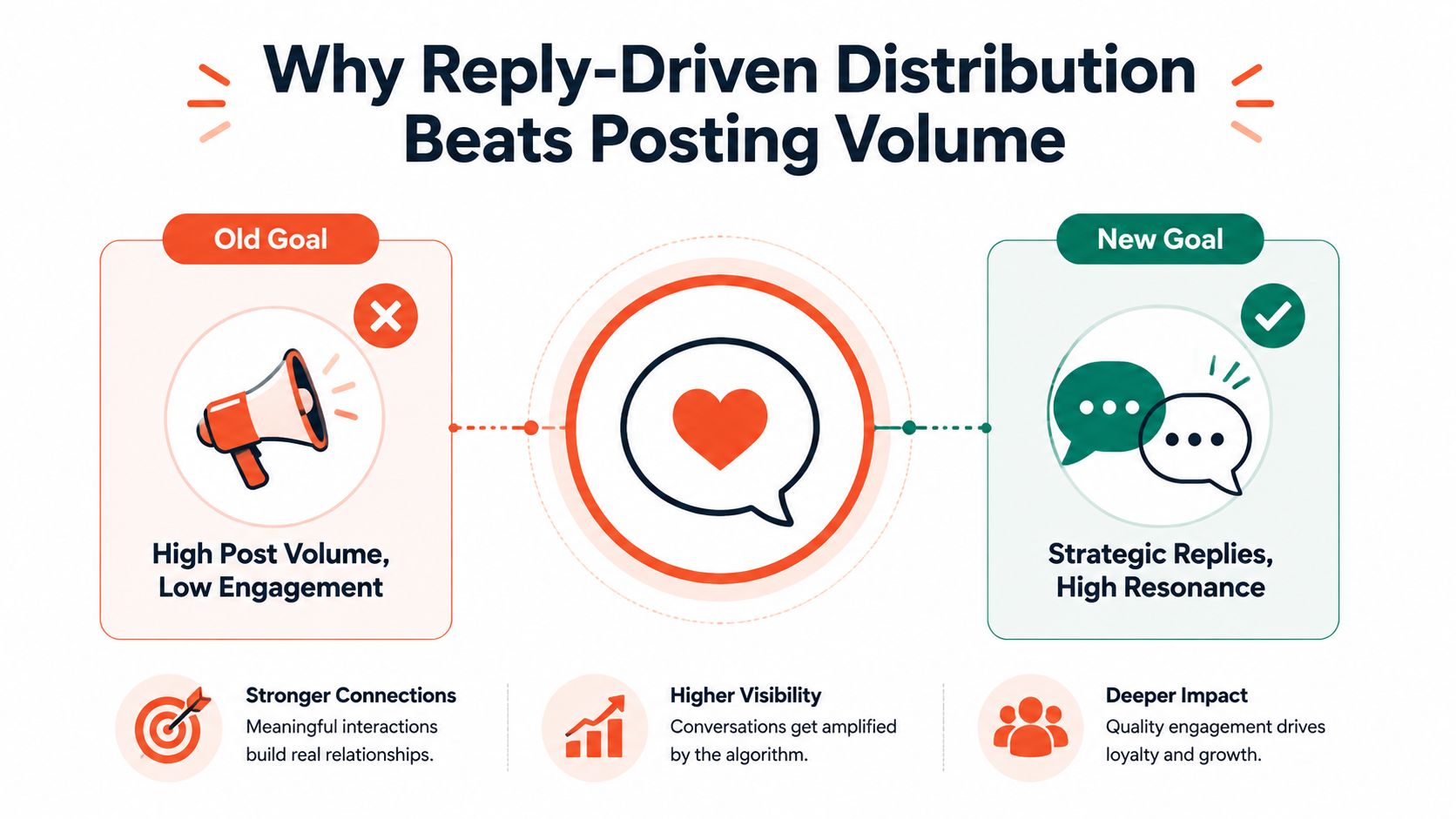
The asymmetric advantage of a useful reply
Creator-led content has shown why personal identity can outperform corporate delivery. A foundational study examined 171 Twitter creators in the US and UK, 3,251 US consumers, and 12 brands across nine industry verticals. It reported an 88% rise in purchase intent when products were promoted through creator posts rather than directly by brands, and found that 94% of creators wanted brand partnerships aligned with their image while 93% wanted brands to value their input (the Twitter creator study).
Those findings are historical, platform-specific evidence, not a promise that every reply will generate demand. They do show the mechanism: audiences respond to a trusted filter. Your reply is valuable when it adds a distinction, example, correction, or practical next step that the original post doesn't provide.
For consultants who want to connect authority with commercial outcomes, the principles in this guide to how to generate leads as a consultant are useful beyond X. On the platform itself, the equivalent is a reply that makes the right reader think, “This person understands the problem I'm dealing with.”
Practical rule: Publish enough original thinking to make your position clear, then spend deliberate time placing that thinking inside relevant conversations.
The seven-part playbook
Define distribution targets. Choose creators, buyers, and communities whose conversations attract your intended audience.
Make your profile legible. A stranger should understand your expertise before they scroll.
Rotate durable formats. Use hooks that expose judgment, proof, and experience.
Build a reply routine. Enter discussions with information, not applause.
Use proven windows. Schedule important posts when weekday activity is strongest.
Measure recognition signals. Track profile visits, qualified follows, saves, replies, and relevant DMs.
Systematize the work. Use tools for sourcing, drafting, scheduling, and review, while keeping judgment human.
For a deeper look at the distribution mechanic, see how replying to tweets grows your account faster. The objective isn't to maximize output. It's to become recognizable in conversations that matter.
Optimize Your X Profile for Instant Recognition
Every reply is a small advertisement for your judgment. The profile is where that attention lands, so ambiguity there wastes the distribution you worked to earn.
Start with the photo. Use one clear subject, strong contrast, and an image that survives thumbnail size. Avoid heavy borders, tiny text, and elaborate illustrations that disappear in the feed, as recommended by this X profile optimization guide. A recognizable face usually gives a personal account more immediate identity than a busy logo.
Build the profile as one system
Your display name should combine identity and searchable context. “Maya Chen, Lifecycle Marketing” tells the reader more than “Maya | Growth | Builder | Writer | Investor.” Your banner should reinforce one value proposition, ideally with a concise proof point that you can substantiate. Don't turn it into a résumé.
The bio needs to answer three questions quickly:
Who you help: Name a specific audience rather than “businesses.”
What you fix: Describe the problem or outcome in plain language.
Why trust you: Add one genuine credibility marker, such as a role, relevant experience, or body of work.
The example in the brief uses a revenue claim, but you shouldn't copy a number unless you can document it. A safer transformation looks like this:
Before: Marketing guy. Thoughts on growth.
After: I help direct-to-consumer teams fix checkout friction. Sharing experiments, teardown notes, and practical conversion lessons.
The second version gives the reader a reason to follow without inflating authority. Your guide to writing a Twitter bio that gets more followers can help you sharpen the wording further.
Choose one conversion path
Your pinned post should perform one job. Pin a strong proof-of-work thread, a clear “start here” introduction, or a resource that matches the promise in your bio. Don't pin a random announcement just because it was recent.
Your link should also point to one next step. Choose a newsletter, consultation page, portfolio, or product. Multiple competing destinations make a visitor decide what to do before they trust you.
Use this quick audit:
Photo: Is the subject obvious at thumbnail size?
Name: Does it include a clear identity or topic?
Banner: Does it communicate one message?
Bio: Can a stranger identify the audience, problem, and proof?
Pinned post: Does it demonstrate your best thinking?
Link: Does it lead to one relevant action?
Open your profile on mobile and give yourself a few seconds. If the answer to “What does this person help me understand or do?” isn't immediate, rewrite before publishing another reply.
Content Formats and Hooks That Travel on X
A good hook earns the first pause. A useful structure earns the share, save, reply, or profile visit. You don't need an endless list of formats. You need a small set that makes your point of view visible from different angles.
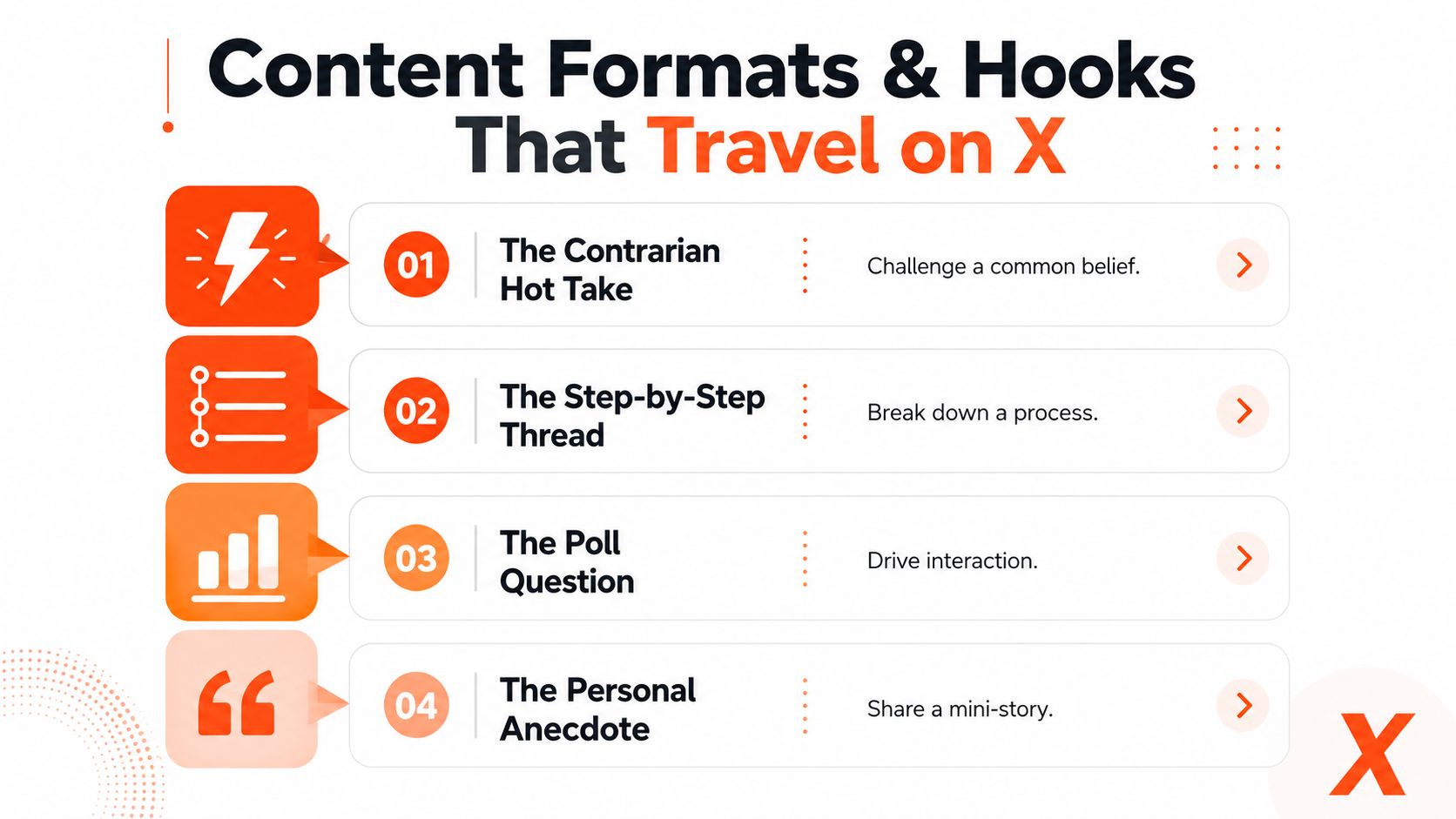
Six formats worth rotating
The contrarian take challenges an assumption without manufacturing outrage.
Example: “Most startup landing pages don't need more copy. They need a clearer answer to one buyer objection.”
Template: “People say [common advice]. In [your context], the bigger problem is [specific distinction].”
The proof-screenshot story pairs evidence with interpretation. Remove private information and explain what the reader should notice.
Example: “This onboarding screen looked polished, but users kept missing the next step. The problem wasn't design quality. It was that the primary action sounded like an internal label.”
Template: “We changed [specific element] after seeing [observable signal]. The lesson was [principle].”
The changed-my-mind post makes intellectual honesty useful rather than performative.
Example: “I used to think every consultant needed a broad positioning statement. After reviewing too many vague profiles, I now prefer a narrow problem and a flexible delivery model.”
Template: “I believed [old view]. Then [experience] changed my mind about [new view].”
The five-line how-to compresses a process:
Pick one audience.
Name its recurring problem.
Show your method.
Add proof from experience.
End with the next action.
Template: “To improve [outcome], do this: [step], [step], [step]. Avoid [common mistake].”
The lived-experience counter works when you disagree with a popular claim because your work exposed a missing condition.
Example: “Daily posting isn't a strategy if every post targets the same people. A smaller account can often gain more by contributing to conversations it couldn't start.”
Template: “The advice works when [condition]. It breaks when [different condition]. My adjustment is [action].”
The experience question invites useful answers instead of empty engagement.
Example: “What made you trust a consultant before the first call, their case-study detail, public writing, referrals, or something else?”
Template: “People who have dealt with [problem], what changed your approach?”
For posts about visual storytelling, these best tips for Twitter videos offer a useful production reference. The principle remains the same: the format should clarify your expertise, not disguise a weak idea.
Plan a week without becoming repetitive
A practical rhythm is three to five main posts per week, daily replies, and one weekly review of saves, replies, profile visits, and useful conversations (personal branding publishing guide). Rotate the formats so your audience sees expertise, experience, and judgment rather than one repeated trick.
Use these hook-writing patterns when a draft feels flat. Then ask one editorial question before publishing: “Would someone send this to a colleague because it explains something clearly?” If the answer is no, strengthen the insight instead of adding more punctuation.
The Reply Game That Builds Real Recognition
At 8:30 in the morning, don't open X and scroll until something feels interesting. Open a short list of conversations you chose in advance: target creators, buyers in your niche, and thoughtful contrarian voices. The mix matters because founders and consultants often reply only to peers, then wonder why buyers never encounter their thinking.
Scan their recent posts for prompts that can support a real contribution. A post with a clear disagreement, an unresolved question, or a practical claim gives you more room than a polished announcement.
Three replies that earn a second look
The first is the insider data point, but only when you have direct experience and can explain the context.
Original post: “Teams don't need a larger content team.”
Reply: “Agreed, but the bottleneck is often review ownership. In small teams, drafts sit because nobody can approve a strong opinion. Assigning one accountable editor can matter more than adding another writer.”
The second is the lived-experience counter.
Original post: “Just share your work publicly.”
Reply: “That helps builders, but service providers need to explain the decision behind the work too. A screenshot shows what changed. A short post about why you chose that change helps a buyer judge whether your process fits.”
The third is the tactical one-liner. It should be compact, but never empty.
Original post: “How do you improve a weak landing page?”
Reply: “Ask five recent buyers to finish this sentence: ‘I nearly didn't buy because…’ Use their language before rewriting the page.”
“Great post” is not a reply strategy. Agreement may be polite, but it gives readers no reason to remember you.
A reply should leave the original author with a better idea than the one they started with.
A repeatable daily block
Set aside 20 minutes and divide the work into three passes:
Select: Choose a handful of high-relevance posts from your monitored accounts and adjacent communities.
Contribute: Write replies containing an example, distinction, correction, or usable action.
Return: Revisit conversations that gained traction and answer follow-up questions with the same care as the first reply.
Don't paste the same opinion under multiple posts. Don't force a sales pitch into a discussion. Don't treat a creator's audience as a list to harvest. Helpful participation compounds into recognition because people see a consistent standard of thought across different conversations.
A reply-led brand also needs range. Comment on the buyer's operational problem, the creator's strategic claim, and the adjacent discipline that informs your work. Those intersections often reveal more distinctive positioning than repeating the vocabulary of your own niche.
A 30-Day Growth Plan With Proven Posting Windows
Follower growth rarely comes from publishing more into an empty feed. A 30-day plan should make replies the daily distribution engine, then use original posts to give new visitors something worth remembering. The first two weeks establish a manageable baseline, the third makes one signature format recognizable, and the fourth tests a larger asset such as a thread or collaboration post.
A 2026 analysis of 4.8 million channel-week observations reported that accounts posting 10 or more times per week gained about 32 followers per week above silent-week baselines, while accounts posting once or twice weekly still outperformed zero-post weeks (X posting frequency analysis). Use that as a directional operating signal, not a promise. Consistent participation gives your replies and posts more chances to be discovered.
Timing can improve the odds that a useful post gets seen. Separate analysis of 8.7 million posts identified engagement peaks on Tuesday at 9 a.m., Wednesday at 10 a.m., and Thursday mid-morning, with weaker performance during the 6 to 11 p.m. window and on Saturdays (X best-time analysis). A second 2026 analysis identified Tuesday at 9 a.m. as the strongest single window, with Wednesday at 9 and 10 a.m. close behind. Test these windows against the hours when your target readers are active.
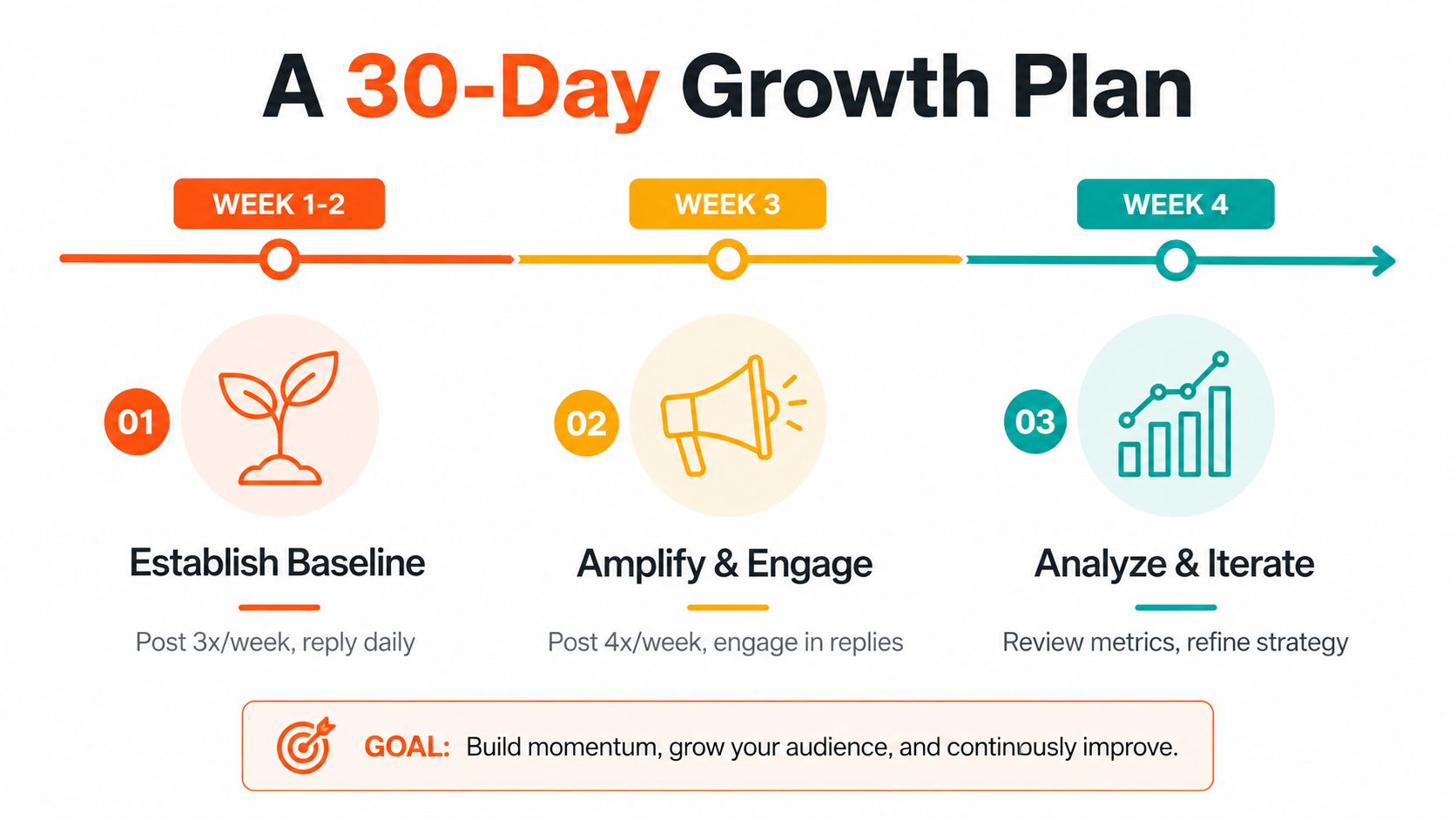
The 30-day operating plan
Week one and week two, establish the baseline. Publish three main posts per week and reply daily. Improve the profile before increasing output. Record which topics create substantive replies, profile visits, and follow-up conversations.
Week three, amplify one signature format. Publish four main posts using a recognizable structure, such as weekly teardowns, changed-mind posts, or practical checklists. Direct replies toward conversations where that format adds useful context, rather than scattering the same opinion across unrelated posts.
Week four, analyze and iterate. Publish a thread or collaboration post, then review the month's strongest conversations. Keep ideas that produced useful discussion and remove formats that consumed time without creating meaningful engagement.
Phase | Primary Lever | Cadence | Target Metric |
|---|---|---|---|
Week one and two | Establish baseline | Three main posts weekly, daily replies | Profile visits and meaningful replies |
Week three | Amplify and engage | Four main posts weekly, active reply participation | Saves and qualified follows |
Week four | Analyze and iterate | One larger distribution asset, continued replies | Inbound conversations and repeatable formats |
Schedule strong original posts in weekday morning windows, especially around Tuesday at 9 a.m. and Wednesday morning. Timing supports relevance, it does not replace it. A generic post at the perfect hour still loses to a useful contribution published when the right audience is present.
Measure What Actually Compounds
Follower count is easy to admire and difficult to diagnose. A better dashboard shows whether the right people recognize your expertise, return to your profile, and start conversations that can lead somewhere.
Review five signals each week:
Profile visits: Rising visits indicate that posts and replies create curiosity. If visits rise but follows don't, repair the profile promise.
Qualified follows: Look for people who follow after engaging with your work. Their relevance matters more than raw volume.
Reply depth: Count replies per post, not just impressions. A thoughtful exchange shows stronger recognition than passive reach.
Save rate: Saves indicate that readers consider the idea reusable. Keep formats that make people want to return.
Relevant inbound DMs: Separate genuine questions, collaboration offers, and buyer conversations from generic outreach.
Use an analytics tool only if it helps you answer a decision. This overview of Twitter analytics tools can help you compare options without building a dashboard for its own sake.
Read the signals together
A post with high impressions and no profile visits may have entertained people without establishing your identity. A post with modest reach, strong saves, and a few relevant DMs may have done more for your business. Don't label a format a failure from one post. Look for repeated patterns across topics and structures.
The credibility mechanism matters here. An Indian creator-economy study reported that digital personal branding predicted perceived credibility with a path coefficient of β=.58, while credibility and trust explained 39% of the variance in purchase intention for knowledge products (creator credibility study). The same research identified content quality, consistency, engagement, authenticity, and demonstrated expertise as important components. That supports a practical conclusion: measurement should track trust-building behavior, not just exposure.
Run a monthly prune
At the end of each month, sort your posts into three groups:
Double down: Formats that produced saves, deep replies, or relevant DMs.
Repair: Ideas with profile visits but weak follows, which may need sharper positioning.
Prune: Formats that repeatedly created activity without useful recognition.
Don't archive a topic just because it underperformed once. Remove patterns that fail after you improve the hook, audience fit, and evidence. Your goal is a smaller system that produces clearer signals, not a larger archive of mediocre output.
The Workflow and Tooling Stack for Sustainable Growth
Willpower is a poor content system. A sustainable workflow gives each task a place: collect ideas, choose conversations, draft, schedule, reply, and review.
Start with an idea source that reflects your niche rather than a blank document. A favorites-based idea lab can surface recurring structures from creators you study, but you should add your own examples and judgment. AI can help transform notes into formats, yet a generic draft usually sounds generic because it lacks a lived detail, a real objection, or a defensible point of view.
A compact weekly stack
Use the following sequence:
Idea sourcing: Save strong posts and extract the underlying pattern, not just the topic.
Reply surfacing: Create a shortlist of high-value conversations so your daily block stays focused.
Draft rewriting: Convert rough notes into a contrarian take, tactical list, anecdote, or question, then edit out phrases you wouldn't say aloud.
Scheduling: Place important posts in your audience's weekday morning windows, with city-specific recommendations when your audience spans Berlin, New York, London, or Mumbai.
Coaching and review: Pair automated feedback with human judgment about why a post worked, where the hook weakened, and what proof is missing.
SupaBird brings these functions into one X-focused workflow through Ideas Lab, the Engage module, X-GPT, a scheduling calendar, and X Coach, which combines AI feedback with access to a human mentor. Use it as connective tissue, not as a substitute for subject knowledge or genuine participation.

Run the system in focused blocks
A practical day can fit into 60 to 90 minutes:
Spend the first block selecting ideas and writing one valuable reply.
Use the next block to draft or revise an original post.
Reserve the final block for targeted replies and follow-up conversations.
At the end of the week, review the five metrics above and choose one change. Don't alter your niche, cadence, format, and profile simultaneously. Controlled adjustments make it possible to tell whether a better hook, stronger proof, or better conversation selection created the improvement.
SupaBird helps creators, founders, marketers, and consultants source ideas, find high-impact conversations, rewrite drafts, schedule posts, and receive actionable X Coach feedback in one workflow. Visit SupaBird to test a reply-led personal branding system that keeps your publishing consistent without turning your voice into generic AI content.

The Reply Guy Strategy: A Growth Guide for X

Why New X Accounts Get Less Reach

ClimbX Review (2026): Features, Pricing, Pros and Cons

How Developer Startups Build a Brand on X Before Launch

30-Day Starting Plan for New X (Twitter) Accounts

How Often Should You Tweet for Maximum Growth?

What Should Your First 10 Tweets Be About?

How to Run X for Ten Clients: The Agency Workflow

How to write a bio that gets people to follow you
