Personal Brand Strategy for X: Founders & Creators
Author:

A founder opens X, writes a post between meetings, hits publish, and waits. A few impressions come in. Maybe a like from a friend, a polite reply, then nothing. The next day brings a different angle, a new hook, maybe a trend copied from another account. The result is usually the same. Activity goes up, but authority doesn't.
That pattern is common in the AI era because more content gets produced every day, while clear positioning stays rare. Founders and creators aren't losing because they lack ideas. They're losing because they're treating X like a slot machine instead of an operating system. A real personal brand strategy fixes that. It turns scattered posting into a repeatable workflow that connects audience, message, content, engagement, and business outcomes.
Table of Contents
Why Your Personal Brand Needs a Strategy Not Just Tactics
Random posting creates random outcomes. A founder might share product updates one day, a hot take the next, then disappear for a week. That isn't a content problem. It's a strategy problem.
A tactic is a single move. A strategy is the system that decides which moves matter, who they're for, and what result they should produce. On X, that difference shows up fast. Tactical accounts chase hooks, trends, and formats. Strategic accounts build recognition because every post points back to a clear position.
The gap between awareness and execution is bigger than generally perceived. More than 70% of professionals acknowledge that personal branding is strategically important, yet only 15% report having a clearly defined personal brand strategy, according to Tenet's personal branding statistics roundup. That's why so many smart founders sound inconsistent online. They know it matters, but they haven't documented what they want to be known for.
What a strategy changes on X
On X, a documented personal brand strategy answers a few practical questions:
Audience focus who should recognize the account and care about it
Topic boundaries which subjects fit the brand and which dilute it
Format choices whether an idea should become a short post, thread, reply, poll, or clip
Business intent what counts as success beyond attention
Without those answers, the timeline trains the creator instead of the creator training the timeline.
Practical rule: If a post gets attention but doesn't strengthen the association the audience should remember, it's noise.
The shift founders need to make
Founders often overvalue frequency and undervalue coherence. Posting more can help, but only when the message compounds. A strong personal brand strategy gives each post a job. Some posts attract the right people. Others deepen trust. Others start conversations that turn into partnerships, demos, or referrals.
That's the key move on X in the AI era. Don't aim to post constantly. Aim to build a repeatable system that makes the right content easier to produce.
Laying Your Foundation With a Clear Brand Statement
Most weak personal brands fail before the first post. The profile says “builder, investor, thinker, advisor.” The content jumps between startup lessons, AI tools, productivity, life updates, and vague motivation. Nothing is wrong individually, but nothing sticks together.
A clear brand statement fixes that. The useful version isn't clever. It's specific enough to guide decisions.

Find the audience worth serving
The strongest X brands usually serve a narrow audience first. Not “everyone interested in AI.” Not “founders.” That's too broad to create recognition.
A better audience definition sounds like this:
B2B SaaS founders trying to explain their product clearly
Indie hackers building AI tools with tiny distribution budgets
Consultants who need authority, not entertainment
Creator-operators turning expertise into products
A founder should choose an audience they already understand from direct work, repeated conversations, or firsthand pain. That's where the best posts come from. Not from brainstorming in the abstract, but from pattern recognition.
Useful inputs for audience research on X:
Scan saved posts and bookmarks. Patterns reveal what the account already cares about.
Read replies under niche creators. The questions in reply sections often show the market's real confusion.
Review DMs, sales calls, and onboarding notes. Repeated objections usually become strong content themes.
Audit the current profile. If the bio attracts the wrong people, the content will feel off no matter how good it is.
For founders tightening that profile, this guide on writing a better Twitter X bio is a useful companion because the bio should reinforce the same positioning as the brand statement.
Write one sentence that guides everything
A useful personal brand statement has three parts. It should define the target audience, the area of expertise, and the unique differentiation in a single sentence, as outlined in Copyfol.io's breakdown of effective personal brand statements.
A practical template is:
This founder helps [audience] achieve [outcome] through [unique method or lens].
Examples:
A SaaS founder helps bootstrapped software teams clarify product messaging through customer-led positioning.
An AI creator helps non-technical operators use automation tools through plain-English workflows and teardown content.
A growth consultant helps early-stage startups get traction on X through fast feedback loops, creator-style testing, and distribution systems.
A brand statement should make content easier to reject. If an idea doesn't support the sentence, it probably doesn't belong.
That last part matters. The statement isn't just a tagline. It's a filter. It tells the founder what not to post.
A good test is simple:
Question | If the answer is no |
|---|---|
Does this topic help the stated audience? | Skip it |
Does it reinforce the chosen expertise? | Reframe it |
Does it show the unique lens? | Add a sharper opinion or example |
On X, clarity beats breadth early. A founder can always expand later. It's much harder to recover from being forgettable.
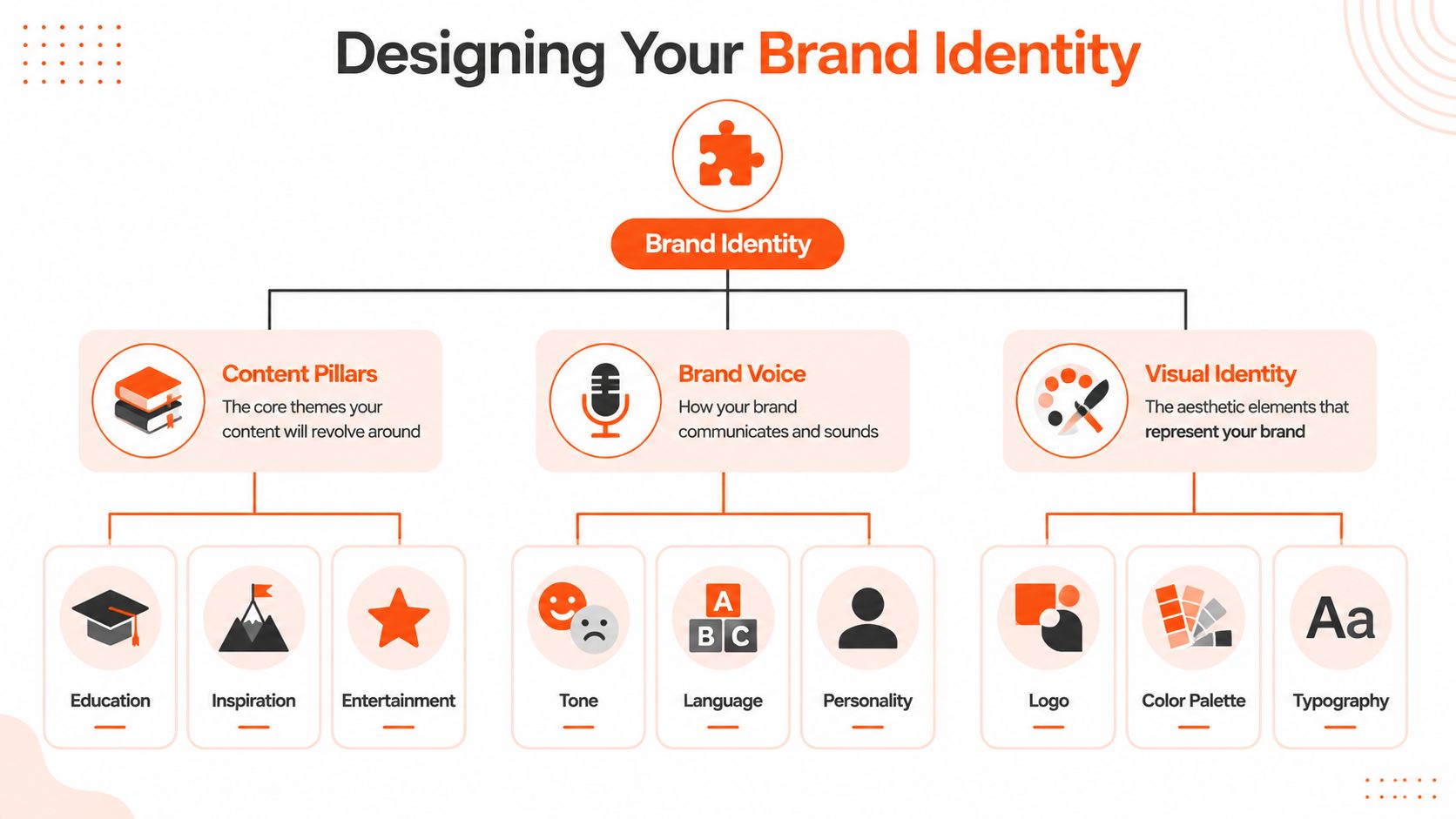
Designing Your Brand Identity Content Pillars Voice and Visuals
Once the positioning is clear, the next job is turning it into something people can recognize. At this point, many accounts drift. The bio says one thing, the posts sound like someone else, and the visuals feel copied from five different creators.
That inconsistency costs credibility. The most common pitfall in personal brand strategy is inconsistency in messaging, tone, and style across platforms, which directly erodes brand identity and credibility. Establishing a uniform profile photo, bio, and tone of voice is fundamental, according to the University of Pennsylvania LPS guidance on building a personal brand online.
Turn positioning into content pillars
Content pillars are the recurring themes that make the account legible. They stop a founder from posting whatever feels interesting in the moment.
Take a founder whose positioning is: helping indie hackers grow AI products through simple distribution systems.
That can turn into pillars like these:
Build in public shipping notes, product lessons, launch reflections
Growth experiments hooks tested, offer changes, landing page rewrites, onboarding friction
AI workflows tool stacks, prompt structures, automation setups, practical use cases
Founder decisions trade-offs, pricing choices, focus, mistakes, hiring restraint
Each pillar should generate multiple post types. For example, “growth experiments” can become a short opinion post, a thread with screenshots, a poll about buying objections, or a reply under a larger creator discussing conversion friction.
A simple content map looks like this:
Pillar | Native X examples |
|---|---|
Build in public | lessons from a launch, feature decisions, customer feedback |
Growth experiments | hook tests, lead magnet angles, homepage rewrites |
AI workflows | tool comparisons, automation sequences, prompt examples |
Founder decisions | trade-off posts, unpopular opinions, execution discipline |
For idea generation within those pillars, this resource on finding content ideas is useful because it turns a broad niche into repeatable prompts and angles.
Choose a voice people can recognize
Voice gets overlooked because it feels less concrete than a content calendar. On X, it matters because users often remember tone before they remember details.
A founder should pick a voice that matches both expertise and temperament. Common options include:
Operator voice practical, blunt, focused on what worked
Teacher voice clear, generous, step-by-step
Analyst voice pattern-based, comparative, evidence-aware
Builder voice reflective, experimental, transparent about trade-offs
What doesn't work is switching voice every week. A calm operator account shouldn't suddenly post outrage bait. A teacher account shouldn't write cryptic one-liners because they looked viral on someone else's feed.
Consistency doesn't mean sounding robotic. It means the audience can tell who wrote the post before seeing the username.
Make the account look intentional
Visual identity on X is simple, but it still matters. Start with the essentials:
Headshot clear, professional, and current
Banner aligned with the niche, product, or personal positioning
Profile colors repeated across graphics, carousels, or screenshots when possible
Bio formatting readable, specific, and compatible with the brand statement
For founders updating profile images, this roundup of actionable LinkedIn photo advice is worth borrowing from even for X because the same visual rules apply. Clean lighting, direct framing, and a credible expression outperform casual or cluttered photos for most professional brands.
The goal isn't to look corporate. It's to look deliberate.
Building Your Content Engine for X
A founder with a clear strategy can still stall the moment the blank composer opens. That's where most personal brand systems break. The thinking is solid, but the workflow is weak.
The fix is a content engine. Not a motivational routine. A real production loop that turns audience pain, founder experience, and market signals into a steady stream of X-native posts.
Build a workflow that removes blank page syndrome
A reliable engine usually starts upstream. The best creators on X don't wait for inspiration. They collect raw material continuously.
A practical workflow looks like this:
Capture signals daily
Save interesting posts, customer objections, product questions, screenshots, and surprising replies.Tag by pillar
Sort each note into a content pillar such as growth, AI workflow, founder decision, or build-in-public.Turn one note into multiple angles
A single customer objection can become a contrarian post, an educational thread, a poll, and a reply strategy.Draft in batches
Writing several posts at once keeps the voice more consistent than drafting one post under pressure every morning.
This is also where broader systems thinking matters. A strong social media content strategy keeps the founder from treating every post as a one-off event.
Match the format to the goal
Different post formats do different jobs on X. A smart personal brand strategy doesn't force every idea into a thread.
Use short posts when the point is sharp and opinionated.
Use threads when the founder needs to break down a process, sequence, teardown, or lesson.
Use polls when the goal is research, light engagement, or surfacing disagreement.
Use screenshots and visual posts when proof matters more than phrasing.
Use short video clips when the nuance or energy of the delivery matters.
Video deserves special attention. YouTube viewers retain 95% of a message when delivered via video compared to only 10% when read as text, according to the U.S. Chamber's overview of personal branding strategy. Founders don't need to become full-time video creators, but short clips can build familiarity faster than text alone.
A practical example:
A founder learns that prospects keep misunderstanding an AI feature.
The text post version becomes a sharp one-liner about poor onboarding.
The thread version breaks down the three most common misconceptions.
The video version shows the product and explains the fix with tone and context.
That same idea can carry a week of publishing if the system is built correctly.
Later in the workflow, this embedded breakdown adds a useful visual example of turning ideas into stronger social execution.
Use AI as an editor not a substitute
AI helps most when it accelerates thinking that already has a point of view. It's useful for reframing hooks, trimming threads, generating alternate openings, or reworking a post into a stronger format. It's less useful when a founder asks it to create authority from scratch.
The safest rule is simple. Human insight first, AI refinement second.
That's also why guides on AI content optimization are useful when applied carefully. The key benefit comes from improving clarity, structure, and relevance, not from flooding the timeline with generic output.
Accounts that win on X usually sound lived-in. The creator has seen the problem, made the decision, tested the idea, or paid the cost. AI can sharpen that. It can't fake it for long.
Mastering Execution Cadence Scheduling and Engagement
Good content posted inconsistently creates weak momentum. Good content posted without engagement creates weak distribution. X rewards creators who treat execution like operations, not performance art.
Most founders don't need a complicated publishing machine. They need a rhythm they can keep during normal business weeks.
Run a weekly operating rhythm
A simple weekly cadence works well because it reduces decision fatigue.
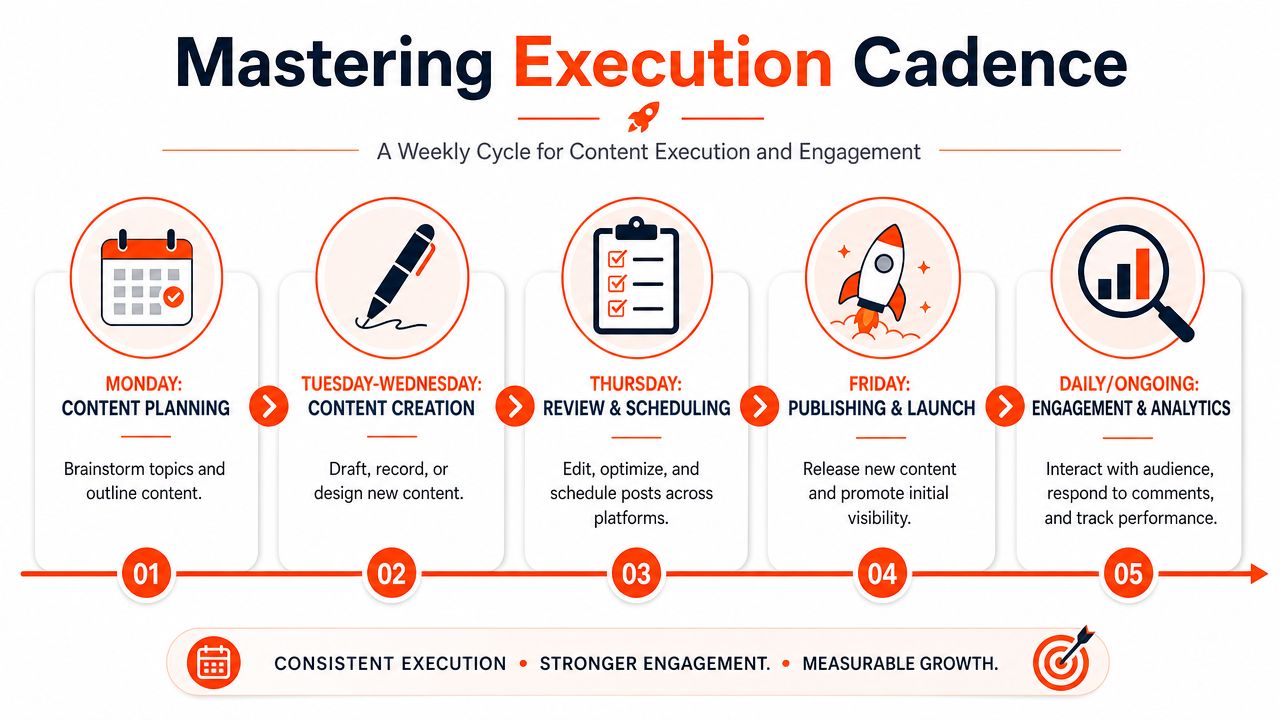
A practical operating rhythm:
Monday choose themes from active business reality, not abstract brainstorming
Tuesday draft short posts and one deeper thread
Wednesday refine hooks, tighten wording, prepare visuals or screenshots
Thursday schedule content and identify relevant conversations to join
Friday publish a stronger opinion or lesson learned from the week
Daily reply, quote-post selectively, and answer DMs that indicate buyer intent
This approach also makes repurposing easier. A good founder post can become a LinkedIn version, newsletter paragraph, sales email angle, or talking point for a podcast appearance. A clear content repurposing strategy keeps the brand efficient without sounding repetitive.
Treat replies like distribution not housekeeping
Many founders still think growth comes mostly from original posts. On X, strategic replies often create faster trust because they place the account inside existing attention streams.
Brand messages shared through an employee's or founder's personal accounts receive 561% more reach than when shared through the official company brand account, and are re-shared 24 times more frequently, as highlighted in this LinkedIn post collecting personal brand performance data. On X, that shows up when a founder account enters active conversations with clear opinions and useful additions instead of just broadcasting from the company handle.
A strong engagement playbook includes:
Replying early to relevant posts in the niche with a real point, not praise
Following conversation chains where ideal customers reveal confusion or urgency
Quote-posting selectively when the founder can add a distinct lens
Using DMs carefully after genuine public interaction, not cold pitching
The best reply posts don't sound like networking. They sound like competence in public.
A useful test for replies is whether they can stand alone as mini-posts. If a reply contains a clear lesson, disagreement, or pattern, it can pull profile visits from people who had never seen the account before.
Scheduling matters too, but not as much as consistency plus relevance. A founder should learn when their audience is active, then keep showing up at those times long enough to gather real signal.
Measuring What Matters and Iterating for Growth
A founder can get trapped by attention metrics fast. Likes feel good. Follower spikes feel like proof. But a personal brand strategy that doesn't improve business outcomes is just a better hobby.
That's why the measurement layer needs discipline. Personal branding outcomes should be tracked using specific metrics like increased inbound opportunities, higher conversion rates, and stronger referrals, rather than engagement metrics like likes or comments, according to NMS Consulting's framework for personal branding strategy.
Stop grading the brand on vanity metrics
Vanity metrics aren't useless. They can help identify resonance. The problem starts when they become the main scorecard.
A founder should care more about questions like these:
Did more qualified people visit the profile?
Did the right prospects mention specific posts on calls or in DMs?
Did partnerships, podcast invites, or referrals increase?
Did content make the sales conversation easier because trust was already built?
A post with modest engagement can still be one of the most valuable assets of the month if it attracts a buyer, partner, or investor who fits the strategy.
A high-performing post isn't the one that gets the loudest reaction. It's the one that creates the best next step.
Use a simple monthly review
A monthly review should be short enough to keep doing. Most founders only need one dashboard and honest notes.
A practical review template:
Category | What to check |
|---|---|
Inbound opportunities | DMs, consultation requests, intros, speaking or partnership asks |
Conversion quality | which posts preceded sales calls or qualified conversations |
Referral strength | mentions from other creators, founders, customers, or communities |
Content performance | which pillar drove profile clicks, saves, replies, or serious discussion |
Brand clarity | whether new followers fit the intended audience |
Then add a short written review:
Which pillar produced the strongest business signal?
Which post format created the best conversations?
Which topics attracted the wrong audience?
What should be repeated next month?
What should be cut without regret?
Iteration becomes strategic instead of emotional. A founder stops asking, “Did that flop?” and starts asking, “What did that teach?”
The best personal brand strategy on X behaves like a feedback loop. Publish. Observe. Interpret. Adjust. Repeat. Over time, the account becomes sharper because the creator isn't guessing anymore.
From Plan to Action
A useful personal brand strategy on X comes down to three moves. Build the foundation with a clear audience and brand statement. Turn that into recognizable pillars, voice, and visuals. Then run an execution system that produces content, starts conversations, and measures business impact.
Perfection isn't required. Repetition is. The strongest founder brands usually don't look complicated from the outside. They look clear, consistent, and hard to confuse with anyone else. That comes from systems, not bursts of motivation.
Creators and founders who want a focused system for generating ideas, improving drafts, finding the right conversations, and scheduling consistently on X can explore SupaBird. It's built for people who want a practical workflow instead of more posting guesswork.

The Reply Guy Strategy: A Growth Guide for X

Why New X Accounts Get Less Reach

ClimbX Review (2026): Features, Pricing, Pros and Cons

How Developer Startups Build a Brand on X Before Launch

30-Day Starting Plan for New X (Twitter) Accounts

How Often Should You Tweet for Maximum Growth?

What Should Your First 10 Tweets Be About?

How to Run X for Ten Clients: The Agency Workflow

How to write a bio that gets people to follow you
