How to Go Viral on Twitter: Your 2026 Strategy
Author:

Most advice about how to go viral on Twitter is too vague to be useful.
“Write great content.” “Be consistent.” “Engage more.” None of that is wrong, but none of it explains why one strong post dies at launch while another spreads far beyond the author's follower base. Creators usually blame luck. That's the wrong diagnosis.
Virality on X is less like winning a raffle and more like running a launch sequence. The post has to earn attention fast, fit the way people read on mobile, and trigger enough early interaction for the platform to keep testing it with wider audiences. When that sequence breaks, even smart content stalls. When that sequence works, accounts with small followings can punch far above their size.
That matters because a lot of talented founders, marketers, and creators are still playing the platform backwards. They spend most of their effort polishing the tweet itself and almost none on the mechanics around it. The result is familiar. Strong insight. Weak distribution. Good post. Bad outcome.
The repeatable version looks different. It starts before publishing. It leans hard on hooks that stop the scroll, formats that increase reading time, and a first-hour response system that turns comments into distribution signals. For newer accounts, it also means earning visibility in other people's replies before expecting original posts to take off on their own.
The biggest shift is mental. A viral tweet shouldn't be treated as a magical event. It should be treated as a product launch with packaging, timing, audience targeting, and post-launch support. That's why some creators can produce breakout posts again and again while others wait for a random hit.
This is the system behind that repeatability. Not fluff. Not recycled “post threads” advice. A practical framework for creating posts that have a real chance to travel.
Table of Contents
Introduction Beyond Luck and Lightning Strikes
Luck exists on X. It just isn't the main thing.
A post can catch a wave because the right person shares it or because a live conversation shifts in the author's favor. But creators overrate randomness because they usually don't see the machinery behind the breakout. They see the result, not the setup. They see the viral post, not the account that spent days warming up conversations, refining hooks, and showing up in the right reply sections.
That misunderstanding leads to terrible habits. People post once, disappear, and assume the platform judged the idea. Usually it didn't. It judged the launch. A weak launch can bury a strong idea before the broader audience ever sees it.
The opposite is also true. A merely solid idea can spread if it enters the feed with the right packaging and momentum. That's why “just write better” doesn't solve the problem for most creators trying to learn how to go viral on Twitter. Better writing matters, but packaging, timing, and reply velocity often decide whether the platform gives that writing a chance.
The myth that hurts creators most
The most damaging myth is that follower count is the gatekeeper. It isn't.
For accounts with 0 to 500 followers, the more effective growth driver is often replying to high-profile posts rather than only broadcasting from their own timeline, based on comments attributed to Twitter product head Mikita Beer in this discussion of the reply-first strategy. That's a direct challenge to the common advice that every creator should focus mainly on posting more original tweets from day one.
New accounts usually grow faster by attaching their insight to existing attention than by waiting for attention to appear on their own timeline.
That doesn't mean original content should stop. It means original content works better when the account has already built some visibility and interaction patterns through replies. A creator with a small audience can't rely on reach from followers alone. That creator needs borrowed distribution.
What a repeatable system actually looks like
The repeatable version of virality has four moving parts:
Part | What it does | Common mistake |
|---|---|---|
Hook | Stops the scroll fast | Opening with context instead of tension |
Format | Makes the post easy to consume | Packing too many ideas into one tweet |
Launch | Creates early interaction | Posting and leaving |
Review | Turns one hit into a pattern | Treating a winner as luck |
A practical example helps. A founder launching a tiny SaaS feature has two options.
The weak version says: “Built a new onboarding feature today. Would love feedback.”
The stronger version says: “Most onboarding flows lose users before they ever see the product's value. This small change fixed the handoff.”
Same product. Different packaging. The second version names a problem people recognize and creates curiosity about the fix. That's the difference between posting information and launching a post.
The Anatomy of a Viral Tweet and Hooks That Stop the Scroll
Most tweets fail in the first line.
Not because the idea is bad, but because the opening asks the reader for patience instead of earning attention. On X, that's fatal. Viral potential depends heavily on naming a relatable problem early and building curiosity before revealing the answer, according to this breakdown of threat relatability and curiosity on X.
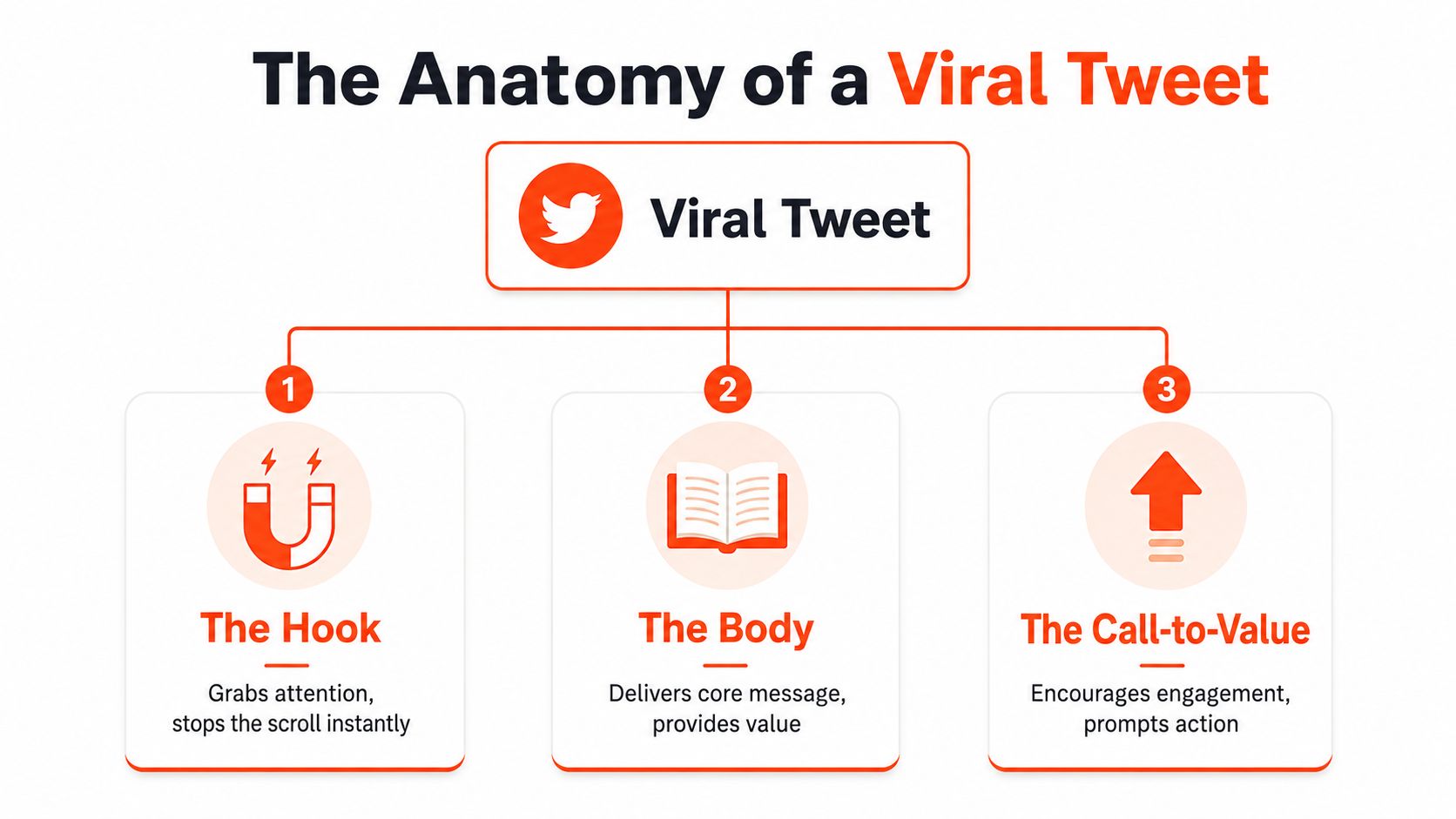
The Hook does most of the work
The hook has one job. Stop the scroll.
That usually happens through one of three patterns:
Relatable threat: “Most creators kill their reach before the tweet even goes live.”
Contrarian claim: “Posting more often isn't the fastest way to grow on X.”
Curiosity gap: “One small change made this launch post much easier to share.”
These work because they create tension. The reader sees a problem, disagreement, or gap in knowledge and wants closure.
A weak hook often starts with autobiography. “Spent the last few weeks thinking about content.” Nobody cares yet. The reader hasn't been given a reason to care.
A better version starts with the reader's problem. “Most content doesn't fail because it's low quality. It fails because it launches cold.”
For creators who want more help with opening lines, this guide on writing stronger hooks for X posts is useful because it focuses on scroll-stopping phrasing rather than generic inspiration.
Practical rule: If the first line sounds like setup, cut it. Start where the tension starts.
Writers who are already studying crafting high-converting social media content will recognize the same principle. Strong copy leads with urgency, contrast, or desire. Tweets are no different. They just punish slow openings faster.
The Body earns the attention
The body delivers the promise of the hook. Many posts collapse at this stage.
A body that rambles kills momentum. A body that lands one clean insight keeps people reading and sharing. On X, short lines help. So do distinct beats.
For a single tweet, the body should usually do one of these:
Explain a mechanism
Example: “The platform tests new posts with a small audience first. If those people engage, the post expands.”Show a contrast
Example: “Good content without distribution looks invisible. Solid content with a strong launch can travel.”Give a usable takeaway
Example: “Write the first line for strangers, not loyal followers.”
A practical body often looks like this:
Pain point named
Reason it happens
Short fix
Concrete example
That structure reads cleanly on mobile and gives the reader something worth bookmarking.
The Call-to-Value moves the reader
Most CTAs on X are too needy. “Please follow for more.” “Like and retweet.” “Thoughts?” None of those add value.
A better close tells the reader what to do in a way that deepens the conversation or extends the learning.
Examples:
“Reply with the hook that got your last post ignored.”
“Bookmark this before the next launch.”
“If the post is about a product launch, the video should show the value before the caption explains it.”
That last point matters because the CTA doesn't always have to ask for a reply or follow. Sometimes the best call-to-value is a final line that makes the post more useful and more shareable.
A simple before-and-after shows the difference:
Version | Close |
|---|---|
Weak | “Follow for more social media tips” |
Stronger | “Test two hook versions on the same idea and compare which one earns faster replies” |
The stronger close gives the reader a next step. That's what makes it feel less like marketing and more like signal.
Proven Viral Structures and Thread Formulas
A good idea becomes much stronger when it's packaged in a structure people already know how to read.
That's why certain post formats keep outperforming random one-off writing. They reduce friction. The reader can tell where the post is going, what kind of value it offers, and whether it's worth investing attention. For creators who struggle with blank-page syndrome, a format often matters more than inspiration.
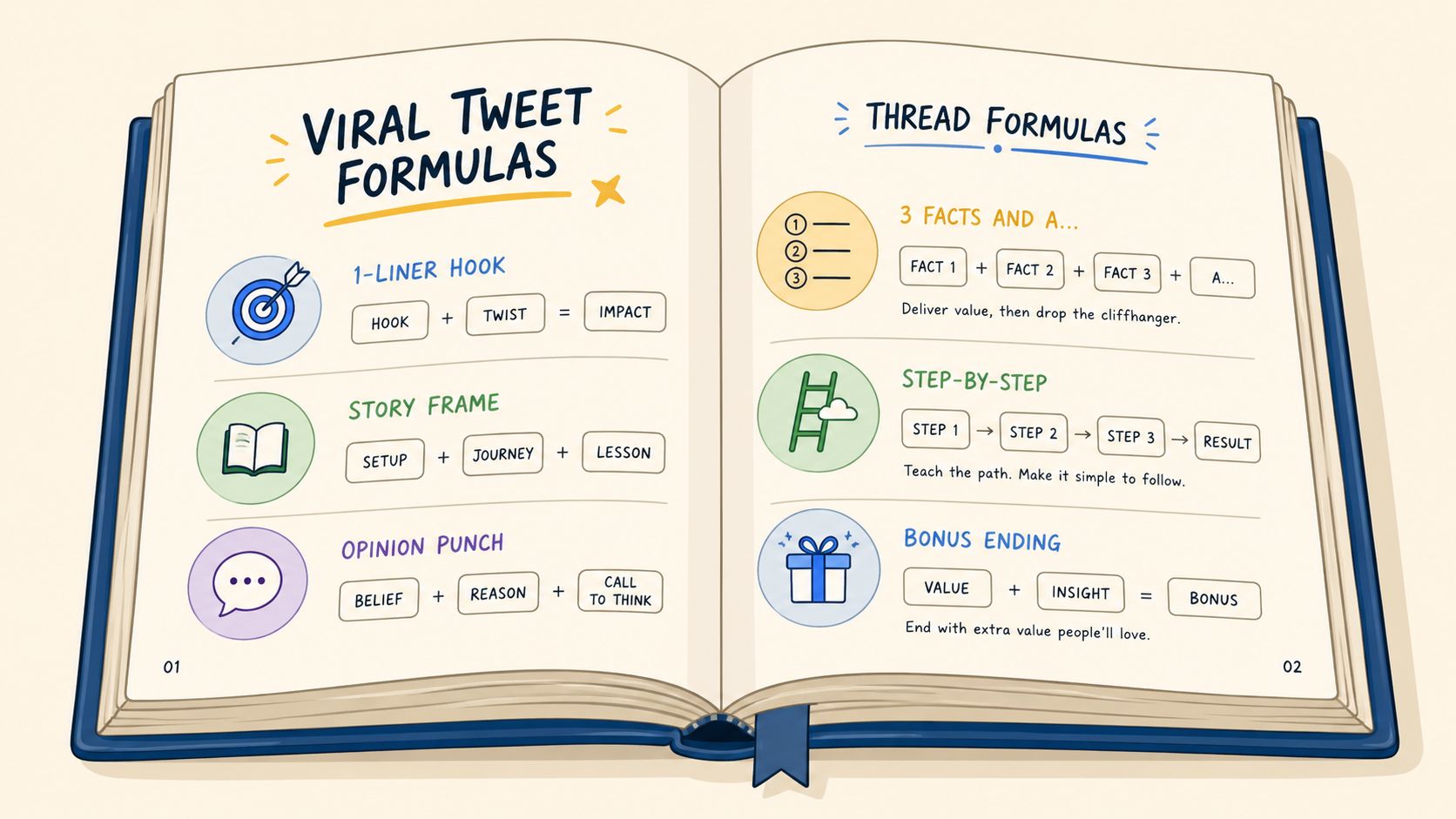
The paired tweet for complex ideas
When the topic is nuanced, a single tweet often tries to do too much. A paired tweet fixes that.
A randomized-controlled trial found that using paired tweets, where the first tweet presents the motivation or problem and the second presents the findings or data, produced significantly higher engagement than a single post with the graphical abstract alone in this research on sharing complex ideas on Twitter.
The practical version looks like this:
Tweet 1: Name the pain, tension, or open question
Tweet 2: Deliver the evidence, mechanism, or lessons
Example for a SaaS founder:
Tweet 1
“Most users don't churn because the product is bad. They churn because they never reach the first useful moment.”
Tweet 2
“Three onboarding changes fixed that: shorter setup, earlier product preview, and clearer next step.”
That format works because the first tweet creates emotional relevance, and the second satisfies curiosity.
A creator hunting for new formats can borrow adjacent angles from content idea workflows built for X creators, then fit those ideas into paired tweets instead of forcing everything into a single block of text.
The problem agitate solve thread
This thread formula works well for education, critique, and founder lessons.
The sequence is simple:
Start with a problem people already feel
Agitate it by showing the cost of ignoring it
Offer a clean fix
End with a next step or example
Here's a stripped-down version for marketing posts:
Tweet 1
“Most product launches flop on X for one reason. The post explains the feature before it sells the problem.”Tweet 2
Explain what readers are doing wrong.Tweet 3
Show the cost. Low curiosity, weak replies, poor sharing.Tweet 4
Give the fix. Lead with the pain point, not the product.Tweet 5
Show a rewrite.
This works because readers feel progress. Each tweet earns the next one.
A short walkthrough helps:
Plain version: “Here are some lessons from launching on X.”
Stronger threaded version: “Most launch tweets die because they read like updates, not opportunities. Here's the rewrite pattern that fixes that.”
Later in the thread, the reader sees the transformation, not just the advice.
A useful companion example sits below.
The numbered list that stays readable
Lists work when they're skimmable and specific. They fail when every item is the same size and tone.
A strong numbered post might look like this:
Hook first
Open with the pain point, not the backstory.A short tactical insight.
Example rewrite
Show the weak version and the stronger version.Common mistake
Call out what ruins the tactic in practice.
That variation matters. Readers don't want five identical mini-essays. They want movement.
The quote tweet angle for live conversations
Not every viral opportunity starts from an original tweet. Sometimes the most impactful move is attaching a sharper point of view to an active conversation.
This works especially well for newer accounts. A founder might quote tweet a large creator's generic post about “building in public” and add one grounded lesson from customer support, pricing, or onboarding. The original post supplies distribution. The quote adds specificity.
The fastest path to visibility is often not a fresh post. It's a better angle inside a conversation that already has momentum.
The mistake is repeating the original post in different words. The quote tweet needs tension, extra context, or a more useful example.
The First-Hour Flywheel and Your Engagement Strategy
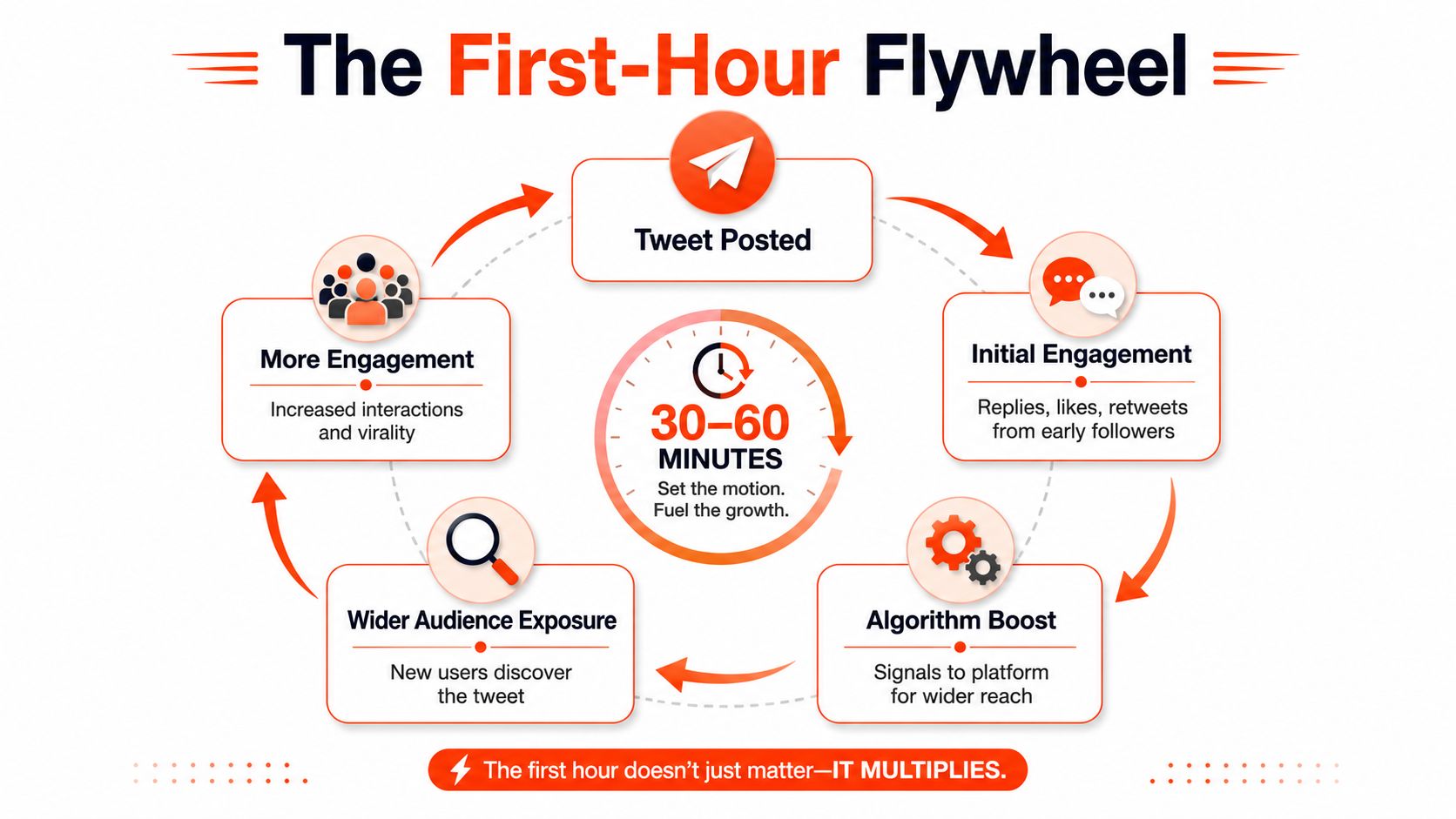
Most creators think engagement starts after the post gets traction. On X, engagement creates the traction.
That first window after publishing is where the post gets judged hardest. Fast, thoughtful replies in the first hour can be the difference between 500 people and 500,000, and spending 10 to 20 minutes replying to target accounts before posting can warm up the account's activity signals, according to this analysis of pre-engagement priming and first-hour reply chains.
What happens before posting
The smartest posts don't launch cold.
Before publishing, spend a short block of time inside the target niche. Not doomscrolling. Focused replies. The goal is to show up in relevant conversations so the account is already active when the main post goes live.
A practical pre-launch routine:
Pick target accounts
Choose creators, founders, or operators in the same niche whose audiences overlap with the post topic.Leave thoughtful replies
Add one useful angle, one example, or one disagreement with substance.Avoid generic praise
“Great post” doesn't help. Neither does a joke that has nothing to do with the niche.
For creators who want a faster way to find posts worth replying to, this walkthrough of targeted engagement workflows shows a practical method for filtering reply opportunities instead of manually searching the timeline.
What happens right after publishing
The first-hour flywheel is simple, but it's demanding.
A new post gets tested with a small audience. In another analysis, X reportedly shows a post to roughly 5 to 10% of followers depending on account health, and engagement from that early group determines whether distribution expands, as summarized in this article on viral tweet timing and early replies. That same write-up says early engagement inside the first 30 minutes to one hour is the strongest algorithmic driver, and each reply to a comment can double the post's reach.
That changes how launch hour should be handled.
Action | Weak approach | Strong approach |
|---|---|---|
After posting | Close the app | Stay active for the launch window |
Comments | Like them | Reply with substance |
Good questions | Answer briefly | Expand with examples |
Early momentum | Ignore it | Turn it into reply chains |
A comment section isn't customer service. It's part of the post.
A practical example: A creator posts, “Most launch tweets fail because they explain features before stakes.”
Someone replies, “How would that work for a B2B product?”
Weak response: “Depends on the audience.”
Strong response: “Lead with the operational pain. Example: ‘Teams don't ignore your dashboard because they dislike analytics. They ignore it because the signal arrives too late to act on.’”
That reply becomes extra content. Future readers see more value. The thread gets deeper. Distribution signals increase.
A flywheel example in the wild
The flywheel has four stages:
Pre-engagement creates activity signals
The post goes live at a strong audience window
Replies build visible conversation fast
The growing conversation attracts more readers, which creates more replies
This is why passive posting underperforms. The author who treats launch hour like dead time leaves reach on the table.
There's another trade-off worth stating clearly. Not every post deserves full launch support. If a tweet gets weak response and the comments are low-quality, heavy effort won't always rescue it. But when a post shows signs of life early, the right replies can help it travel much farther.
Strategic Timing Scheduling and Visuals
A strong post still needs distribution conditions that give it a fair shot.
Timing and visuals are the two biggest multipliers here. One controls whether the right people are around to react. The other controls whether the post wins attention quickly enough on a mobile feed.
Timing is a filter not a footnote
Posting time changes the quality of the initial test audience. That's why timing often beats pure craftsmanship.
In one guide to viral posting, the strongest engagement window is cited as Tuesday through Thursday between 8–11 AM EST, with a recommendation to pre-engage for 10–15 minutes before publishing in that slot in this timing-focused article on tweet performance. That doesn't mean every account should blindly post then. It means creators should start there, then compare it with their own audience patterns.
A useful workflow looks like this:
Check account analytics
Look for when replies come in fastest, not just when impressions appear.Match time to format
Sharp opinions may work in one slot. Educational threads may work in another.Schedule on purpose
The point of scheduling isn't convenience. It's making sure strong posts reach the line on time.
Anyone building a real publishing cadence should also study broader Twitter content scheduling tips to pressure-test assumptions about audience windows and avoid guessing.
This is also where tools help. A scheduling workflow that includes city-based timing and repeatable publishing windows can reduce randomness. Scheduling retweets strategically on X-why-it-matters-and-how-to-use-it-for-growth) is one example of how creators keep good posts circulating without manually re-launching them every time.
Why visuals outperform plain text
Visuals aren't decoration. They're attention tools.
Video content outperforms text-only posts by 10–50x for viral campaigns on Twitter, especially for creators under 3,000 followers, and the first hour of momentum is the defining factor in whether the post spreads or stalls, according to this analysis of video-first launch performance on X. That same analysis notes that users decide whether to stop scrolling in about 0.5 seconds.
Another dataset adds useful context. 93% of all video views on Twitter happen on mobile devices, according to this roundup of Twitter usage and multimedia behavior. That means a good video for X needs to work on a phone first, not as a cut-down version of a desktop demo.
A practical production standard
For creators and founders, the best-performing visual usually isn't the most polished. It's the one that communicates value fastest.
A good minimum standard:
Keep the opening visual obvious
The viewer should understand the subject instantly.Use captions
Mobile viewers often watch without sound.Show the product or proof early
Don't spend the opening on logos or scene-setting.Make the post readable without the caption doing all the work
In some launches, the caption should stay short and let the visual carry the message.
Practical examples help.
A weak product post uses a static screenshot with a long paragraph explaining why the feature matters.
A stronger one uses a short mobile-friendly demo clip that shows the problem, then the fix, then a one-line caption that frames the outcome.
The same rule applies to images and GIFs. Every visual should strengthen the point. If it doesn't add clarity, proof, or tension, it's clutter.
Conclusion How to Test Analyze and Replicate Virality
Virality becomes more repeatable when creators stop romanticizing it.
A breakout post is useful. A documented pattern is far more valuable. The creators who grow steadily on X don't just celebrate winners. They audit them. They look at what earned attention, what held it, what triggered replies, and what turned passive viewers into profile visitors.
Review the post like an operator
After a post performs well, the right question isn't “How can that be repeated exactly?” The right question is “What principle worked here?”
Use a simple review lens:
Hook
Did the first line name a pain point, create tension, or challenge a belief?Format
Was it a single tweet, thread, paired tweet, quote tweet, or video-first post?Launch
Was there active reply support during the critical window?Outcome
Did the post pull comments, shares, profile visits, or follow-through?
Creators on other platforms can also benefit from these insights. A thoughtful guide for creator Instagram engagement is useful not because Instagram and X work the same way, but because disciplined review of engagement quality matters on both. Smart operators compare patterns instead of chasing isolated spikes.
The point isn't to clone a viral post. It's to identify the ingredients that made strangers care.
Build a repeatable testing loop
A clean testing loop keeps the process practical:
Write two hook variations for the same idea.
Choose one format on purpose.
Publish when the audience is most likely to respond.
Support the post during launch.
Review what happened.
Rework the same principle into a new topic.
That loop is how creators move from occasional hits to consistent upside. Not by posting endlessly. Not by copying bigger accounts word for word. By running the same disciplined system again and again until the account develops pattern recognition.
The durable framework is simple: Hook. Format. First-hour flywheel. Analyze. Repeat.
That's the actual answer to how to go viral on Twitter. Not certainty. Not hacks. Better odds created through better execution.
Creators who want help running that system consistently can use SupaBird to generate post ideas, rewrite drafts into stronger formats, find relevant posts to reply to, and schedule content around audience timing without managing every step manually.

The Reply Guy Strategy: A Growth Guide for X

Why New X Accounts Get Less Reach

ClimbX Review (2026): Features, Pricing, Pros and Cons

How Developer Startups Build a Brand on X Before Launch

30-Day Starting Plan for New X (Twitter) Accounts

How Often Should You Tweet for Maximum Growth?

What Should Your First 10 Tweets Be About?

How to Run X for Ten Clients: The Agency Workflow

How to write a bio that gets people to follow you
