How to Get Followers in Twitter: Proven Tactics for 2026
Author:

Most advice on how to get followers on Twitter starts with a fantasy: publish a lucky viral post, discover the perfect posting time, and wait for the algorithm to do the rest. That approach produces occasional spikes, but it rarely produces a durable audience. A viral post without a clear profile promise converts poorly, while endless engagement without a dependable content engine becomes exhausting.
Follower growth works better as a compounding system. Ideas create consistent publishing, strategic replies create profile visits, strong formatting earns retweets, and time-zone-aware scheduling increases the chance that each post finds an active audience. The tactics below are designed to work together, not as disconnected hacks.
Table of Contents
Why Most Follower Growth Advice Fails
The lottery model is attractive because it makes growth feel simple. You chase a trending conversation, post at an arbitrary “best time,” and hope one post carries the account. The problem is that visibility and conversion are different jobs. A post can receive attention while your profile still gives visitors no clear reason to follow.
A foundational study of more than 500 active Twitter users, based on over 500,000 tweets across 15 months, found that follower growth depended on a combination of content, behavior, and network structure rather than one isolated tactic. Researchers recorded follower counts every three months, and most users gained about 12 to 106 followers per three-month period, with a median gain of 36 (Adweek's summary of the Twitter growth study). That pattern matters because it replaces viral wishful thinking with a more useful operating assumption: steady improvement is normal.

The difference between a spike and a system
A viral post can introduce you to people who have never seen your work. A system gives those people somewhere to go next. Before publishing, make sure your profile answers three questions quickly:
What do you talk about? State the niche in plain language.
Who benefits? Name the audience or problem you serve.
Why follow now? Pin a useful introduction, proof post, or representative thread.
Strategic engagement has the same requirement. A thoughtful reply can place your name beside a trusted creator, but a vague bio wastes that profile visit. The reply gets attention, the profile earns the follow, and the content queue gives new followers a reason to stay.
This is particularly relevant for independent creators. A musician, for example, needs a repeatable publishing and promotion system rather than a single launch-day push. The 2026 playbook for independent musicians offers useful context for connecting content, audience development, and promotion across a longer campaign.
Practical rule: Treat every impression as the beginning of a path. The post earns attention, the profile earns trust, and the next post earns retention.
The four operating pillars are straightforward: pipeline, engagement, formatting, and scheduling. The pipeline prevents blank-page weeks. Engagement places you in relevant conversations. Formatting helps ideas travel through feeds and retweets. Scheduling makes your output more dependable across different audience locations. Remove one pillar and the others work less efficiently.
Building a Never-Empty Idea Pipeline
Most creators don't stop because they lack expertise. They stop because their ideas remain trapped in their head, mixed together with unfinished thoughts, customer questions, saved posts, and half-formed opinions. A pipeline turns that disorder into a queue you can publish from.
Start with source capture
Choose the top 10 creators in your niche and study their work for patterns, not copy. Record recurring themes, opening structures, audience objections, visual choices, and the questions that generate real discussion. You're looking for evidence of what the audience repeatedly wants to understand.
Keep a swipe file with four fields:
Hook: The opening line that made you stop scrolling.
Subject: The problem or idea underneath it.
Format: Story, list, opinion, tutorial, quote post, or thread.
Your angle: What experience, counterpoint, or example can you add?
The last field protects you from producing imitation content. A creator might write about launching a product. Your version could focus on the onboarding mistake you made, the customer objection you misread, or the decision you'd reverse.
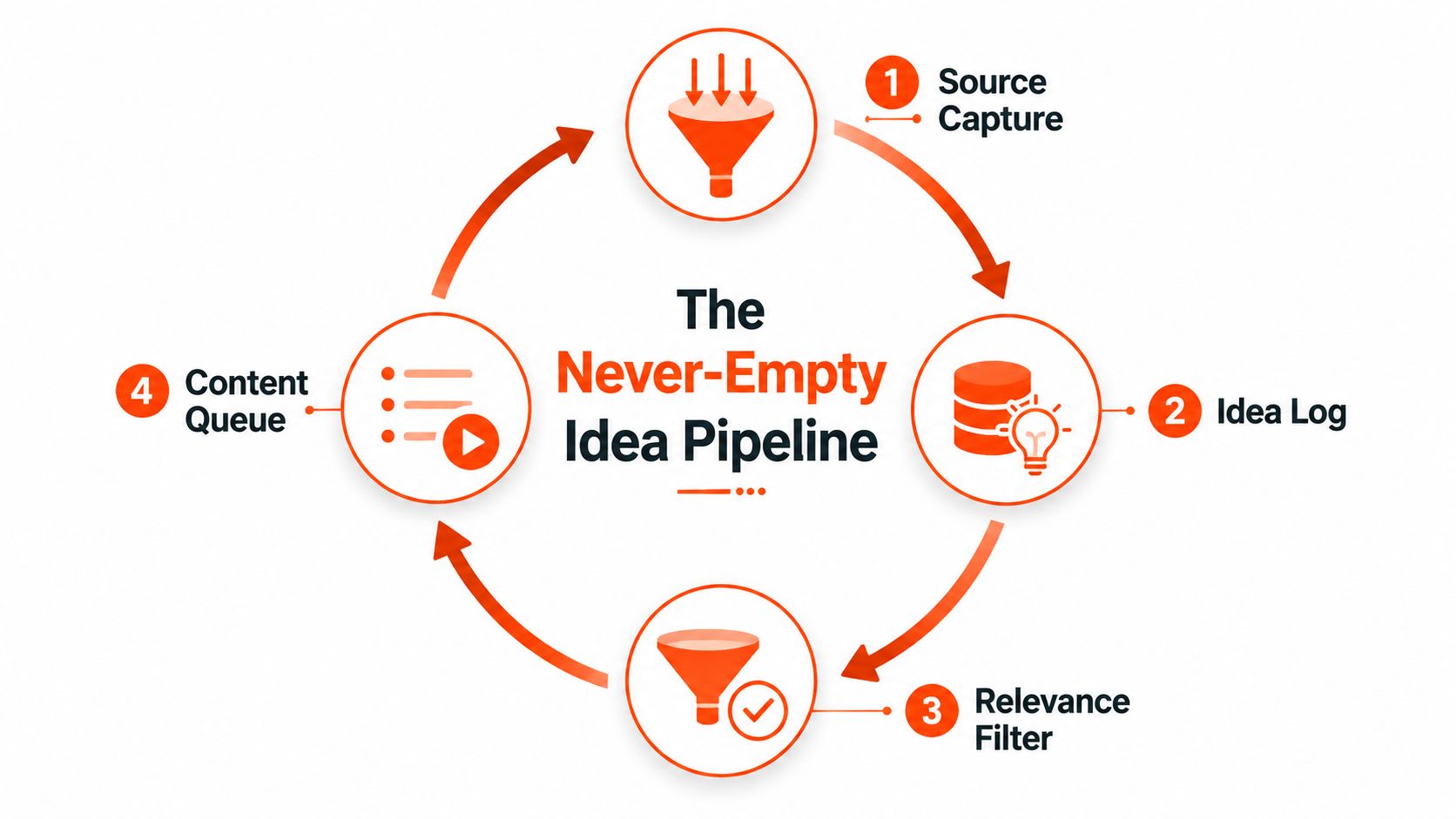
Use an idea log and a relevance filter
Create four content buckets:
Educational: Explain a process, principle, or tool.
Opinion: Take a defensible position on a common belief.
Story: Describe what happened, including the mistake or tension.
Tactical: Give a sequence someone can apply immediately.
On Monday, feed your niche pillars, audience objections, and contrarian observations into an AI brainstorming workflow. With a tool such as SupaBird, you can turn those inputs into a large batch of draft concepts quickly, then reject anything generic, unsupported, or disconnected from your actual experience. The machine supplies possibilities. You supply judgment.
A practical 45-minute ritual looks like this:
10 minutes: Review saved posts, customer conversations, and your swipe file.
10 minutes: Add fresh observations to the idea log.
10 minutes: Generate variations around your strongest themes.
15 minutes: Select, edit, and queue posts for the week.
Use this guide to finding content ideas when your source capture process starts to feel repetitive. The objective isn't to publish every generated idea. It's to maintain enough raw material that you can choose the clearest, most relevant version.
A creator selling analytics software might turn one customer question into four posts: an educational explanation of the metric, an opinion about misleading dashboards, a story about a reporting mistake, and a tactical checklist for weekly reviews. One observation becomes a small content cluster without repeating the same post.
Engaging Your Way Into the Algorithm
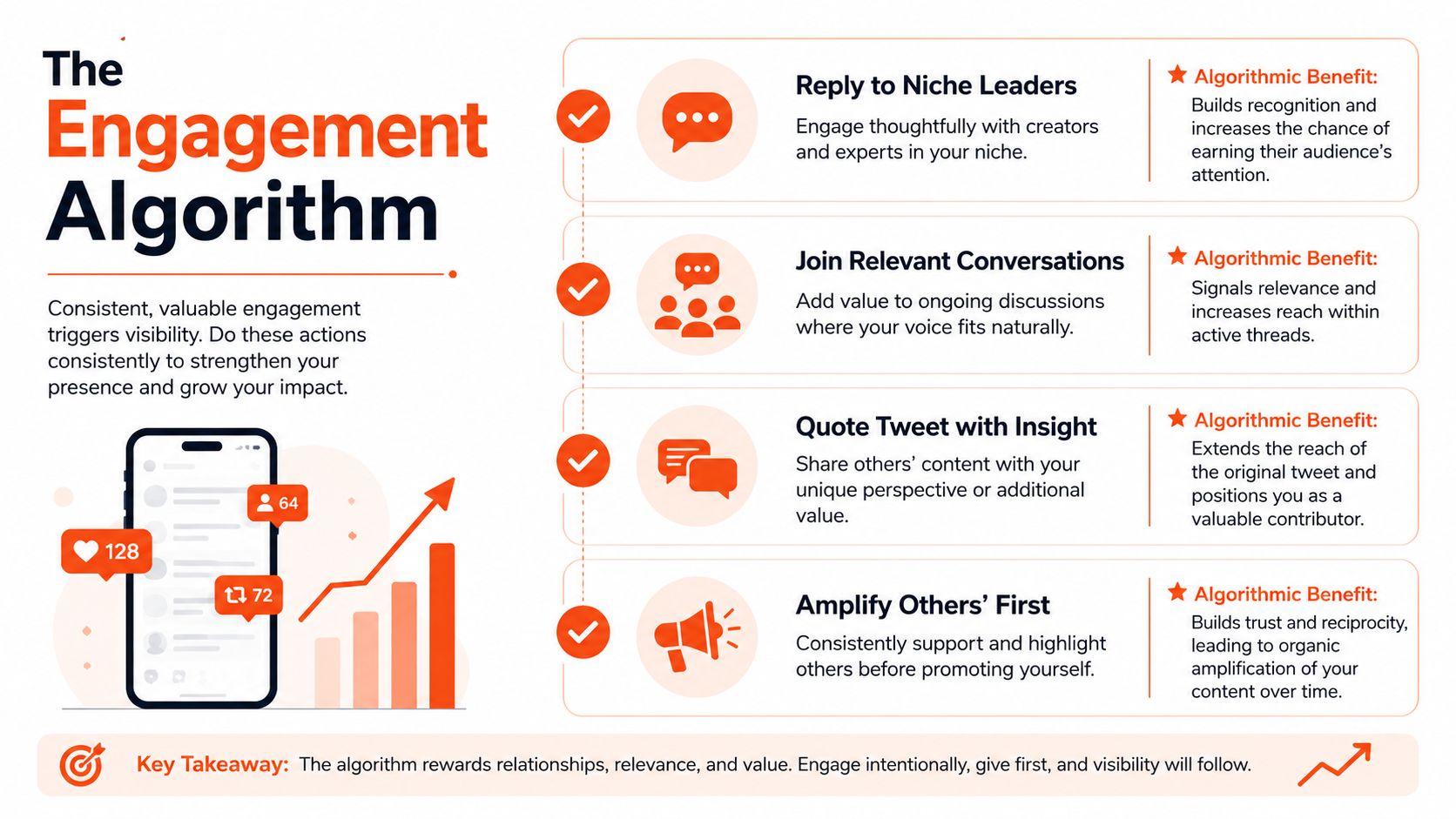
Posting alone makes you dependent on your existing distribution. Strategic replies place your profile inside conversations that already have attention, context, and an audience. The distinction is important: you're not replying to accumulate activity. You're replying where your expertise can improve the conversation.
Build a signal-account list
Find accounts whose audiences overlap with the people you want to reach. Prioritize niche leaders who discuss real problems and whose posts attract substantive replies. Add them to a private list, turn on notifications selectively, and watch for posts where you can contribute something specific.
A useful reply usually does one of three things:
Extends the idea: Add a concrete example or implementation detail.
Complicates the idea: Explain where the advice changes by audience, market, or business model.
Makes the next question easier: Ask a narrow follow-up that shows you understood the original point.
“Great post” doesn't create a reason to click. “This changes for early-stage SaaS teams because the first constraint is usually activation data, not traffic. I'd measure the first meaningful action before optimizing acquisition” gives readers a useful reason to investigate who wrote it.
Aim to respond early when possible, especially during the first 15 minutes after a major account publishes. Early participation can keep your reply near the active part of a conversation, but speed never excuses a shallow response.
Run a repeatable reply session
Reserve 30 minutes of targeted replies before publishing your own content. Start with your signal-account list, then move into adjacent conversations where your perspective fits. Reply to people who respond to you as well. A conversation that continues is more valuable than a drive-by compliment.
Use quote posts when your framing adds meaning that the original post lacks. Summarize the relevant point, state your interpretation, and explain why it matters to your audience. Don't quote a large account merely to borrow its reach. Readers notice when the added text contributes nothing.
For teams that need stronger visual assets to support social storytelling, Social Media Video Production can provide useful context on creating material that gives conversations more substance.
Before sending a reply, ask:
Relevance: Does this audience care about the point I'm adding?
Specificity: Have I included an example, distinction, or useful question?
Clarity: Can a stranger understand my reply without guessing?
Profile fit: Does my profile support the expertise I'm signaling?
Conversation value: Would the original author or another reader want to continue?
The guide to using replies for faster account growth is useful for turning this habit into a deliberate workflow rather than aimless scrolling.
Formatting Posts That Travel Through Retweets
Retweets rarely come from posting more often. They come from making an idea easy to grasp, easy to remember, and useful enough for readers to attach their name to it. A post that travels usually combines a clear tension, a practical explanation, and a conclusion worth passing on.
Build each post around hook, development, payoff. The hook names an unexpected problem or creates a sharp question. The development explains the mechanism, evidence, or experience behind it. The payoff gives readers an applicable conclusion or a sentence that captures a belief they already hold.
Four formats worth keeping in rotation
The contrarian list challenges familiar advice and supports a better alternative. For example:
“Posting more won't fix a weak content angle. Check these three things first.”
Follow with the audience problem, the evidence behind your view, and the adjustment you would make. Specific reasoning gives the list more value than a string of opinions.
The experiment report builds credibility through detail. “I changed the onboarding email” leaves too much unexplained. State what prompted the change, what the earlier approach missed, and what the result taught you. Readers can share a lesson more confidently when they understand the conditions behind it.
The short thread fits a process that cannot fit comfortably in one post. Open with the outcome or tension, give each self-reply one focused step, and finish with a concise summary. If the idea is already clear in one post, keep it there.
The visual-first post gives readers something concrete to inspect. Use a relevant screenshot, diagram, or product flow, then write text that explains what the image proves. Repeating labels adds little.

Edit for feed behavior
Write the first sentence for someone scanning the For You feed. Replace abstract openings with a concrete observation. Short paragraphs and deliberate line breaks help readers find the central point before they leave.
A retweet trigger is a statement readers want associated with their own perspective. It can name a professional frustration, draw a sharp distinction, or state a useful principle. “Most content calendars fail because they schedule outputs before collecting evidence” gives readers more to recognize and repeat than “Content calendars are important.”
Use emojis when they clarify structure or tone. Add a self-reply only when it contributes an example, screenshot, source, or second layer of context. Remove sentences that merely restate the hook.
Use this guide to writing stronger hooks to build a library of openings, then revise each one until it sounds like a person with a clear point of view. Formatting can increase distribution. It cannot supply a useful idea.
Scheduling for Maximum Discoverability
Timing is a distribution variable, not a substitute for quality. The strongest schedule depends on where your audience lives, when those people are active, and whether your post needs immediate conversation or can accumulate attention more slowly.
Several analyses point to weekday morning strength. Buffer's analysis of 8.7 million posts identified Tuesday at 9 a.m. as the single strongest slot, with Wednesday at 9 a.m. and Wednesday at 10 a.m. close behind, while its broader reliable window was 9–11 a.m. on weekdays (Buffer's X timing analysis). Sprout Social's analysis of nearly 2 billion engagements found a broader 12–6 p.m. window on Tuesdays, Wednesdays, and Thursdays (Sprout Social's posting-time study).
Those findings don't contradict each other. They show why you should test morning and lunchtime windows by audience market instead of copying one universal clock. A creator targeting London, New York, Berlin, and Mumbai may need separate publishing blocks, not one schedule chosen for the creator's own location.
Use cadence as an experiment
A practical benchmark is 1–3 posts per day, with the strongest gains often associated with 10 or more posts per week (X posting-frequency benchmark). Hold the format constant for 7 days, then compare impressions, engagements, profile visits, and follows per impression before increasing volume. More posts help only when the added posts create incremental discovery instead of diluting quality.
The first hour deserves close attention. Research on Twitter engagement found that about 50% of engagement can occur within an hour of posting (X timing and growth statistics). Stay available after publishing so you can answer early replies and give a promising post a genuine conversation.
Content Type | Best Time Window (Audience TZ) | Cadence | Link Placement | Expected Reach Multiplier |
|---|---|---|---|---|
Standalone insight | Weekday morning, then test lunchtime | 1–3 daily posts within a sustainable mix | Prefer a reply or follow-up | Measure against your own baseline |
Short thread | Audience peak, with time to respond afterward | Rotate through the weekly queue | Add the link after the native-text opener | Compare profile visits and follows |
Engagement reply | Soon after a signal account posts | 30-minute focused session | Keep the reply conversational | Track profile visits from replies |
Visual post | Morning or lunch window by market | Test adjacent slots | Explain the asset first, link later | Compare impressions and engagement |
Avoid placing an external URL in the main post when reach is the priority. A 2026 synthesis reports that keeping external links out of the tweet body is part of a converging best-practice pattern, alongside Tuesday–Thursday morning publishing (X posting times and engagement guidance). Publish the native idea first, then add the destination in a reply or follow-up post when appropriate.
Measuring and Compounding Your Growth Over Time
Follower growth becomes manageable when each week produces a clear decision. Review more than the follower total. Check whether the right people discover your profile, whether visitors follow, and whether replies create conversations worth continuing.
Publishing and interaction work together. The foundational growth research described earlier supports this view: follower gains reflect several dimensions at once, so one high-performing post should inform your system, not dictate it.
Use a weekly review loop
At the end of each week, review your top three and bottom three posts. Compare:
Profile visits: Which topics made people curious enough to investigate?
Follows per impression: Which posts converted attention into audience?
Reply engagement: Which conversations attracted thoughtful responses?
Format: Did a list, story, visual, or thread create the strongest profile action?
Timing: Did performance change across audience-local windows?
Change one variable at a time. Test the hook style, posting window, thread structure, or link placement while keeping the topic and general format stable enough for a useful comparison. Record the outcome in a simple log. Turn winning patterns into templates, then adapt the idea instead of copying one post repeatedly.
AI coaching can expose blind spots by comparing drafts with your historical patterns. Use it to flag vague openings, buried payoffs, repeated angles, or missing examples. Human judgment still decides whether the idea reflects your experience and deserves publication.
Match the system to your stage
At 0 to 1K, prioritize discovery through useful replies, a clear profile, and consistent original posts. At 1K to 5K, narrow the strongest themes and build recognizable formats around them. At 5K to 10K and beyond, protect quality while expanding distribution through collaborations, visual assets, and repeatable editorial series.
A longitudinal study of viral events among scientists shows how reach can change a growth trajectory. Ten weeks after a first viral event, the viral group had gained an average of 322.9 followers compared with 66.8 for a matched non-viral group. By the end of the observation period, the averages were 2,793.7 and 652.14 follower gains respectively, with r = 0.49 and p < 0.0001 (longitudinal study of viral posts and follower growth). Do not wait for virality. Build a profile and follow-up queue that can convert extra reach when it arrives.
Followers account for about 50% of all retweets, and the median retweet delay is 9.35 hours for followers versus 13.75 hours for non-followers. That supports a practical priority: convert discovery into retention with a coherent profile and a steady queue of strong follow-up posts.
Use these X growth metrics and data methods to formalize the review. Each week, keep what earned qualified attention, revise what attracted views without follows, and remove formats that consume time without producing useful signals.
SupaBird combines an Ideas Lab, an Engage module, X-GPT draft optimization, a city-aware scheduling calendar, and X Coach support. These tools help maintain the pipeline, respond to relevant conversations, and publish consistently. Visit SupaBird to review drafts and turn follower growth into a repeatable operating system.

The Reply Guy Strategy: A Growth Guide for X

Why New X Accounts Get Less Reach

ClimbX Review (2026): Features, Pricing, Pros and Cons

How Developer Startups Build a Brand on X Before Launch

30-Day Starting Plan for New X (Twitter) Accounts

How Often Should You Tweet for Maximum Growth?

What Should Your First 10 Tweets Be About?

How to Run X for Ten Clients: The Agency Workflow

How to write a bio that gets people to follow you
