How to Gain Twitter Followers: Your 2026 Playbook
Author:

Most advice on how to gain Twitter followers is wrong because it treats growth like a posting contest. Post more. Chase trends. Copy whatever went viral yesterday. That approach can inflate numbers, but it often builds a weak audience that doesn't read, reply, buy, or remember.
A better goal is simpler. Build an account that attracts people who care about the same topic, recognize the value fast, and keep showing up. That's the difference between vanity growth and durable growth. It's also the difference between an account that looks busy and one that creates opportunities, leads, and authority.
Anyone trying to earn money through social media eventually runs into the same constraint. Follower count alone doesn't pay. Attention from the right people does. A useful companion read on long-term audience building is this guide on Twitter/X follower growth over time, because the ultimate objective is compounding relevance, not chasing random spikes.
Table of Contents
Beyond Vanity Metrics The New Rules of Follower Growth
The old playbook says more followers is always better. That's lazy advice. A large passive audience can make an account look established while producing weak conversations, weak click-through, and weak retention.
The smarter target is follower quality. The account should attract people who fit the niche, engage repeatedly, and care about the topic enough to act on it. That means every part of growth has to filter, not just attract.
A practical rule helps here. Every post, reply, and profile element should answer one question: who is this for? If the answer is “everyone,” the content usually lands with no one.
Practical rule: Growth gets easier when the account becomes legible. A founder account should look like a founder account. A designer account should look like a designer account.
That's why sustainable growth works best as a system. The profile sets the promise. Content proves the promise. Replies distribute the promise. Workflows keep the promise consistent. People looking to gain Twitter followers need that sequence more than another list of motivational tips.
Laying the Foundation for Targeted Growth
Follower growth on X does not break because posting is too hard. It breaks because the account is vague.
If a profile reads like three different people are running it, the right audience will not wait for clarity. They leave. The fix starts before content volume, posting frequency, or engagement routines. Set up an account that attracts the right people and filters out the wrong ones.
Choose a niche people can identify in one glance
Broad categories do not convert well on X because they create weak expectations. A visitor who sees “marketing,” “AI,” or “startups” still has to guess what they will get by following. That extra guess kills momentum.
Specificity gets remembered. “B2B SaaS homepage teardowns for founders” is clear. “Practical AI workflows for solo consultants” is clear. “Content systems for creators selling digital products” is clear.
Different account types should define their niche at a different altitude:
Account type | Weak niche | Strong niche |
|---|---|---|
Founder | startups | bootstrapped SaaS lessons, product distribution, build-in-public updates |
Creator | lifestyle | creator systems, short-form content workflows, monetization experiments |
Marketer | growth | organic social strategy for B2B teams, content repurposing, brand positioning |
A good niche does two jobs at once. It makes the account easier to follow, and it makes content decisions faster. If a post does not fit the niche, it does not go out.
That trade-off matters. Narrower positioning usually slows raw reach at first, but it improves follow quality, reply quality, and profile conversion.
Build a profile that converts attention into follows
The profile is the first filter in the system. Every reply, repost, and post impression sends people there. If the profile is weak, the distribution work gets wasted.
Start with four assets:
Photo: Use a clear face photo or a recognizable brand mark. Low-quality avatars reduce trust fast.
Bio: State who you help, what you talk about, and why your perspective is credible.
Header: Support the niche with proof. Use a product visual, category statement, client result, or repeatable promise.
Pinned post: Pin the best entry-point post for a new follower. Do not pin a stale launch update unless it still explains the account well.
I treat profile writing like landing page writing. Every line has a job. The bio frames the value proposition. The header adds context. The pinned post closes the gap between curiosity and follow.
For a tighter bio workflow, use this guide on how to write a good Twitter/X bio that gets you more followers.
Presentation matters here too. Consistent preview images, headers, and linked-page metadata all help enhance social media branding, especially when people move from your profile to your site or product.
Define the audience before you chase reach
Accounts grow faster once they know exactly who should follow.
Write a simple audience filter with three parts:
Role: founder, operator, creator, marketer, recruiter
Problem: needs leads, better content systems, stronger distribution, clearer positioning
Stage: beginner, growing team, established operator, agency owner
A good example is “bootstrapped SaaS founders trying to get their first consistent inbound from content.” That is specific enough to guide posts, replies, examples, and offers. It also tells you what to ignore.
I use a simple test. If a post gets attention from people who will never care about the core topic, the post may help impressions while hurting the account. Vanity reach often brings low-intent followers, weak reply threads, and messy audience signals.
Measure whether the account is attracting the right people
Quality shows up in behavior, not follower count.
Useful signals include recurring replies from people in the niche, profile visits after niche-specific posts, DMs that reference a clear topic, and followers who engage more than once across different formats. Those people are the base of the growth engine.
Weak signals look different. Broad opinion posts can spike impressions and add followers who never interact again. Meme-style posts can inflate reach while making the account harder to categorize. That trade-off is fine for entertainment accounts. It is usually bad for founder, operator, and expert accounts trying to build authority, pipeline, or partnerships.
A smaller audience of the right builders, buyers, or peers will outperform a larger passive audience almost every time. On X, targeted growth compounds because the right followers do more than count. They reply, share, refer, and come back.
The Content Engine What to Post and When
Most accounts don't need more ideas. They need a reliable publishing mix. Random posting creates random growth. A content engine fixes that by assigning each format a job.
The simplest version uses four formats: educational posts, conversation posts, behind-the-scenes posts, and promotional posts. That mix keeps the account useful, human, and commercially relevant without sounding repetitive.
A visual model helps make that mix concrete.

Use four content types on purpose
Each format should solve a different problem.
Educational posts: These earn trust. Example: a founder posts a short teardown of why a landing page headline failed and how it was rewritten.
Engagement posts: These surface opinions and invite discussion. Example: “What's the hardest part of posting on X consistently, finding ideas or staying specific?”
Behind-the-scenes posts: These add texture. Example: a creator shares a screenshot of a content workflow, then explains what changed after simplifying it.
Promotional posts: These convert attention into action. Example: a consultant shares a practical result from a client workflow, then invites readers to book a call or download a framework.
That mix is more useful than “post threads” or “post memes.” Format alone isn't strategy. Intent is.
Write with a hook to value structure
Every post needs a first line that buys the second line. Good hooks don't just sound clever. They frame a useful payoff.
A simple template works across niches:
Hook: Make a specific claim or observation.
Value: Teach, explain, or reveal process.
Action: Ask for a reply, click, or follow if relevant.
Examples:
Founder post: “Most startup tweets fail before the second line. The problem isn't writing. It's positioning.”
Creator post: “A content calendar usually breaks for one reason. It assumes motivation will stay high.”
Marketer post: “The easiest way to waste organic reach is posting for peers instead of buyers.”
Posts with media perform especially well when the goal is follower growth. Posts with media like images or videos generate up to 2x more engagement than text-only posts. Videos on Twitter also increase the average lift in user intent by 34%, making them a high-impact format for increasing time spent on content and signaling value to the algorithm (dsmn8 data on media and video performance on Twitter).
That's why strong operators attach visuals intentionally:
a screenshot of a workflow
a simple chart
a short native video
a branded image with one core idea
For teams tightening previews and link presentation across channels, this guide on how to enhance social media branding is useful because weak metadata can make good content look low quality before anyone clicks.
A practical source of repeatable angles is studying what already works. This library of ideas on how to find content ideas is a good shortcut for building a repeatable topic pipeline instead of improvising every day.
Later in the workflow, video deserves its own slot because it changes how people consume the post.
Video works best when it feels native to the timeline. Short explanation clips, direct camera takes, and annotated screen recordings usually outperform overproduced brand edits on X.
Match format to market timing
Timing matters, but not in the simplistic “post at one magic hour” way. The right timing depends on where the audience lives and what kind of post is being published.
A workable cadence looks like this:
Format | Best use | Timing logic |
|---|---|---|
Short educational post | daily consistency | publish when target audience is actively scanning the feed |
Reply-driven discussion post | conversation depth | publish when there's time to answer comments quickly |
Thread or multi-part post | authority building | publish when the audience can stay with a longer idea |
Video or visual post | dwell time and sharing | publish when visual content won't get buried immediately |
For markets like New York, London, and Berlin, the practical move isn't guessing one universal slot. It's watching where profile visits and replies concentrate, then aligning each format to those windows. Educational content often works well in active workday windows. Discussion prompts can perform better when the creator can stay online and keep the thread alive.
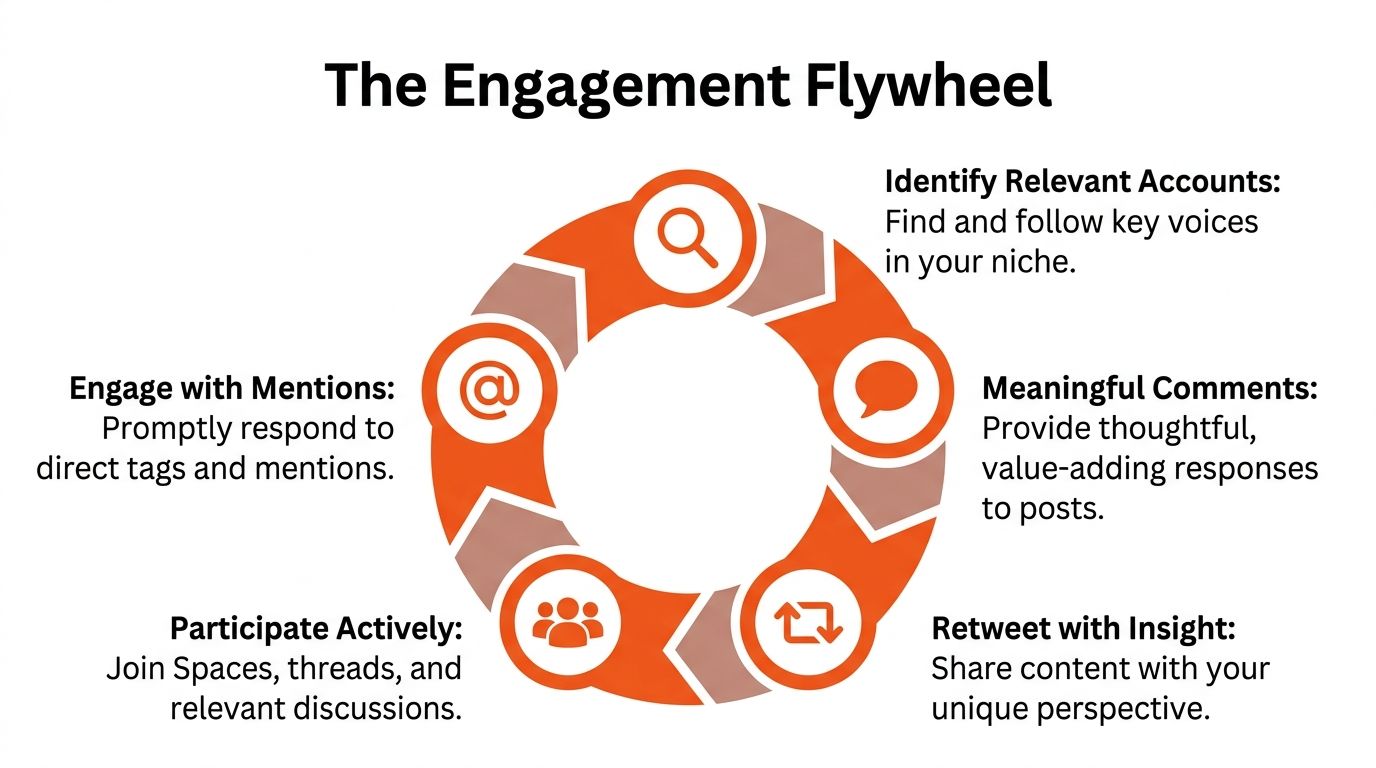
The Engagement Flywheel How to Interact for Reach
Most advice about growth on X overvalues posting and undervalues distribution. Small accounts do not have a content problem first. They have an attention problem.
Replies solve that faster than another standalone post because they place your thinking inside conversations that already have reach. If the goal is qualified followers, not random impressions, the job is simple. Show up where the right audience is already paying attention, add a sharper point than everyone else, and give people a reason to click through.
Replies beat isolated posting for small accounts
A good post from a new account can disappear in minutes. A good reply on a high-visibility post can outperform it because the audience is already there.
That is why I treat replies as a distribution system, not an engagement chore. The best targets are creators, operators, and niche experts who already attract the exact followers you want. A founder selling to marketers should reply under marketers. A product designer should reply under design leaders and startup operators, not broad meme accounts with inflated reach and weak follower fit.
Speed matters here. Early replies usually get more exposure because they sit near the top while the original post is still gaining momentum. Hypefury makes the same point in its guide to growth on X. Consistent early replies on relevant posts create more profile visits than waiting for your own posts to carry the account alone (Hypefury on building growth through replies and engagement).
What a strong reply actually looks like
Strong replies do one of four jobs. They sharpen the original point, add a concrete example, introduce a useful objection, or ask a question that opens a second layer of discussion.
Here is the standard I use:
Add a missing constraint: “This works if the offer is already clear. If the positioning is fuzzy, more traffic just exposes the confusion faster.”
Supply a real example: “We tested this with two versions of the same post. The blunt opinion got more likes. The case-study version got more profile clicks and better followers.”
Introduce a trade-off: “This is strong for short sales cycles. For enterprise deals, the better play is repetition across multiple posts and replies.”
Ask a question with teeth: “Would you run the same approach for a technical buyer who cares more about proof than personality?”
Replies that perform well often read like standalone posts compressed into three lines. They are specific enough to teach and open-ended enough to invite another response.
Replying under larger creators works best when the reply starts a thread instead of ending one. That lines up with practical advice from TodayMade. Insight, disagreement, and discussion earn more attention than praise that could have been written by anyone (TodayMade guidance on strategic Twitter replies).
Quote tweets belong in this system too, but they need a higher bar. Use them when you have a clear angle, a counterpoint, or a case study to layer onto the original idea. If you need a clean primer, this guide on how to quote tweet on Twitter covers the mechanics.
The best reply feels valuable even if nobody reads the original post.
A daily engagement workflow that scales
Random engagement creates random results. A repeatable workflow creates compounding visibility.
I prefer three short engagement blocks over one long session because X rewards timing and follow-through.
First pass
Scan a tight list of high-signal accounts in your niche.
Open fresh posts with traction.
Reply only where you can add substance in one minute or less of thinking.
Skip anything that invites generic agreement.
Second pass
Return to threads where your reply got traction.
Answer follow-up comments fast.
Like strong responses from other people in the thread if they add to your positioning.
Save any reply that performs well so it can become a future standalone post.
Third pass
Join one broader conversation outside your immediate circle.
Use a selective quote tweet or reply to a debated topic where your expertise is obvious.
Review which interactions drove profile clicks, follows, and relevant conversations.
The key trade-off is volume versus quality. Fifty weak replies will get seen and forgotten. Fewer strong replies will pull in the right followers, the kind who read your posts, respond to offers, and stay. For creators building a system around that process, the best stack usually includes scheduling, drafting, clipping, and research support. Tools listed in these top AI tools for content creation can help reduce the manual work, but they do not replace judgment.
A strong flywheel on X looks like this. Post to establish your ideas. Reply to distribute those ideas into larger conversations. Turn the best replies into future posts. Repeat until the account stops depending on luck.
Scaling Your Growth with Smart Workflows and Tools
Manual growth works for a while. Then the account hits the usual wall. Ideas get repetitive, reply tracking slips, drafts pile up, and posting cadence becomes mood-based. Growth stalls because the process depends on memory and motivation.
The fix is operational. The account needs workflows for idea capture, drafting, media production, scheduling, engagement, and review.
Turn random effort into a weekly operating system
A practical weekly system can look like this:
Workflow | What happens inside it | Output |
|---|---|---|
Idea collection | Save strong posts, note recurring audience questions, log objections and patterns | raw topic bank |
Drafting | Turn each idea into short post, thread, video script, or reply angle | content drafts |
Packaging | Add visual, screenshot, clip, or formatting | publish-ready assets |
Scheduling | Place posts into time slots based on audience activity | calendar |
Engagement | Surface relevant accounts and live conversations | replies and quote tweets |
Review | Study what earned replies, profile visits, and follows | next-week adjustments |
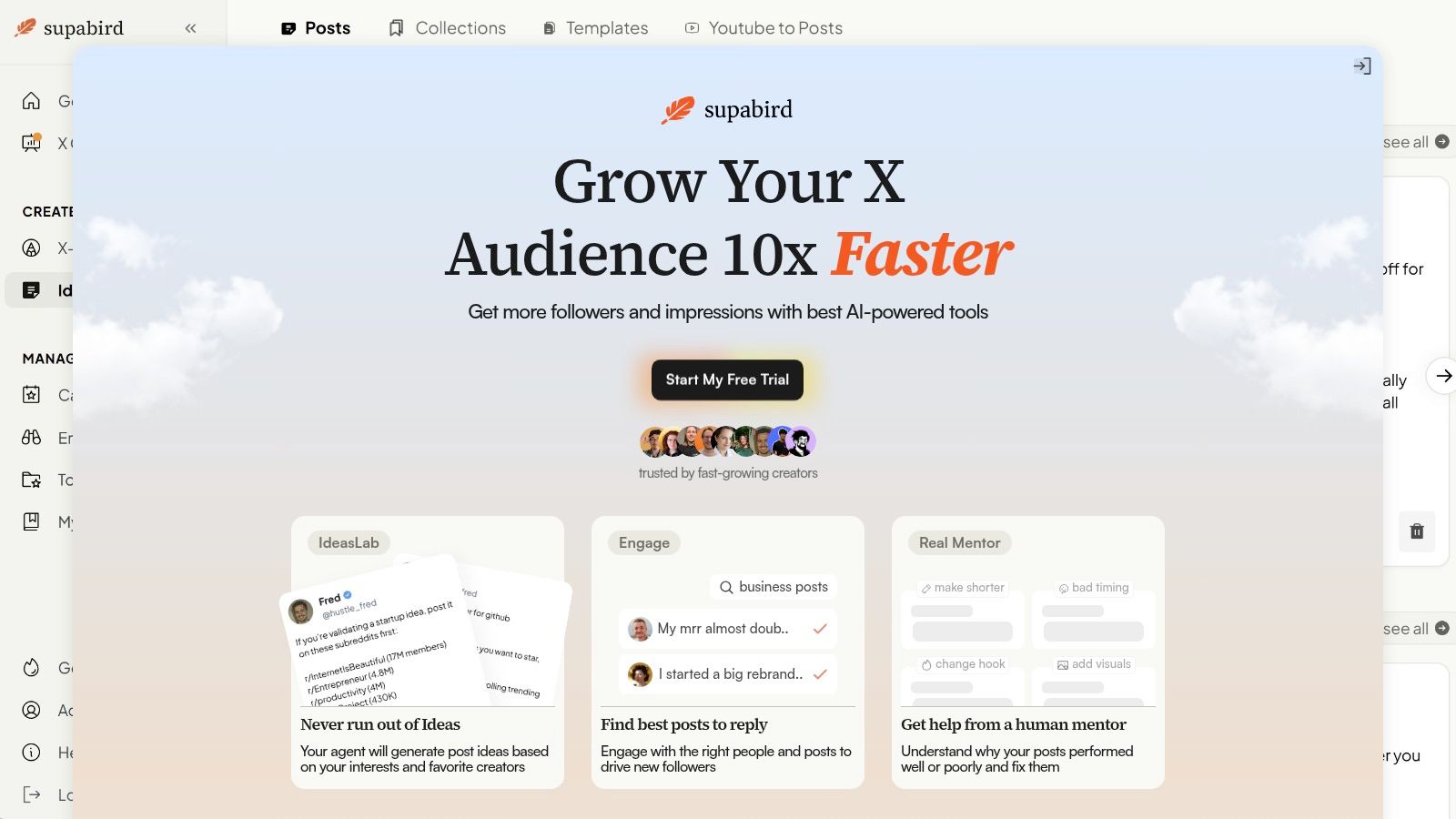
This is also where creators usually start looking at software seriously. Some use scheduling tools. Others use drafting tools. Others want idea generation and engagement support in one place. Anyone comparing platforms should also look at broader lists of top AI tools for content creation, because the right stack depends on whether the bottleneck is ideation, editing, design, or distribution.
The point isn't automation for its own sake. The point is removing friction from repeated tasks so the account can spend more time on angles, positioning, and conversation quality.
Build feedback loops into every workflow
Growth compounds when the account studies response patterns with discipline.
Three reviews matter most each week:
Hook review
Which first lines earned stops, replies, or profile clicks? Save those structures.Format review
Did the audience respond better to a short opinion, a process breakdown, a screenshot post, or a video clip?Audience-fit review
Which posts attracted the right people? Not just the most visible people. The right people.
Qualitative notes matter. “People argued with this post” is not enough. Better notes look like: “Founders replied because the post named a specific go-to-market mistake.” That kind of observation gives the account something reusable.
Smart workflows don't make content better by themselves. They make it easier to repeat what already proved useful.
A strong system also separates creation from evaluation. Draft when the mind is fresh. Schedule in batches. Engage live. Review later. Mixing all four in one sitting usually lowers quality across the board.
Your 30-60-90 Day Action Plan for X Growth
Most accounts fail because they ask for scale before they've earned consistency. A better approach is phased. Build the base first, sharpen signal next, then expand what already works.
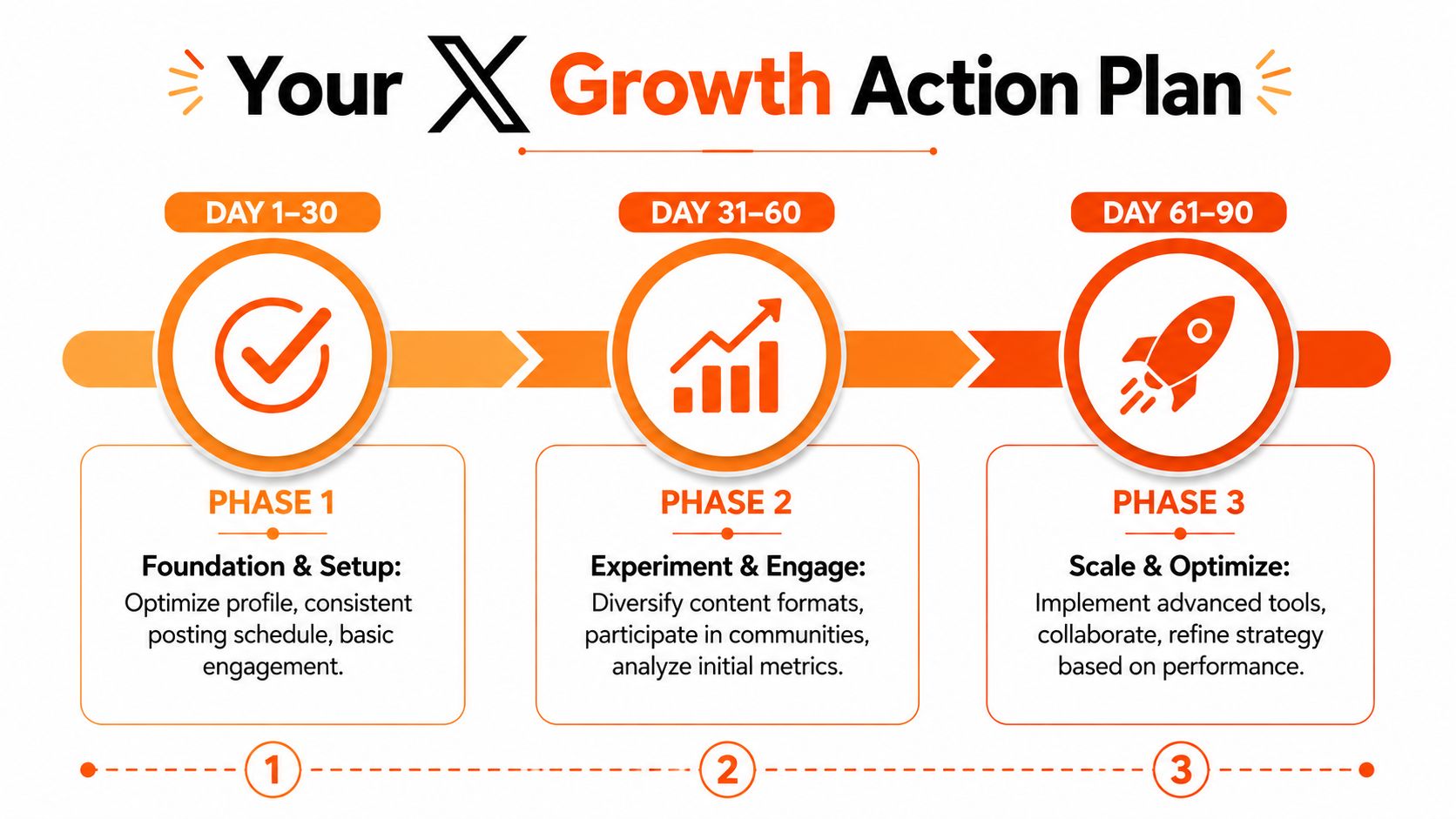
Days 1 to 30 build the base
The first month is about identity and repetition.
For a founder, that means clarifying the market, offer, and point of view. For a creator, it means picking a narrow topic and deciding which content formats fit naturally. For a marketer, it means defining whether the account is personal brand, company-adjacent thought leadership, or both.
Use a simple operating checklist:
Tighten the profile: photo, bio, header, and pinned post should all describe the same niche.
Create a starter content bank: prepare ideas for educational posts, discussion prompts, and behind-the-scenes content.
Commit to consistency: publish on a realistic schedule that can be maintained.
Begin strategic replies: spend time in niche conversations daily rather than waiting for posts to discover the account.
The win condition for this phase is clarity. If someone lands on the profile, they should know what the account does.
Days 31 to 60 refine what gets response
This phase is not about doing more of everything. It's about doubling down on what resonates with the intended audience.
Look for patterns:
Which posts earned replies from the right people?
Which topics created profile visits?
Which formats felt sustainable to produce?
Which conversations led to useful network effects?
A founder might notice that shipping updates get weaker results than teardown-style lessons. A creator might find that short text posts start conversations, while videos bring better dwell time. A marketer might discover that contrarian opinions get attention but practical examples attract better followers.
At this stage, introduce a tighter review loop:
Persona | Keep doing | Cut back |
|---|---|---|
Founder | product lessons, customer pain observations, targeted replies | generic motivation, unrelated commentary |
Creator | repeatable series, visual posts, audience questions | scattered topics, trend chasing |
Marketer | campaign analysis, positioning insights, process examples | jargon-heavy theory, broad “growth” platitudes |
Days 61 to 90 scale what already works
By the third phase, the account should know three things: what it talks about, which formats fit, and where the best audience interaction happens.
Now the focus shifts to utilization.
Batch more intelligently: produce several versions of proven themes.
Expand distribution: use more quote tweets, communities, and collaborative interactions.
Increase production quality: better screenshots, cleaner visuals, stronger editing.
Protect the niche: say no to posts that earn attention from the wrong crowd.
This is also the right point to standardize recurring series. Examples:
weekly teardown
founder lesson recap
one tactical video each week
recurring audience Q&A
response posts built from common replies
A good 90-day outcome isn't just “more followers.” It's a profile with a visible identity, a backlog of proven content angles, and a routine that can keep producing without burnout. That's the essential answer to how to gain Twitter followers. Build an account that people recognize, trust, and want to return to.
SupaBird helps creators, founders, and marketers turn that process into a real operating system. Its idea generation, engagement discovery, draft rewriting, scheduling, and coaching workflows are built for people who want steady X growth without guessing what to post next. Explore SupaBird if the goal is to make follower growth more systematic and less chaotic.

The Reply Guy Strategy: A Growth Guide for X

Why New X Accounts Get Less Reach

ClimbX Review (2026): Features, Pricing, Pros and Cons

How Developer Startups Build a Brand on X Before Launch

30-Day Starting Plan for New X (Twitter) Accounts

How Often Should You Tweet for Maximum Growth?

What Should Your First 10 Tweets Be About?

How to Run X for Ten Clients: The Agency Workflow

How to write a bio that gets people to follow you
