8 Blank Tweet Template Ideas for X Growth
Author:

Stop Posting Into the Void
A blank tweet template isn't a growth strategy by itself. It becomes useful only when its structure matches the job your post must do, whether that's starting a conversation, earning attention, demonstrating proof, or opening a longer thread. X posts can contain up to 280 characters on standard accounts, and Latin letters, punctuation, and common symbols count as one character under X's official character-counting rules, so structure helps you make every line work.
This guide gives you eight plug-and-play blank tweet template formats. For each one, you'll get the template, a realistic example, variations for different audiences, a timing or CTA suggestion, and quick dos and don'ts. Replace every bracketed prompt with details your audience recognizes, such as a specific workflow, objection, result, mistake, or decision.
The formats include PAS, data-backed insights, contrarian takes, before-and-after stories, micro-lessons, questions, case-study narratives, and list-based systems. You can also use SupaBird as an optional workflow for generating ideas, finding relevant conversations, rewriting drafts, and scheduling posts consistently.
Table of Contents
1. The Problem Agitation Solution Framework
The PAS framework works when your audience already feels a problem but hasn't clearly connected it to a solution. It gives the post a simple progression: identify the friction, make the cost visible, then offer a practical next step.
Blank template
[Audience] struggles with [specific problem].
It leads to [consequence or frustration], especially when [context].
The fix is [solution]. Start by [first action]. [CTA or next step]
Keep the problem to one sentence. On a mobile feed, readers should understand the situation before they reach the second line. The agitation should clarify what the problem costs in time, attention, missed opportunities, or stress. Don't intensify the problem with invented figures. Use a concrete consequence you can defend.
Practical example
A SaaS founder might write:
Your team keeps hearing the same feature request.
Product ignores it, customers lose patience, and support repeats the conversation.
Build a feedback loop that tags requests, groups patterns, and gives product one clear weekly view.
Start with the last month of support tickets.
A consultant could adapt the same structure:
You're selling hours instead of outcomes.
Every new client adds delivery work, so your income stays tied to your calendar.
Package your method into a focused offer with a clear result.
Reply “package” if you want the outline.
The structure stays consistent, but the stakes change with the audience.
Timing and follow-up
Use PAS when you want to promote a service, explain a product, or establish authority around a recurring pain point. Make the CTA match the depth of the solution. Ask for a reply when you want to learn how people describe the problem, or link to a guide when the solution needs more context.
Review replies from your most engaged followers before publishing the next version. Their wording can help you replace abstract phrases with language your market uses. If the post attracts questions, turn those questions into a practical implementation thread within 48 hours, a timeframe also recommended for follow-up content in the guidance on blank tweet templates.
Include one clear action, not several competing requests. Don't blame the audience for the problem, overstate the pain, or present a vague solution such as “work smarter.”
2. The Data Backed Insight Drop
A data-backed insight earns attention by opening with evidence, then explaining why the evidence changes what readers should do. The number isn't the whole post. It creates the reason to reconsider a familiar assumption.
Blank template
[Specific data point] changes how [audience] should think about [topic].
The usual assumption is [common belief].
The more useful takeaway is [interpretation].
Do this next: [action]
Only use a statistic when you can verify it and cite it. For example, OpenTweet's template library says it offers 200+ free tweet templates derived from data from over 50,000 tweets. That supports a post about studying patterns at scale, but it doesn't prove that every template will work for every account.
Practical example
Threads of 5 to 9 tweets earn about 3× the engagement of single tweets in a neutral benchmark of X content formats.
The useful lesson isn't “make every post longer.”
Use a strong opening tweet when the idea needs context, then give each follow-up tweet one job.
Start with the smallest thread that can explain the point.
That claim comes from AutoTweet's X content-format statistics. The interpretation remains editorial. A thread can underperform if the hook is weak, the sequence wanders, or the topic doesn't fit the audience.
A marketing manager could use a sourced internal benchmark instead:
Our last content review showed that posts with a clear audience and one action were easier to reuse than broad announcements.
The implication: don't ask one post to educate, sell, and collect feedback at the same time.
Choose the primary job before writing the hook.
Make the insight useful
Link to a deeper analysis when the evidence needs explanation. This guide to growth metrics for serious creators can support a follow-up resource for readers who want a more systematic measurement process.
Save verified findings in a content bank and revisit them when planning related posts. Don't use precise-looking numbers without a source, combine unrelated studies into one conclusion, or treat correlation as proof of causation. A statistic should sharpen the reader's decision, not decorate the first line.
3. The Contrarian Take or Hot Take Frame
A contrarian post earns attention by challenging a familiar belief. It works best when the disagreement leads to a clear reason, an example, or a better operating principle. Provocation without reasoning creates noise, while a defensible opinion gives people something worth discussing.
Blank template
[Common belief] is the wrong goal for [audience or situation].
What matters more is [alternative principle], because [reason].
Try [specific behavior] instead.
A founder might write:
Viral reach is the wrong goal for an early product.
Useful conversations matter more, because they reveal objections, language, and buying intent.
Spend your next publishing session answering the questions your best prospects already ask.
A creator could take a different angle:
Consistency doesn't build an account by itself.
Consistency in what you're willing to say builds recognition.
Choose one point of view you can defend, then repeat it through different examples.
The opening should state the take plainly. Don't hide it behind a long setup or use an exaggerated claim you can't explain.
Turn disagreement into credibility
Follow the opinion with “because” reasoning. The explanation should make sense even to someone who disagrees. Avoid attacks on mainstream creators, competitors, or audience members. Your post should challenge an idea, not a person.
Practical rule: Publish a contrarian take only when you can explain the decision it changes.
Use this format when you have a genuine observation from your work. A consultant who has seen clients chase reach without building a qualified audience has a stronger foundation than someone manufacturing controversy for replies.
Answer thoughtful disagreement in the replies. A respectful response can show how you think, clarify edge cases, and reveal objections that deserve a future post. Test the idea with a smaller audience first if the claim affects your positioning or product direction.
Timing and restraint
Hot takes lose force when they appear constantly. Use them when you have a distinct point to make, then give the conversation room to develop. Ask a follow-up question only if you want the answer. “What experience changed your mind about this?” is more useful than a generic request to agree.
Don't publish a contrarian format just because it has performed for another account. Your audience may reward a different kind of tension, such as a tradeoff, a workflow mistake, or an overlooked customer need.
4. The Before After Transformation Story
Before-and-after posts show change through contrast. They help readers understand not only what improved, but what process produced the improvement. The strongest versions include a truthful starting point, a clear timeline, and the method that connected the two states.
Blank template
Before: [starting condition].
Changed: [specific method, decision, or tool].
After: [measurable or observable result] in [honest timeframe].
The lesson: [principle]. [CTA]
A founder could write:
Before: launch posts described features but didn't explain the customer problem.
Changed: every draft started with one painful use case and one clear outcome.
After: prospects understood the product faster during launch conversations.
The lesson: frame the problem before listing the solution.
Here's the thread explaining the process.
If you have genuine account data, show it transparently. A visual card can help readers compare the two states, but the image should support the explanation rather than replace it. SupaBird's reusable X post template resource is relevant when you want to turn a short before-and-after concept into a tweet-style visual or text draft.
Keep proof honest
Specific results can make a transformation credible, but never invent metrics, timelines, or customer outcomes. State whether the result came from your own account, a client, an experiment, or an internal process. If client confidentiality matters, remove identifying details while keeping the method and context accurate.
You can adapt the frame for a consultant:
Before: every project started from a blank proposal.
Changed: built a repeatable discovery process and offer structure.
After: proposals became easier to compare and explain.
The lesson: standardize the decision process before adding more services.
Follow-up sequence
Add a CTA that fits the reader's next need. “Here's how” works for a thread, “reply with your bottleneck” supports research, and a case-study link suits readers who want detail. Follow up with the exact steps while the original post is still generating questions, rather than leaving the transformation unexplained.
Use a screenshot, chart, or side-by-side visual only when it proves a meaningful difference. Don't present a polished outcome without showing the decision or method that produced it. Readers want a path they can adapt, not a result they can't reproduce.
5. The Micro Lesson or Quick Actionable Tip
A micro-lesson gives the reader one action they can apply quickly. Its value comes from specificity. “Improve your hooks” is a topic, not a lesson. “Replace the first sentence with the reader's concrete problem” is a usable instruction.
Blank template
[Action verb] [specific part of the workflow].
Do it because [brief mechanism or reason].
Example: [short illustration].
Save this for [specific situation].
A creator might write:
Read the author's recent posts before writing a reply.
You'll avoid repeating points they've already made and can add something that fits the conversation.
Example: reference one idea, extend it with your experience, then ask a focused question.
A copywriter could use:
Replace “We help companies grow” with “We help [audience] solve [specific problem] so they can [desired outcome].”
Specific language makes the reader decide whether the offer fits.
Write for one person before you try to appeal to everyone.
For a larger bank of prompts, use SupaBird's guide to finding content ideas, then turn each idea into one action rather than a broad lesson.
Make the action testable
Lead with a verb such as “replace,” “review,” “remove,” “compare,” or “write.” Explain why the action matters in one sentence. If you can't test the advice yourself, rewrite it as an observation instead of presenting it as a rule.
Batch related lessons around one audience problem. For example, a solopreneur could publish separate posts about choosing a niche, writing an offer, answering objections, and following up with leads. Each post remains useful alone, while the group builds a recognizable point of view.
The best micro-lesson leaves the reader with a next move, not a motivational slogan.
Pin a particularly clear lesson when it represents the expertise you want profile visitors to associate with you. Don't pack several tips into one post. A list belongs in the eighth format, while a micro-lesson should feel focused and easy to remember.
6. The Question Based Engagement Hook
A question-based blank tweet template starts a conversation by giving people a real decision to consider. Questions work better when they describe a situation and expose a tradeoff. Readers can answer from experience instead of guessing what the post means.
Blank template
You're facing [specific scenario].
Would you choose:
A) [option one]
B) [option two]
Why? What would you change after [relevant experience]?
A product founder might write:
Your product has a working version, but early users keep requesting changes.
Would you choose:
A) Pause promotion and improve the product
B) Keep selling while you prioritize the strongest feedback
What would guide your decision?
A marketer could ask:
Your strongest customers came through a mix of content, email, and referrals.
Which channel would you invest in first if you had to simplify the system, and what evidence would you use?
These questions create useful market research because the replies reveal priorities, language, objections, and decision criteria. SupaBird's guide to writing hooks can help you develop a sharper opening before you ask for the audience's view.
Manage the conversation
Ask something you want to know. Avoid yes-or-no prompts and vague questions such as “What do you think?” Give enough context for a thoughtful answer, but don't turn the post into a survey form.
Reply to substantive comments early and build on what people share. You can ask a clarifying question, summarize a pattern, or explain where your own view differs. Later, turn recurring answers into a synthesis post that credits the community without exposing private information.
Use this format when conversation is the objective, not as a disguised sales pitch. If you're researching a product idea, ask about the problem and current workaround before asking whether people want your proposed feature. Don't lead respondents toward the answer you hope to receive.
7. The Case Study Narrative or Mini Documentary
A mini documentary gives a post a beginning, a decision point, and an outcome. It feels more credible than a generic lesson because readers can follow the circumstances that made the decision necessary.
Blank template
[Person or team] started with [specific situation].
They tried [initial approach], but [obstacle].
The turning point came when they [decision].
The result was [verified outcome].
The principle: [transferable lesson]. [CTA]
A SaaS team might write:
A small software team kept adding features while prospects struggled to explain the product.
They stopped expanding the roadmap and interviewed users about the first problem they needed solved.
The turning point was rewriting the homepage around that problem.
The lesson: clearer positioning can come before more functionality.
I detail the interview framework in the thread.
A creator story can focus on behavior rather than a dramatic metric:
A founder published regularly but rarely replied to other people.
Their posts announced ideas without joining the conversations around them.
They began writing thoughtful responses to relevant discussions and used those replies to refine future posts.
The lesson: publishing and participating solve different parts of audience growth.
For more ways to shape this kind of narrative, see SupaBird's case study examples.
Place a visual near the opening if it clarifies the sequence. A problem-to-solution graphic can help readers scan the story before reading the details.
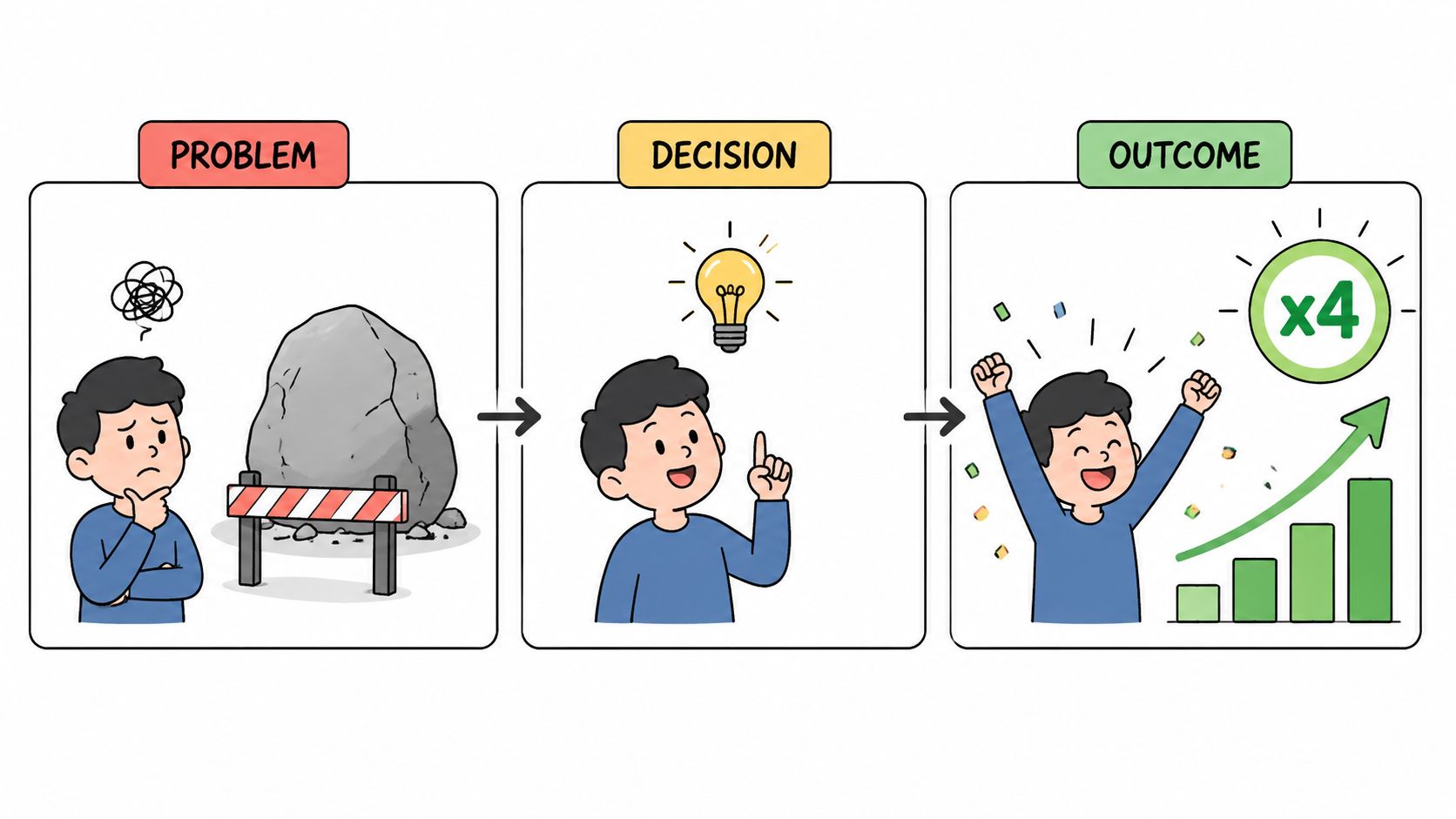
Add the decision logic
The turning point matters more than a polished outcome. Explain what the person noticed, what they stopped doing, and why the new approach fit the situation. An anonymized story can still feel specific if you preserve the role, constraint, timeline, and decision.
Expand a strong narrative into a thread with one idea per post. A practical thread structure uses a hook, credibility or context, body tweets, a recap, and one CTA, with the X thread guide from WordCounterTool recommending 5 to 12 tweets for many threads. Don't add a second CTA halfway through. Let the story earn the action at the end.
Here is a visual companion for teams that want to explain the process in motion:
8. The List Based Framework or System Breakdown
A list-based post turns a process into a sequence readers can scan and reuse. It works for workflows, decision systems, tool stacks, troubleshooting guides, and educational threads. The list should solve one problem, not become a collection of unrelated tips.
Blank template
[Benefit or problem] in [number] steps:
[step one]
[step two]
[step three]
[step four]
Start with [first action]. [CTA]
A creator could write:
A repeatable X post has four parts:
Hook, give readers a reason to stop
Insight, explain what they should understand
Proof, show why the point is credible
Action, tell them what to do next
Start by rewriting the first line of your next draft.
A solo founder might adapt it into a workflow:
A simple weekly content system:
Capture customer questions
Group them by recurring problem
Draft one lesson per problem
Add proof from your work
Schedule and review the replies
Keep the system small enough to maintain.
Make every item independent
Use consistent formatting so readers can understand each point while scanning. Numbers are useful when sequence matters. Keep each item concrete, and give it a verb or decision rather than a label alone.
SupaBird can fit into this type of system as an optional workflow. Its Ideas Lab supports idea generation, X-GPT helps rewrite drafts, the Engage module surfaces conversations to join, and its calendar supports scheduling. X Coach combines daily AI feedback with access to a human mentor, which can help a creator examine why a post worked or fell short.
Expand a strong list into a thread when each point deserves an example. Review which posts earn meaningful replies, saves, or profile interest before promoting the structure again. Don't promise a performance lift without account-specific evidence, and don't add tools just to make the list longer.
8 Tweet Template Frameworks Comparison
Template | Implementation complexity | Resource requirements | Expected outcomes | Ideal use cases | Key advantages |
|---|---|---|---|---|---|
The Problem-Agitation-Solution (PAS) Framework | Medium, needs accurate audience insight and emotional framing | Low–Medium, audience research, concise copywriting | High engagement; increased authority and conversions | Founders, consultants, indie hackers establishing thought leadership | Strong emotional hook; positions you as a solver; thread-friendly |
The Data-Backed Insight Drop | Medium–High, requires sourcing and verifying data | Medium–High, access to credible data, citations, analysis time | Very high engagement among professionals; credibility boost | Marketing managers, SaaS builders, data-driven creators | Authority via statistics; counterintuitive attention; highly shareable |
The Contrarian Take / Hot Take Frame | Medium, needs clear, well-reasoned stance and careful tone | Low, writing skill and active reply moderation | Extremely high engagement; debate and viral potential | Thought leaders, founders, personal brands seeking distinct positioning | Breaks patterns; memorable positioning; sparks discussion |
The Before-After Transformation Story | Medium, requires authentic metrics and transparent timeline | Medium, verifiable results, visuals, possible case permissions | High engagement; strong social proof; drives DMs and conversions | Coaches, consultants, SaaS founders showcasing measurable results | Concrete proof; relatable aspiration; builds trust and credibility |
The Micro-Lesson / Quick Actionable Tip | Low, one focused, tested idea per post | Low, subject expertise and minimal prep/testing | High utility engagement; saves, retweets, follower loyalty | Educators, coaches, technical experts, creators | Immediately usable; easy to batch; builds goodwill |
The Question-Based Engagement Hook | Low–Medium, craft a compelling scenario and clear question | Low, minimal prep but requires active reply handling | Very high reply rate; actionable audience insights | Community builders, product managers, market researchers | Drives conversation; collects feedback; generates UGC |
The Case Study Narrative / Mini Documentary | High, detailed storytelling, data, and narrative skill required | High, research, drafting time, visuals, client consent/anonymization | High engagement; deep credibility; strong thread potential | Coaches, consultants, SaaS founders, service providers proving methodology | Emotional retention; demonstrates process; reusable evergreen content |
The List-Based Framework / System Breakdown | Medium, design coherent, original steps with context | Low–Medium, subject knowledge, examples, formatting | Extremely high engagement; highly shareable and savable | Teachers, operators, creators systematizing knowledge | Scannable and referenceable; establishes structure; easy to repurpose |
Turn Templates Into a Repeatable X System
Start with the job your next post must do. If you want replies, choose the question-based hook. If you need to explain a customer pain, use PAS. If you have verified evidence, build a data-backed insight. If your strongest material is a process, use the list-based framework. The right blank tweet template reduces drafting friction because it gives the post a shape before you choose the wording.
Customize the hook first. Replace broad prompts with the audience's actual situation, such as a launch decision, support problem, content bottleneck, or service-delivery constraint. Then add one piece of proof. That proof might be a verified observation, a transparent process, a customer quote you have permission to use, or a specific example from your own work. Don't add a second claim just to make the post sound more authoritative.
Choose one CTA. Ask for a reply when conversation or research matters. Invite readers to a thread when the idea needs context. Link to a resource when the reader needs implementation detail. A single action keeps the post easier to follow and makes your response data easier to interpret.
Review what happens after publishing. Look at the quality of replies, the questions people ask, the saves, and the profile actions that matter to your objective. A post with broad attention but no relevant conversation may not deserve another version. A quieter post that attracts the right prospects may be worth developing further. Use your own results instead of assuming a generic template transfers across accounts.
Rotate formats rather than posting the same structure every day. A founder might alternate a product lesson, a customer story, a question, and a thread opener. A consultant could combine PAS for demand creation with micro-lessons for trust and case studies for proof. Repetition should reinforce your point of view, not make every post sound identical.
When you need a more consistent creation and feedback workflow, SupaBird's Ideas Lab, X-GPT, Engage module, calendar, and X Coach can support different stages of the process. Use the tools to generate options, find relevant conversations, refine drafts, schedule consistently, and review what you can improve. You can also design templates with ChurchSocial.ai if you need a separate visual planning workflow for branded content.
The system becomes valuable when you keep learning from execution. Save the formats that fit your audience, rewrite them in your own voice, and retire the ones that repeatedly miss the intended job. Templates should give you a starting structure, not replace judgment, specificity, or genuine participation.
SupaBird helps you turn blank tweet templates into a practical X workflow with idea generation, draft rewriting, conversation discovery, scheduling, and feedback tools. Visit SupaBird to explore the platform and build a publishing system you can use consistently.

The Reply Guy Strategy: A Growth Guide for X

Why New X Accounts Get Less Reach

ClimbX Review (2026): Features, Pricing, Pros and Cons

How Developer Startups Build a Brand on X Before Launch

30-Day Starting Plan for New X (Twitter) Accounts

How Often Should You Tweet for Maximum Growth?

What Should Your First 10 Tweets Be About?

How to Run X for Ten Clients: The Agency Workflow

How to write a bio that gets people to follow you
