You're staring at a half-finished draft, the cursor is blinking, and the year has already started to blur into a pile of screenshots, wins, lessons, and “I should post about that later” notes. That's the exact moment when a year in review stops being a sentimental recap and becomes a publishing asset. Done well, it turns twelve months of scattered proof into a thread people save, reply to, and follow from.
The reason this format matters is simple, annual summaries compress a lot of change into something people can judge. Major institutions use year-end recaps to make a year legible, and that's part of why the genre works so well for creators too. A strong year in review thread gives your audience context, evidence, and a reason to trust what you're building next.
Table of Contents
The December 28 Blank Page Problem
The blank composer on December 28 has a specific kind of pressure. You know the year mattered, but the raw material is messy, half of it lives in screenshots, and the rest is trapped in memory. That's why most year in review threads feel vague, they're written from reflection alone instead of being assembled from records.
A better approach starts with a simple shift. Treat the thread like a publishing system, not a recap. That means you're not trying to remember everything, you're choosing the few moments that prove progress, explain setbacks, and show what changed. A useful first pass is to collect proof before you try to write a single polished line.

Practical rule: if you can't point to the source material, the line probably doesn't belong in the thread.
The strongest threads look inevitable because the writer did the unglamorous work first. That's the same logic behind annual reporting in public institutions, where the recap turns a year of releases into a single narrative of change, and where annual benchmarks help people compare one period to another using a consistent frame U.S. Census Bureau year-in-review story. For a creator, that same structure means collecting evidence now so the final thread feels precise later.
If you're stuck on what to write, use a source list instead of a mood board. Pull the posts that performed well, the work that shipped, the messages that mattered, and the receipts that make each point real. If you need help generating raw angles before you sort them, this guide on how to find content ideas pairs well with the audit phase.
Gather the Raw Material Before You Write
Start with a working folder, not a draft. One folder for screenshots, one for links, one for metrics, and one for personal milestones is enough to keep the material separated until you know what earns a place in the thread. A year in review becomes less emotional and more editorial.
What to pull into the folder
Think in categories, then collect one anchor for each:
Revenue or business results: save the dashboard screenshot, invoice summary, or monthly report that proves the moment.
Audience growth or distribution: capture the post analytics, profile view trends, or follower milestones that show reach, not just activity.
Products shipped: screenshot the launch page, changelog, or before-and-after version.
Lessons learned: save the note, doc, or post draft where the insight first showed up.
Failures or misses: keep one clear example so the thread doesn't read like a victory lap.
Human moments: gather client messages, collaborator notes, or personal milestones that add texture.
Useful filter: if a memory doesn't change the reader's view of your year, it probably stays out.
The key is to classify each item against original success criteria, then label it as achieved, partially achieved, or not achieved using evidence from records rather than memory alone annual project review guidance. That same framework keeps you honest when the year was uneven. It also stops you from merging “felt busy” with “moved the business.”
The quickest prep ritual
Spend about 90 minutes on three passes. First, collect everything without judging it. Second, delete anything you can't support with a source or screenshot. Third, choose one metric per category so the final thread doesn't drown in detail. That last step matters because a thread can't hold every story, it needs a few strong ones that map cleanly to the year.
If you're writing for a client, a company, or a product that touches other people's data, get permission before posting anything sensitive. Keep private numbers private, and use broad, qualitative language when the proof belongs to someone else.
Hook Formulas That Earn the First Scroll
The opener does most of the work. If tweet one feels generic, the reader assumes the whole thread will be generic too. That's why the best year in review hooks don't say “what a year,” they make a sharp promise or reveal a tension.
If you want a tighter hook-writing system, pair this with how to write hooks and rewrite your first line until it carries one clear idea. A strong opener usually does one of five things.
Five hooks that actually pull attention
Contrarian number: lead with the result everyone would not expect.
Unflattering truth: name the friction instead of hiding it.
Receipts-led confession: open with proof, then explain what it means.
Future-self mirror: write the line you wish you had read at the start of the year.
Mistake pivot: say what you got wrong and what changed because of it.
The reason these work is that they create a reason to continue. They don't summarize the year, they create a gap between what the reader expects and what you're about to show. That gap is the scroll-stopper.
Practical rule: one bold claim per hook, no hashtags in the opener, and keep the first tweet short enough that the eye lands fast.
Here's the move I see most creators get wrong. They write, “Here's my year in review thread.” That's an announcement, not a hook. A better version is, “I shipped more this year after deleting most of my old workflow.” The second line gives the reader a tension, a result, and a reason to care.
If you're optimizing for engagement velocity, a tool like grow your audience with Auralume AI can be useful because it pushes you to test stronger opening patterns instead of guessing. The larger point is simple, the hook should make the reader feel that the next tweet will explain something worth knowing.
A Reusable Thread Blueprint From Tweet 1 to Tweet 12
Most creators improvise the middle and then wonder why the thread feels flat. A better year in review thread alternates proof and reflection, so the reader never gets buried in a wall of wins. The sequence below gives the thread a rhythm that feels deliberate.
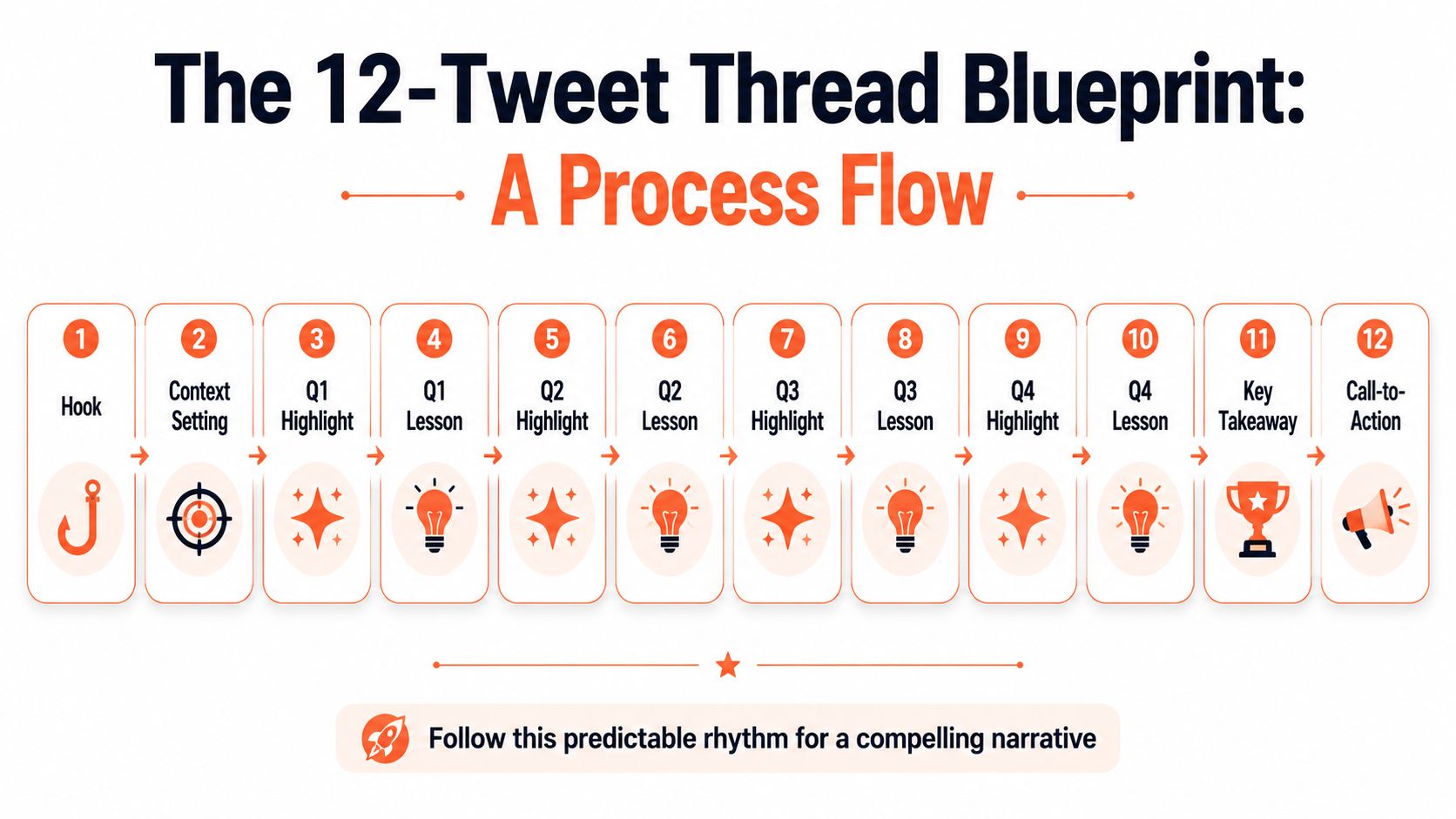
A simple 12-tweet structure looks like this:
Slot | Purpose | What it should do |
|---|---|---|
1 | Hook | Create curiosity or tension |
2 | Context | Set the year, the goal, or the baseline |
3 | Proof | Show one concrete win |
4 | Lesson | Explain what that win taught you |
5 | Proof | Add a second win or milestone |
6 | Lesson | Tie that result to a change in process |
7 | Proof | Show a third signal of progress |
8 | Vulnerability | Name a miss or a rough patch |
9 | Numbers | Add one clear metric or dashboard shot |
10 | Insight | Translate the numbers into meaning |
11 | What's next | Point to the next season |
12 | CTA | Invite a reply, follow, or conversation |
A founder's version might put the product launch, customer proof, and operating lesson in the middle. A creator-coach's version might swap in client outcomes, content experiments, and a belief change. The skeleton stays the same, the evidence changes.
If you want a template to fill in fast, use this:
Tweet 1: [hook]
Tweet 2: This year started with [baseline].
Tweet 3: I shipped [proof point].
Tweet 4: That taught me [lesson].
Tweet 5: I also [second proof point].
Tweet 6: The process change was [specific shift].
Tweet 7: I almost missed [third proof point].
Tweet 8: The hardest part was [vulnerability].
Tweet 9: The numbers showed [metric].
Tweet 10: That meant [interpretation].
Tweet 11: Next year, I'm focused on [direction].
Tweet 12: What changed most for you this year?
If you want more layout ideas, the best Twitter post templates in 2026 are useful because they make structure visible instead of mysterious. The point isn't to sound formulaic, it's to make the story easy to follow.
Visuals and Data That Earn Saves and Reposts
Text alone blends into the feed. A thread gets more durable when one or two tweets carry a visual that makes the result feel concrete, especially when the image does not require extra explanation. The best year in review visuals are usually simple, cropped tightly, and readable on a phone.
Use the visual type that matches the claim. A revenue or milestone tweet works best with a clean screenshot or a single-number graphic. A process or lesson tweet can use a photo, a whiteboard shot, or a document crop. A recap tweet does better with a small collage than with a busy slide deck. The reader should understand the point before they zoom.
What to post and what to avoid
Sparkline-style chart: good for movement over time, weak if labels are too small.
Before-and-after screenshots: strong for proof, weak if you include too many tabs or UI distractions.
Four-panel mosaic: useful for personal or product recaps, but only if each panel earns its place.
One number, one image: the cleanest format when you want the tweet to be quotable or repostable.
Crop aggressively. Remove browser bars, irrelevant headers, and side clutter. Place the caption where the eye lands first, not buried under tiny text. If you're showing a client or company number, confirm that you're allowed to share it, and blur anything that identifies a private account or third-party detail.
Annual reports work for a reason, they combine scale and movement into something the audience can process quickly. The U.S. yearly recap format makes that clear by putting growth, inflation, population, and wealth distribution into one readable frame 2023 America in Facts annual report. For a creator, that means one good screenshot often beats five weak ones.
If an image doesn't add evidence, leave it out. A polished thread with fewer visuals usually beats a cluttered thread with more.
Timing, Scheduling, and City-Level Posting Windows
Posting time is not trivia. It determines whether the thread starts with real readers or spends its first hours collecting silence. If you're writing a year in review, you want the launch window to match the audience's work rhythm, not your own calendar anxiety.
For a hybrid audience split between Berlin and New York, a morning launch in the overlap window usually gives the post a chance to catch both workdays. For an audience centered in Mumbai, the publication time should map to the local morning routine instead of a U.S. afternoon guess. A city-aware calendar matters because the first hour often sets the tone for replies and reposts.
Audience | Launch Window | Primary City | Day-2 Follow-Up |
|---|---|---|---|
B2B founders | Monday morning | New York | Quote-tweet with one lesson |
Personal essay creators | Saturday morning | London or New York | Reply with a reflective add-on |
Nostalgia-first recaps | December 30 or 31 | Local audience city | Repost with a fresh caption |
South Asia-led audiences | Morning local time | Mumbai | Pin a reply with a question |
For time-zone logic and scheduling habits, the best time of day to post on X in 2026 guide is useful because it pushes you to think by audience, not superstition. That matters more than chasing a magical hour.
What to do after launch
Pin the thread. Reply to substantive comments in the first 12 hours. Use one mid-thread reply to add a small clarification or a poll that restarts attention. Then quote-tweet the thread the next day with a one-line note about what you'd tell your past self.
A useful reply pattern sounds like this, “What changed most for me was [specific shift]. What changed for you?” That keeps the conversation open without sounding automated. A weaker version is “thanks for sharing,” which ends the exchange immediately.
Ignore hostile comments that add nothing. Engage polite skeptics, because they usually give you a better follow-up prompt than the original post.
The point of the launch window is not just reach. It's momentum. A good opening day gives the thread enough activity to keep circulating when the audience wakes up again, checks notifications, or sees your repost on the next day.
Metrics That Tell You Whether It Worked
A thread is a campaign, not a mood. If you don't decide what success means before you publish, you'll end up judging it by vanity signals alone. That's a bad fit for a year in review, because value often shows up in replies, profile visits, and follow-on conversations.
The same measurement problem shows up in review research. Success rates change when the definition changes, which is why you need to define the threshold up front instead of after the fact success-rate lens in review domains. That lesson translates directly to creator work, vague criteria make every result look better than it is.
What to track
Profile visits from non-followers: this shows whether the thread created curiosity.
Follows attributed to the thread: this is closer to audience growth than likes.
DM replies from prospects: useful for founders, consultants, and service creators.
Inbound leads in the days after launch: the thread did business if people reached out.
Reply quality and sentiment: strong replies tell you the message landed with the right people.
If you want a plain-English breakdown of what those signals mean, what engagement metrics actually mean is a helpful companion because it keeps the focus on behavior, not scoreboard theater. A high like count can feel good. It doesn't always mean the thread moved the right people.
Set your threshold before you post. A hit might mean the thread generated the best replies of the quarter, or brought in a meaningful number of profile visits from people you want to hear from. If you work from a prewritten threshold, you'll review the post instead of grading it generously because it took effort.
Your planning checklist should stay short: gather, hook, blueprint, visuals, timing, engage, measure. That's enough to turn the next year in review into a repeatable asset instead of a one-time burst of effort.
If you want a tighter system for planning, writing, and timing your next year in review thread, SupaBird brings the parts together in one workflow, from idea generation to hook rewrites and city-aware scheduling. Visit SupaBird if you want a faster way to ship the next thread with less guessing and more repeatable growth.

How Often Should You Tweet for Maximum Growth?

What Should Your First 10 Tweets Be About?

How to Run X for Ten Clients: The Agency Workflow

How to write a bio that gets people to follow you

Digital Product Launch Strategy

Best Twitter Growth Service for Creators in 2026
From X to Every Platform: Repurpose Without Flopping

How to Get Cited by Grok: Winning X’s AI Search in 2026

5 X (Twitter) Growth Metrics Every Serious Creator Should Track — and How to Get the Data