Twitter Call to Action That Converts in 2026
Author:

A Twitter call to action can change click behavior, but the effect depends on the action you request and where users see it. Twitter's analysis of more than 20,000 Promoted Tweets found that explicit download requests increased URL clicks by 13% in timelines and 11% in search over a three-month test period (platform-level CTA findings). The lesson isn't “add a verb.” It's match one clear CTA to one measurable business objective.
Publishing “Check this out,” “Thoughts?” or “RT if useful” without deciding whether you want traffic, conversation, distribution, followers, or signups creates activity, but not necessarily progress. The framework below treats every CTA as a contract with the reader: the post promises a specific value, and the reader understands exactly what to do next.
Table of Contents
Why Most Twitter Call to Action Advice Misses the Point
Generic CTA advice treats conversion as a copywriting problem. In practice, it is a measurement and objective-matching problem. A persuasive phrase can still fail when it requests the wrong behavior, appears before the value is clear, or is judged against the wrong KPI.
A CTA must share limited space with the hook, proof, context, and link. A post that explains the offer, asks for a follow, requests a repost, and adds a click instruction gives each action less attention. Readers should understand the payoff quickly while the timeline is moving.

The three failures behind vague CTAs
The objective is unclear. “Thoughts?” may generate replies, but it does not reliably produce clicks or signups. “Read the teardown” gives the reader a different job.
The message asks for too much. Asking readers to follow, click, repost, and reply in one post splits attention. Independent social-post research summarized in the LSU thesis on CTA performance found that multiple CTAs reduce engagement.
The KPI does not match the request. Judge a reply CTA by replies or qualified follow-up conversations, not impressions alone.
CTA performance also changes with placement. The same request can behave differently in the timeline and in search, as reported in this Twitter CTA analysis. Track the requested action by placement instead of celebrating aggregate engagement.
A post can earn 500 likes and still produce zero clicks if its closing line asks readers to reply rather than visit the offer. The engagement is real, but it signals the wrong outcome for a traffic campaign.
Scheduling tools such as top Hootsuite alternatives make repeatable A/B testing easier by letting teams queue variants and tag them for attribution. The software matters less than the operating discipline: name one objective, write one request, and measure the matching action.
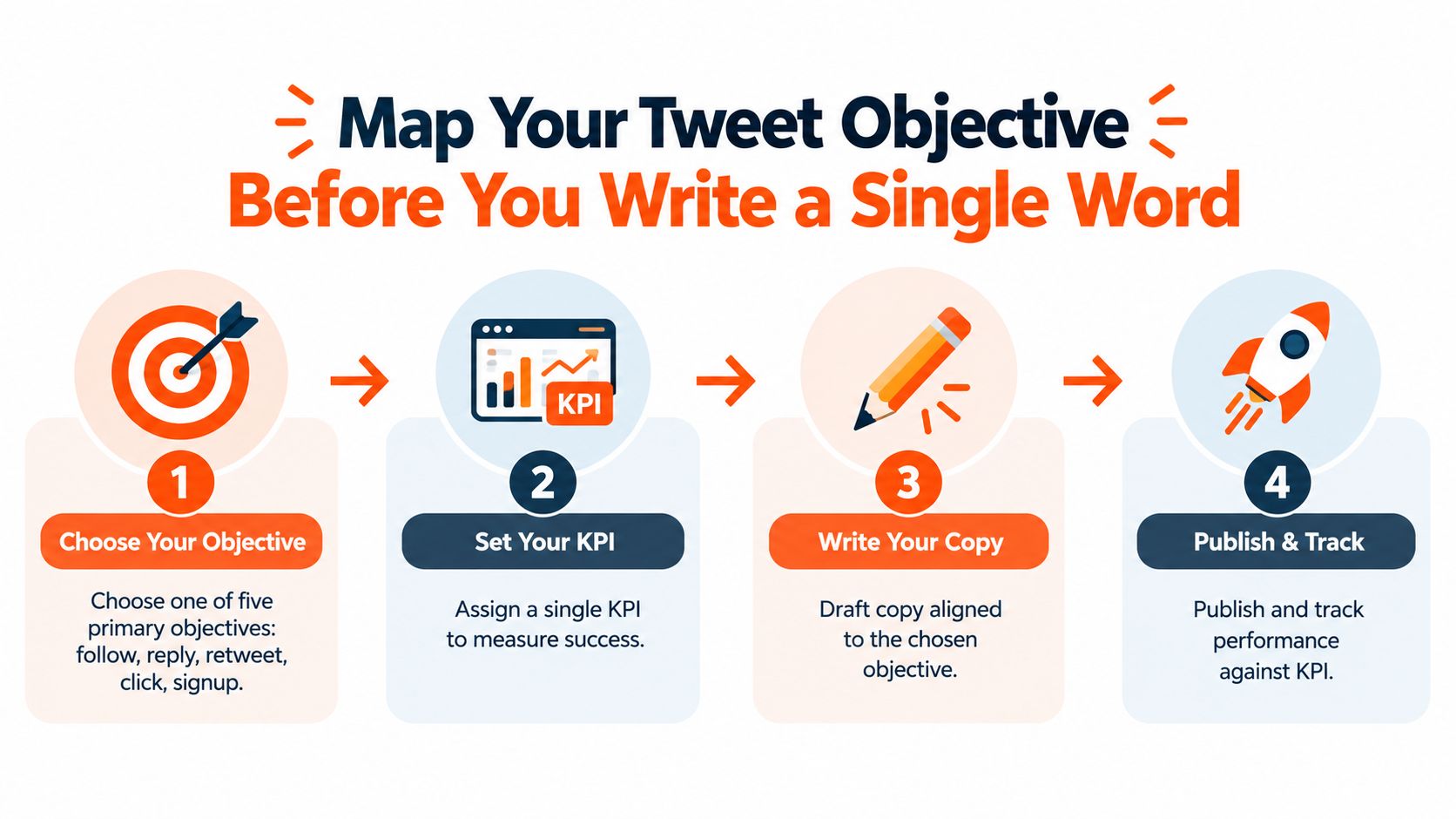
Map Your Tweet Objective Before You Write a Single Word
Start with a blank document and answer four questions. This takes less time than rewriting a tweet that tried to do five jobs at once.
1. Choose one primary objective
Use one of five objectives:
Follow, to grow the relevant audience.
Reply, to start a conversation or collect insight.
Retweet, to expand distribution.
Click, to send qualified traffic.
Signup, to create a conversion.
Don't combine “click and follow” in the same CTA unless one is clearly secondary. If both matter, publish separate versions or use a thread where each post has a distinct role.
2. Assign one KPI
The KPI should be numeric, even if the benchmark is your own baseline. A click-focused post might target a CTR above 1.2%, while a founder could set a reply-rate target above 0.5%. Those example thresholds belong in your operating model, not in a claim about universal performance.
Independent 2026 benchmark data reports a 1.1% median organic Twitter/X CTR, with a 0.4% low range and 2.8% high range (social-media CTR benchmark). The range is a useful reminder that context matters. Your target should reflect audience, offer, placement, and historical performance.
3. Identify audience temperature
Cold readers need a reason to trust the offer. Use proof, a clear benefit, or a useful observation before asking them to act. Warm readers who already engage with your threads can tolerate a more direct request, such as “Join the beta.”
4. Select placement
Put the CTA near the end when the reader needs context. Put it early when speed matters, such as a direct reply prompt or a timely alert. A standalone post can introduce the ask quickly, while a thread can reserve the strongest conversion request for its conclusion.
A B2B founder launching a product might map the tweet as follows:
Objective: Click
KPI: 1.5% CTR
Audience: Warm, based on prior thread participation
Placement: Final line, after the product benefit
The content-idea process can also start with a structured source such as this guide to finding content ideas, but the CTA decision still comes first.
If you can't state the KPI in one number, the tweet isn't ready.
Copy Formulas and Examples for Every Primary CTA
A useful formula reduces decision fatigue, but it shouldn't make every post sound identical. The structure below connects the requested action to a reason for taking it.
Follow CTAs
Formula: Value plus action.
“Follow for weekly teardown of creator-economy launches” works because it tells the reader what future value they'll receive. “Follow me” gives them no reason to return.
Examples:
“Follow for practical SaaS launch experiments.”
“Follow for daily landing-page teardown notes.”
Specificity beats status language. A reader follows a clear content promise, not an empty request.
Reply CTAs
Formula: Incomplete thought plus a constrained response.
Give the audience a position they can challenge or complete:
“Hot take: long threads outperform. Defend or disagree in one line.”
“Most onboarding emails explain too much. What would you remove first?”
The constraint matters. “What do you think?” creates unnecessary work. “Defend or disagree in one line” tells the reader how to participate.
Retweet CTAs
Formula: Social proof or personal relevance plus a low-friction ask.
“If this saved you a meeting, repost for the teammate who needs it.”
“Know a founder stuck on pricing? Repost this checklist to them.”
A large study of 5,148 tweets across 22 accounts found that tweets with “retweet” CTAs captured 72.5% of all retweets, while the fully written “Please Retweet” accounted for 43.3% (retweet CTA study). The result challenges the assumption that the shortest possible wording always wins. Clarity can outperform abbreviation when redistribution is the objective.
Click CTAs
Formula: Payoff in seven words or fewer plus one clear destination.
“Download the free launch checklist.”
“Read the pricing teardown before your next call.”
Concrete verbs perform better than vague prompts. Twitter's platform analysis found that explicit download language increased URL clicks by 13% in timelines and 11% in search (download CTA findings).
Place the link where your audience can act without confusion. If your team uses a reply link, test it against an in-post link rather than assuming one distribution rule applies to every account. Use one destination and explain the benefit before the click.
Signup CTAs
Formula: Action plus objection handling.
“Join the beta. Free, no card, 90-second setup.”
“Get the template. No call required.”
The line should answer the hesitation that blocks conversion. “Sign up now” is direct but incomplete. Removing uncertainty makes the requested action easier to evaluate.
Objective | Formula | Trigger Words | Example Line |
|---|---|---|---|
Follow | Value plus action | Follow, get, learn | Follow for weekly launch teardowns |
Reply | Incomplete thought plus prompt | Reply, defend, disagree | Defend this take in one line |
Retweet | Relevance plus redistribution | Repost, share, pass on | Repost for the teammate who needs it |
Click | Payoff plus destination | Read, download, see | Download the free launch checklist |
Signup | Action plus objection handling | Join, start, book | Join free, no card required |
For broader principles, how to write effective CTAs is a useful reference on reducing ambiguity and making the next step explicit. Pair that with stronger hooks from this guide to writing hooks, because even a precise CTA can't rescue a post that never earns attention.
Apply one final test: the CTA should make sense when read alone. Remove the hook and inspect the line. If it contains two competing verbs, vague pronouns such as “this,” or a request hidden behind hashtags, rewrite it.
Formatting and Timing Rules That Multiply CTA Performance
X rewards fast comprehension. The reader should understand the tension, benefit, and next action without decoding a dense paragraph.
Respect the platform's 280-character ceiling, but don't treat the limit as a target. Keep the first 60 to 70 characters strong enough to earn attention, especially on mobile previews. A compact structure works well:
Hook
Useful claim or payoff
CTA
One link, if traffic is the objective
Placement by post type
A standalone tweet can place the CTA near the end after the value is established. In a thread, the first post should earn the click into the thread, a middle post can prompt a reply or repost, and the final post can carry the deeper action, such as a signup.
Use line breaks to separate the claim from the ask. Keep mentions away from the CTA when possible, since a cluster of handles can crowd the action. Hashtags should support discovery, not bury the verb.
Timing needs an audience hypothesis, not a universal superstition. A B2B team can test weekday mornings in its audience's local time, while a consumer account may compare midday publishing. Entertainment accounts should test weekends rather than assume weekday behavior transfers across categories. The best time to post on X in 2026 can help build that test schedule.
For video-heavy accounts, a Twitter transcription without sign-up can surface the spoken promise and reveal whether the CTA is clear even when the viewer doesn't watch with sound.
Before publishing, check:
One action: The post requests one behavior.
Visible payoff: The value appears before the ask.
Clean layout: Line breaks support scanning.
Single destination: Click posts don't scatter attention across links.
Audience timing: The publishing window matches the reader's timezone.
A Simple A/B Testing Loop for X CTAs
You don't need a statistics background to run a useful CTA test. You need a controlled comparison and the patience to change one variable at a time.
Start with a hypothesis:
Tweet B, with a verb-led CTA, will beat Tweet A, with a noun-led CTA, on click-through rate.
Keep the hook, offer, audience, link destination, and publishing conditions as similar as possible. Test “Download the checklist” against “The checklist,” not against an entirely different post.
Set a minimum of 1,000 impressions per variant and observe each version for 48 hours. Run the comparison on the same day of the week when possible. Use X's native impression data and UTM-tagged links for click attribution.
CTA Objective | Primary Metric | Min Impressions per Variant | Min Lift to Ship | Decision Window |
|---|---|---|---|---|
Click | Click-through rate | 1,000 | 15% in the hypothesis | 48 hours |
Reply | Reply rate | 1,000 | Defined before launch | 48 hours |
Signup | Signup rate | 1,000 | Defined before launch | 48 hours |
Retweet | Retweet rate | 1,000 | Defined before launch | 48 hours |
Follow | Follow rate | 1,000 | Defined before launch | 48 hours |
Use 95% confidence as the preferred shipping threshold, or make a decision after 5,000 impressions per arm, whichever comes first. Those are operating rules for a practical test, not guarantees of statistical certainty across every account.
If the result is inconclusive, don't declare both versions equal. Carry the weaker version into the next test with one improvement, such as a clearer benefit or a shorter ask. The loser becomes your next hypothesis.
Measuring Outcomes That Actually Matter Beyond Engagement
Likes and retweets are useful diagnostic signals, but they aren't the business outcome by default. A post can collect visible interaction while sending no qualified traffic, generating no leads, and activating no users.
Map each CTA to a downstream event:
Follow CTA: Audience-to-website session rate over 30 days.
Reply CTA: Qualified DM or email captures.
Click CTA: On-site conversion rate.
Signup CTA: Activated accounts.
For traffic posts, append utm_source=x and utm_campaign=tweet-cta to the link. That gives GA4 or Plausible a consistent attribution pattern and lets you compare CTA types without relying on platform engagement alone.
A practical weekly dashboard needs only three columns:
Tweet | CTA type | Seven-day downstream action rate |
|---|---|---|
Product launch post | Click | Site conversion |
Founder question | Reply | Qualified follow-up |
Template offer | Signup | Activated account |
A viral reply-bait post that produces qualified pipeline can beat a post with more likes. Conversely, a high-engagement post that produces zero signups is a vanity result, even if it looks impressive in the feed. The disconnect between online interaction and real-world collective action has also been documented in research analyzing more than 1.2 million X posts tied to nearly 25,000 petitions (study summary).
Creators who want a broader measurement system can use these X growth metrics and data methods, then add one column that connects each metric to revenue or audience value.
Your Next Ten Tweets a Practical CTA Checklist
Use the checklist as a forcing function for your next ten posts:
Name one objective for each tweet.
Select one KPI before drafting.
Place the CTA in the final line when context is required.
Keep the draft under 240 characters when possible, leaving room for edits.
Remove competing links and secondary asks.
Reserve threads for higher-funnel education when a standalone post can't provide enough context.
Match timing to the audience timezone rather than your own convenience.
Add UTM parameters to click-focused links.
Queue an A/B variant when traffic and publishing capacity allow.
Schedule a metric review at 72 hours and record the downstream action.
Ask one question before every post: Can I name the single business outcome this tweet should produce? If you can't, the CTA is decorative. Rewrite it until the requested action and KPI are obvious, then feed the result into the testing loop instead of treating the checklist as a static worksheet.
SupaBird helps creators, founders, and marketers generate ideas, find relevant conversations to engage with, rewrite drafts, and schedule X posts around audience timing. Visit SupaBird to turn this CTA framework into a repeatable publishing and measurement workflow.

The Reply Guy Strategy: A Growth Guide for X

Why New X Accounts Get Less Reach

ClimbX Review (2026): Features, Pricing, Pros and Cons

How Developer Startups Build a Brand on X Before Launch

30-Day Starting Plan for New X (Twitter) Accounts

How Often Should You Tweet for Maximum Growth?

What Should Your First 10 Tweets Be About?

How to Run X for Ten Clients: The Agency Workflow

How to write a bio that gets people to follow you
