
Most advice about X gets the problem backward. It tells creators to chase hacks after publishing, when the actual game starts before a tweet ever appears in someone's feed. Growth on X isn't random. It isn't magic. And it isn't a pure popularity contest.
The biggest reason that myth falls apart is simple. In March 2023, X open-sourced its recommendation system on GitHub, which gave outsiders an unusually clear look at how the feed works. The system described there pulls roughly 1,500 candidate tweets per session from both followed and unfollowed accounts, then sends them through a model called Heavy Ranker to score and order them, as summarized by Knight Columbia's review of the algorithm reveal. That matters because creators no longer have to treat distribution like superstition.
The practical version of Twitter algorithm explained is this. X rewards content that enters the right candidate pool, earns the right kind of engagement quickly, and avoids signals that trigger ranking friction. Anyone building with intention can use that framework. For a more growth-focused breakdown of what creators can learn from the reveal, this analysis of X's algorithm disclosure is worth reading.
Table of Contents
The Twitter Algorithm Is Not a Black Box
Calling the X algorithm a black box is outdated. Complicated, yes. Fully transparent, no. But unknowable? Not anymore.
One foundational milestone in understanding the platform is that X open-sourced its recommendation system in March 2023. That made it one of the most transparent major social algorithms available for public inspection. The code and surrounding analysis made one thing clear. X doesn't just show posts in a loose popularity order. It runs a structured recommendation pipeline.
That distinction changes how creators should behave. If the feed were pure chaos, consistency and positioning wouldn't matter much. But if the feed is a system with stages, then each action on the platform has a job. Some actions help a post qualify for consideration. Others help it win the ranking round. Some behaviors undermine distribution before a tweet gets a fair shot.
Practical rule: Stop asking whether the algorithm “likes” an account. Ask which stage a tweet is failing in.
A founder who posts good ideas but never joins conversations usually has a sourcing problem. A creator who gets impressions but weak discussion usually has a ranking problem. An account that publishes useful posts but floods the timeline with low-context link drops often runs into filtering friction.
That's why “just post great content” is incomplete advice. Great content still needs the right pathways into the feed. The more useful question is whether a post was built for the mechanics of the system. On X, content quality and distribution design have to work together.
How the X Algorithm Thinks A Three Stage Process
X's feed works like a casting director building a movie. First, it gathers possible actors. Then it runs auditions. Then it makes final cuts before the scene goes live.
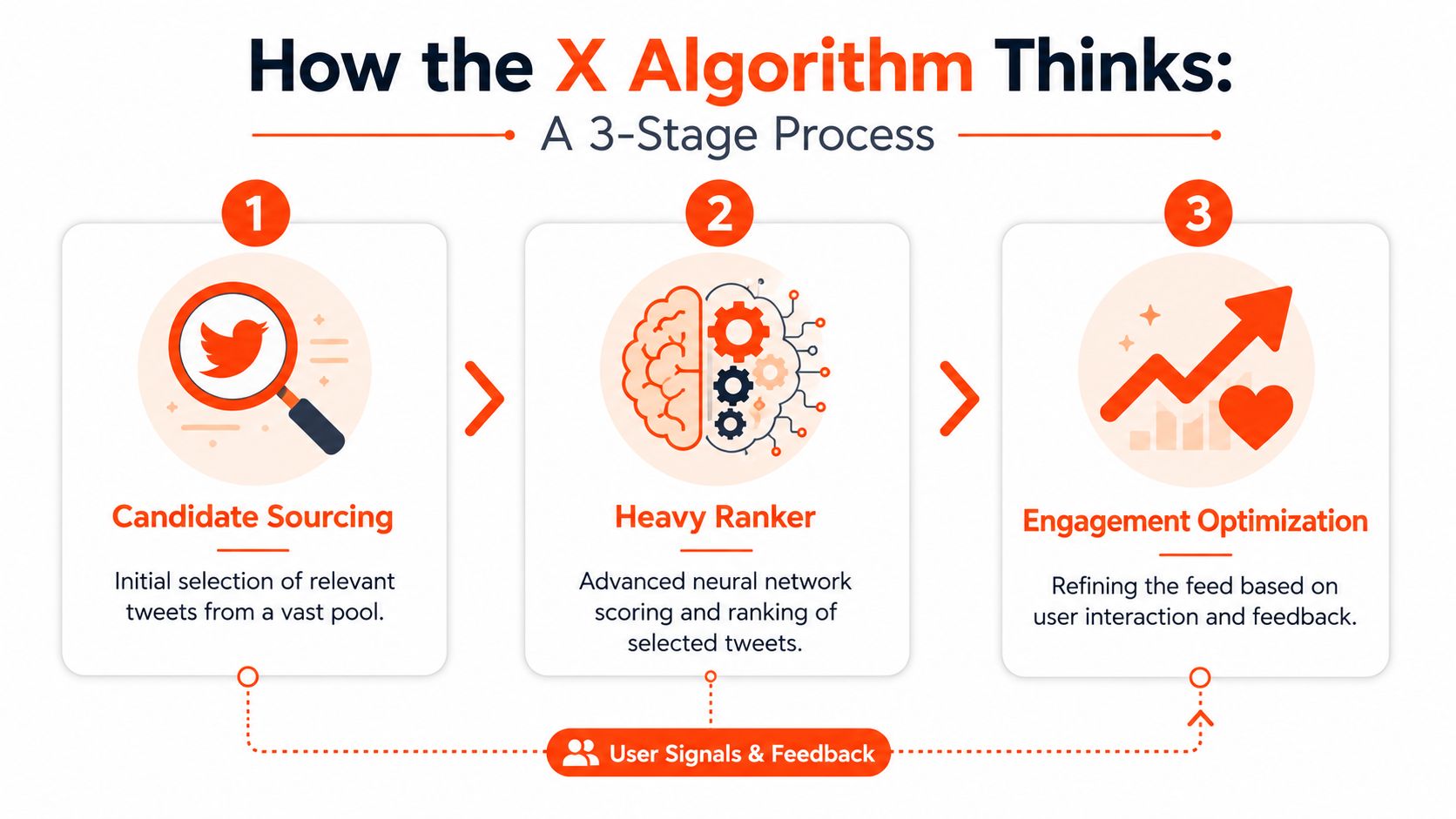
The recommendation system is a multi-stage, latency-constrained pipeline. It first pulls roughly 1,500 candidate tweets per session from a huge pool of active tweets, then ranks them with a neural model called Heavy Ranker, and finally applies heuristics and filters, as described in this breakdown of how the X recommendation pipeline works.
A casting call is the right analogy
Stage one is candidate sourcing. This is the casting call. The system collects possible tweets from several places, including in-network accounts, out-of-network accounts, Real Graph, SimClusters, and UTEG. In plain English, X is looking at who a user already follows, who they're likely to care about, what topic communities they overlap with, and what social interactions point toward likely interest.
Stage two is ranking. This is the audition. Heavy Ranker scores those candidates using engagement predictions and other signals. Not every candidate gets equal treatment. Some tweets look more likely to hold attention, trigger interaction, or fit the viewer's history.
Stage three is filtering. This is final review before release. The system applies heuristics and rules that can suppress low-quality, repetitive, or problematic content. A tweet can be good enough to enter the room and still lose reach at the last checkpoint.
Why this model changes creator strategy
Most creators spend all their energy on stage two. They obsess over hooks, formatting, and whether a post should be a one-liner or a thread. That matters, but only after the tweet gets sourced.
A better operating model looks like this:
Stage | What X is deciding | Creator job |
|---|---|---|
Candidate sourcing | Should this tweet enter consideration? | Build social graph relevance and topic consistency |
Ranking | Is this likely to earn meaningful engagement? | Write for replies, clarity, and immediate interest |
Filtering | Is anything about this likely to reduce feed quality? | Avoid spammy patterns and low-trust behavior |
A tweet doesn't go viral because it was “good.” It spreads because it survived all three stages better than competing tweets.
That's the value behind any serious Twitter algorithm explained guide. It turns vague advice into stage-specific action. Instead of trying random growth tricks, creators can diagnose where distribution breaks and fix the right layer.
Stage One Getting Seen with Candidate Sourcing
The most overlooked battle on X happens before ranking. If a tweet never enters enough candidate pools, its quality barely matters.

One of the clearest practical insights from the open-source pipeline is that X sources feed candidates from roughly 50% in-network and 50% out-of-network before ranking, as noted in this explanation of the X recommendation split. For smaller accounts, that's the opening frequently missed. Half the fight isn't about existing followers at all.
Half the feed is an opportunity
Creators often act as if follower count is the main gate. It isn't. Followers help with in-network distribution, but out-of-network slots create an open competition for attention.
That's why some small accounts pop while larger accounts stall. A smaller account that sits inside an active topic cluster and earns interaction from the right people can enter recommendation paths outside its follower base. A larger account that posts off-topic, ignores discussion, or stays isolated can get trapped inside a weak network bubble.
The immediate implication is uncomfortable for broadcasters. Posting into the void and waiting for reach doesn't work well. X is built to reward accounts that participate in conversations that connect them to topic communities.
What actually improves sourcing odds
The strongest sourcing moves usually look ordinary from the outside.
Reply inside the right neighborhood: Thoughtful replies to accounts in the same niche help an account appear connected to a topic cluster. A SaaS founder commenting on product onboarding, pricing psychology, and churn retention is easier for the system to place than someone posting random one-off takes.
Stay topically consistent: SimClusters work like community maps. When an account jumps from crypto to fitness to B2B sales to politics with no clear throughline, it becomes harder to classify.
Create posts that fit existing demand: If a niche is already discussing AI workflows, growth loops, or founder lessons, writing directly into that active context gives the tweet a better chance of entering relevant candidate pools.
Use discovery research before posting: Finding active conversations in a niche is easier with search workflows. This guide to Twitter advanced search on mobile is useful for locating fresh threads, recurring topics, and accounts worth engaging before publishing.
A practical example makes this clearer. Consider two creators in the same niche.
Creator behavior | Likely sourcing outcome |
|---|---|
Posts one original thread per day, rarely replies | Limited social graph expansion |
Replies to active niche threads, then posts a related opinion with a clear angle | Better chance of entering out-of-network consideration |
This is also where timing of engagement around a post matters qualitatively. Early interaction can help the system interpret relevance. But the key mistake is thinking early engagement starts at publish time. In reality, it starts with audience positioning before the tweet goes live.
Stage Two Winning the Rank with Heavy Ranker
Getting sourced is admission to the audition. Heavy Ranker decides who gets the lead role.
The ranking model evaluates predicted engagement and relevance. In practice, that means creators need to stop optimizing for vanity signals and start optimizing for actions that show real interest. On X, not all engagement is equal.

Several analyses of the open-sourced recommendation code note that replies often receive disproportionately high importance, with some engagement-focused guides emphasizing replies at about 9× relative weight compared with other actions, based on the code's logic, as discussed in this guide to getting recommended by Twitter's algorithm. That's the ranking signal many creators still underuse.
Replies beat passive engagement
Likes are easy. Replies require effort.
That's exactly why the model treats them differently. A like can mean mild agreement or quick acknowledgment. A reply usually signals stronger attention, more cognitive involvement, and a greater chance that a conversation will continue. For a recommendation system trying to keep people engaged, conversation is more valuable than passive approval.
If a post earns many likes but almost no replies, it may be pleasant. If it earns replies, it's creating a session.
This is why “good tweet” and “high-ranking tweet” aren't always the same thing. A polished statement can get applause. A well-designed prompt can trigger discussion. Heavy Ranker is far more interested in the second outcome.
What strong ranking content looks like
A creator who understands ranking writes with response friction in mind. The goal is to make it easy for the right reader to contribute.
Here are patterns that tend to align with that logic:
Open loops: “What's one pricing lesson founders learn too late?” invites participation better than “Pricing matters more than most founders think.”
Decision prompts: “Would you hire a marketer before product-market fit?” creates a fork that people can take a side on.
Specific disagreement hooks: A sharp, debatable claim often earns more replies than a generic positive statement.
Context plus tension: “Tried three onboarding flows. The one that felt least polished converted best. Why?” gives people something to solve.
A weak version looks like this: “10 lessons on building a startup.”
A stronger version looks like this: “Which startup lesson took the longest to learn, hiring too early, shipping too slowly, or chasing too many features?”
The second gives readers a reason to answer.
For operators who want to measure which posts create discussion instead of just collecting lightweight approval, a set of Twitter analytics tools for 2026 can help compare post formats, reply depth, and topic performance.
Ranking insight: Write tweets that people can enter, not just admire.
Another practical trade-off matters here. Reply bait with no substance can still backfire. Questions need enough tension, specificity, or usefulness to attract worthwhile responses. “Thoughts?” is lazy. “What would you cut first in this landing page?” gives readers a concrete job.
Stage Three Avoiding Penalties with Heuristics and Filters
A lot of creators use “shadowbanned” as a catch-all explanation for weak reach. That label usually hides a simpler truth. X doesn't need a dramatic secret punishment to reduce distribution. It already has heuristics and filters.
Why shadowbanning is the wrong mental model
Thinking in terms of mystery bans leads to bad decisions. It makes creators paranoid, reactive, and obsessed with folklore.
A better lens is feed quality control. The platform wants posts that keep users engaged without making the experience feel spammy, repetitive, manipulative, or low trust. If an account keeps tripping quality checks, it doesn't need a cinematic penalty. Its content can lose placement opportunities.
Most reach problems aren't conspiracies. They're pattern problems.
That's why some habits hurt even when the content itself is decent. A smart thread can still underperform if it comes from an account that constantly posts naked outbound links, repeats the same callout structure, or behaves like an automation script instead of a person.
A cleaner account wins more distribution
Account health is subtraction work. It's less glamorous than writing hooks, but it protects distribution.
A practical checklist looks like this:
Reduce low-context link dropping: If every post exists to push traffic elsewhere, the account starts to feel extractive rather than native to the platform.
Vary post types: Endless clones of the same template can make the timeline feel manufactured.
Watch audience friction: If posts repeatedly attract mutes, blocks, or annoyed replies, distribution risk rises qualitatively.
Avoid bot-like behavior: Aggressive automation can create exactly the sort of trust problems that filtering systems are built to catch. Anyone tempted by shortcuts should read why a Twitter auto follow bot creates more risk than growth.
A useful rule is simple. If a human scrolling the feed would think “this account is gaming the platform,” the filtering layer may eventually agree.
Good creators often focus on what to add. Mature creators also know what to remove.
Actionable Tactics to Master the Algorithm in 2026
Theory matters only if it changes the publishing workflow. The best way to apply the algorithm is to tie each tactic to the stage it helps.
The Reply First strategy
This targets candidate sourcing and ranking at the same time.
Before publishing a main post, spend time replying to active conversations in the same niche. Not filler replies. Useful ones. Add a counterpoint, a framework, a mistake to avoid, or a clear example. Then publish a related post while that topic is active in the account's local network.
Example: A founder replies to three threads about onboarding mistakes with short observations about user confusion, activation friction, and feature overload. Then the founder posts, “Most onboarding doesn't fail because users are lazy. It fails because the first screen asks them to understand the whole product.”
That post now sits closer to active topic demand than an isolated thought would.
The Cluster Positioning method
This is mostly a stage one play.
Pick a narrow lane and repeat it long enough for the account to become legible inside a cluster. A consultant posting about sales systems, lead qualification, and objection handling has stronger topical coherence than someone alternating between memes, politics, and business advice.
For tactical scheduling, a creator can pair that consistency with audience timing research. This roundup of 2026 Twitter posting times is useful for building a posting window around when followers and adjacent audiences are more likely to be active.
The Early Velocity setup
This supports ranking.
The model reacts to strong early engagement signals qualitatively, especially when a tweet starts drawing meaningful interaction soon after publication. That means the opening line has one job. Earn the second line or the reply.
A simple practical format:
Lead with tension.
Add a concrete observation.
End with a reply prompt.
Example: “Most founders add features when activation drops. That usually makes activation worse. What's one thing users misunderstood in your onboarding?”
That gives readers a problem, a point of view, and a reason to respond.
This walkthrough shows the same principle in motion:
The Clean Distribution routine
This protects filtering.
Create a simple weekly review:
Audit repetitive posts: Remove formats that feel copied and overused.
Check link balance: Keep more value native to X instead of turning every post into an exit ramp.
Review conversation quality: Prioritize threads where the replies add depth, not noise.
Trim automation habits: If an action saves time but damages trust, it isn't efficient.
The practical example here is obvious. An account that alternates useful original posts, smart replies, and selective promotion looks native to the platform. An account that auto-engages, over-schedules generic content, and drops constant outbound offers looks engineered for extraction. One earns distribution. The other keeps fighting the system.
From Algorithm Fear to Follower Growth
Creators don't need to fear the feed. They need to understand what it's trying to do.
X wants to keep users interested, engaged, and returning. That's why the system favors posts that enter the right candidate pools, create strong interaction signals, and maintain a healthy quality profile. The algorithm isn't asking whether an account deserves reach. It's estimating whether a specific post will improve a user's session.
That's the shift that turns guessing into strategy. Candidate sourcing rewards relevance and network positioning. Ranking rewards conversation. Filtering rewards account hygiene. When those three pieces line up, growth stops feeling random.
A practical Twitter algorithm explained framework is less about hacking the platform and more about aligning with its incentives. The creators who grow steadily usually aren't tricking the system. They're making it easy for the system to understand who their content is for, why people engage with it, and why it belongs in the feed.
SupaBird helps creators turn that strategy into a daily workflow. It surfaces strong conversations to join, generates post ideas based on proven creator patterns, rewrites drafts into sharper formats, and helps schedule content consistently across time zones. For founders, marketers, and creators who want a more structured way to grow on X, SupaBird is worth exploring.

How Developer Startups Build a Brand on X Before Launch

30-Day Starting Plan for New X (Twitter) Accounts

How Often Should You Tweet for Maximum Growth?

What Should Your First 10 Tweets Be About?

How to Run X for Ten Clients: The Agency Workflow

How to write a bio that gets people to follow you

Digital Product Launch Strategy

Best Twitter Growth Service for Creators in 2026
From X to Every Platform: Repurpose Without Flopping
