How to Use Twitter for Business in 2026
Author:

Most advice on how to use Twitter for business starts with “post consistently.” That's incomplete. In 2026, the first question isn't how often you can publish. It's whether X can produce a business outcome that justifies the time, creative effort, and paid spend.
X still has meaningful scale, with 251 million daily active users and about 557 million potential ad reach in 2026, according to Sprout Social's X statistics. But scale doesn't guarantee returns. Organic engagement has weakened, so founders and marketing teams need a sharper operating model: define the outcome, publish for a specific audience, participate in relevant conversations, and measure clicks, leads, trials, or sales instead of celebrating reach alone.
Table of Contents
Is Twitter Still Worth Using for Business in 2026
The contrarian answer is that X should not automatically be a priority channel. A 2026 cross-platform summary reports an average brand engagement rate of 0.035% on X, down from 0.049% in 2023, and below Instagram, TikTok, and LinkedIn. A separate 2026 roundup reports that engagement fell from about 0.15% in 2024 to 0.12% in 2025. Treat both figures as directional evidence, not a forecast for your account, because the original claims are not linked here to their primary reports.
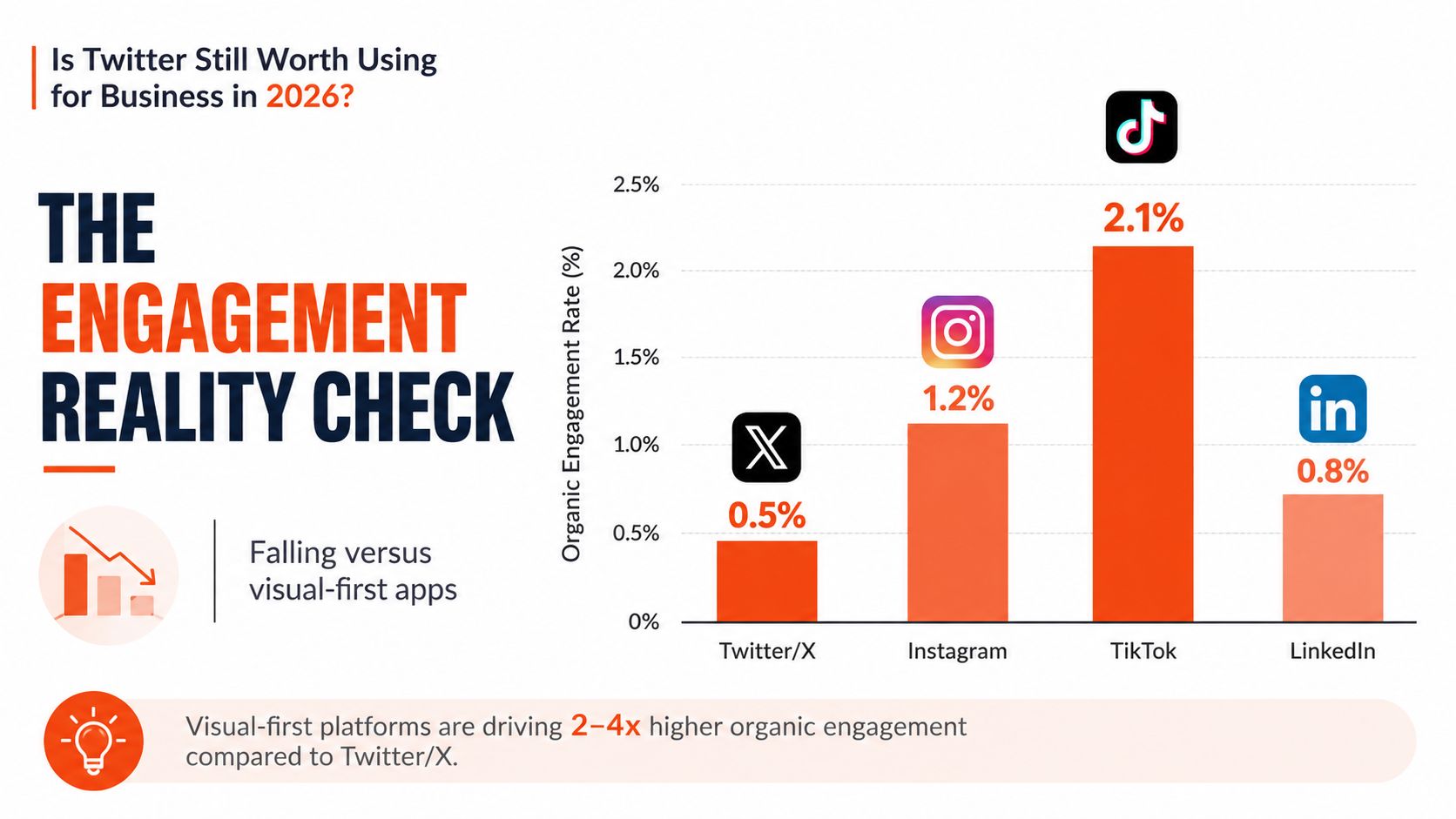
The numbers weaken one common recommendation: publish more and assume growth will follow. More publishing can improve your learning rate, but it can also fill your account with low-intent posts that create activity without creating pipeline. If buyers rarely discuss their problem on X, your team cannot respond while conversations are active, or your offer needs a visual demonstration better suited to TikTok or Instagram, keep X at a maintenance level.
Where X still earns attention
X remains useful for real-time discovery, founder visibility, customer support, and topical marketing. Its audience includes the largest national user base in the United States, and men aged 25 to 34 are reported as the top demographic in the Sprout Social dataset. That audience can suit SaaS companies, developer products, agencies, and B2B services aimed at working-age professionals.
X also supports high-intent discovery. 89% of users reportedly use X to discover new products, while 76% say conversations influence purchase decisions, according to Venture Harbour's Twitter business statistics. The figures do not mean every post will convert. They support a narrower operating thesis: X performs best when your business joins an existing conversation, demonstrates useful expertise, and gives the right buyer a reason to investigate.
ROI test: Keep X if you can connect it to a measurable outcome, such as qualified conversations, demo requests, product trials, customer retention, or founder-led distribution.
Define that outcome before choosing a cadence. “More visibility” cannot guide decisions. “Generate conversations with technical buyers who match our target account profile” can. Every tactic in the rest of this guide should serve that test.
Setting Up a Business Profile That Converts Visitors
Your profile is the landing page behind every post, reply, and mention. A strong post can earn attention, but a vague profile wastes the visit because the reader still can't tell who you help or what to do next.
Start with a recognizable handle. Use the company name when it's available, or choose a close variation that's easy to remember and say aloud. Avoid stuffing the handle with keywords or numbers that make it look temporary. If the account represents a founder, use the founder's name and make the business connection clear in the display name.
Your avatar should remain recognizable at small sizes. A founder account usually performs better with a clear face, while a company account can use a simple mark or product symbol. The header should reinforce positioning, not repeat the logo. Use strong contrast and one concise promise, such as “Automated reporting for lean finance teams,” followed by a product category or audience cue.
Use the bio to answer the buyer's first questions
A useful bio answers three things:
Audience: Who is this for?
Outcome: What changes after they use your product or service?
Next step: Where should an interested visitor go?
A weak SaaS bio says, “Building the future of productivity.” It could belong to almost anyone. A stronger version says, “Analytics for indie SaaS teams. Find the activation leaks before they become churn. Weekly teardown threads.”
A consultant can apply the same logic: “I help B2B founders turn product expertise into a repeatable content pipeline. Practical positioning, research, and distribution.” The point isn't cleverness. It's reducing the work a visitor must do to understand the account.
For more detail on positioning language and profile structure, use this guide to writing a Twitter bio that gets more followers.
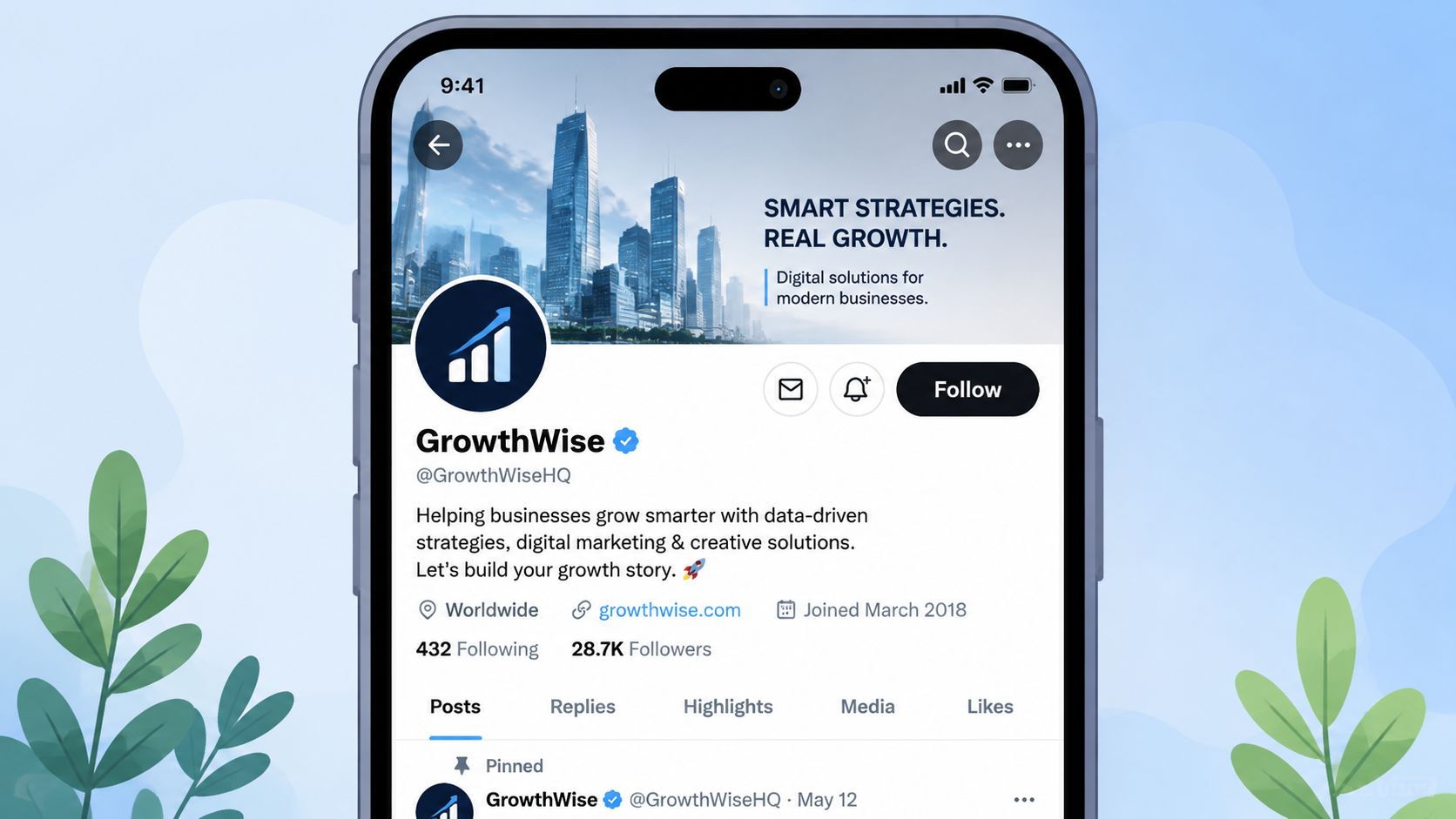
Treat the pinned post as your sales page
Pin one post that gives a new visitor immediate context. Good options include a short product explanation, a founder story tied to the problem, a customer-facing tutorial, or a resource that demonstrates your expertise. Don't pin a post merely because it received likes. Pin the post that creates the clearest path from interest to action.
Use the location field for a useful signal, such as “Remote, Europe,” “New York SaaS,” or a specific service area. Add one destination to your profile link, then use campaign tracking so you can distinguish profile traffic from other sources. Verification and business profile features can support trust, but they won't repair unclear positioning. Clarity comes first.
Finding Your Audience and Picking Content Pillars
Broad audiences produce bland posts. “Founders” is too wide for a useful editorial system. Narrow the initial audience by problem, stage, role, or buying context. “Bootstrapped SaaS founders trying to improve activation” gives you far more material than “people interested in software.”
A practical competitor audit starts with 10 accounts in your lane. Review their top 10 tweets, then tag each post by topic, format, audience problem, and implied promise. You're not copying their hooks. You're looking for repeated conversations, neglected questions, and positions nobody owns clearly.
Build a small, connected pillar system
Choose three to five content pillars, but make each pillar do a different job:
Teach the mechanism. Explain how the problem works. A conversion consultant might break down why a signup form loses intent.
Show the work. Share experiments, decisions, teardown notes, or product trade-offs. This creates credibility without relying on generic authority claims.
Interpret the market. Comment on launches, category changes, or customer behavior through your specific lens.
Handle objections. Address security, implementation effort, cost, switching risk, or internal approval.
Present the offer. Explain who should buy, what the process looks like, and what the product replaces.
The fifth pillar shouldn't dominate. It should give interested readers a clear next move.
A SaaS founder could write one sentence that defines the account: “I post practical activation lessons for small SaaS teams, based on product teardowns, experiments, and customer research.” That sentence becomes a filter. If a draft doesn't help the target reader understand, decide, or act, it probably belongs elsewhere.
Research questions, not just topics
Search replies, quote posts, support tickets, sales-call notes, and competitor mentions for questions buyers repeat. Save exact language such as “How do I know whether onboarding is the problem?” or “Can I implement this without changing our data model?” Those questions become post hooks, thread outlines, poll prompts, and sales enablement material.
Keep a simple research sheet with columns for customer phrase, underlying concern, pillar, proof available, and CTA. The complete guide to building a Twitter audience can help you turn that research into a more deliberate audience system.
Tweet Formats and Posting Cadence That Actually Compound
Format should follow the job. Use a single post for a sharp observation, a thread for a connected explanation, a reply for distribution inside an existing conversation, a quote post for interpretation, a poll for focused research, and short native video for demonstration.
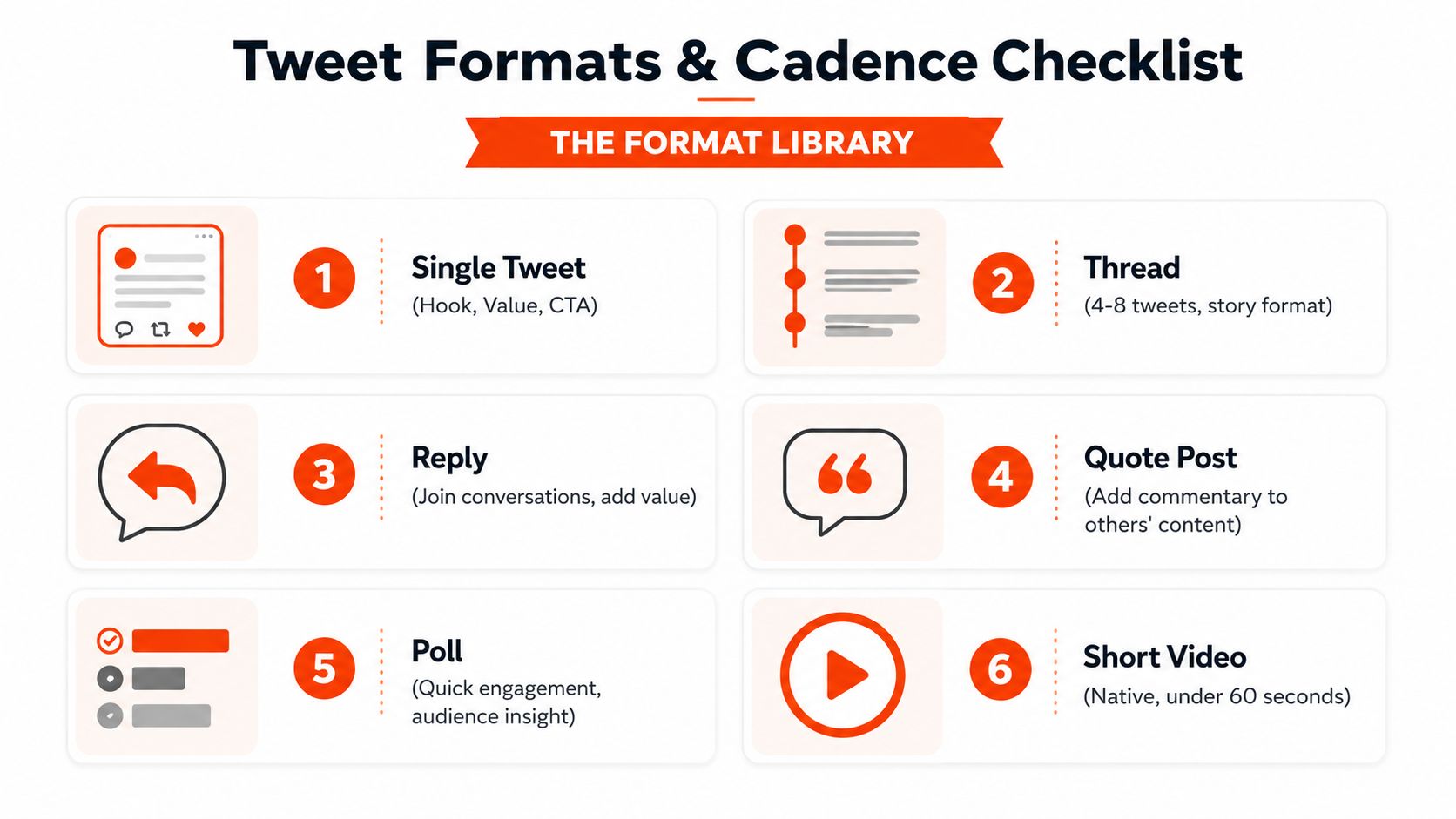
A single-post template is Hook, value, CTA. Example: “Most onboarding audits start too late. Check the first moment a new user understands the product, then remove every step before it.” Ask for a relevant example, point to a diagnostic, or invite a qualified reader to reply. A vague CTA adds activity without creating a useful next action.
For a thread, make the promise clear, sequence the ideas, and finish with a conclusion. Don't stretch one observation into a long chain. Use this structure:
State the problem and promise the lesson.
Explain the hidden cause.
Give a practical process.
Show a mistake or trade-off.
Finish with a next step.
Replies need information, not applause. Quote posts need your interpretation rather than a repeated headline. Use polls only when the answer can change a content or product decision. Short video should show one action, not recreate a webinar.
Use cadence as a learning system
The 3-1-1 cadence is a workable starting point: three value-led posts, one personal or behind-the-scenes post, and one promotional post. Treat it as a testing framework, not a rule. Change the mix when a launch, incident, or major insight gives your audience a legitimate reason to hear from you more often.
Publishing frequency should support learning, not fill a quota. Track which formats earn qualified replies, profile visits, saves, and product conversations. If a high-volume schedule produces impressions but no useful action, reduce output and improve the premise.
Timing is another hypothesis. Test audience local time rather than your office clock. For audiences in New York, London, Berlin, and Mumbai, create separate scheduling views and compare midweek morning windows with midday slots. The best time of day to post on X in 2026 offers a starting point, but your own audience data should decide the schedule.
Repurpose one newsletter idea into a thread, a quote post, and three reply hooks. Keep the core argument consistent while changing the entry point. For visual work, a practical review of AI design tools can help produce supporting assets without turning every post into a design project.
A useful cadence review asks three questions: Which format attracts the right readers? Which post creates a conversation or product action? Which posts are merely consuming production time?
Engagement Tactics That Build a Real Community
Posting is only half the job. Smaller business accounts can compete by being present in the conversations where buyers, practitioners, and adjacent creators already exchange opinions.
Begin with a short reply warmup before publishing. Read posts from customers, category specialists, competitors, and people discussing the problem your product solves. Add a useful observation, a counterexample, or a clarifying question. Don't leave generic praise that makes your account look automated.
Write replies people can use
Three reply patterns work across industries:
Agree and add: “That matches what we've seen in onboarding. The missing step is usually the first successful action, not the welcome screen.”
Polite disagreement: “I'd separate the two cases. This works for a self-serve product, but sales-assisted buyers need proof before activation.”
Specific praise: “The distinction between acquisition friction and activation friction is useful. Teams often measure them together and lose the diagnosis.”
Reply early when you can, but don't treat timing as a substitute for relevance. Keep lists for customers, category voices, competitors, prospects, and journalists. Saved searches for product terms, competitor names, and recurring pain points make valuable conversations easier to find.
A useful operating habit is to stay available for roughly 30 minutes after publishing. Answer questions, clarify the point, and extend strong replies into a deeper exchange. If someone asks for an example, give one. If a reply reveals a recurring objection, turn it into a future post.
Move to DMs with permission
A DM should continue an existing conversation, not interrupt it with a pitch. If someone asks about your product, requests a resource, or describes a problem that your offer addresses, respond directly and make the next step easy. Ask whether they'd like the relevant link or a short explanation.
Avoid the pitch-slap sequence: “Thanks for the follow, want a demo?” It ignores intent and makes the account feel transactional. A better transition is, “You mentioned reporting takes hours each week. I've got a short checklist for that workflow. Want me to send it?”
Measure engagement by the quality of conversations, not only public reactions. A thoughtful reply from a qualified buyer can be more valuable than a large number of low-intent likes.
Organic Growth vs Paid Promotion on X
Organic and paid promotion should serve the same ROI model. Organic publishing reveals which ideas earn attention, trust, profile visits, and qualified conversations. Paid promotion distributes a message to a defined audience after the message has shown enough promise. It cannot fix an unclear offer, weak creative, or a landing page that fails to convert.
Treat organic activity as the learning layer and paid activity as the distribution layer. Organic posts help you test positioning, customer language, formats, and calls to action without media spend. Paid campaigns can then concentrate reach around a launch, report, event, or resource that already has a clear business purpose.
Factor | Organic | Paid Promotion |
|---|---|---|
Primary strength | Trust, conversation, founder visibility | Controlled distribution and audience targeting |
Best use | Learning what resonates and building relationships | Amplifying a validated offer or event |
Main cost | Time, creative consistency, response capacity | Media spend and campaign management |
Useful signal | Qualified replies, profile visits, clicks, follows | Cost per click, lead quality, conversion rate |
Main risk | Slow learning when publishing is sporadic | Paying to scale a message that doesn't convert |
When organic makes sense
Organic is the better first layer when positioning is still changing, buyer language is unclear, or the founder needs to build authority. Publish useful explanations, respond to relevant discussions, and record which topics generate profile visits, clicks, and meaningful replies. A product-led startup might explain a recurring workflow problem in a thread, then share a practical resource only when it advances that conversation.
Organic growth becomes dead weight when the team publishes without a hypothesis. A feed filled with company updates, recycled links, and vague motivational statements can remain active while producing no useful learning. Set a question for each content test, such as whether a specific pain point attracts qualified operators or whether a customer example produces more product-page visits than a feature announcement.
When paid promotion earns a test
Use X Ads when the objective is specific and the post communicates the offer clearly. Choose the campaign objective around the business action required, then match targeting to an audience your team can serve. Promoted posts can support a launch, report, event, or high-value resource. Follower campaigns can fit a distribution strategy built around the account itself, although follower volume does not replace qualified demand.
Do not build a budget from a generic industry benchmark. Set a controlled test the business can afford to lose, define the success event before launch, and stop when traffic fails to create downstream value. The appropriate budget depends on conversion economics, audience size, creative capacity, and the sales process.
Paid distribution should answer a question. It should not conceal an unproven message.
Instrument every post
Track performance at both post and campaign level. A useful working sheet includes:
Content fields: Date, format, topic, CTA type, landing page, and whether the post was organic, boosted, or whitelisted.
Performance fields: Impressions, engagements, engagement rate, link clicks, and follows gained.
Attribution fields: UTM parameters, campaign name, source, medium, and downstream conversion.
InfluencerDB's Twitter analytics statistics cites a median engagement rate per post of 0.03%. Use that figure as context, not as a target or a reason to optimize for reactions. Segment results by format and CTA. A post with fewer reactions but more qualified link clicks may be the profitable winner.
Review the last 30 days each week. Keep a short list of formats that generate clicks, topics that attract qualified replies, and CTAs that lead to action. Cut posts that repeatedly earn attention without advancing the objective. If execution capacity is limited, compare your workflow with a Twitter growth service, while keeping measurement, attribution, and decisions in-house.
Common Mistakes and How to Avoid Them
Business accounts rarely fail from one dramatic error. Momentum usually disappears through repeated choices that make the account unclear, inactive, or disconnected from revenue.

Seven problems that quietly destroy performance
A vague bio: “Helping businesses grow” gives visitors little reason to follow. Name the audience, outcome, and next step.
A disappearing act: Heavy posting for two weeks followed by silence prevents followers from forming a reliable expectation. Use a calendar you can maintain.
Ignored replies and DMs: Broadcasting without responding tells potential customers that conversation is unwelcome. Assign clear response ownership.
Like-first optimization: Likes can make performance look healthy while clicks and leads stay flat. Track the action tied to revenue.
Format imitation: Copying a viral hook without understanding its audience, timing, or context creates awkward content. Borrow the mechanism, not the surface style.
Company-only publishing: Product announcements cannot carry an entire account. Add education, market interpretation, customer language, and useful examples.
Quitting after 30 days: Early results often show what needs changing rather than proving the channel has no value. Review the evidence before ending the test.
Daily publishing can support learning, provided the cadence is sustainable. A study cited by Rival IQ's timing analysis found that accounts posting daily had 40% higher average engagement than sporadic posters. That does not justify flooding the feed. Publish consistently enough to identify messages that earn business-relevant actions.
Run a 30-day reset: rewrite the bio, choose three content pillars, prepare a format library, assign reply coverage, tag each campaign, and review clicks, follows, replies, and engagement rate weekly. Keep posts that create qualified movement. Cut the rest without sentimentality.
SupaBird helps founders, creators, and marketing teams generate X post ideas, identify conversations worth joining, schedule content across cities, and review publishing performance. Visit SupaBird to make your X workflow repeatable instead of leaving it to an inconsistent calendar.

The Reply Guy Strategy: A Growth Guide for X

Why New X Accounts Get Less Reach

ClimbX Review (2026): Features, Pricing, Pros and Cons

How Developer Startups Build a Brand on X Before Launch

30-Day Starting Plan for New X (Twitter) Accounts

How Often Should You Tweet for Maximum Growth?

What Should Your First 10 Tweets Be About?

How to Run X for Ten Clients: The Agency Workflow

How to write a bio that gets people to follow you
