
Most new X accounts fail before the first post. Not because the owner picked the wrong niche, but because the setup was treated like admin work instead of brand strategy.
A founder opens X, grabs whatever handle is available, writes a vague bio, skips the header, follows nobody, and posts once. The account exists, but it doesn't give visitors a reason to trust it, follow it, or remember it. That's the gap most generic tutorials miss when they explain how to create a Twitter account.
A strong launch starts earlier. The best new accounts make deliberate choices about identity, positioning, security, and the first week of activity. Those choices shape how the account looks to real people and how useful its early data becomes later.
Table of Contents
Your X Account Is a Growth Engine Not Just a Profile
Those searching for how to create a Twitter account want the mechanics. Sign up, confirm the code, upload a photo, done. That approach creates an account, but it doesn't create momentum.
X works better when the account is treated like a publishing asset from day one. Every setup decision affects who follows, who replies, and whether profile visitors turn into regular readers. That's especially important because Tweet Binder notes that X's main reporting dashboard is available for accounts that are at least 14 days old in its Twitter analytics guide. Those first two weeks are the period where a new account builds the posting history that later helps with analysis.
Practical rule: The first post isn't the beginning of growth. The decisions made before the first post are.
That shifts the job. A new account shouldn't be built to merely “look complete.” It should be built to support testing. The handle should be memorable in replies. The bio should attract the right audience. The first posts should give the account enough signal to learn from once broader analytics become available.
Creators who plan to repurpose ideas across formats should think this through early. A simple text-first account can later branch into visuals, threads, screenshots, and even transforming tweets into video clips when a topic starts resonating. The point isn't to do everything on day one. The point is to build an account that can expand without needing a full rebrand.
A content system helps before analytics become richer. A practical starting point is building a small theme list, a posting rhythm, and a few audience promises. That's the kind of work covered in a broader social media content strategy guide, and it matters more on X because weak early positioning creates noisy data later.
What growth-minded setup changes
A growth-minded account is different from a casual personal account in a few ways:
The username supports recall. People should be able to type it after seeing one reply.
The bio filters for fit. It should tell the right people why they should care.
The first week has intent. Every post should test a message, topic, or audience angle.
The account looks active. An empty profile makes every later growth tactic harder.
The Pre-Launch Checklist for a Strong Start
A bad X launch usually starts the same way. The founder opens the sign-up page, grabs the first available handle, writes a vague bio in 20 seconds, posts nothing for three days, and wonders later why the account never gains traction.
Do the strategy work before the account exists. It is faster to launch once with clear decisions than to rename, rewrite, and reposition after people have already seen the profile.
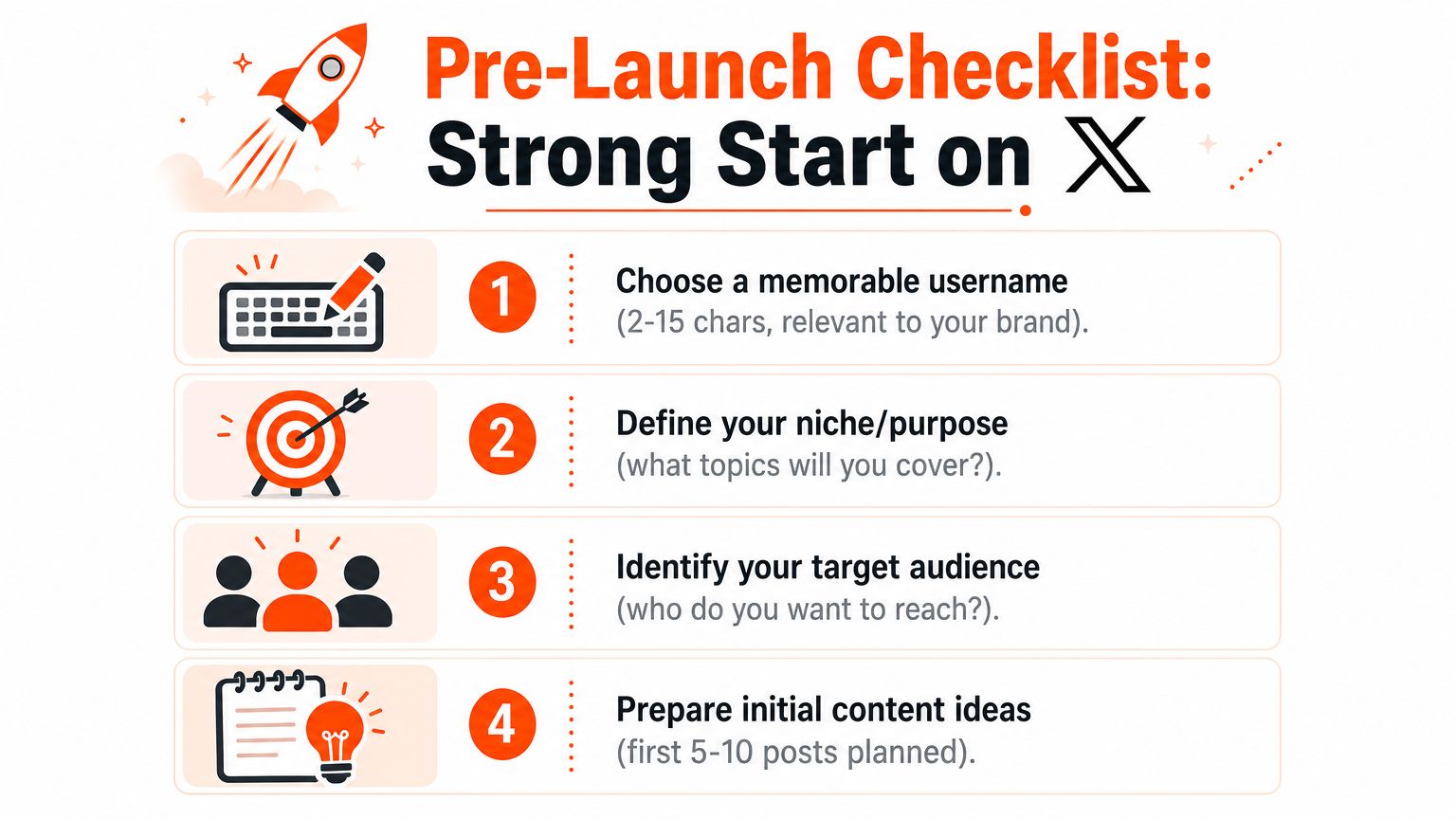
Prepare the identity assets first
Start with handle options, not one handle. Usernames have a tight character limit, so long company names and slogan-heavy personal brands often need a shorter version that still sounds credible.
Good handles are easy to spell from memory, easy to spot in replies, and broad enough to survive a pivot. I usually recommend picking three to five options before signup so availability does not force a weak choice.
Useful patterns include:
Founder-led brand:
NameBuilds,NameWrites,NameOnSaaSCompany-led brand:
BrandHQ,BrandApp,UseBrandNiche-led account:
RevenueWithName,OpsByName,DesignWithName
Avoid handles that create cleanup work later. Extra underscores, random numbers, and trendy wording can make the account look temporary. That matters because people make trust judgments fast on X, especially when they find you through replies.
Write the bio before you need it
Your bio has one job. Tell the right person what they will get if they follow.
Weak bio example:
Bad version: “Founder. Marketing. Building stuff.”
Stronger bio example:
Better version: “Founder sharing lessons on SaaS growth, positioning, and content systems.”
The stronger version gives the account a lane. That helps new visitors decide quickly, and it helps you stay consistent once posting starts.
A new visitor should understand the account in one profile glance.
Gather the rest of the launch assets before signup so the profile looks intentional on day one:
Asset | What to decide |
|---|---|
Profile photo | Clear face for a personal brand, clean logo for a company account |
Header image | One visual that reinforces the niche or offer |
Website link | Main site, newsletter, product page, or lead magnet |
First post ideas | A short list so the account doesn't look abandoned |
The first-post list matters more than new creators expect. An empty account makes every later growth tactic harder, while a prepared account can publish immediately. If you need raw material for that list, build a small idea bank from customer questions, objections, and themes from this guide on how to find content ideas.
Define the account's promise
Before launch, write down three answers:
Who is this account for
What topics will appear repeatedly
Why should someone follow instead of reading one post and leaving
This takes five minutes and prevents months of drift.
Founders and marketers often skip this because it feels minor compared with the technical setup. In practice, early growth is shaped by this foundation. A clear promise makes content planning easier, profile writing sharper, and audience fit stronger from the first week.
The Step-by-Step Account Creation Walkthrough
The actual signup flow is simple. The important part is making smart choices while moving through it.
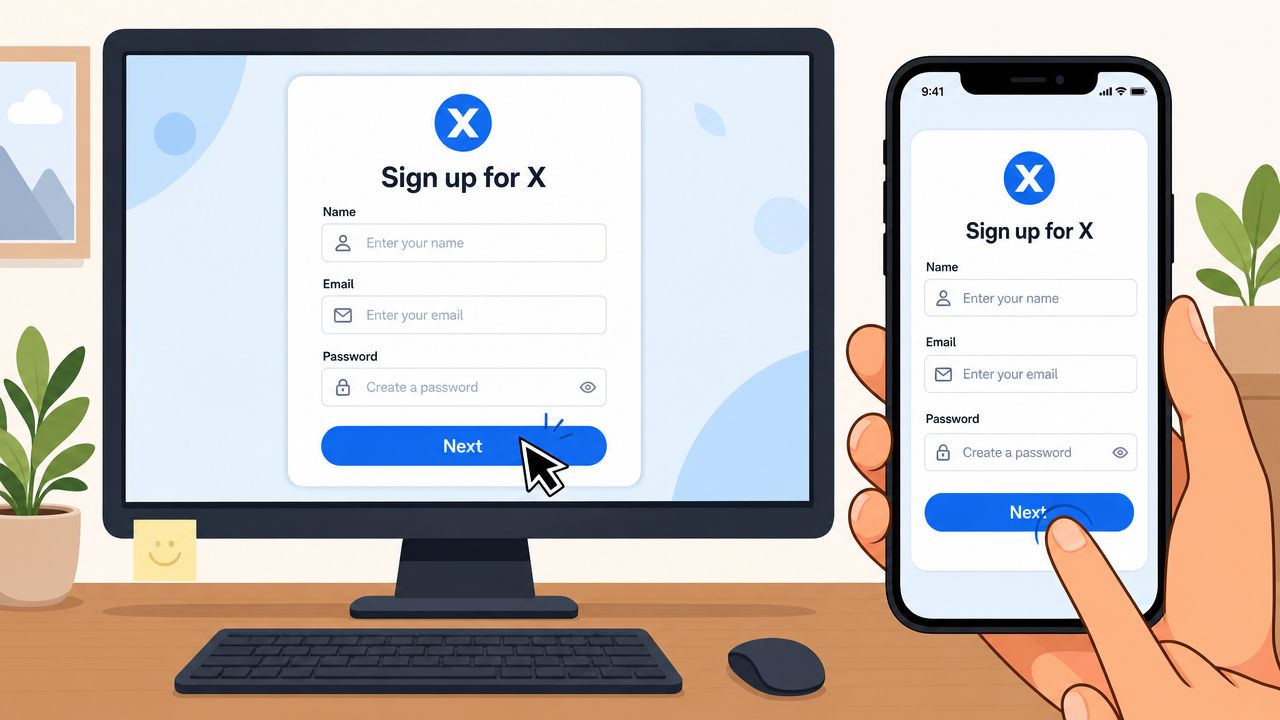
On web or in the app, X asks for the same core details. The standard technical setup requires a name, a unique email or phone number, date of birth, and a verification code, and setup guidance also notes that one email can only be tied to one X account in this account creation walkthrough. For founders and marketers, that makes the inbox choice more important than it looks.
Choose the signup method with recovery in mind
There are several ways into the platform, but the decision should be based on account ownership and future access.
A dedicated email address is usually the cleanest choice for a creator brand or business-facing account. It's easier to hand over safely later, easier to document internally, and less likely to create confusion than using a shared personal inbox. A phone number may work well for some users, but many teams prefer email-first ownership because it's easier to manage over time.
A practical approach:
Personal expert account: use an email the account owner controls long-term
Company account: use a dedicated business inbox, not a teammate's personal email
Multiple brands: create separate inboxes before signup starts
Complete the form without improvising
The actual process is straightforward:
Enter the account name. This can be adjusted later, so focus more on clarity than perfection.
Use the chosen email or phone. Avoid temporary inboxes and shared addresses.
Enter date of birth and verification code. Complete this cleanly to avoid extra friction.
Set a strong password immediately. Don't leave security for later.
Claim the best available handle from the prepared shortlist.
Most onboarding delays happen because the user didn't prepare alternatives. If the first choice is taken, move to a second option that still matches the brand.
A short visual walkthrough can help if the interface feels unfamiliar:
Finish the technical layer before styling the profile
Before writing the perfect bio or uploading art, lock in the fundamentals:
Password quality matters. Treat the account like a business asset.
Store login details safely. Especially if an assistant or team member may help later.
Check that the recovery path works. Don't assume it does.
Launch speed matters less than launch cleanliness. A rushed setup creates small account problems that keep resurfacing.
Once the account is live and accessible, profile work starts.
Crafting a Profile That Attracts Followers
A new founder sets up an X account, adds a logo, writes “building in public,” and starts posting. A week later, the profile still looks empty, the posts get ignored, and profile visits do not turn into follows. The problem usually is not effort. It is positioning.
On X, people decide fast. They scan your photo, handle, bio, header, link, and recent posts to answer one question. Is this account worth following? A profile that answers that clearly gets more chances. A profile that looks unfinished gets skipped.

Treat the profile like a conversion surface. Every field should reduce doubt and increase relevance.
Build the profile around a follow decision
These are the parts that do the work:
Profile image. Use a clear headshot for a personal brand or a clean logo for a company account. Tiny, busy images disappear in the feed.
Header image. Add context fast. Show the product, category, promise, or point of view.
Bio. State who you help, what you talk about, and why your perspective is useful.
Website link. Send interested visitors to the next step, such as a homepage, newsletter, or lead magnet.
Pinned post. Give new visitors one strong starting point instead of making them guess.
This is basic profile hygiene, but it also affects growth. A visitor who understands your niche in five seconds is far more likely to follow than one who has to interpret vague branding.
If image dimensions are slowing you down, use a tool to resize image for Twitter before uploading your profile photo or header.
Write a bio that earns the follow
Weak bios describe identity. Strong bios describe value.
Version | Bio |
|---|---|
Weak | “Entrepreneur | Thoughts on business and life” |
Stronger | “Helping SaaS founders improve positioning, content, and audience growth on X” |
The stronger version works because it gives a visitor direction. It names the audience, the topics, and the outcome. That makes the account easier to trust and easier to remember.
A practical bio formula:
Who it helps
What you post about
What result, insight, or angle people can expect
If you need help tightening that into a short line, this guide to writing a good Twitter X bio that gets you more followers breaks down the structure in more detail.
Keep the language specific. “Helping B2B founders write clearer positioning” beats “sharing ideas about startups.”
Make the profile feel active from day one
A polished profile with no signs of life still struggles. New visitors look past the bio and check your recent posts. If they see nothing useful, nothing personal, or nothing current, they leave.
Start with a pinned post that does one of these jobs well:
Introduce the account and explain who should follow
State a strong point of view on your market or niche
Share one useful resource tied to your product, newsletter, or expertise
I usually recommend founders pin an introduction post first, then replace it later with their best-performing post or clearest offer. Early on, clarity matters more than polish.
Follow relevant founders, operators, customers, and publications right away. Not because following alone creates growth, but because it shapes your feed, helps X understand your niche, and gives you better conversations to join.
A good profile does not read like a résumé. It reads like the front page of a publication people want to return to.
Securing Your New Account and Setting Privacy
A new X account is a brand asset. Treating security like a later task is a mistake, especially for founders, marketers, and anyone building attention around a business.
The first layer is login protection. Use a strong password and enable the strongest authentication options available in the account settings. If the account is tied to a business, access should be documented and reviewed rather than passed around casually in chat.
Signup choice affects future recovery
X's own help flow highlights different creation methods, including Continue with Apple, and the practical tradeoff is long-term recovery. As noted in X's account creation help, different signup methods can affect privacy and account access later if something goes wrong.
That matters more than most new users expect. A fast signup method can feel convenient today and become confusing later when login credentials, devices, or team ownership changes.
A sensible decision framework looks like this:
Choose email-based ownership when the account supports a business, newsletter, or long-term creator brand
Use platform sign-in carefully when privacy is a priority, but make sure recovery steps are understood
Keep recovery details organized if more than one person may touch the account later
Privacy settings should match the account's purpose
A public growth account should usually stay easy to discover. That means reviewing settings with visibility in mind rather than locking everything down by default.
Check areas like:
Post visibility
Tag permissions
Direct message preferences
Discoverability controls
Automation decisions also belong in this conversation. Growth-minded users should be careful with tools and tactics that can make an account look unnatural. A useful reference point is this explanation of an auto follow bot on Twitter, especially for understanding why low-quality automation can damage trust.
A secure account is easier to grow because it's easier to keep. Recovery problems can erase months of momentum.
Your First Week on X for Maximum Growth
The account is live. The next mistake is posting once and waiting.
Early growth on X usually comes from visible participation, not passive publishing. A new account needs to show what it talks about, who it belongs with, and whether it adds something useful to ongoing conversations.
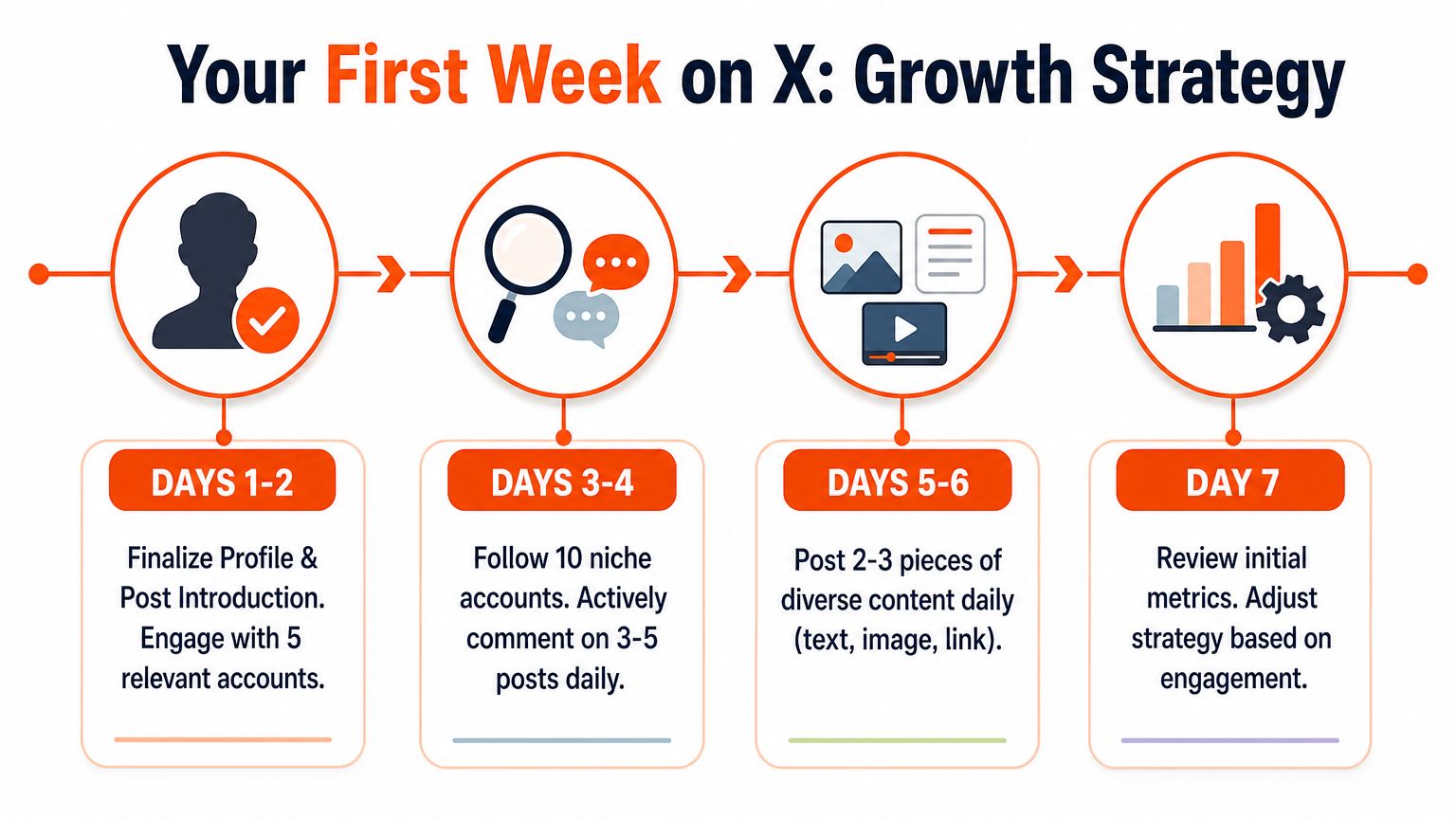
A practical first-week rhythm
A simple launch pattern works better than overthinking.
Days 1 and 2
Publish an introduction post. Say who the account helps, what themes it will cover, and what people can expect.
Reply to relevant accounts. The goal is to appear in the right conversations early.
Follow thoughtfully. Pick operators, customers, niche writers, and adjacent experts rather than random large accounts.
Days 3 and 4
Post opinionated short-form content. Strong takes get remembered better than generic summaries.
Comment with substance. Replies should add a perspective, example, or useful disagreement.
Test different formats. Alternate between plain-text posts, a visual post, and a post with a link.
Days 5 through 7
Repeat what gets traction. If one topic draws profile visits or replies, stay on it.
Refine the hook style. Short, specific openings usually outperform vague intros.
Review patterns. Don't judge by emotion. Look at the visible signals.
Use the free analytics that already exist
An advantage many beginners overlook is that even on a brand new, free account, X shows post-level analytics such as impressions, engagements, and profile visits directly under each post, and Target Internet notes that this creates an immediate feedback loop before fuller analytics access in its guide to viewing tweet stats.
That means the first week can be run like a simple experiment.
Track questions such as:
Which topics earn profile visits
Which hooks get replies
Which post formats create conversation
Which posts attract the wrong audience
For creators posting links, it also helps to understand what a healthy click pattern looks like conceptually. This guide to optimal click-through rates for creators is useful for framing link-post expectations without relying on guesswork.
Don't ask whether a post “felt good.” Ask whether it earned the next action, a reply, a profile visit, or a follow.
Keep the system light enough to sustain
The first week shouldn't turn into a content treadmill. It should establish a repeatable loop:
Post
Engage
Observe
Adjust
For users who want help generating angles, organizing ideas, and finding relevant conversations, tools like SupaBird can support that workflow with idea generation, engagement prompts, and draft rewriting. The important part isn't the tool. It's keeping the process consistent enough to learn from.
Common Questions About New X Accounts
Can the username be changed later
Yes. That's why it's better to choose a clean, workable handle now than to delay launch chasing a perfect one. The goal is memorability and relevance, not perfection on day one.
If the ideal handle isn't available, use a simple variation that still looks credible. Adding a niche cue or a brand suffix usually works better than adding random characters.
Should a founder have one account or separate personal and brand accounts
That depends on how the audience connects with the business.
A founder-led company often grows faster with one clear personal account because people tend to follow people before they follow companies. A separate brand account makes more sense when the business publishes updates, support content, or product announcements that need a distinct voice.
What if the dream handle is taken
Don't settle for a messy alternative too quickly. Test a shortlist with slight variations:
Name plus niche
Name plus brand
Brand plus product cue
A cleaner abbreviation
Avoid imitating another account too closely. Similar handles create confusion in mentions, replies, and searches.
Which signup method is usually the safest choice
For most business, creator, and marketing use cases, a dedicated email-based setup is the most manageable choice because ownership and recovery are easier to organize. Social sign-in methods can be fine, but only if the recovery path is understood before something breaks.
How soon should posting start
Immediately after the profile is complete. A polished account with no activity still looks unfinished. A complete profile plus a few relevant posts gives new visitors a reason to stay.
What should the first post be
A simple introduction works well if it answers three things:
Who the account is for
What it will cover
Why the perspective is worth following
Then move quickly into useful posts. New followers care less about the launch announcement than about whether the next few posts deliver value.
Creators who want a more systematic way to plan posts, find better ideas, and stay consistent on X can explore SupaBird. It's built for founders, marketers, and creators who want structure around publishing and engagement instead of guessing what to post next.

30-Day Starting Plan for New X (Twitter) Accounts

How Often Should You Tweet for Maximum Growth?

What Should Your First 10 Tweets Be About?

How to Run X for Ten Clients: The Agency Workflow

How to write a bio that gets people to follow you

Digital Product Launch Strategy

Best Twitter Growth Service for Creators in 2026
From X to Every Platform: Repurpose Without Flopping

How to Get Cited by Grok: Winning X’s AI Search in 2026
